
Futures
ES & NQ December 2026 Rollover: ESZ26 to ESH27, NQZ26 to NQH27 & Expiry
December 2026 ES and NQ rollover dates, Z26 to H27 contract codes, CME Dec 14 roll and Dec 18 expiry, MES/MNQ, volume migration and continuous charts.
On this page+
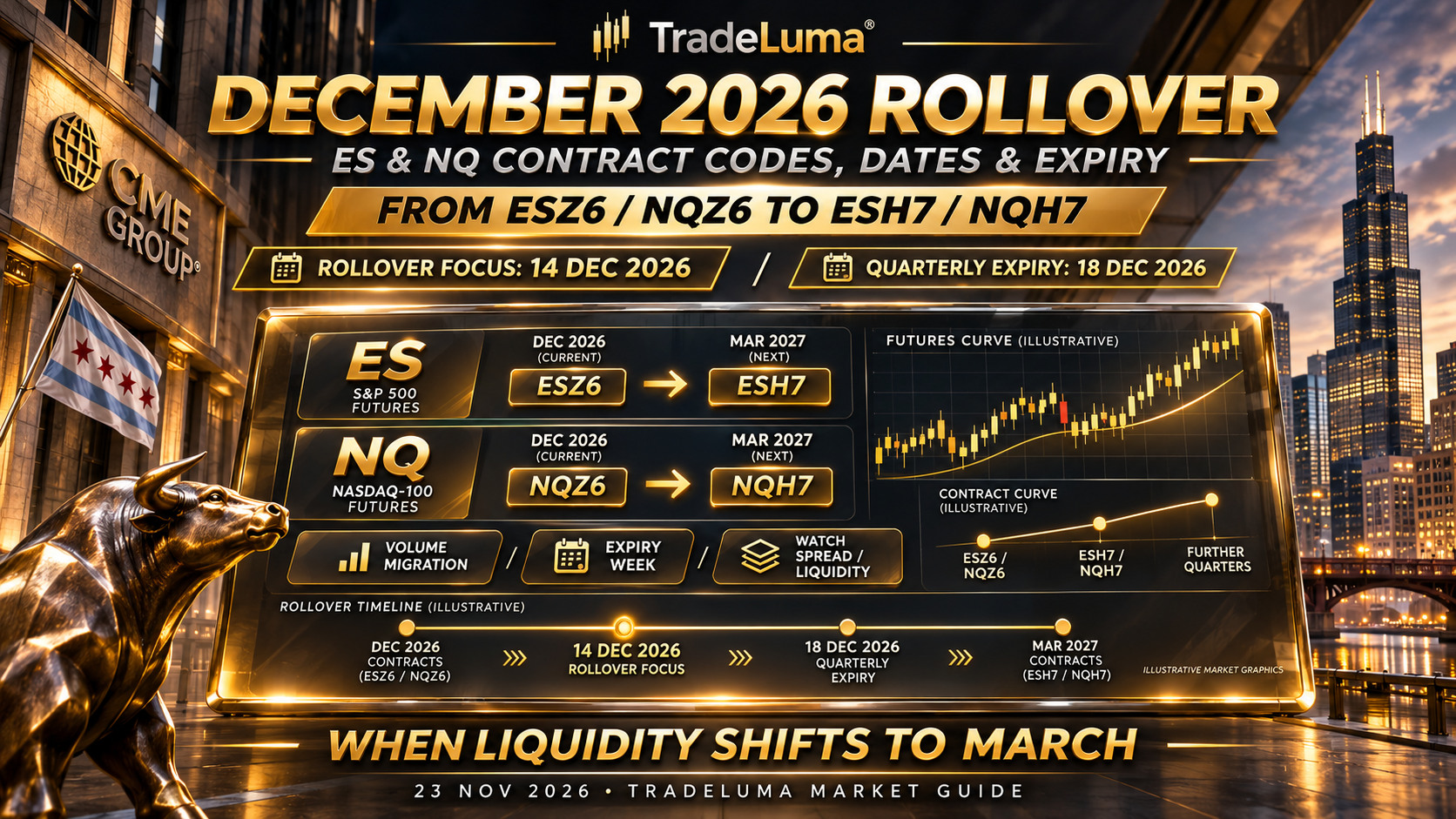
CME Group identifies Monday, 14 December 2026, as the customary roll date for US equity-index futures expiring on Friday, 18 December. For E-mini S&P 500 and E-mini Nasdaq-100 futures, the transition commonly discussed is from December 2026 contracts ESZ26 and NQZ26 to March 2027 contracts ESH27 and NQH27. Some quote services abbreviate the same year codes as ESZ6, ESH7, NQZ6 and NQH7. The smaller Micro E-mini products MES and MNQ follow the same quarterly calendar. The roll date is a market convention, not a forced account-wide automatic close, and expiry is a separate event with product-specific final settlement rules. This TradeLuma guide, dated 23 November 2026, explains what those symbols mean, when volume often migrates, why continuous charts may show discontinuities, and how to handle broker mapping and roll P&L without changing a working trading strategy's signal rules.
When do ES and NQ roll in December 2026?
CME Group's Equity Index Roll Dates page explicitly shows a US equity-index quarterly expiration of 18 December 2026 and customary roll date of 14 December 2026. The common convention is the Monday before the third Friday of an expiry month. The exchange lists this as the date market participants typically begin treating the next expiry as the lead month, not as a compulsory position-transfer command.
A trader can roll earlier or later when the exchange and broker allow both expiry months to trade. Actual volume migration is gradual and can be accelerated or delayed by positioning and market conditions. The prudent choice is to confirm tradability, bid/ask spreads and broker limits for both months rather than mechanically assume that all volume instantly changes at midnight.
What ESZ26, NQZ26, ESH27 and NQH27 mean
Each listed quarterly symbol combines a futures root, contract-month letter and expiration year. ES denotes the E-mini S&P 500, NQ the E-mini Nasdaq-100. Z is December and H is March. ESZ26 therefore denotes the December 2026 E-mini S&P 500, and ESH27 denotes the March 2027 contract. The same mapping applies to NQZ26 and NQH27.
Some platforms shorten the year to its final digit: ESZ6 and ESH7, or NQZ6 and NQH7. Others append an exchange code, show a month/year selector or use an internal contract ID. The exact strings can vary across charting and brokerage APIs. Never use the abbreviated year alone if it makes the target contract ambiguous.
Why the March 2027 contract becomes the new lead
Standard US equity-index futures use quarterly cycles: March (H), June (M), September (U) and December (Z). After the December expiry approaches, March 2027 is the next regular quarterly delivery month. As market participants shift positions, the March contract commonly attracts more depth and volume, making it preferable for many active strategies.
However, deferred contracts can trade before the formal roll window, and the expiring December contract may still have substantial open interest for some time. 'Front month' and 'lead month' do not always mean exactly the same thing: one refers to chronological proximity, while the other describes where trading activity has concentrated.
The full December 2026 rollover timeline
On Monday 23 November 2026 the December ESZ26 and NQZ26 contracts are still the nearer quarterly expiries. In early December, traders monitor the December-versus-March volume ratio and implied fair-value spread. Monday 14 December is CME's customary roll date for this cycle. Friday 18 December is the date on CME's expiration calendar.
The final trading and settlement mechanics vary by product and contract design. Review CME's listed expiration and daily/final settlement documents for the exact month, plus any broker-imposed earlier close-out deadline. A continuously displayed chart may show March earlier or later than a particular broker's preferred roll setting.
MES and MNQ: micro products also roll
MES is the Micro E-mini S&P 500 future and MNQ is the Micro E-mini Nasdaq-100 future. The December codes are MESZ26 and MNQZ26; March codes are MESH27 and MNQH27. The Micro contracts are one tenth the notional size of their corresponding E-mini products, according to CME.
Contract size should never be inferred from a chart's price alone. A 10-point move in ES means US$500 gross per standard contract, but the same 10-point move in MES means US$50. Likewise a 10-point NQ move corresponds to US$200 per NQ contract and US$20 per MNQ contract before trading costs.
ES, MES, NQ and MNQ tick values
ES uses a US$50-per-index-point multiplier. Its conventional 0.25-point tick is worth US$12.50. MES is US$5 per point and US$1.25 for the same 0.25 move. NQ uses US$20 per Nasdaq index point, so a 0.25 tick is US$5.00. MNQ is US$2 per point with a US$0.50 minimum tick. Both standard and micro sizes can have meaningfully different spreads and commissions.
For a hypothetical protective stop 15 ES points from entry, the price-distance risk is 15 × US$50 = US$750 per ES contract or US$75 per MES. For a hypothetical 35-point NQ stop, it is 35 × US$20 = US$700 per NQ or US$70 per MNQ. Actual realised losses may be greater because stops can slip or gaps can occur.
How to roll a long ES position
Imagine a trader long one expiring ESZ26 future who wants to maintain one E-mini S&P 500 contract of exposure in March. A standard approach is to sell one ESZ26 to close the December long and buy one ESH27 to open a March long. Depending on brokerage support, the trade might instead be placed as an exchange-supported calendar spread.
Both legs need execution confirmation. If the December close fills but the March buy does not, the account has no corresponding new long. If the March buy fills first and the December exit does not, the account temporarily carries two longs. A roll is an execution workflow with temporary exposure risks, not an automatic change of a ticker's label.
How to roll a short NQ position
A trader short one December NQZ26 future would generally buy NQZ26 to close the expiring short and sell NQH27 to establish a new March short. The signed quantities and contract IDs must be matched to the intended resulting net exposure. A platform which simply repeats the original 'SELL' alert without closing the old expiry may accidentally double its short exposure.
When using automation, reconcile executed fills and actual broker positions by contract month rather than by the root symbol alone. Two NQ contracts with different expiries are separate instruments; a strategy's desired net 'short Nasdaq futures' exposure is a higher-level intention that the execution layer must map deliberately.
Rollover spread: why March and December prices differ
Index futures months can trade at different prices because of financing costs, expected dividends and market risk premiums over their respective horizons. Suppose, hypothetically, ESZ26 is quoted at 5,000 and ESH27 at 5,012. That is a positive 12-point March-minus-December price spread, equivalent to US$600 per standard ES multiplier.
This is a relative quotation between two separate expiries, not a US$600 commission or immediate automatic realised loss for changing months. Realised rollover economics depend on each leg's actual fills, subsequent price evolution, financing/fair-value effects and costs. A continuous price series that simply joins the contract levels can obscure the reason for a price jump.
Why continuous charts jump during rolls
Vendors build continuous futures charts by stitching together consecutive listed expiries. Some use volume-based roll thresholds; others follow calendar dates or open interest. Adjusted back-series may remove artificial price gaps to help trend analysis. An unadjusted series can jump by roughly the difference in the two contract-month prices at the switch.
Neither choice is always superior. Back-adjusted data aids some historical indicator calculations but no longer represents every real traded contract price. An unadjusted series preserves actual contract-month quotes but can create false signals at a roll boundary. Document the chart method and test its effects before declaring a rollover gap to be a breakout.
TradingView ES1!, NQ1! and broker contract mapping
Continuous symbols such as ES1!, NQ1!, MES1! and MNQ1! are useful charting tools, not necessarily direct executable brokerage contracts. A real order must identify an actual month/year instrument that the broker recognises. The rollover timing used by a chart provider may not match the contract chosen by a broker mapping service.
Use exchange root, explicit expiry, exchange venue, currency and the broker's contract identifier when needed. Before production trading during roll week, confirm the mapping against an authoritative broker instrument lookup. Avoid guessing that a continuous chart's visible 'March' label means all outstanding December orders have been canceled.
What happens to working orders when the contract rolls?
An existing December limit or stop order typically remains associated with the December contract until it is filled, canceled, expires or changed according to broker and exchange rules. Switching a chart to March does not automatically redirect that resting order or transfer its fills. A mismatched protective stop may leave an unexpected position unprotected.
The safest process is to examine all working orders tied to the expiring month, cancel or replace as appropriate, confirm the broker's response, reconcile the old position, and then verify the new March orders. Cancellation requests can race with fills, so do not assume a pending cancel is already final.
Trading strategy backtests during rollover
A robust ES or NQ backtest specifies the underlying price series, the roll rule, handling of contract-month gaps, fees and slippage. The strategy may compute signals from a continuous price series while the execution engine trades listed delivery months. Those choices must be documented because different roll rules change return and drawdown statistics.
Do not conflate a change in chart contract with a change in trading logic. The ideal rollout preserves the original signal logic and separately tests contract mapping, position reconciliation and execution around rollover. Strategy changes should be treated as distinct experiments rather than quietly bundled into exchange maintenance.
Expiry on Friday 18 December versus roll day 14 December
Friday 18 December 2026 is the exchange-listed quarterly expiration date for standard US equity-index futures. Monday 14 December is the customary market roll date. These are four days apart. A trader who does not roll precisely on 14 December may still have the old future, but liquidity and delivery or settlement considerations become increasingly important.
Cash-settled index products can have a special final settlement derived from the relevant index opening prices, not simply the final screen quote of the prior afternoon. Check CME's current product-specific final-trading and settlement rules, and follow the earlier broker deadline if one applies.
Practical checklist for the December 2026 roll
First, identify whether you trade ES, MES, NQ or MNQ. Second, confirm that your December code denotes 2026, that the March code denotes 2027, and that both contracts are tradable with the broker. Third, monitor volume, spread and open interest as December 14 approaches. Fourth, calculate actual multiplier-based risk for each product and account.
Fifth, check every open December order before attempting any replacement. Sixth, confirm both legs' executions and the resulting broker positions. Seventh, ensure chart history and new contract series are aligned for the strategy's intended backtest convention. Record the precise rollover time, account, broker order IDs, old/new expiries and any costs in the trading journal.
Official CME rollover dates and the limits of this guide
CME Group's Equity Index Roll Dates table is the primary source for 14 December rollover and 18 December expiration. Its equity product overview supplies contract multipliers, and the broker or platform documents how it formats instrument IDs and how it handles an expiring contract. These should be verified again near the actual roll.
Written for 23 November 2026, this is an educational publication, not an order-routing instruction, live liquidity claim or a promise that every broker switches at the same time. The approved premium cover's market graphics are conceptual. The article does not change or authorize changes to any existing TradeLuma trading strategy, futures worker or broker execution system.
Frequently asked questions
When is the ES rollover date in December 2026?+
CME lists Monday 14 December 2026 as the customary US equity-index futures rollover date.
When do December 2026 ES and NQ futures expire?+
Friday 18 December 2026 is the quarterly expiration date in CME's published calendar.
What is ESZ26 vs ESH27?+
ESZ26 is the December 2026 E-mini S&P 500 contract; ESH27 is the March 2027 contract. Some vendors abbreviate the codes ESZ6 and ESH7.
What is NQZ26 vs NQH27?+
NQZ26 refers to December 2026 E-mini Nasdaq-100 futures, and NQH27 refers to March 2027.
Do MES and MNQ futures roll on the same date?+
The Micro E-mini equity-index contracts follow the same standard quarterly expiration convention, with December MESZ26/MNQZ26 moving to March MESH27/MNQH27.
Do I have to roll a futures contract on December 14?+
No. It is a customary exchange roll date, not an automatic forced close. Liquidity, expiry and the broker's restrictions determine practical deadlines.
Why does an ES continuous chart jump at rollover?+
A continuous chart can switch between separate months quoted at different fair-value prices; back adjustment and roll rules vary by vendor.
How much is one ES or NQ futures tick worth?+
ES has a US$12.50 minimum 0.25-point tick; NQ has a US$5 tick. MES and MNQ are one tenth the exposure at US$1.25 and US$0.50 per tick.
Can ES1! or NQ1! be sent directly as a broker order?+
A continuous symbol is normally a charting construct. Execute against a valid real delivery-month contract accepted by the broker.
Futures workflows
Explore the strategy side of TradeLuma.
Browse TradeLuma's futures strategy catalogue and the chart, rollover, and reference methodology used for each published strategy.
Explore futures strategies →Continue learning
Related guides.

WTI Oil Futures Curve Explained: Contango, Backwardation, Spreads & Roll Yield
WTI CL futures contango vs backwardation explained with contract-month price examples, calendar spreads, roll yield, 1,000-barrel contract math and common risks.
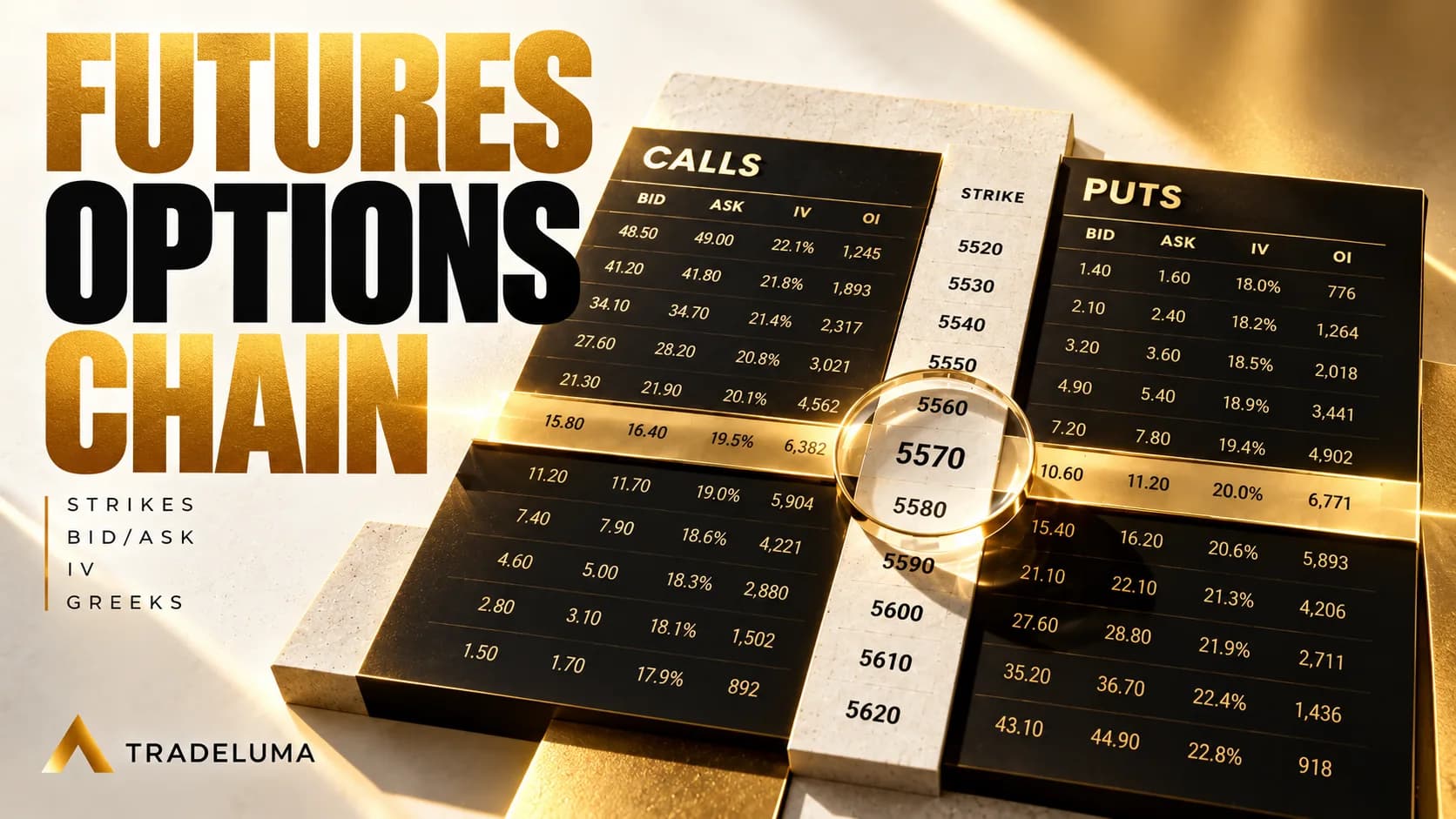
How to Read a Futures Options Chain: Strikes, Bid/Ask, IV & Greeks
Learn how to read an options chain on futures: calls and puts, strike prices, bid/ask, liquidity, implied volatility, Greeks and MES/MNQ premium examples.
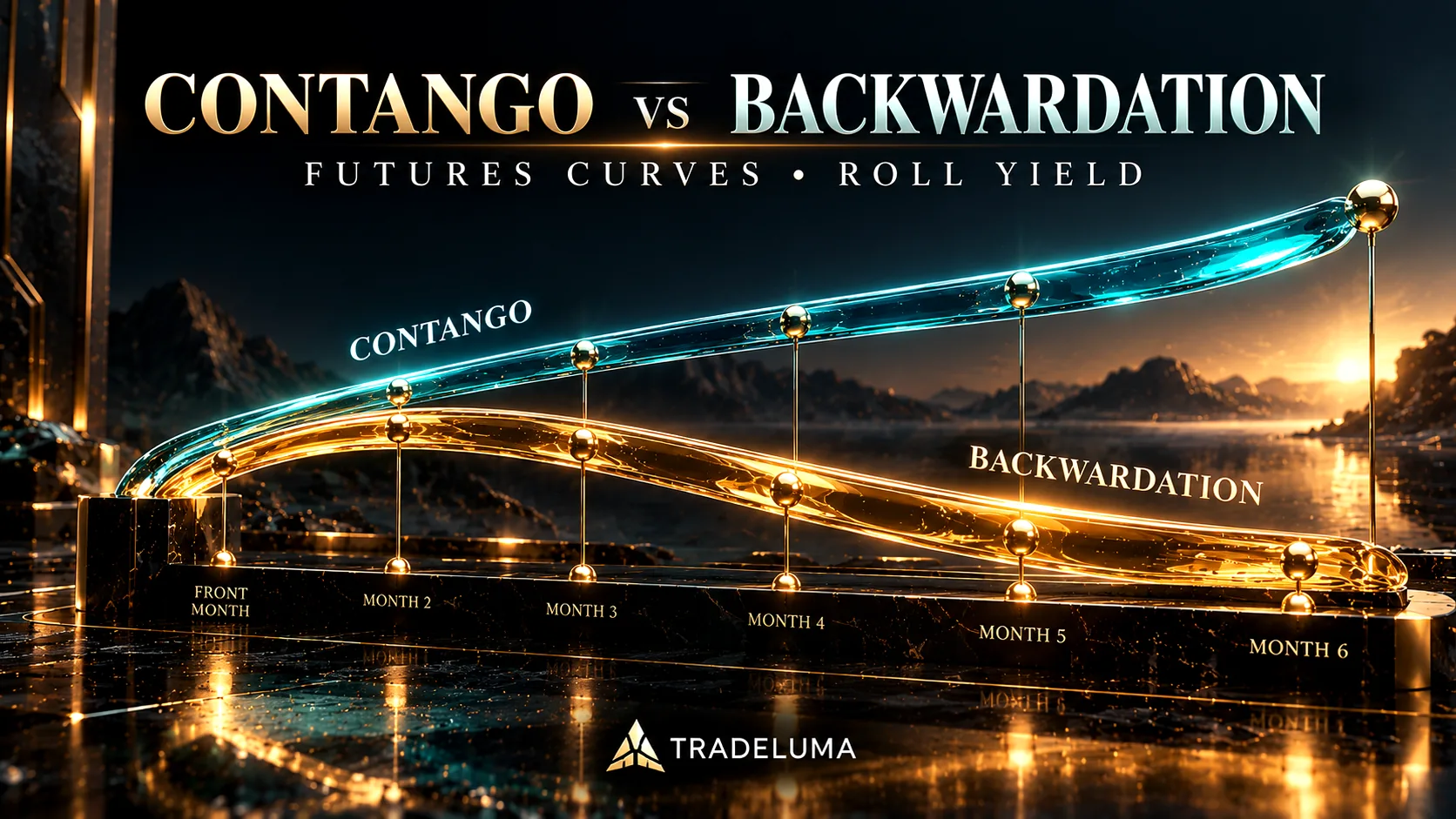
Contango vs Backwardation in Futures: Curves, Roll Yield & Examples
Understand contango and backwardation in futures, why curves slope up or down, how roll yield works, and what it means for oil, gold and rollover.