
Trading Foundations
Trading Journal Guide: What to Track and How to Improve
Learn what to record in a trading journal, which metrics to review, and how to turn setup, risk, execution, and trade history into better decisions.
On this page+

A trading journal is more than a list of profits and losses. Used properly, it preserves the reason for each trade, the risk that was planned, what actually happened during execution, and whether the rules were followed. Over a meaningful sample, that record can show which setups contribute to expectancy, where losses cluster, whether execution costs are eroding an edge, and which mistakes are behavioural rather than strategic.
What a trading journal is for
The primary purpose of a journal is diagnosis. It should make it possible to reconstruct what the trader intended, what the market did, how the order was executed, and whether the outcome came from the strategy or from a deviation in process.
Profit and loss alone cannot answer those questions. A profitable trade can still violate the plan, while a losing trade can be a correct execution of a valid setup.
Record the setup before entry
Capture the market, timeframe, direction, setup name, entry trigger, invalidation point, target or exit logic, and the market context that makes the trade eligible. If possible, save a chart image before entry.
Writing this information before the outcome is known prevents hindsight from turning a vague impulse into a seemingly well-planned setup after the trade closes.
Track planned risk and position size
Record the intended entry, stop, quantity, maximum monetary risk, and the calculation used for position size. For leveraged instruments, include the relevant point value, tick value, or contract multiplier where it affects the risk calculation.
After the trade, compare planned risk with actual realised loss and note any slippage or partial fills. Repeated differences can indicate an execution problem or unrealistic assumptions in the strategy model.
Capture the exit and trade management
Record every meaningful management action: stop movement, partial exit, scale-in, scale-out, target adjustment, or manual close. Note whether each action was part of the original rules or a discretionary change.
This makes it possible to compare the strategy as designed with the strategy as actually traded. If discretionary changes consistently reduce expectancy, the journal can show it; if they improve results over a large sample, they can be tested formally.
Use R-multiples to compare different trades
R-multiple expresses the result relative to the amount initially risked. A trade that risked $100 and made $200 is +2R; one that lost the planned $100 is -1R. This allows trades with different position sizes and markets to be compared on a common scale.
R-multiples are especially useful for studying payoff distribution, average winner, average loser, and whether a small number of outliers produce most of the strategy's performance.
Tag trades by setup and market regime
Useful tags might include breakout, pullback, trend, mean reversion, high volatility, low volatility, session, or higher-timeframe direction. Keep the number of tags manageable and define them consistently.
Once enough trades exist, compare expectancy and drawdown across tags. A strategy may look average overall but perform well in one regime and poorly in another, providing a testable hypothesis for future refinement.
Track rule adherence and decision quality
Create a simple field for whether the trade followed every required rule. If not, record the exact deviation, such as late entry, oversized position, widened stop, unplanned re-entry, or trade outside the allowed session.
This separates execution discipline from strategy quality. If rule-following trades are profitable while discretionary deviations lose money, the priority is process. If both groups struggle, the strategy itself may need review.
Review weekly and over larger samples
A weekly review can identify obvious operational issues, but strategy changes should usually rely on a larger sample. Review total trades, win rate, average win, average loss, expectancy, profit factor, drawdown, R distribution, costs, and performance by setup.
Also review missed trades and blocked trades when relevant. The goal is not to find a reason to trade more; it is to understand whether the plan is being executed consistently and whether the edge remains supported by evidence.
Keep the journal simple enough to maintain
A journal with dozens of fields can create excellent data for a week and no data after that. Start with the fields that directly answer your most important questions, then add new fields only when they have a clear purpose.
Automation can capture timestamps, fills, quantity, P&L, and order status, leaving the trader to add context, screenshots, and review notes. The best structure is the one that produces complete, reliable records over time.
Frequently asked questions
What should I record in a trading journal?+
Record the setup, market, timeframe, entry, stop, target or exit rule, position size, planned risk, actual fills, result, rule adherence, relevant chart images, and review notes.
Is a trading journal only for losing trades?+
No. Winning trades also need review because a profitable outcome can come from poor process, while a loss can be a valid execution of the plan.
What is an R-multiple in a trading journal?+
An R-multiple expresses a trade's result relative to its initial planned risk, allowing trades of different sizes to be compared consistently.
How often should a trading journal be reviewed?+
Frequent reviews can catch process issues, while strategy conclusions are better based on a larger sample of trades rather than a few recent outcomes.
Put it into practice
Use the risk maths next to the guide.
Open TradeLuma's free position-size, risk/reward, expectancy, and drawdown tools to test the numbers behind a risk-management decision.
Open free trading calculators →Continue learning
Related guides.

Market sentiment in trading: how traders think about fear, optimism, and positioning
Learn what market sentiment means, how it differs from simple price direction, and how traders use sentiment as context rather than as certainty.
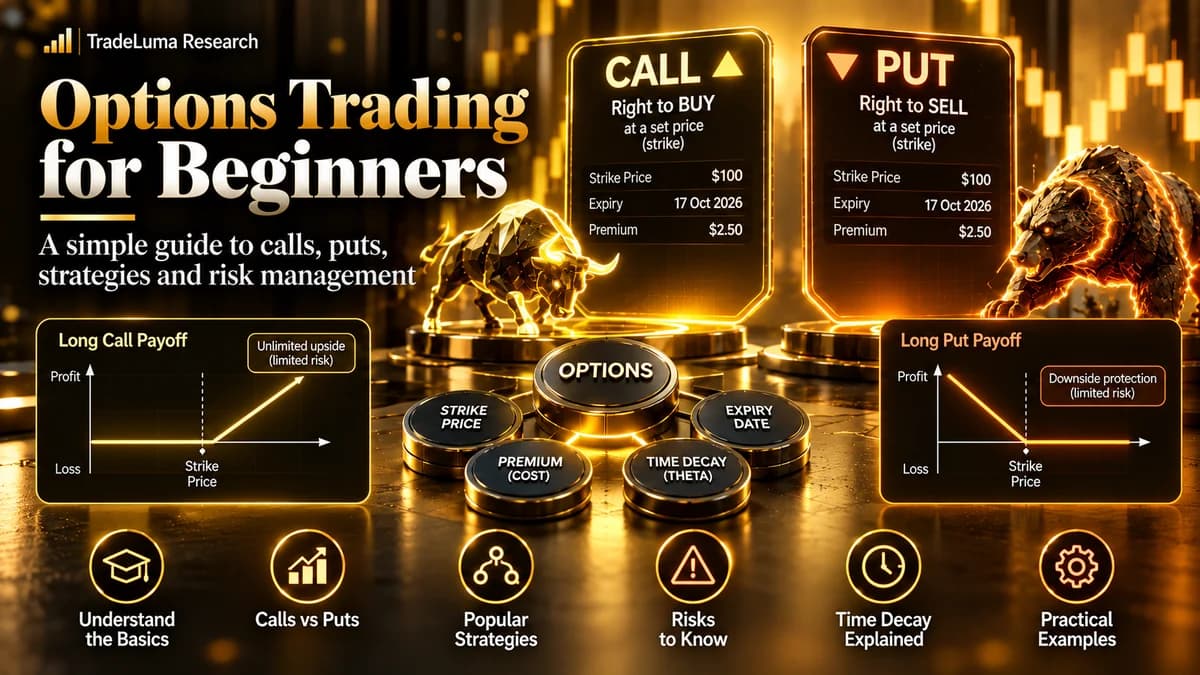
Options trading for beginners: calls, puts, and the risks to understand first
A beginner-friendly introduction to options trading, including calls, puts, premium, expiration, and why options behave differently from simple share or futures positions.

Futures trading for beginners: what a futures contract is and how traders approach the market
A beginner-friendly guide to futures trading, covering contract basics, margin, rollover, leverage, and practical risk considerations.