
Futures
Tick Size vs Tick Value in Futures: ES, NQ, MES, MNQ, Gold & More
Learn the difference between futures tick size and tick value, with current ES, NQ, MES, MNQ, Gold, Micro Gold, WTI and Micro WTI examples.
On this page+
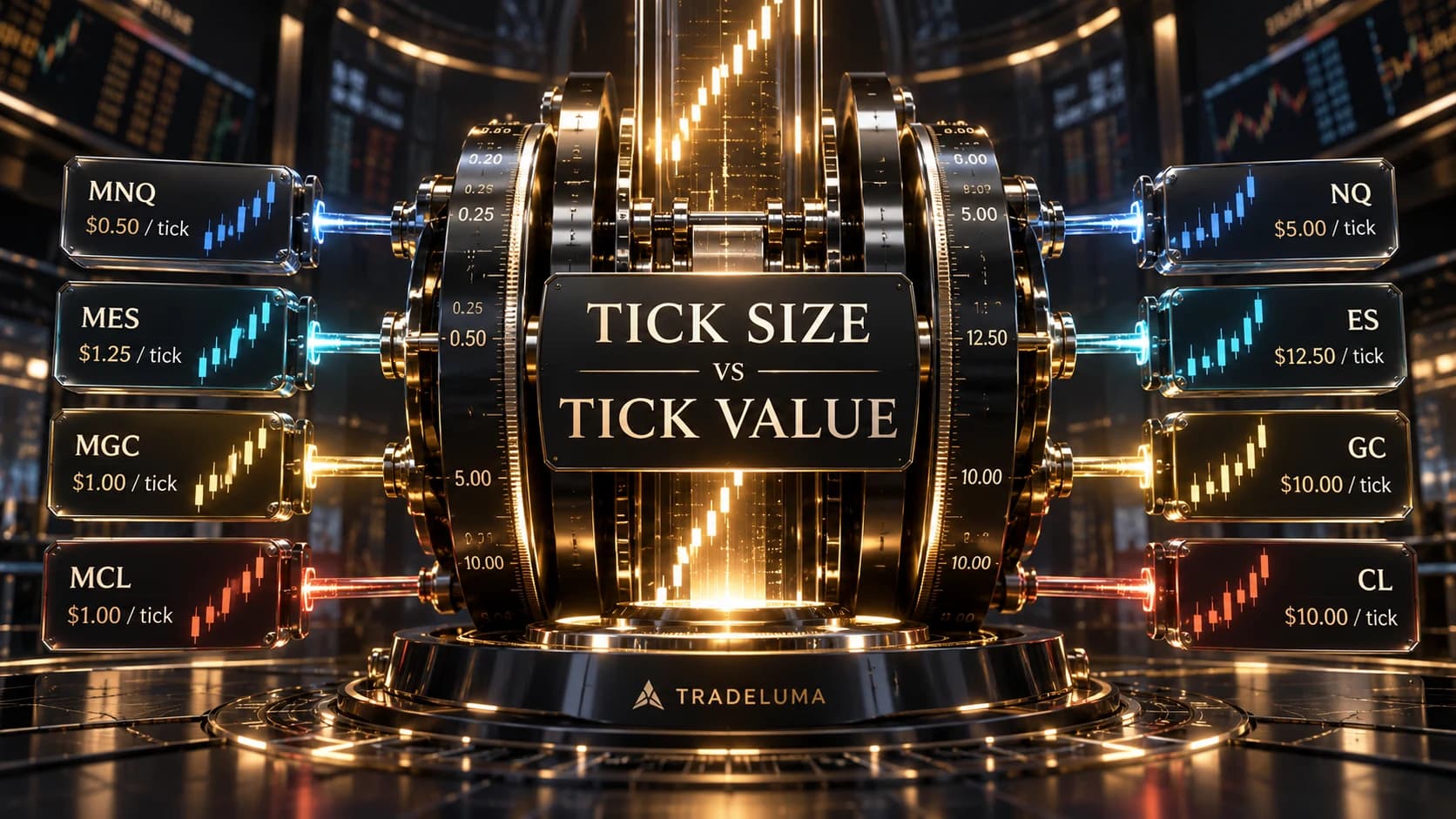
Tick size and tick value sound similar, but they answer two different questions. Tick size is the smallest price movement an outright futures contract can normally make. Tick value is the dollar impact of that minimum move for one contract. Confusing the two can turn a sensible chart stop into the wrong cash risk, especially when moving between products such as ES and MES, NQ and MNQ, Gold and Micro Gold, or WTI and Micro WTI. This guide explains the formulas, compares common contracts, and shows how tick value connects price movement to position sizing, P&L and automated risk checks.
Tick size vs tick value: the simple difference
Tick size is the smallest permitted price increment for the futures contract being traded. If a contract has a 0.25-point tick size, valid outright prices normally move in quarter-point steps such as 6000.00, 6000.25, 6000.50 and 6000.75.
Tick value converts that price increment into money. If the same contract is worth $20 per index point, a 0.25-point tick is worth $5. The chart moved only one tick, but the account value changed by $5 per contract before commissions and other costs.
The tick-value formula
For index futures, the basic relationship is: tick value = tick size × dollar multiplier per index point. NQ, for example, has a $20-per-point multiplier and a 0.25-point minimum tick, so one outright tick is worth $5. MNQ uses the same 0.25-point tick size but a $2-per-point multiplier, making one tick worth $0.50.
Commodity contracts may be quoted per barrel, ounce or another unit. The principle is unchanged. WTI Crude Oil moves in $0.01-per-barrel increments across 1,000 barrels, producing a $10 tick. Micro WTI uses 100 barrels, so the same $0.01 price move is worth $1.
ES and MES tick size and tick value
E-mini S&P 500 futures, code ES, use a $50-per-index-point multiplier. With a 0.25-point outright tick, one ES tick is worth $12.50. A one-point move equals four ticks and is worth $50 per contract.
Micro E-mini S&P 500 futures, code MES, are one tenth the E-mini size at $5 per point. MES also uses a 0.25-point outright tick, so each tick is worth $1.25 and a one-point move is worth $5 per contract.
NQ and MNQ tick size and tick value
E-mini Nasdaq-100 futures, code NQ, use a $20-per-index-point multiplier and a 0.25-point outright tick. One NQ tick is therefore worth $5, while a full one-point move is worth $20 per contract.
Micro E-mini Nasdaq-100 futures, code MNQ, use a $2-per-point multiplier with the same 0.25-point tick. One MNQ tick is worth $0.50 and a one-point move is worth $2. This ten-to-one difference is why copying an NQ quantity directly into MNQ, or vice versa, can radically change account risk.
YM, MYM, RTY and M2K: the other major US index contracts
E-mini Dow futures, YM, use a $5-per-point multiplier and a one-point minimum tick, so one tick is worth $5. Micro E-mini Dow, MYM, uses a $0.50-per-point multiplier and a one-point minimum tick, making one tick worth $0.50.
E-mini Russell 2000 futures, RTY, use a $50-per-point multiplier and a 0.10-point outright tick, making one tick worth $5. Micro E-mini Russell 2000, M2K, uses $5 per point and the same 0.10-point tick, making one tick worth $0.50.
GC and MGC Gold futures tick values
Benchmark Gold futures, GC, represent 100 troy ounces. The standard minimum price fluctuation is $0.10 per ounce, so a one-tick move is worth $10 per contract. A $1-per-ounce move in gold is ten ticks and changes one GC contract by $100 before costs.
Micro Gold futures, MGC, represent 10 troy ounces. They also move in $0.10-per-ounce increments, but the smaller contract makes one tick worth $1. A $1-per-ounce move changes one MGC contract by $10. The chart can look identical while the cash impact differs by a factor of ten.
CL and MCL crude-oil tick values
WTI Crude Oil futures, CL, represent 1,000 barrels and are quoted in dollars per barrel. The minimum outright increment is $0.01 per barrel. Multiplying $0.01 by 1,000 barrels gives a $10 tick value.
Micro WTI Crude Oil futures, MCL, represent 100 barrels with the same $0.01-per-barrel increment. One MCL tick is therefore worth $1. A $1 move in crude corresponds to 100 ticks, or $1,000 in CL and $100 in MCL per contract.
Tick value and point value are not the same thing
Point value tells you the dollar impact of a one-unit price move. Tick value tells you the dollar impact of the minimum permitted move. When a contract trades in quarter points, one point contains four ticks. When it trades in tenths, one point contains ten ticks.
For NQ, one point is $20 and one 0.25-point tick is $5. For MNQ, one point is $2 and one 0.25-point tick is $0.50. For ES, one point is $50 and a quarter-point tick is $12.50. Keeping point value and tick value separate prevents a common risk-calculation error.
How to convert a stop into dollar risk
Start by measuring the distance from entry to stop in the contract's price units. Convert that distance into ticks, multiply by the tick value, then multiply by the number of contracts. The core formula is: cash risk before costs = ticks to stop × tick value × contracts.
Suppose an MNQ trade has a 50-point stop. At 0.25 points per tick, 50 points equals 200 ticks. At $0.50 per tick, that is $100 of price risk per MNQ contract before commissions and slippage. The identical 50-point stop in NQ would be $1,000 per contract because each tick is worth $5.
How to calculate futures P&L from ticks
For a completed trade, gross P&L can be expressed as ticks moved × tick value × contracts. A 40-tick favourable move in two MES contracts is 40 × $1.25 × 2 = $100 before transaction costs. A 40-tick adverse move produces the same $100 gross loss in the opposite direction.
The formula is simple enough to automate, but the execution record should use the actual filled prices rather than only the strategy's expected entry and exit. Slippage, partial fills and average fill price can change the real number of ticks captured or lost.
Why the same chart move creates different dollar risk
Two contracts can track the same underlying index and display almost the same chart while carrying very different multipliers. That is exactly what happens with E-mini and Micro E-mini pairs. MES and ES follow the S&P 500, while MNQ and NQ follow the Nasdaq-100, but the Micro contract is one tenth the size of its E-mini counterpart.
This is why strategy logic and account risk should be separated. An indicator can generate the same entry and stop levels on related contracts, yet the correct quantity depends on the contract multiplier, tick value, account limits and transaction costs.
Tick size affects entries, stops and targets
Orders normally need to respect the contract's permitted price increment. A limit price that falls between valid ticks may be rejected, rounded or handled according to broker rules. Stops and profit targets also need to resolve to valid increments.
Automated systems should normalise order prices to the exchange tick grid before submission and should do so using the exact tradable contract rather than a generic assumption. A hard-coded 0.25 tick size is correct for many US index futures but wrong for products such as YM, RTY, GC or CL.
Outright futures, spreads and options can use different increments
A contract family can have more than one permitted minimum increment. Calendar spreads may trade in a smaller increment than the outright future, and options can use variable tick tables depending on premium. Therefore a single tick number should not be applied blindly to every instrument sharing the same root symbol.
This guide focuses on common outright futures examples. If an automation workflow supports spreads, options or exchange-defined special transactions, it should load the specification for that instrument type rather than inherit the outright tick rule.
Commissions and slippage matter more when the tick value is small
A smaller tick value can improve position-size precision, but it can also make transaction costs larger relative to the intended profit target. If a strategy aims to capture only a few ticks, commissions, exchange fees and bid-ask spread can consume a meaningful share of the gross edge.
Compare costs in ticks as well as dollars. A $2 round-trip cost represents four MNQ ticks but less than half an NQ tick. That does not make one contract automatically better; it shows why strategy economics should be tested on the exact contract actually traded.
Continuous charts do not remove contract-specification risk
Continuous futures symbols are convenient for charting and backtesting, but live broker orders must resolve to a specific tradable expiry. The continuous series does not replace the multiplier, tick size, tick value or expiry details of the actual contract.
When a strategy rolls from one expiry to another, the execution layer should confirm that the new contract specification matches the expected product. Symbol mapping mistakes can create a much larger error than a one-tick calculation.
What an automated trading system should validate
Before accepting an order, an execution system can validate the contract identifier, exchange, expiry, multiplier, minimum increment, quantity and resulting cash exposure. It can then check whether entry, stop and target prices sit on valid ticks and whether the calculated risk stays inside account limits.
The system should also record the specification used for the decision. If a broker rejects an order for an invalid price increment or if an exchange changes a contract rule, that audit trail makes the problem much easier to diagnose.
A practical tick-size and tick-value checklist
Before trading a new futures symbol, confirm five numbers: contract multiplier or quantity, minimum price increment, tick value, point value where relevant, and the number of ticks between entry and invalidation. Then convert the planned stop into dollars for the exact quantity.
Finally, verify the specification with the exchange or broker for the instrument being traded, include estimated commissions and slippage, and confirm that any automation uses the tradable contract rather than a continuous chart symbol.
Frequently asked questions
What is the difference between tick size and tick value?+
Tick size is the smallest permitted price movement for the contract. Tick value is the dollar amount that one minimum tick changes the value of one futures contract.
How do you calculate futures tick value?+
For index futures, multiply the minimum price increment by the contract's dollar multiplier per point. For commodity futures, multiply the quoted minimum price change by the contract quantity.
What is the NQ tick value?+
NQ uses a 0.25-point minimum outright tick and a $20-per-point multiplier, so one NQ tick is worth $5 per contract.
What is the MNQ tick value?+
MNQ uses a 0.25-point minimum outright tick and a $2-per-point multiplier, so one MNQ tick is worth $0.50 per contract.
What is the ES tick value?+
ES uses a 0.25-point minimum outright tick and a $50-per-point multiplier, so one ES tick is worth $12.50 per contract.
What is the MES tick value?+
MES uses a 0.25-point minimum outright tick and a $5-per-point multiplier, so one MES tick is worth $1.25 per contract.
What is the Gold futures tick value?+
Benchmark GC Gold futures have a $10 minimum tick value per contract. Micro Gold MGC has a $1 minimum tick value per contract.
What is the crude-oil futures tick value?+
WTI Crude Oil CL has a $10 minimum tick value per contract. Micro WTI MCL has a $1 minimum tick value per contract.
How do I calculate risk from a futures stop loss?+
Convert the entry-to-stop distance into ticks, then multiply ticks by tick value and by the number of contracts. Add realistic commissions and slippage to estimate total trade risk.
Can futures tick sizes change?+
Exchange rules can change and different instrument types such as calendar spreads or options can use different increments, so traders should verify the current specification for the exact instrument.
Futures workflows
Explore the strategy side of TradeLuma.
Browse TradeLuma's futures strategy catalogue and the chart, rollover, and reference methodology used for each published strategy.
Explore futures strategies →Continue learning
Related guides.
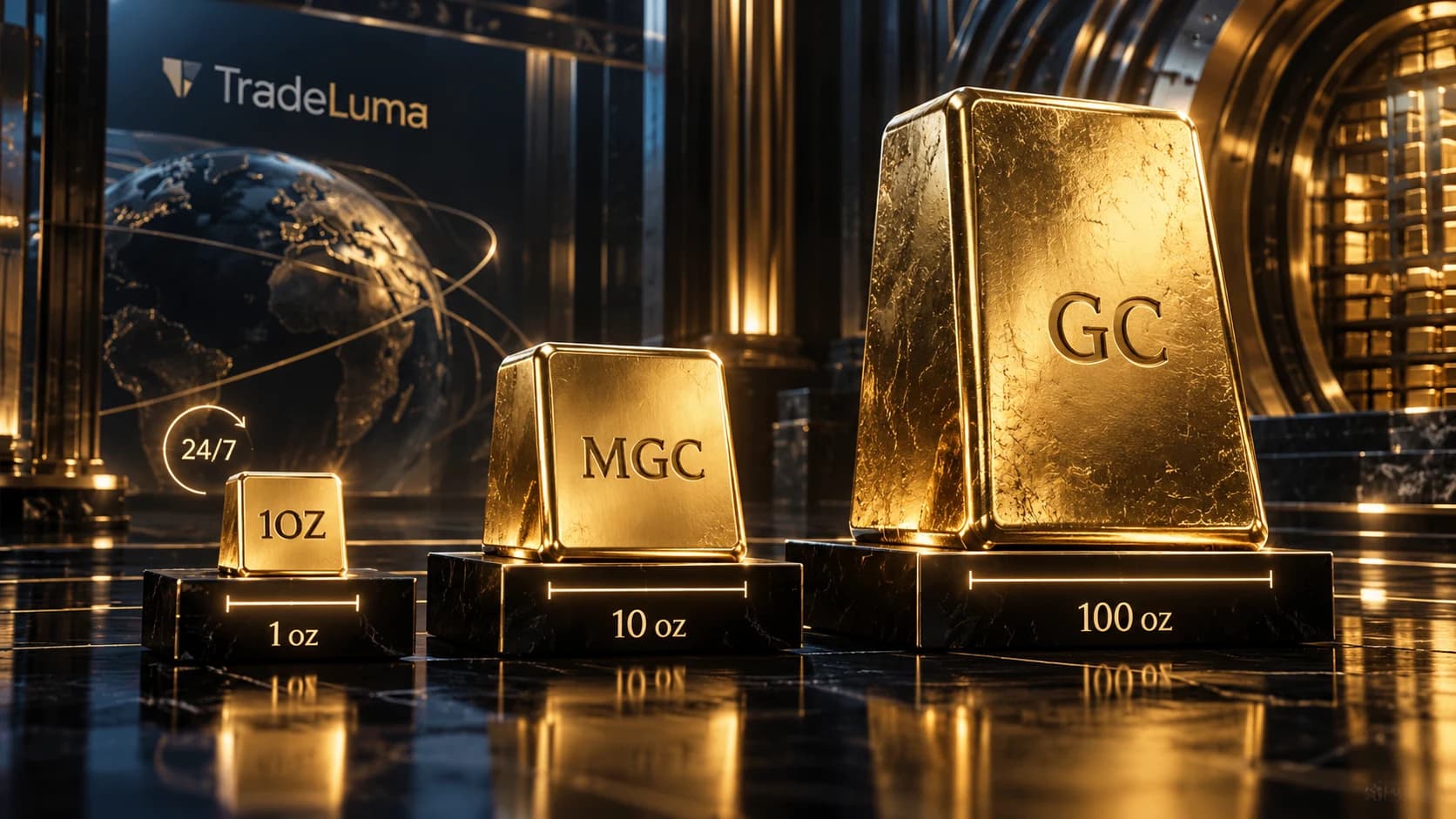
1-Ounce Gold Futures vs Micro Gold (MGC) vs Gold (GC): 2026 Guide
Compare 1-Ounce Gold (1OZ), Micro Gold (MGC) and Gold (GC) futures by contract size, tick value, trading hours, settlement, expiry and risk.
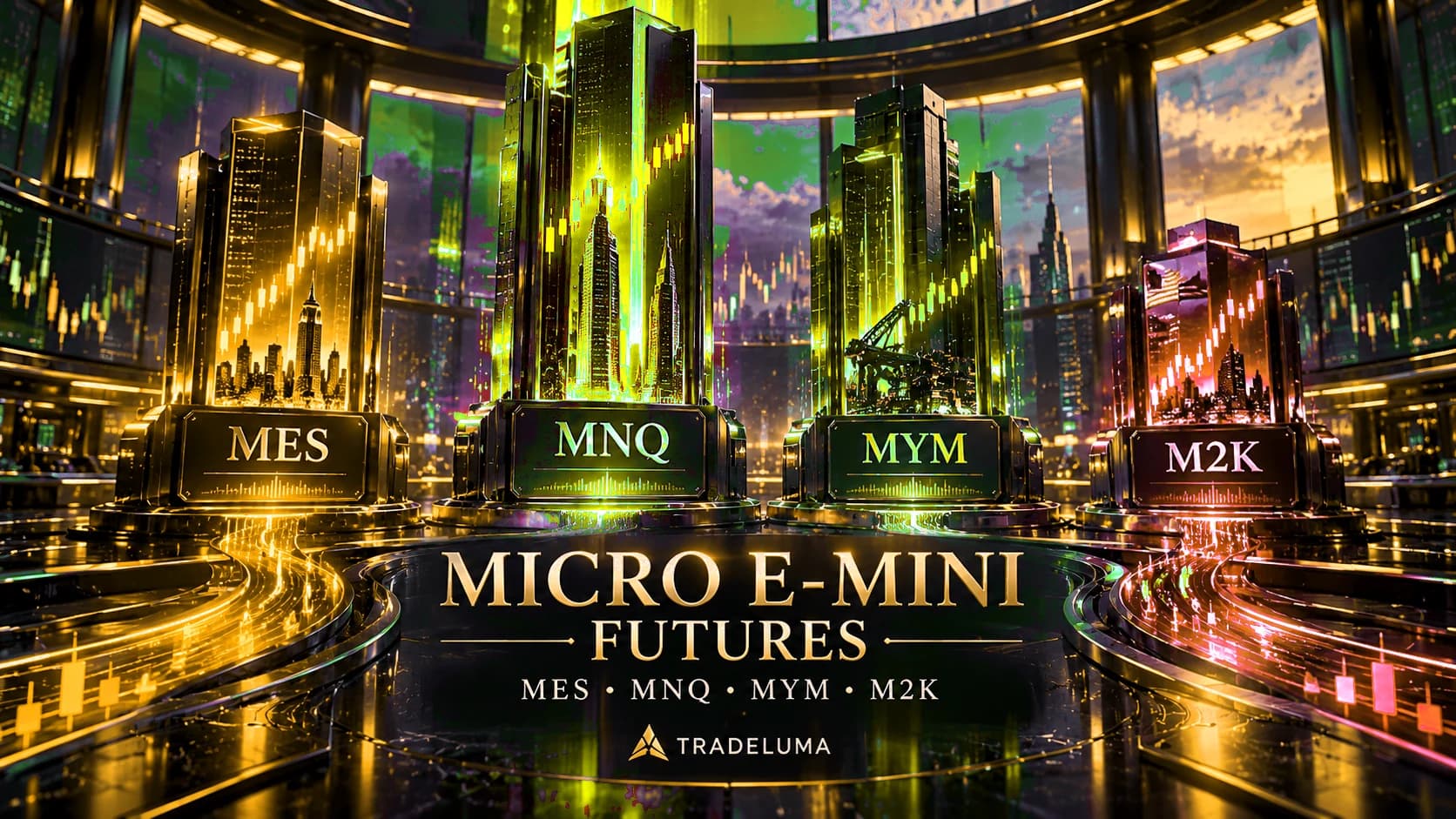
Micro E-mini Futures Explained: MES vs MNQ vs MYM vs M2K
Compare MES, MNQ, MYM and M2K Micro E-mini futures by index, multiplier, tick value, trading hours, expiry, settlement and risk.
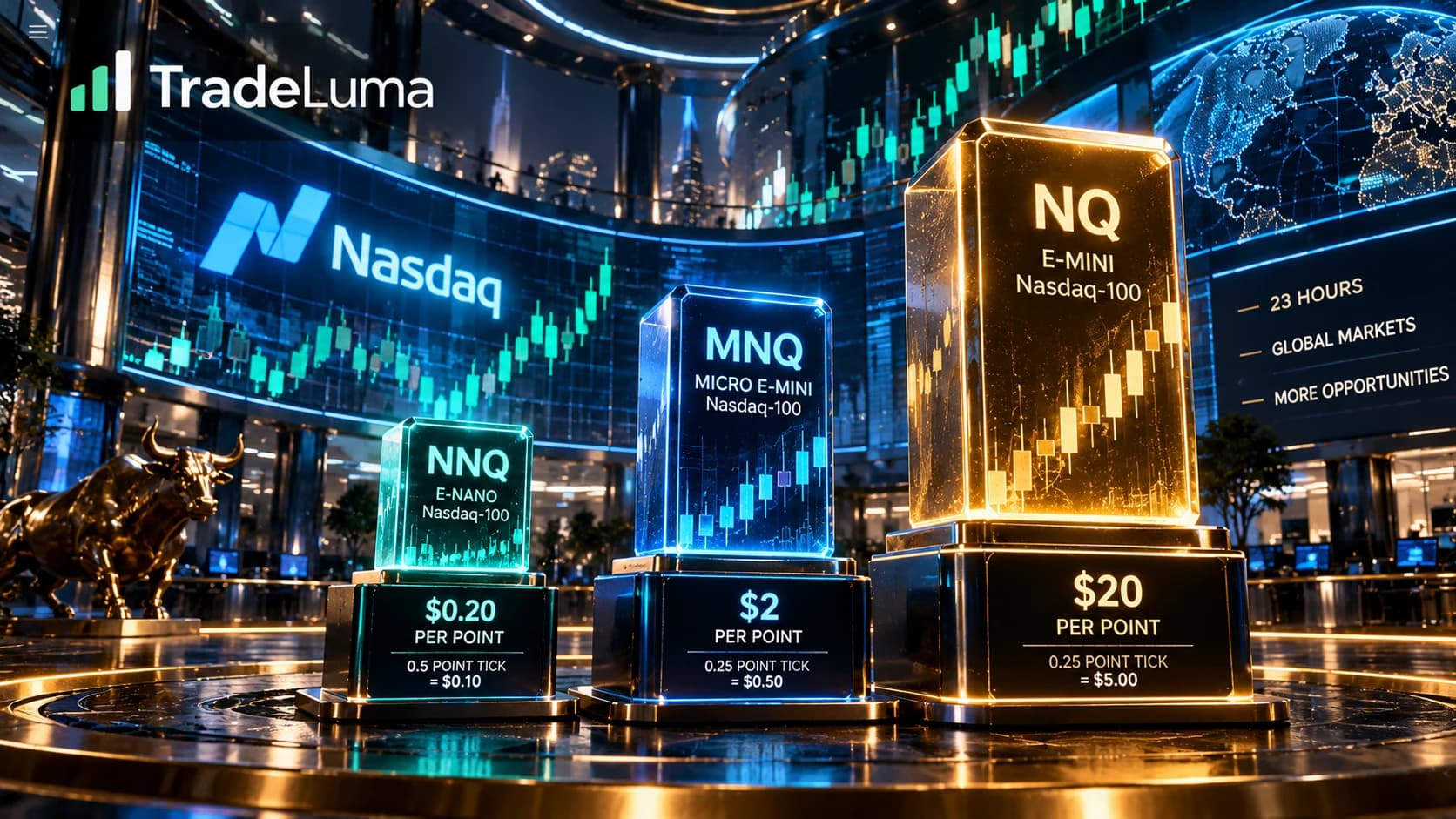
E-Nano Futures vs Micro E-mini: NNQ vs MNQ vs NQ (2026 Guide)
Compare E-nano, Micro E-mini and E-mini equity index futures, including NNQ vs MNQ vs NQ contract size, tick value, trading hours, settlement and risk.