
Futures
1-Ounce Gold Futures vs Micro Gold (MGC) vs Gold (GC): 2026 Guide
Compare 1-Ounce Gold (1OZ), Micro Gold (MGC) and Gold (GC) futures by contract size, tick value, trading hours, settlement, expiry and risk.
On this page+
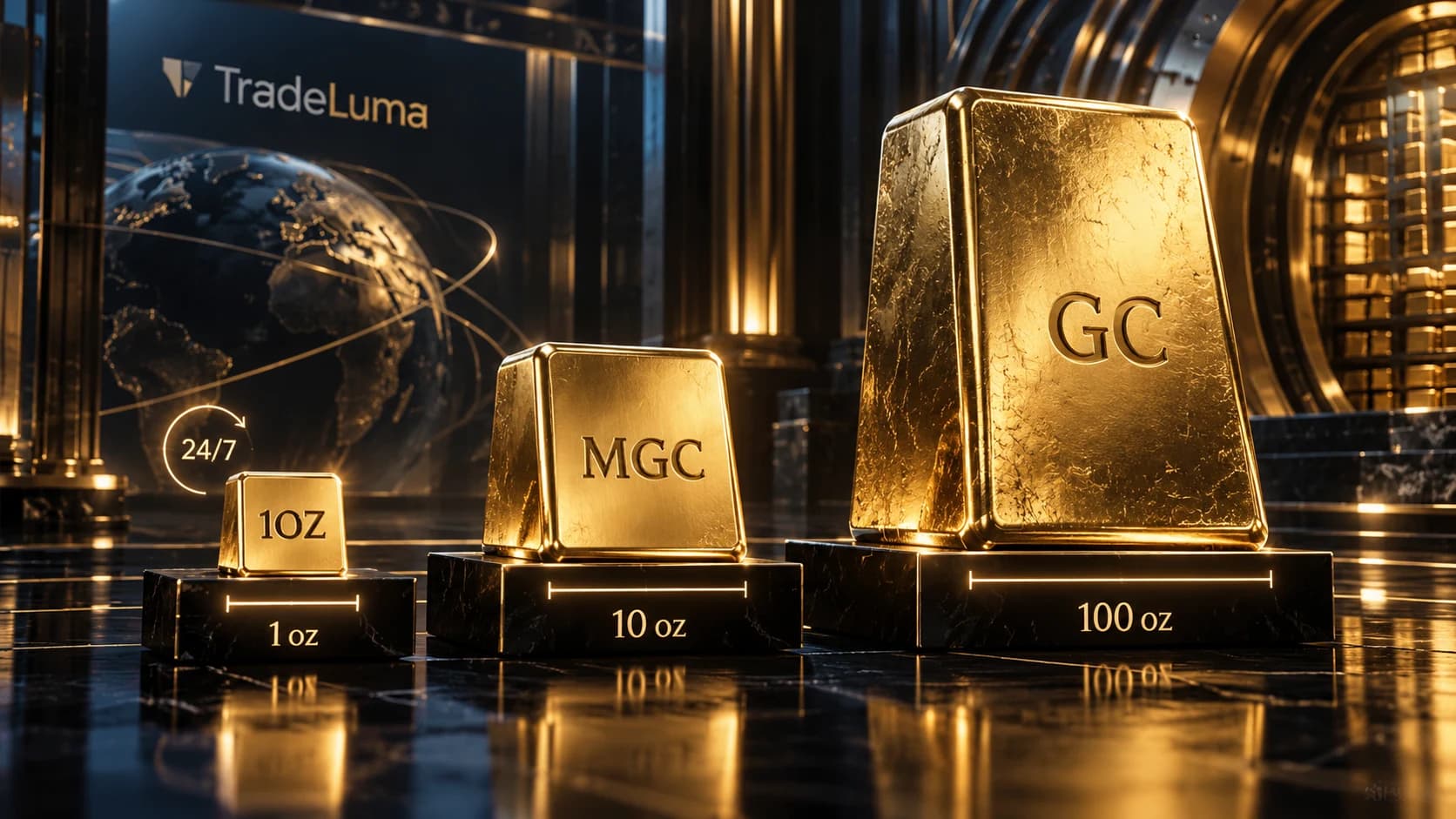
Gold futures now come in meaningfully different sizes and, since the 2026 expansion of 1-Ounce Gold trading, meaningfully different trading schedules too. The 1-Ounce Gold contract (1OZ) represents one troy ounce, Micro Gold (MGC) represents 10 troy ounces, and benchmark Gold futures (GC) represent 100 troy ounces. That size ladder changes the dollar value of every move, while 1OZ adds another distinction: it trades 24/7 on CME Globex subject to short scheduled maintenance windows. This guide compares the three contracts side by side so traders can understand exposure, tick value, hours, settlement and expiry before choosing how to test or automate a gold-futures workflow.
1OZ vs MGC vs GC at a glance
The three contracts track the same broad gold market but package the exposure differently. One 1OZ contract represents 1 troy ounce, one MGC contract represents 10 troy ounces, and one GC contract represents 100 troy ounces. In size terms, 1OZ is one tenth of MGC and one hundredth of GC.
That simple ratio is the fastest way to understand risk. For the same $1 move in gold, one 1OZ contract changes by about $1, one MGC contract by about $10, and one GC contract by about $100 before commissions and other trading costs.
What is the 1-Ounce Gold futures contract?
1-Ounce Gold futures, product code 1OZ, are COMEX-listed futures sized at one troy ounce. CME positions the contract as the smallest contract in its main gold-futures size ladder, giving traders a much finer way to scale notional exposure than MGC or GC.
The contract is quoted in US dollars and cents per troy ounce. Its minimum trading increment is $0.25 per ounce, and because the contract represents exactly one ounce, one tick is worth $0.25 per contract.
Micro Gold futures (MGC) explained
Micro Gold futures, product code MGC, represent 10 troy ounces. That is one tenth the size of standard GC and ten times the size of 1OZ.
MGC is quoted in dollars and cents per troy ounce with a $0.10 minimum price fluctuation. Multiplying $0.10 by the 10-ounce contract size gives a $1 minimum tick value per contract. A $10 move in gold therefore changes one MGC contract by about $100 before costs.
Benchmark Gold futures (GC) explained
Gold futures, product code GC, are the 100-troy-ounce benchmark contract. They are widely used by professional and institutional participants and provide much larger dollar exposure per contract than MGC or 1OZ.
GC uses a $0.10 per ounce minimum price increment. Across 100 ounces, that makes the minimum tick worth $10 per contract. A $10 move in the gold price changes the value of one GC contract by about $1,000 before costs.
Contract size changes P&L faster than the chart suggests
A gold chart can look identical regardless of which contract is being traded, but the account-level result is not identical. If gold rises by $50 per ounce, one long 1OZ contract changes by about $50, one MGC contract by about $500, and one GC contract by about $5,000 before fees and slippage.
That is why position sizing should begin with contract specifications rather than with how large or small the chart move appears. The same stop distance can represent dramatically different cash risk across 1OZ, MGC and GC.
Tick size and tick value: the numbers to remember
For 1OZ, the minimum trading increment is $0.25 per troy ounce and the contract size is one ounce, so the tick value is $0.25. For MGC, the increment is $0.10 per ounce across 10 ounces, so the tick value is $1. For GC, the increment is $0.10 per ounce across 100 ounces, so the tick value is $10.
The tick is only the smallest allowed price step. Risk is usually easier to calculate from the full stop distance: cash risk before costs is approximately stop distance in dollars per ounce multiplied by contract ounces multiplied by the number of contracts.
The biggest 2026 difference: 1OZ trades 24/7
CME expanded 1OZ to 24/7 Globex trading in July 2026. The contract can trade through the weekend, with scheduled maintenance rather than the traditional full weekend closure used by most futures contracts.
CME lists regular 1OZ maintenance from 4:00 p.m. to 4:02 p.m. Central Time Monday through Friday and a longer Saturday maintenance window from 2:00 a.m. to 4:00 a.m. CT. Weekend and holiday activity can carry the trade date of the following business day, so execution systems should distinguish calendar time from exchange trade date.
MGC and GC still use the traditional gold-futures schedule
MGC and GC trade on the conventional nearly 23-hour weekday Globex schedule rather than the new 1OZ weekend model. CME lists trading from Sunday 5:00 p.m. through Friday 4:00 p.m. Central Time, with a 60-minute break beginning at 4:00 p.m. CT each trading day.
This means a strategy that assumes all CME gold products share the same session calendar can be wrong. A weekend signal may fall inside an open 1OZ session while MGC and GC are closed.
24/7 availability does not mean identical liquidity every hour
Being technically open is not the same as having the same depth, spread and participation around the clock. Gold liquidity can change sharply between Asian, European and North American hours, around economic releases and during quieter weekend periods.
For automated trading, session availability and liquidity filters should be separate settings. A system may be allowed to receive 1OZ prices 24/7 while still restricting new entries during thin conditions, maintenance windows or periods that have not been tested.
Settlement is different: 1OZ is cash settled
1OZ is cash settled to the benchmark 100-troy-ounce Gold futures contract. MGC and GC are physically deliverable futures, although many active traders close or roll positions before the delivery process becomes relevant.
This distinction matters operationally. A trader should not assume that smaller size means the same expiry and settlement mechanics. Broker policies can also impose their own close-out deadlines before an exchange delivery period.
Expiry and contract months are not identical
1OZ lists February, April, June, August, October and December contracts within a 24-month period. Its last trading day is the third-last business day of the month before the contract month, so its lifecycle ends earlier than MGC or GC.
MGC is also listed in the main February, April, June, August, October and December cycle within a 24-month window, but trading terminates on the third-last business day of the delivery month. GC has a broader listing schedule and also terminates on the third-last business day of the delivery month. Rollover logic therefore needs to be contract-specific.
Notional exposure and margin are different concepts
Notional exposure is approximately the gold price multiplied by the number of ounces in the contract. If gold were $5,000 per ounce, the approximate notional exposure would be $5,000 for 1OZ, $50,000 for MGC and $500,000 for GC per contract.
Margin is only the collateral required to hold the leveraged position; it is not the maximum possible loss. Exchange margin levels can change as volatility changes, and brokers may require more than the exchange minimum or use separate intraday policies. For that reason, a durable trading plan should calculate risk from price movement and contract size rather than treating margin as the stop loss.
Why smaller contracts can improve position-size precision
A smaller contract lets a trader make smaller adjustments to exposure. If one MGC contract is too large for a planned cash-risk limit, 1OZ can offer ten smaller units across the same 10-ounce notional size. The same principle applies when comparing MGC with GC.
More granularity can help position sizing, scaling and testing, but it can also increase the number of orders and commissions if a trader replaces one larger contract with many smaller contracts. Contract choice should therefore consider both risk precision and execution costs.
Which gold futures contract fits which workflow?
1OZ can suit workflows that need very small increments of gold exposure or access beyond the traditional weekday schedule. MGC sits in the middle and provides 10-ounce units. GC provides the largest exposure and is the benchmark contract in the group.
That is a structural comparison, not a recommendation. The right contract depends on broker support, market data, liquidity at the hours being traded, account risk limits, strategy holding period, transaction costs and whether the strategy has actually been tested on that contract.
TradingView symbols and broker contracts must be mapped carefully
Continuous chart symbols are useful for analysis, but broker orders must resolve to an actual tradable contract. A strategy that analyses a continuous gold series still needs a rule that maps the signal to the correct 1OZ, MGC or GC expiry at the broker.
The mapping should include product code, contract month, exchange, multiplier, tick size and rollover state. This becomes even more important with 1OZ because its expiry timing and 24/7 schedule differ from MGC and GC.
What 24/7 1OZ changes for automated trading
A 24/7 contract removes the simple assumption that the market is unavailable throughout the weekend. Automation can now receive legitimate 1OZ market events during periods when many futures systems would previously have been idle.
That creates new requirements: maintenance windows must be modelled, weekend broker-session availability must be checked, risk controls need to stay active beyond the weekday schedule, and monitoring should understand the exchange trade date. A system should also confirm that the broker actually supports 1OZ and weekend order handling before treating exchange availability as broker availability.
Common mistakes when comparing 1OZ, MGC and GC
The most dangerous mistake is copying a quantity from one contract to another without adjusting for the multiplier. Ten MGC contracts equal the same nominal ounces as one GC contract, while ten 1OZ contracts equal one MGC contract.
Other mistakes include assuming the tick values are the same, using margin as a risk limit, treating 24/7 as equally liquid 24/7, forgetting that 1OZ expires earlier relative to its contract month, and routing a continuous chart symbol directly to the broker without explicit contract mapping.
A practical gold-futures contract checklist
Before enabling a strategy, confirm the product code, contract size, tick size, tick value, tradable expiry, exchange session, maintenance window, broker permissions, market-data entitlement, settlement type and rollover rule. Then calculate the cash impact of the planned stop for the exact quantity.
For automated workflows, add one more check: verify that the strategy's session logic matches the selected product. A rule designed around MGC's weekday session should not silently become a weekend-enabled strategy simply because the execution symbol is changed to 1OZ.
Frequently asked questions
What is the difference between 1OZ, MGC and GC gold futures?+
The main size difference is 1, 10 and 100 troy ounces respectively. They also differ in tick value, settlement and trading schedule, with 1OZ offering 24/7 trading subject to maintenance windows.
How much is one tick in 1-Ounce Gold futures?+
The minimum 1OZ price increment is $0.25 per troy ounce. Because one contract represents one ounce, one tick is worth $0.25 per contract.
How much is one tick in Micro Gold futures?+
MGC moves in $0.10 per ounce increments across a 10-ounce contract, so the minimum tick is worth $1 per contract.
How much is one tick in GC Gold futures?+
GC moves in $0.10 per ounce increments across a 100-ounce contract, so the minimum tick is worth $10 per contract.
Does 1OZ Gold trade on weekends?+
Yes. Since the July 2026 expansion, 1OZ trades 24/7 on CME Globex apart from scheduled maintenance windows, including weekend access.
Do MGC and GC trade 24/7?+
No. They use the conventional Sunday-to-Friday Globex schedule with a daily 60-minute maintenance break rather than the weekend-enabled 1OZ schedule.
Is 1OZ physically delivered?+
No. 1OZ is cash settled to the benchmark Gold futures contract. MGC and GC are physically deliverable contracts.
Is 1OZ one tenth the size of MGC?+
Yes. 1OZ represents one troy ounce and MGC represents 10 troy ounces, so ten 1OZ contracts represent the same number of ounces as one MGC contract.
How many MGC contracts equal one GC contract?+
Ten MGC contracts represent 100 troy ounces, the same contract quantity of gold as one GC contract, although execution costs and liquidity can differ.
Can the same TradingView strategy trade 1OZ, MGC and GC?+
The signal logic may be reusable, but contract mapping, quantity, tick value, session rules, broker support and rollover handling must be adjusted for the selected product.
Which gold futures contract is best for beginners?+
There is no universally best contract. Smaller contracts reduce the dollar impact of each price move, but traders still need to understand leverage, margin, liquidity, execution costs, broker rules and expiry before trading.
Futures workflows
Explore the strategy side of TradeLuma.
Browse TradeLuma's futures strategy catalogue and the chart, rollover, and reference methodology used for each published strategy.
Explore futures strategies →Continue learning
Related guides.
E-Nano Futures vs Micro E-mini: NNQ vs MNQ vs NQ (2026 Guide)
Compare E-nano, Micro E-mini and E-mini equity index futures, including NNQ vs MNQ vs NQ contract size, tick value, trading hours, settlement and risk.

GPU Futures Explained: H100 vs B200 Compute Futures — 2026 Guide
Learn how CME GPU compute futures work, including H100 GPU1 and B200 GPU2 rental indexes, 730 GPU-hours, tick value, settlement, expiry and risk.
Futures rollover and contract expiry: an automation guide
Understand expiry, liquidity migration, first notice, physical delivery risk, rollover mapping, and how automated futures workflows should respond.