
Futures
How to Read a Futures Options Chain: Strikes, Bid/Ask, IV & Greeks
Learn how to read an options chain on futures: calls and puts, strike prices, bid/ask, liquidity, implied volatility, Greeks and MES/MNQ premium examples.
On this page+
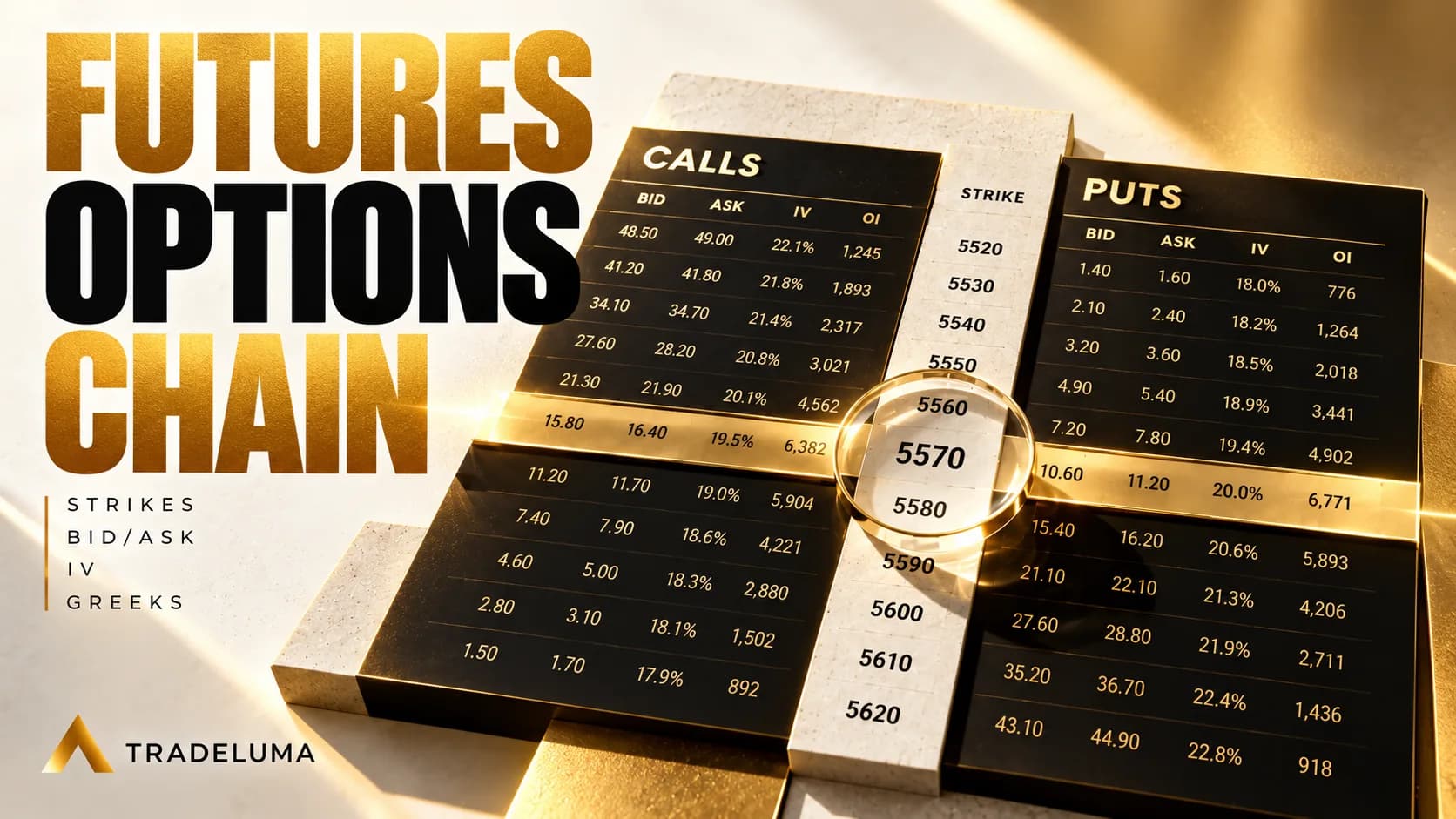
A futures options chain lists the available calls and puts for a particular futures product and expiration, usually arranged by strike price with quotes, volume, open interest, implied volatility and option Greeks. It can look like a wall of numbers, but a disciplined reading order makes it manageable. This TradeLuma guide walks through each field, explains how to convert quoted premiums into dollars and shows why choosing the correct underlying contract and settlement method matters just as much as finding an attractive strike. All quote figures below are hypothetical educational examples, not live market prices or trade recommendations.
What is a futures options chain?
A futures options chain is a listing of option contracts connected to a specified futures market. Each contract combines an option type (call or put), an expiry date, a strike and an underlying futures instrument. The screen then displays market quotes and analytics for that combination. It is a contract-selection tool, not a chart showing where the market will go.
In a conventional side-by-side layout, calls appear on the left, strikes in the middle and puts on the right. Some brokers reverse this layout or let you choose the visible columns. Learn the labels rather than memorising the screen colours; colour schemes can change with a platform theme.
Start with the product and underlying futures month
Before reading any strike, check whether you are looking at ES, MES, NQ, MNQ or another asset class and which underlying futures month applies. An option on a December futures contract is not necessarily economically identical to one on the March contract. The relevant futures price may differ from a spot index and from a continuous back-adjusted chart.
Also confirm the option is an exchange-listed contract available in your account and that your broker displays the correct currency, multiplier and settlement specification. Similar marketing names and nearby strikes can conceal materially different deliverables.
Select the exact expiration before comparing strikes
An options chain usually has an expiry selector: daily, weekly, end-of-month, quarterly or a named contract month. Options with the same strike and underlying but different expiration dates can carry radically different premiums, Greeks, risk and trading hours. Do not compare a 0DTE quote with a 30-day quote as though they were interchangeable.
Check the exchange-local expiry date, last-trading time and your broker’s earlier cut-off. Holiday schedules can modify listings. The chain may default to the nearest available expiry, which is not necessarily the expiry you intended to trade.
The eight columns worth learning first
The most useful starting fields are expiration, option type, strike, bid, ask, last, volume and open interest. Add implied volatility and Greeks after the basic contract has been identified. Many platforms also display mark or midpoint, settlement price, quote size and underlying futures price.
One practical reading order is: product and expiry → call or put → strike → bid and ask → size and activity → IV and Greeks → exercise and settlement rules → final order preview. That order reduces the chance of selecting a liquid-looking quote on the wrong contract.
Strike price: the centre of the chain
The strike is the price level used to determine exercise value and option moneyness. For a call, intrinsic value depends on how far the underlying futures reference is above the strike. For a put, it depends on how far the futures reference is below the strike. Different option products can define final settlement using different reference prices.
For illustration, if a relevant futures price is 5,572 and a call has a 5,570 strike, that call has 2 points of intrinsic value. A 5,570 put is out of the money at that same instant. This comparison is only a snapshot and says nothing by itself about whether either option is a good trade.
Calls versus puts in a futures options chain
A long call generally benefits from an increase in the relevant futures price, all else equal; a long put generally benefits from a decline. But option values also respond to time, volatility and other factors. The payoff of a long option differs fundamentally from that of a short or uncovered option.
On a two-sided chain, the same strike appears between call and put quotations. A trader can therefore compare pricing around a common futures reference. Ensure you are not accidentally reading the call bid next to the put ask: those quotes describe different instruments.
ATM, ITM and OTM: use the underlying futures reference
At-the-money (ATM) describes a strike near the relevant underlying futures price. In-the-money (ITM) calls have strikes below that reference; ITM puts have strikes above it. Out-of-the-money (OTM) options have no intrinsic value at that snapshot. Platforms may classify a nearby strike differently because of rounding or stale data.
Futures options are not priced directly against the cash index in all cases. Use the matching futures quote, not an unrelated ES/SPX comparison or a perpetual continuous symbol. At expiry, the exchange may use a specified fixing instead of the last price visible in your app.
Bid, ask and the quoted spread
The bid is the highest displayed buying interest at that point in time, and the ask (offer) is the lowest displayed selling interest. Their difference is the quoted bid/ask spread. A narrow spread can help execution efficiency; a wide spread creates a potentially significant round-trip friction even before commissions and other charges.
For example, an MES option quoted 28.00 bid and 29.00 ask has a 1.00-point quoted spread. At a $5-per-point multiplier, that spread represents $5 per contract. Paying the offer and immediately hitting the bid, if those quotes remain available, would sacrifice about $5 before fees. Actual execution depends on price and displayed depth.
Quote size and depth: can your order actually trade?
A 0.25-point spread is not very informative if only one contract is posted at the best ask and you want twenty. Quote size shows the number of contracts displayed at a specific price, while full market depth can reveal additional levels. Both can change quickly when orders are cancelled or prices move.
A limit order lets you specify a maximum purchase price or minimum sale price, but it does not guarantee a fill. A market order prioritises execution, not price, and may sweep thin order-book levels. Pay particular attention to liquidity around economic announcements and close to expiry.
Last price is historical, not a guaranteed trading price
The last column normally reports a recent transaction or an exchange-defined latest price field. It may be minutes old in a quiet strike, whereas the bid and ask are current available quotations (subject to your data entitlement and delay). A last price of 15.00 does not mean that you can buy at 15.00 if the current ask is 19.00.
CME’s public quote pages can be delayed, and brokers may show delayed, consolidated or indicative feeds. Before sending any live order, confirm whether your platform has real-time options data. A green or red change next to “last” is not a promise of executable liquidity.
Mark, midpoint, settlement and theoretical value
Midpoint is commonly calculated as (bid + ask) ÷ 2. A platform’s “mark” may use midpoint, a proprietary fair-value method or quote-quality filters; check how your broker defines it. The daily settlement and model-theoretical price are separate measures intended for clearing, analytics or valuation.
For a 28.00/29.00 market, the simple midpoint is 28.50. That does not require a seller to accept 28.50, and your closing estimate should not assume that mid fills are available during thin or volatile sessions. Use realistic spreads and commissions when estimating a strategy’s performance.
Volume: how many contracts traded today?
Volume is the number of option contracts traded during a given reporting interval, usually the current trading session. It can help identify more active strikes or expiries, but a busy day does not prove that the current order book is deep at your chosen price. A sudden burst may also reflect a block or spread transaction.
Compare volume for the exact option series rather than the underlying future. A very active MES futures contract does not guarantee every weekly MES option strike will be liquid. Look at quoted size, bid/ask spread and current activity together.
Open interest: positions still open, not today’s turnover
Open interest (OI) is the count of outstanding option contracts that remain open after clearing, rather than a total of today’s transactions. It can be relatively high at an older strike even if there is little activity at that precise moment. It is normally an end-of-day measure, sometimes preliminary and subject to revision.
High OI may help identify an established contract, but it is not evidence of bullish or bearish direction by itself. You cannot infer buyers’ motivations, hedges or positions solely from OI. The separate TradeLuma Open Interest vs Volume guide explores this distinction in greater depth.
Implied volatility (IV): pricing uncertainty, not probability certainty
Implied volatility is the volatility input consistent with an observed option value under a chosen pricing model and assumptions. It is commonly shown as an annualised percentage. An IV of 24% does not mean the option has a 24% probability of expiring in the money, nor does it predict that the underlying will move exactly 24%.
Comparing IV across expiries and strikes can identify differences in pricing of uncertainty, but the calculation depends on accurate quotes and model inputs. Near expiry, tiny changes in a thin bid or offer can produce unstable implied values. Compare similar contracts using consistent models and live data.
IV smile, skew and term structure
IV is rarely identical across every strike. The pattern across strikes is often called smile or skew, and the pattern across expiry dates is a term structure. For example, downside puts may carry relatively higher IV than equidistant calls during a period of heightened demand for downside protection.
That does not make expensive-IV options automatically poor trades. Option risk and realised volatility matter. A meaningful comparison uses the same underlying, quote timestamp, expiry and an appropriate moneyness measure; otherwise apparent differences may simply reflect incompatible contracts.
Delta: how an option responds to a futures move
Delta estimates how much the option price changes for a small change in the relevant underlying futures price, all else equal. As a rough example, an option with a 0.50 delta may change about 0.50 option points for a one-point underlying move, before other effects and changes in delta itself.
The sign and unit of delta depend on option type, side and platform convention. A long put often has negative delta. Never assume your displayed broker Greek is already converted into dollars; multiply quoted option-point sensitivity by the contract multiplier when that is the platform’s stated convention.
Gamma: why delta changes
Gamma estimates the rate at which delta changes as the underlying futures price changes. A near-the-money, short-dated option can have high gamma, meaning its directional sensitivity may change substantially after even a modest market move. A static delta estimate can therefore misstate the result of a large move.
Gamma risk is especially important around 0DTE and news releases. For a short option, changing delta can create a rapidly growing futures-equivalent exposure. Liquidity and gap risk may make hedging harder precisely when the model reports the most sensitivity.
Vega: sensitivity to changing implied volatility
Vega approximates the change in option value for a change in implied volatility, often one percentage point of IV. A long option generally has positive vega. A higher underlying price is not enough to guarantee a call gains value if implied volatility simultaneously falls sharply.
VEGA conventions vary: some platforms show price points per one volatility percentage point and others per unit of volatility. When estimating dollar changes, confirm both the volatility increment and the contract multiplier, then remember that all Greeks themselves can change as the market moves.
Worked MES example: read one row from left to right
Imagine that the relevant MES futures contract is 5,572.00 and the chain displays a 5,570 call with bid 28.00, ask 29.00, IV 19.5%, daily volume 420 and OI 1,350. Its intrinsic value at that instant is 2.00 points, while the asking premium is 29.00 points, leaving about 27.00 points of time value. At a $5 multiplier, buying one at the ask would cost US$145 before fees.
An immediately available closing bid of 28.00 would correspond to US$140, or a hypothetical US$5 spread cost before commissions. Neither displayed OI nor IV makes this option favourable automatically. The example is deliberately synthetic; the visual’s 5,570 strike and numeric columns are illustrations, not current CME quotes.
Worked MNQ example: similar chain, different dollars
Consider an MNQ-linked call quoted at 92.00 bid and 95.00 ask, with the relevant MNQ futures price near 20,500. The standard micro Nasdaq-100 multiplier is $2 per index point. The ask premium is therefore 95 × $2 = US$190 for one contract; the 3.00-point bid/ask spread represents US$6 per contract, before other costs.
If the option has a model delta of 0.55, a 10-point rise in the underlying might initially suggest about 5.5 points of option-price change, or US$11 for one contract, before gamma, theta, IV and quote changes. This is a local sensitivity illustration, not a guarantee of the final premium or profit.
Reading a 0DTE chain is not the same as reading a monthly chain
Zero-days-to-expiration options can become extremely sensitive to the underlying price and to the exact closing or fixing mechanism. Near the money, gamma may rise sharply while any remaining time value can disappear quickly. A quote that looked tradable at the start of the session may become stale in seconds around a scheduled economic release.
Before using a 0DTE chain, confirm when the contract stops trading, which settlement reference applies and how your broker handles exercise. The mere fact that an option settles in cash does not prevent the buyer losing the entire premium or a short-option position losing far more.
Cash settlement versus futures-deliverable exercise
Not every MES- or MNQ-related option settles identically. The distinct CME financially settled Micro E-mini weekly series introduced in June 2026 settle intrinsic value in cash and are European style. Other, older Micro options can exercise into underlying futures contracts with subsequent margin and position-monitoring requirements.
Look at the exchange product code, expiry family, exercise style and deliverable shown in the contract specification. Do not assume that an option whose broker display mentions MES or MNQ is one of the new financially settled series. Matching strike and expiry alone is insufficient to identify a fungible contract.
A practical order-ticket checklist for futures options
Before placing an order, verify: (1) the underlying futures symbol and month, (2) exchange option product code, (3) expiry date and time, (4) call or put, (5) strike, (6) quantity, (7) bid/ask and size, (8) premium-dollar multiplier and fees, (9) exercise/settlement method and (10) the order type and limit price. Check account buying power after these items.
If one piece is uncertain, stop the order instead of relying on the colour of the “buy” button or an automatic contract default. Brokerage interfaces can change their expiration selection after switching tabs. Paper-trading order previews and contract-details screens are useful rehearsal tools.
Option chain mistakes that can distort a backtest
A strategy model that assumes trading at midpoint every time can look far better than one filled at realistic bid and ask prices. Likewise, using future-known end-of-day IV, finalised OI or a survivorship-filtered contract universe introduces look-ahead bias. An observed last trade is not necessarily a quote that your strategy could have executed.
Include timestamped bid/ask, spread, minimum tick, quote size, fees, actual expiry rules and any settlement consequences. Use the correct underlying futures mapping during contract rollover. Also document whether the backtest uses a specific option series or substitutes a simplified theoretical pricing model.
Risk controls when a chain feeds automated orders
Automated execution adds another layer of validation: contract identifiers must map to the intended instrument, and order quantities must respect buying-power and daily-loss controls. Market-data staleness, rejected orders and duplicate signals are particularly hazardous with short-dated options because the risk profile can change rapidly.
A general TradingView alert or futures-contract automation path does not by itself prove options-order compatibility. TradeLuma is signal-routing infrastructure, not a recommendation to trade options; broker permissions, supported instrument types and the actual submission implementation must be verified separately before any live use.
How to decide which option chain row deserves attention
Begin with the trade thesis and maximum acceptable loss or exposure, not a cheap-looking premium. Filter for the relevant underlying and settlement family, select a realistic expiration, identify strikes consistent with your directional or hedging goal, then check liquidity and Greeks. Translate all amounts into dollars before comparing alternatives.
A sensible “no trade” decision can result when quotes are stale, spreads are excessive, the option family is unclear or a position might be exercised into futures unexpectedly. The chain is most useful as a structured decision screen that exposes these issues early—not a source of guaranteed profitable strikes.
What to study after this options chain guide
TradeLuma’s Options on Futures Explained guide introduces calls, puts and payoff mechanics. The Options Greeks for Futures guide develops delta, gamma, theta and vega in greater depth. The Cash-Settled Micro E-mini Options guide covers the new 2026 MES/MNQ weekly series and distinguishes them from older futures-deliverable contracts.
For the broader context, compare the Futures Trading Fees guide for the real round-trip cost and the Open Interest vs Volume guide for interpreting participation. Together, these topics build a much stronger foundation than learning option strikes in isolation.
Frequently asked questions
What is a futures options chain?+
It is a list of available call and put contracts for an underlying futures product, organised by strike and expiration with quotes and often IV, Greeks, volume and open interest.
How do I read a futures options chain as a beginner?+
First select the correct underlying futures month and expiry. Then choose call or put, review the strike, live bid/ask and size, convert the premium into dollars, and confirm settlement and order details.
What do calls and puts mean in the options chain?+
Calls generally gain exposure to higher underlying futures prices, while puts generally gain exposure to lower prices, all else equal. Premium and Greeks also change with volatility and time.
What is a strike price in futures options?+
It is the contractual reference price used to measure option intrinsic value. For calls, futures prices above strike are in the money; for puts, futures prices below strike are in the money.
What is the difference between bid and ask on an options chain?+
Bid is the currently displayed buying interest and ask is the displayed selling interest. The difference is the quoted spread; both prices and displayed quantities may change before execution.
Is the last price the price I can buy an option at?+
No. The last price is a historical trade or vendor-defined latest transaction field. The current ask and its available size provide a more relevant starting point for a buy order, subject to market-data quality.
What is the mark price on an options chain?+
A mark is a broker-defined valuation, frequently based on midpoint or a pricing method. It is not guaranteed to be executable. Check the specific platform’s definition.
What does IV mean on an options chain?+
IV is implied volatility: a model-implied pricing measure typically quoted on an annualised basis. It is not a certainty about future movement or the option’s probability of profit.
What does OI mean on an options chain?+
OI stands for open interest, the number of outstanding option contracts remaining open after clearing. It differs from volume, which counts contracts traded over a period.
Are high-volume options always liquid?+
No. Volume describes completed trades, whereas available liquidity depends on current bid/ask, depth, size and market conditions. A contract can have high reported volume yet thin current quotes.
How do I calculate MES futures option premium in dollars?+
For a standard MES-linked option quoted in index points, multiply the quoted premium by $5 per point and contract quantity. For example 29 points × $5 = US$145 for one contract, before fees.
How do I calculate MNQ option premium in dollars?+
For a standard MNQ-linked option quoted in index points, multiply the premium by $2 per point and quantity. A 95-point quote equals US$190 for one contract before fees.
What is ATM in a futures options chain?+
ATM means at the money: a strike close to the relevant underlying futures price. ITM and OTM describe whether an option currently has intrinsic value, not its likely profitability.
What are Greeks in a futures options chain?+
Delta approximates price sensitivity to the underlying, gamma delta’s sensitivity, theta sensitivity to time, and vega sensitivity to implied volatility. They are model-dependent changing estimates.
Is a 0DTE futures option less risky because it expires today?+
No. A long option can rapidly lose the full premium, while uncovered short options can generate much larger losses. Near-expiry gamma, fast quotes and the exact settlement mechanism increase complexity.
Do MES and MNQ options always settle in cash?+
No. CME added financially settled European-style Micro E-mini weekly option series in June 2026, but older Micro options may exercise into futures. Confirm the specific option product code and settlement instructions.
Why does my options chain show delayed or blank quotes?+
Possible reasons include missing market-data permissions, a delayed feed, no current bids or offers, market closures or a thinly traded strike. Do not treat blanks or indicative prices as valid executable quotations.
Where can I learn more about Micro E-mini option settlement?+
Read TradeLuma’s Cash-Settled Micro E-mini Options: MES, MNQ & 0DTE guide and compare your intended product with the exchange’s official contract specification and broker ticket.
Futures workflows
Explore the strategy side of TradeLuma.
Browse TradeLuma's futures strategy catalogue and the chart, rollover, and reference methodology used for each published strategy.
Explore futures strategies →Continue learning
Related guides.
Options on Futures Explained: Calls, Puts, Premium & Risk
Learn how options on futures work, from calls, puts and premium calculations to exercise, cash settlement, margin, expiry and trading risks.
Options Greeks for Futures: Delta, Gamma, Theta & Vega Explained
Understand the option Greeks for futures: delta, gamma, theta and vega, with worked MES examples, multiplier conversions, volatility and expiry risks.
Cash-Settled Micro E-mini Options: MES, MNQ & 0DTE Explained
Explore CME’s new cash-settled Micro E-mini S&P 500 and Nasdaq-100 options: MES/MNQ multipliers, 0DTE expiries, fixing prices, option codes and settlement risk.