
Futures
Cash-Settled Micro E-mini Options: MES, MNQ & 0DTE Explained
Explore CME’s new cash-settled Micro E-mini S&P 500 and Nasdaq-100 options: MES/MNQ multipliers, 0DTE expiries, fixing prices, option codes and settlement risk.
On this page+
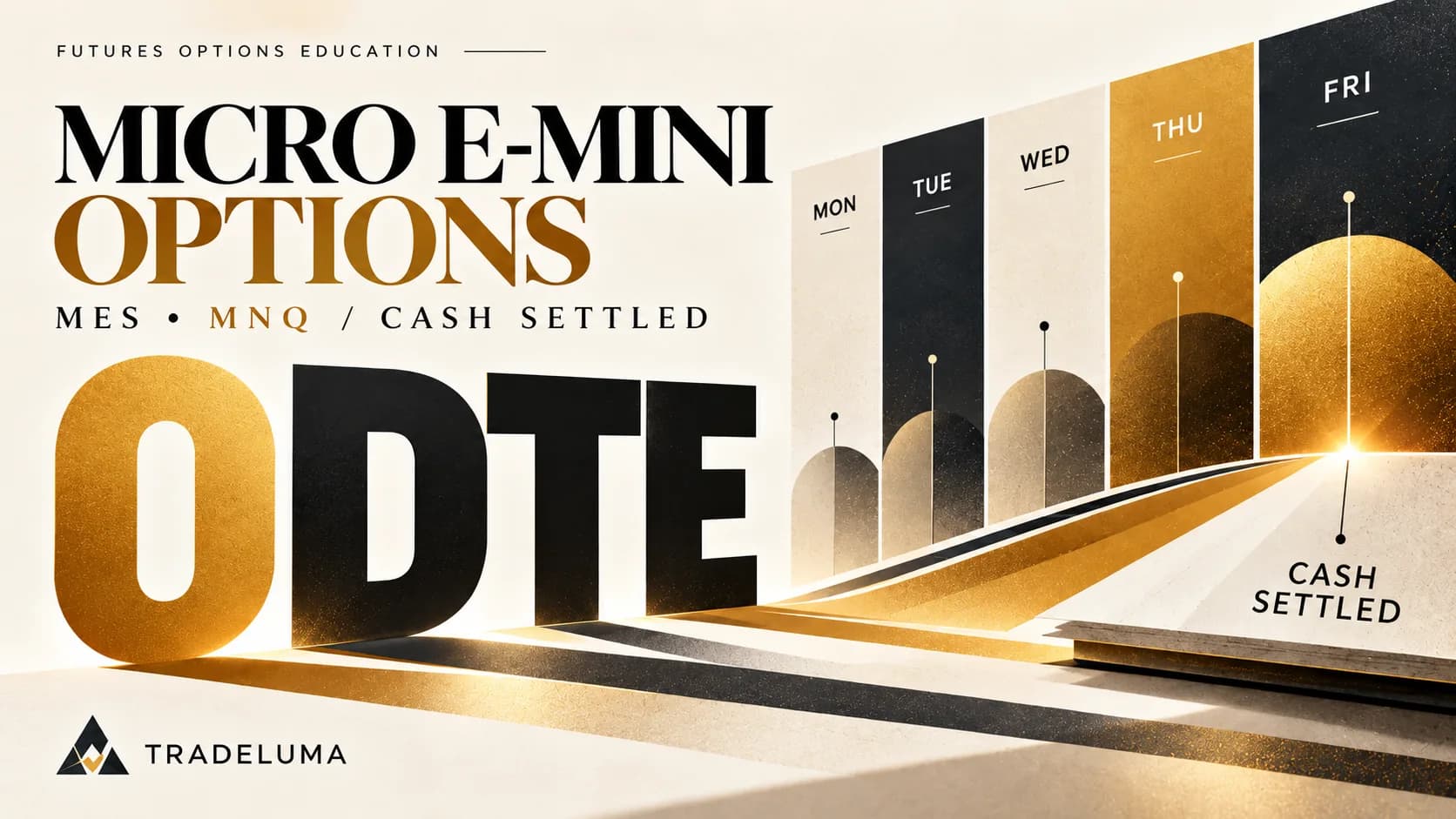
Micro E-mini options became more flexible in 2026 when CME Group introduced a distinct family of financially settled weekly S&P 500 and Nasdaq-100 options. These newer options reference Micro E-mini MES or MNQ futures, offer listed expirations across the Monday-to-Friday trading week and, unlike older futures-deliverable Micro option series, settle the in-the-money value in cash rather than creating a futures position. This guide explains exactly what is new, how to recognise the correct option symbol, how option premiums and final cash payments translate into dollars, what 0DTE really means and which risks remain even when futures delivery is removed.
What changed for Micro E-mini options in June 2026?
CME Group announced a new generation of financially settled options on Micro E-mini S&P 500 (MES) and Micro E-mini Nasdaq-100 (MNQ) futures for 29 June 2026. The distinctive changes are the expiration settlement method, a simplified weekly listing cycle, and new product codes identifying the financial series. The options remain derivatives tied to equity-index futures; they are not share options or direct ownership of an index.
A Micro option is one tenth the size of the comparable E-mini option. Smaller notional exposure can allow more granular position sizing, but it does not automatically make a trade inexpensive or conservative. Option price, implied volatility, transaction costs, buying power and the possibility of outsized losses from uncovered short positions all still matter.
What does cash-settled mean in this product?
At expiry, an in-the-money financially settled Micro E-mini option produces a dollar settlement calculated from its intrinsic value. It does not transform into an open MES or MNQ futures contract. Out-of-the-money options generally expire without intrinsic cash value. The long option buyer can still have lost the entire premium and paid trading costs.
Financial settlement is a characteristic of the particular option series, not a blanket feature of every symbol shown beneath the MES or MNQ umbrella. The futures themselves are separately cash settled on their own final settlement timetable; older options can still exercise into a futures position before that futures contract settles.
MES versus MNQ: quick contract comparison
Micro E-mini S&P 500 options reference MES futures and use the corresponding $5 per index point futures multiplier. Micro E-mini Nasdaq-100 options reference MNQ futures and use $2 per index point. The same quoted option premium, for example 12.00 points, corresponds to $60 for an MES-linked contract and $24 for an MNQ-linked contract before fees.
Do not compare premiums based on their point numbers alone. The underlying indexes trade at different levels and can exhibit different volatility, strike intervals and liquidity. Neither MES nor MNQ is universally less risky: risk depends on premium, strike, maturity, volatility, position side and quantity.
Why 0DTE is now a relevant Micro futures options search
A zero-days-to-expiration, or 0DTE, contract has an expiration date on the current trading date. Because CME lists eligible new financial Micro options with Monday, Tuesday, Wednesday, Thursday and Friday expiries, traders may encounter same-day expiration opportunities on each business day that has an eligible listing and normal trading schedule.
0DTE describes time remaining, not a unique options exchange or a promise of daily profitability. On a non-trading holiday or around an exchange schedule change, the expected expiry or trading hours may differ. The most reliable way to identify a true 0DTE order is to check the actual exchange-local expiration date on the specific contract ticket.
How the Monday-to-Friday listing cycle works
CME lists two nearest weeks for each Monday, Tuesday, Wednesday and Thursday financial Micro weekly series, plus eight consecutive Friday weekly expiries. Not every future calendar date is always listed, and holidays can change the timetable. Traders should use the current exchange option chain rather than infer listing availability from weekday labels.
A short listing horizon helps concentrate near-dated contracts, but a specific expiration can still have thin order-book depth. Check bid, ask, last-trade age and open interest for the individual strike and date. If no sensible quote is available, a theoretically attractive Greek or payoff does not make the position executable at that price.
New symbols: how to identify the cash-settled series
The new financially settled Micro E-mini S&P 500 option family uses CME code prefixes MS1A–MS5A for Mondays, MS1B–MS5B for Tuesdays, MS1C–MS5C for Wednesdays, MS1D–MS5D for Thursdays and MS1E–MS5E for Fridays. For the Nasdaq-100 equivalent, the families begin MN1A–MN5E. The number indicates a week identifier, while the letter distinguishes the weekday family.
By contrast, older futures-deliverable Micro E-mini S&P 500 weekly symbols include prefixes such as X1A–X5A, and the older Micro Nasdaq-100 weekly symbols include D1A–D5A. Other legacy Friday, end-of-month and quarterly product codes also exist. Broker platform symbols may add expiry and strike data in a vendor-specific format, so always validate against the exchange instrument specification.
Cash-settled versus older futures-deliverable Micro options
The decisive distinction is the deliverable at exercise. A financially settled MS or MN weekly option pays the option’s cash intrinsic value if it expires in the money. A legacy futures-deliverable Micro option can create a position in the associated MES or MNQ futures contract, which may then require additional margin and monitoring after the option expires.
The two types cannot simply be treated as interchangeable closing legs. CME’s 2026 FAQ states that financially settled options are not eligible for offsets against their physically deliverable E-mini counterparts. Possible portfolio margin offsets are a separate question and depend on an approved clearing methodology. Do not assume that opposite calls or puts with similar strikes and dates cancel if they are from different settlement families.
European-style exercise: what it changes and what it does not
The new financial Micro series are European style: exercise occurs only on expiration day. In-the-money options are automatically exercised based on the exchange-defined final fixing, and CME notes that contrary exercise instructions are not allowed for these series. This simplifies the early-assignment question compared with American-style options.
European exercise does not stop a trader from buying or selling an option in the secondary market before expiry while trading is open. It also does not guarantee a liquid exit, remove mark-to-market losses or make short options safe. A firm may impose stricter trading, closing or risk-reduction cutoffs than the exchange.
The 3:00 p.m. Chicago fixing: what sets the payout?
CME’s published procedure determines the expiry fixing from the volume-weighted average of outright E-mini S&P 500 or E-mini Nasdaq-100 futures trades during the 30 seconds from 2:59:30 to 3:00:00 p.m. Central Time on expiration day. Spread transactions are excluded from that fixing calculation. The fixing is disseminated as ESF for S&P 500 and NQF for Nasdaq-100.
The option is not settled from an arbitrary snapshot of the Micro futures chart or the last traded option premium. Around the final fixing, the displayed MES/MNQ futures quote and the official reference can differ. Traders operating in Australia must also account for US daylight-saving changes when translating Chicago or Eastern times to Melbourne time.
Cash-settlement formula for calls and puts
For a long call, gross expiration cash value = max(official fixing − strike, 0) × multiplier × contract count. For a long put, gross expiration cash value = max(strike − official fixing, 0) × multiplier × contract count. A short option has the opposite cash settlement obligation. These formulas describe intrinsic value, not the final investment profit.
For an option buyer, net result before financing and taxes is the gross expiration cash value minus the premium paid in dollars and all transaction charges. For an option seller, the premium received is offset by any cash settlement obligation, fees and potentially substantial interim mark-to-market or margin demands. Short-option risk can greatly exceed the collected premium.
Worked MES call example: cash payout versus trading profit
Consider one hypothetical new financially settled MES call with a 6,740 strike and an 8.00-point purchase premium. At $5 per point, its premium costs $40 before fees. Suppose the official ESF fixing is 6,750. The option finishes 10 points in the money, so the gross settlement is 10 × $5 = $50.
The illustrative buyer’s result is $50 gross cash settlement − $40 premium = +$10 before fees and taxes. If the fixing had instead been at or below 6,740, the intrinsic payout would be zero and the buyer would lose the $40 premium plus charges. These round numbers are purely teaching values; they are not quotes for October 2026.
Worked MNQ put example: a profitable direction can still lose money
Imagine one new financially settled MNQ put with a 24,100 strike bought for a 35-point premium. At $2 per point, the premium costs $70. If the NQF fixing is 24,080, its expiration intrinsic value is 20 index points × $2 = $40. The put has intrinsic value but the buyer still loses $30 before commissions and other charges.
This is the break-even distinction many beginner guides miss. For a long put held to expiry, the theoretical break-even fixing equals strike − premium points. For a long call it equals strike + premium points. These break-even examples ignore fees, slippage, exercise conventions and other portfolio positions.
0DTE gamma: why risk can accelerate near the strike
Gamma measures how an option’s delta can change when the underlying futures price moves. Near-the-money options with little time remaining may have especially concentrated gamma: an apparently small underlying move can sharply change directional sensitivity, premium and potential short-option losses. At the same time, time value can decay quickly.
Being cash-settled removes the operational risk of ending with a new futures contract through this option series. It does not remove rapid premium losses, order-book gaps, margin stress, assignment cash obligations on short options or differences between expected and official fixing outcomes.
Theta and implied volatility on expiration day
A same-day option can be very sensitive to the remaining hours and minutes, but theta is not a guaranteed, steady amount earned by sellers every minute. Volatility repricing, market jumps and gamma can dominate the decay estimate. An option that looked inexpensive an hour ago may reprice dramatically around a central-bank decision or an economic release.
Vega measures sensitivity to changes in implied volatility under a model convention. Even if near-expiry vega is often lower in absolute time-weighted terms, a sudden volatility change can materially affect the option before settlement. Always convert Greek-estimated premium changes to dollars using the correct $5 or $2 multiplier and contract count.
Liquidity, spreads and slippage in Micro daily expiries
The presence of a Monday-to-Friday expiration schedule does not mean equal liquidity at every strike or on every day. Newer products can attract less depth than older, more established series, and an in-the-money mark is not an executable closing price. Observe the bid-ask spread, displayed depth, price improvement and contract volume at the exact series.
Market orders can fill materially away from the last price in a fast move. Limit orders control the worst acceptable fill price but can remain unfilled. If a short-dated contract approaches expiry without an executable bid, the trader must understand the exchange’s automatic settlement process and the broker’s trading restrictions.
Can you trade a Micro option after the 3:00 p.m. fixing?
The new series’ option-expiry mechanics centre on the published 3:00 p.m. CT fixing. The broader CME Globex equity-index market has much longer trading sessions, but that does not imply an option that has reached its last trading time can still be traded later that day. The exchange last-trade rule, option expiry and broker routing cutoff must be verified separately.
Never extrapolate from a nearly 23-hour futures schedule to an expiring 0DTE option. If automation holds a contract close to fixing, it should know the exact exchange clock, calendar date, active contract and risk-handling cutoff rather than relying on a visual countdown calculated from a browser’s local time.
Buying versus selling: different loss profiles
For a fully paid long option, the usual maximum loss is the purchase premium plus trading costs, assuming no other linked obligations. A long call benefits from a sufficiently high fixing above strike; a long put benefits from a sufficiently low fixing below strike. Time value and execution determine whether a profitable exit is available before the fixing.
A naked short call or put receives premium upfront but can have much larger potential losses and changing margin demands. Equity-index futures and their options are leveraged instruments. The fact that one contract is a tenth of a standard E-mini option does not justify using ten times the contract count without considering aggregate exposure.
What happens on an exchange holiday or early close?
US exchange holidays, special sessions and market disruptions may change listing days, trading hours or settlement procedures. A calendar graphic showing MON–FRI is a conceptual summary of normal weekly coverage, not a guarantee that there is a standard expiry on every possible Monday through Friday.
Check the CME holiday calendar and the exact expiry notice for the affected series. For time-sensitive events, also confirm the broker’s end-of-day cutoffs and whether quotes are live or delayed. A correct daily date in Melbourne can correspond to a different prior calendar date in Chicago.
Which options are fungible and which ones are not?
Fungibility means positions belong to the same eligible product and contract specifications so opposing trades can close each other. A new MS/MN financially settled weekly and an older X/D futures-deliverable weekly can have similar labels but different clearing deliverables; they are not a substitute for the same exact exchange contract.
To close an open options position, select the original product family, maturity, strike and option type, then send an actual closing transaction in that series. A broker’s generic “MES options” label is insufficient evidence that an instrument carries the intended settlement terms.
Reading a broker option ticket correctly
Before confirming an order, identify at minimum: clearing/exchange product code, underlying MES or MNQ month, precise calendar expiry, strike, call or put, European exercise style, financial settlement, premium quote and contract multiplier. It is also prudent to record any exchange last-trade restrictions, data delay and current buying-power impact.
A platform’s option ticker can differ from CME’s published Globex family prefixes, so the contract specification and exchange instrument ID should govern. For automated routing, avoid guessing a symbol from a human-readable label. Resolve the instrument explicitly, then log the identified conid or other broker contract key and its confirmed terms.
Automation safeguards for same-day expiring Micro options
An automation system should separate signal generation from execution permission. Useful checks include exact exchange contract identification, allowlisted settlement type, expiry calendar, maximum premium outlay, maximum contracts, aggregate short exposure, maximum daily loss, order-state acknowledgement, stale-quote detection and a deterministic expiry cutoff.
Close, cancel, replace and reject events should be reconciled against broker-reported positions, not inferred from sending an alert. An order that fails near expiry can change the expected final cash exposure. Strategy backtests should model spread, latency, historical chain availability and the fixing reference; a continuous futures close is not an adequate stand-in.
Backtesting 0DTE Micro options without look-ahead bias
A meaningful backtest needs timestamped option-chain quotes, strikes actually listed on each date, contemporaneous implied volatility, bid-ask spreads, fees and the official exchange settlement reference. Selecting the strike that later looks optimal using final fixing data introduces look-ahead bias. Using yesterday’s most liquid strike for today also distorts fills and risk.
For every hypothetical trade, specify whether exit occurred by a real option quote before last trade or via expiry fixing. These are different exit mechanisms. Report outcomes after realistic costs, missing quotes, reject cases and capital constraints; avoid using end-of-day futures bars to reconstruct a supposedly precise 0DTE options return.
When a financially settled series may be preferable
A trader may prefer a financially settled weekly option when the goal is directional or event-based exposure with an expiry payout in cash and no new futures position created at exercise. That can simplify operational controls and reduce an important category of post-expiry surprises. It can also offer smaller dollar sizing than standard E-mini options.
That preference is conditional, not a blanket recommendation. A legacy series might have a different liquidity profile, time horizon or exercise/hedge requirement. Always compare the exact contract’s fill quality, costs, calendar, settlement and the trader’s ability to absorb worst-case cash demands.
Common mistakes when interpreting the 2026 product launch
First, treating all MES or MNQ options as newly cash-settled: old and new series are distinguished by specific product codes. Second, assuming “cash settled” means an option cannot lose more than its premium: that generally describes a fully paid long option, not a naked short option. Third, pricing the expiry payout from the last underlying Micro chart trade instead of CME’s official ESF or NQF fixing.
Fourth, confusing the $5/$2 underlying point multiplier with a fixed options tick size; fifth, assuming every weekday has identical availability or liquidity; sixth, taking a short option through an economic announcement without explicit margin and loss limits. A simple contract-identification checklist prevents several of these errors before they reach the broker.
How this guide fits the TradeLuma futures library
The TradeLuma Options on Futures guide explains calls, puts, premium and the general exercise framework. The Options Greeks for Futures guide covers delta, gamma, theta and vega. The Futures Settlement Explained guide separates ordinary daily mark-to-market, final cash settlement and deliverable mechanisms. This 2026-specific article focuses on the newly launched cash-settled Micro weekly series.
For position sizing, pair this guide with the Micro E-mini Futures Explained, Futures Tick Size vs Tick Value, Futures Trading Fees and Futures Margin Explained articles. For strategy operations, consult the trading-hours, order-recovery and emergency risk-control guides. TradeLuma provides trading infrastructure education, not personalised financial advice or any promise of returns.
Final checklist before an MES or MNQ 0DTE option trade
Verify that the exchange product code belongs to the intended MS or MN financial weekly family. Confirm MES or MNQ underlying, option strike, call/put, contract month, exact expiry, current Chicago time, bid-ask depth, live quote timestamp, multiplier, premium cost in dollars, commissions and the 3:00 p.m. CT fixing method.
Next, calculate the maximum acceptable long-premium loss or short-option obligation, margin and order-rejection plan. Understand when your broker stops accepting closing orders, and choose in advance whether to close before expiry or accept official cash settlement. A documented repeatable process matters more than the attractiveness of a same-day expiry headline.
Micro E-mini options: key 2026 facts at a glance
Launch: 29 June 2026. Exchange: CME. Markets: S&P 500 and Nasdaq-100 Micro E-mini futures options. Multiplier: MES $5 per index point; MNQ $2 per index point. Exercise: European style, on expiry only. Cash fixing: 2:59:30–3:00:00 p.m. Chicago time in corresponding E-mini outright futures; published as ESF and NQF. Listed weekday expiry families: Monday through Friday, with two nearest Monday–Thursday and eight Friday weeks under CME’s published cycle.
Codes: S&P weekly families MS1A through MS5E, Nasdaq weekly families MN1A through MN5E, depending on weekday and week identifier. These terms refer to the designated new financial options, not all MES/MNQ options across every expiry class. Verify the current CME product specification and broker availability before trading.
Frequently asked questions
What are cash-settled Micro E-mini options?+
They are CME-listed options referencing MES or MNQ futures whose designated new financial weekly series settle intrinsic value in cash at expiration rather than delivering a futures position.
When did cash-settled Micro E-mini options launch?+
CME announced a listing date of 29 June 2026 for the new financially settled S&P 500 and Nasdaq-100 Micro weekly option families.
Are all MES and MNQ options now cash settled?+
No. The newer financially settled MS/MN code families must be distinguished from older option products with different exercise and futures-delivery mechanisms. Confirm exact series terms.
Which is smaller, MES options or MNQ options?+
They reference different equity indexes. MES options use a $5 per underlying index point multiplier and MNQ options use $2 per point; comparable premium and risk require more than comparing the multiplier.
How do I calculate the premium of an MES option?+
Multiply the quoted option premium in index points by $5 and by the number of contracts, then add relevant charges. For example, 8 premium points for one contract costs $40 before fees.
How do I calculate the premium of an MNQ option?+
Multiply the premium in index points by $2 per option contract and by the contract count. For example, 35 quoted points for one contract costs $70 before fees.
How is expiration cash settlement calculated?+
For a call, max(official fixing minus strike, zero) times the multiplier; for a put, max(strike minus official fixing, zero) times the multiplier. Subtract purchase premium and costs to measure a buyer’s net result.
What is the ESF or NQF fixing?+
CME uses a 30-second volume-weighted average of corresponding outright E-mini futures trades from 2:59:30 to 3:00:00 p.m. CT on expiry; the disseminated fixing symbols are ESF and NQF.
Can an in-the-money new Micro weekly option create a futures position?+
The designated new financially settled series pay cash based on their settlement fixing and do not create an underlying MES or MNQ futures position at option expiry.
Do cash-settled Micro options have early assignment?+
CME describes the new financial series as European-style options exercisable only on expiry, removing the early-exercise feature of American-style options. Short-option mark-to-market and expiry obligations remain.
Can I trade 0DTE MES or MNQ options every weekday?+
The new family has Monday-to-Friday weekly expiration listings, subject to which contracts are actually listed, holiday schedules and broker availability. Verify the specific expiry date.
What are the new CME symbols for financial Micro weekly options?+
New S&P 500 Micro option weekly code families begin MS1A–MS5E; Nasdaq-100 families begin MN1A–MN5E. Your broker may display a longer vendor-specific contract name.
What are the older MES and MNQ weekly option codes?+
Older Micro options may show X-prefixed S&P 500 weekly series or D-prefixed Nasdaq-100 weekly series, alongside legacy Friday, month-end and quarterly codes. Their terms must not be assumed to match the new cash-settled family.
Is a cash-settled 0DTE option low risk?+
No. Buyers can lose the full premium plus costs, and short option losses or margin demands can be considerably larger. Near-expiry gamma, slippage and news-event moves may be abrupt.
Does 0DTE mean I can hold the contract until midnight?+
No. Contract-specific last-trading and expiry rules govern, including the Chicago fixing time. Check the CME listing and any earlier broker cutoff.
Can a cash-settled Micro option close an older futures-deliverable option?+
Do not assume so. The settlement families are not fungible and an opposing position in another series is not necessarily a close. Match the exact exchange contract to exit.
Are broker fees and spreads included in the cash-settlement payout?+
No. The intrinsic cash settlement is separate from premium paid or received, broker and exchange fees, and any execution spread and slippage.
What TradeLuma guide should I read next?+
Read Options on Futures Explained for fundamentals, Options Greeks for Futures for sensitivity analysis, and Futures Settlement Explained to understand the distinction between cash and futures-deliverable exercise.
Futures workflows
Explore the strategy side of TradeLuma.
Browse TradeLuma's futures strategy catalogue and the chart, rollover, and reference methodology used for each published strategy.
Explore futures strategies →Continue learning
Related guides.

How to Read a Futures Options Chain: Strikes, Bid/Ask, IV & Greeks
Learn how to read an options chain on futures: calls and puts, strike prices, bid/ask, liquidity, implied volatility, Greeks and MES/MNQ premium examples.

Options on Futures Explained: Calls, Puts, Premium & Risk
Learn how options on futures work, from calls, puts and premium calculations to exercise, cash settlement, margin, expiry and trading risks.

Futures Settlement Explained: Cash vs Physical Delivery & Daily Mark-to-Market
Learn how futures settlement works: daily mark-to-market, cash settlement, physical delivery, final prices, expiry risk and practical ES, gold and oil examples.