
Futures
Natural Gas Futures Trading Hours: Sunday Open, NG vs MNG Tick Value & Risk
When do natural gas futures reopen Sunday? Compare CME NG and Micro MNG session times, tick values, contract sizes, expiry and Melbourne time conversions.
On this page+
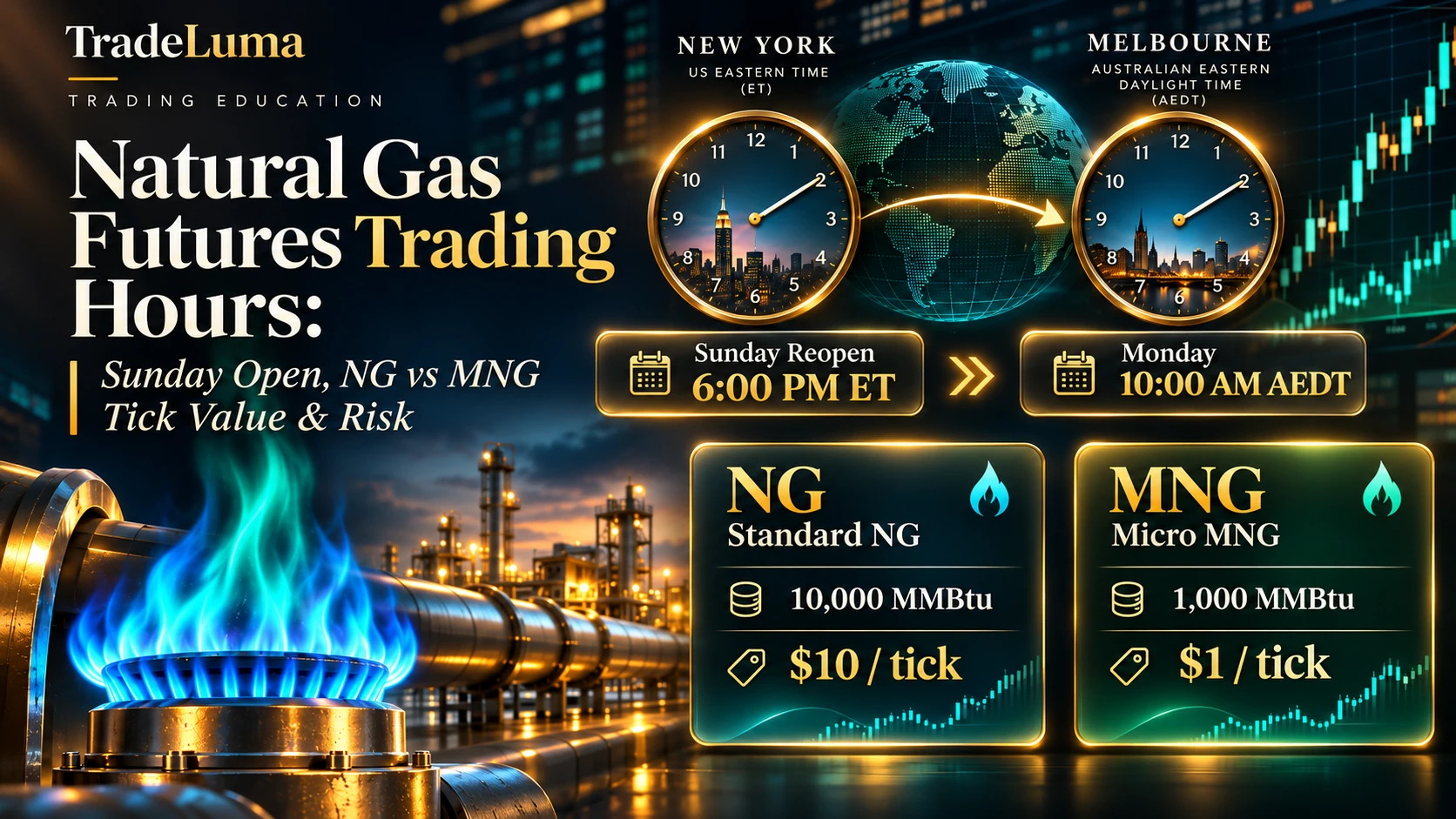
What time do natural gas futures reopen on Sunday? In a normal CME Globex week, NYMEX Henry Hub Natural Gas (NG) starts trading on Sunday at 6:00 p.m. US Eastern Time and continues through Friday at 5:00 p.m. Eastern, with a daily 5:00–6:00 p.m. ET maintenance break. On 21 November 2026, New York is on Eastern Standard Time and Melbourne is on Australian Eastern Daylight Time, so the Sunday 6:00 p.m. ET reopening is Monday 10:00 a.m. AEDT. That conversion changes when either country switches daylight saving. Beyond the clock, one standard NG contract represents 10,000 MMBtu and each 0.001-dollar tick is worth US$10; Micro Henry Hub Natural Gas (MNG) represents 1,000 MMBtu with a US$1 tick. This practical guide separates trading sessions, price increments, P&L mathematics, physical versus financial settlement, and the risks of holding a highly volatile energy contract.
Natural gas futures Sunday open: the direct answer
CME Group publishes the normal Henry Hub natural gas electronic trading session as Sunday through Friday, 6:00 p.m. to 5:00 p.m. Eastern Time. Because the daily maintenance window runs from 5:00 to 6:00 p.m. ET, this is approximately 23 hours of access per trading day, not an uninterrupted 24-hour market. Sunday evening in New York is the start of Monday’s exchange trading session.
The relevant clock is the exchange’s US Eastern Time schedule, not an Australian chart label or your broker’s computer time. A broker can impose additional order cutoffs, temporarily restrict a product or display an exchange session in a different zone. On public holidays and extraordinary exchange notices, use CME’s trading calendar rather than extrapolating from the normal weekly schedule.
Sunday evening in New York versus Monday morning in Melbourne
On Saturday 21 November 2026, Melbourne observes AEDT (UTC+11) while New York observes EST (UTC−5). Melbourne is therefore 16 hours ahead: Sunday 22 November at 6:00 p.m. EST is Monday 23 November at 10:00 a.m. AEDT. A 5:00 p.m. ET maintenance start corresponds to 9:00 a.m. AEDT the next day; the 6:00 p.m. ET reopening corresponds to 10:00 a.m.
This is a date-specific conversion, not a permanent rule. US daylight saving and Australian daylight saving begin and end on different dates. During much of the Australian winter, New York’s 6:00 p.m. EDT reopening converts to Monday 8:00 a.m. AEST. Transitional weeks can differ by another hour. Always convert the actual session date, particularly for strategies that store clock times instead of exchange time-zone identifiers.
NG and MNG contract specifications at a glance
Standard NG is the NYMEX physically deliverable Henry Hub natural gas future. Its contract unit is 10,000 MMBtu. The minimum price fluctuation is US$0.001 per MMBtu, so one tick changes contract value by 10,000 × 0.001 = US$10. Its quote of, for example, 3.000 means US$3.000 per MMBtu, not a US$3 total contract.
Micro Henry Hub Natural Gas (MNG) uses a 1,000-MMBtu unit, one tenth the standard contract’s quantity. With the same US$0.001-per-MMBtu minimum price increment, one micro tick is US$1. Ten micro contracts provide the same nominal exposure to a given price change as one standard contract, before fees, spread, slippage, broker limits or differences in tradeable liquidity.
NG tick value: how many ticks are in a price move?
NG uses three decimal places in its standard quoted price increment. A move from 3.000 to 3.001 is one tick; 3.000 to 3.010 is ten ticks; 3.000 to 3.100 is 100 ticks. A 0.010 move therefore represents US$100 per NG contract, and a 0.100 move represents US$1,000, before commissions and slippage.
The formula is ticks = absolute price change ÷ 0.001, then gross US-dollar P&L = ticks × US$10 × number of NG contracts. For MNG, use US$1 instead of US$10. The calculation is symmetrical: a move against the position creates the corresponding gross loss. Stops may fill at worse prices in fast or illiquid trading.
Worked example: the same stop in NG and MNG
Assume a hypothetical entry at 3.150 and protective stop at 3.115. The intended stop distance is 0.035, or 35 ticks. One standard NG future has 35 × US$10 = US$350 of price-distance risk before transaction costs. One MNG future has 35 × US$1 = US$35. Three MNG contracts would represent US$105. These are calculations based on the intended exit, not guaranteed maximum losses.
If the market gaps beyond 3.115 or an order cannot be matched, the actual loss may exceed that figure. The risk of holding a position over the weekend or a sharp energy-data announcement is not captured by a tidy tick-value formula. Include a slippage allowance, contract-appropriate liquidity and sufficient account buffer.
Why a US$0.001 tick is not a 0.001% price move
A tick is an absolute unit of quoted price, whereas a percentage change depends on the starting price. At a hypothetical gas price of 3.000, a 0.001 tick is roughly 0.033% of that price. At a price of 5.000, the same 0.001 tick is about 0.020%. The tick value in US dollars remains US$10 for NG and US$1 for MNG because the contract multiplier does not change with the price level.
This distinction matters when comparing backtests across years with very different natural gas price regimes. Fixed tick stops, percentage stops, and volatility-normalised stops react differently to shifts in price and typical daily range. A risk engine should store the intended contract multiplier explicitly.
What happens at the daily CME Globex break?
The ordinary 5:00–6:00 p.m. ET maintenance break is not a one-hour promise that resting orders will remain untouched. Order eligibility, expirations, exchange state, platform routing and any broker maintenance rules must be checked individually. Orders that are accepted before a pause can have a different state after the market reopens.
Do not treat an absent acknowledgement as evidence that an order was never sent. For signal-driven systems, maintain a client-generated order reference and reconcile the broker’s actual working orders and position before deciding whether a retry is appropriate. Sending another order merely because the first webhook timed out can create an unintended duplicate position.
Weekend reopening liquidity, gaps and stop orders
Natural gas can move on weather forecasts, production news, LNG infrastructure outages, storage expectations and geopolitical headlines while regular futures trading is closed. A Sunday reopen can therefore begin at a price materially different from Friday’s last trade. The first minutes may have thinner depth or wider spreads than active US sessions, although conditions vary.
A stop order is an instruction triggered under defined exchange or broker conditions, not insurance against a gap. A stop-limit may not execute at all if the market trades through its limit. Test the exact order types your broker supports for NG and MNG and know how exchange or broker risk controls behave during unusual volatility.
Storage reports, weather and contract-month effects
The US Energy Information Administration’s Weekly Natural Gas Storage Report is an important scheduled data release for Henry Hub futures, but the publication time can change around holidays. Weather revisions, heating and cooling demand, production, LNG flows and pipeline constraints can also materially affect prices. A trading-hours guide should not be confused with a reliable forecast of the direction of the next move.
Nearby natural gas futures months can price very differently from deferred contracts because of seasonal demand and storage economics. Charting a continuous series may hide the difference between actual contract expiries. When backtesting or automating NG, the broker order must reference a real listed month rather than an analysis-only continuous ticker.
Physical NG settlement versus financially settled MNG
Standard NG is a physically deliverable Henry Hub contract. A retail trader who does not intend delivery needs explicit broker and exchange rules for closing or rolling the position before relevant deadlines. It is unsafe to assume every futures product is cash settled or that the broker will always close a delivery-eligible position on the trader’s preferred terms.
CME’s Micro Henry Hub Natural Gas futures are financially settled and follow their own final trading schedule, which ends one business day before the corresponding standard NG contract’s expiry under published specifications. Financial settlement removes the physical-delivery obligation for MNG, but it does not remove price risk, margin requirements or the need to manage the contract’s last trading day.
Is ten MNG always better than one NG?
Ten MNG contracts and one NG contract have the same gross sensitivity to a US$0.001 move, but they can have different total transaction fees, queue priority and order-book depth. On a round trip, per-contract charges may make ten micros more expensive even when gross market exposure matches. On the other hand, MNG lets smaller accounts scale in or out in increments that would be impossible with one NG.
The better choice depends on liquidity at the intended expiry, available order types, broker permissions, spread, commission schedule and a trader’s risk limit. A position-sizing calculation should therefore compare projected all-in costs and actual executable depth, not just the nominal multiplier.
Sunday-session checklist for Australian traders
Before entering a session: confirm the exchange date in US Eastern Time, translate the reopening into the correct Australian timezone for that date, check holiday notices, identify the exact NG or MNG contract month, confirm current bid/ask and market status, and calculate dollar risk from the product’s multiplier. If data subscriptions are delayed, do not assume the displayed quote is actionable.
After an automated signal: confirm the order acknowledgement, record the broker’s order ID, distinguish an accepted order from an actual fill, and inspect the broker position independently. If the network times out, investigate existing orders before resubmitting. Treat an unexpected account or contract-mapping mismatch as a reason to stop and reconcile.
Official exchange pages to verify before trading
CME’s Natural Gas futures education, CME Henry Hub product listings and the official trading calendar are the appropriate sources for current session hours and exchange notices. The CME Micro Henry Hub natural gas FAQ gives contract sizes, tick values, cash-settlement structure and expiry distinctions. Broker-facing interfaces may abbreviate products or use platform-specific symbol formatting, so match the exchange contract rather than relying on a ticker alone.
The schedule and worked examples above describe standard product mechanics as understood on 21 November 2026. They are not a live quote, investment recommendation, assurance of access at a particular broker, or substitute for reading current exchange rules. If the official schedule changes, the exchange specification takes precedence.
Frequently asked questions
What time does natural gas open on Sunday?+
Under the standard CME Globex schedule, Sunday at 6:00 p.m. US Eastern Time; confirm holiday exceptions.
What is the Sunday natural gas futures open time in Melbourne in November 2026?+
Sunday 22 November 2026 at 6:00 p.m. EST is Monday 23 November at 10:00 a.m. AEDT. Conversion differs when daylight-saving offsets change.
How much is one NG tick worth?+
NG uses a 0.001 US-dollar-per-MMBtu minimum tick on 10,000 MMBtu, equivalent to US$10 per tick per standard contract.
How much is one MNG tick worth?+
Micro Henry Hub Natural Gas futures use 1,000 MMBtu and a 0.001 price tick, equivalent to US$1 per contract.
How many NG ticks are in a move from 3.000 to 3.100?+
100 ticks. At US$10 per standard tick, the gross change is US$1,000 per NG future before trading costs.
Does natural gas futures trading stop every day?+
Normally the CME Globex session has a 5:00–6:00 p.m. ET maintenance break, plus the weekend close and holiday adjustments.
Can natural gas futures gap at the Sunday reopen?+
Yes. News can change the indicative market while trading is closed; stops may execute worse than expected or fail to fill if price limits apply.
Is MNG physically delivered?+
CME’s Micro Henry Hub Natural Gas future (MNG) is financially settled; standard NG is physically deliverable.
Can I use a continuous NG1 chart as a broker order contract?+
A continuous symbol is generally a charting construct. Broker execution requires a valid listed delivery month and contract identity.
Futures workflows
Explore the strategy side of TradeLuma.
Browse TradeLuma's futures strategy catalogue and the chart, rollover, and reference methodology used for each published strategy.
Explore futures strategies →Continue learning
Related guides.

Futures Trading Hours: CME Globex, RTH, Overnight Sessions & Daily Breaks (2026 Guide)
Learn when futures markets open and close, including CME Globex hours for ES, MES, NQ, MNQ, Gold and Crude Oil, plus RTH, overnight sessions, breaks and time zones.
October 2026 FOMC Decision: Fed Held Rates, Minutes & Next Meeting
October 28, 2026 FOMC results: Fed held at 3.75%-4.00%, two dissents, November minutes, December 8-9 meeting and gold/Nasdaq implications.
How to Read a Futures Options Chain: Strikes, Bid/Ask, IV & Greeks
Learn how to read an options chain on futures: calls and puts, strike prices, bid/ask, liquidity, implied volatility, Greeks and MES/MNQ premium examples.