
Futures
FOMC Meeting October 2026: Fed Rate Decision Time, Expectations & Gold/Nasdaq Impact
October 2026 FOMC decision time in New York and Australia, Fed rate expectations, statement and press conference explained, plus gold and Nasdaq trading risks.
On this page+
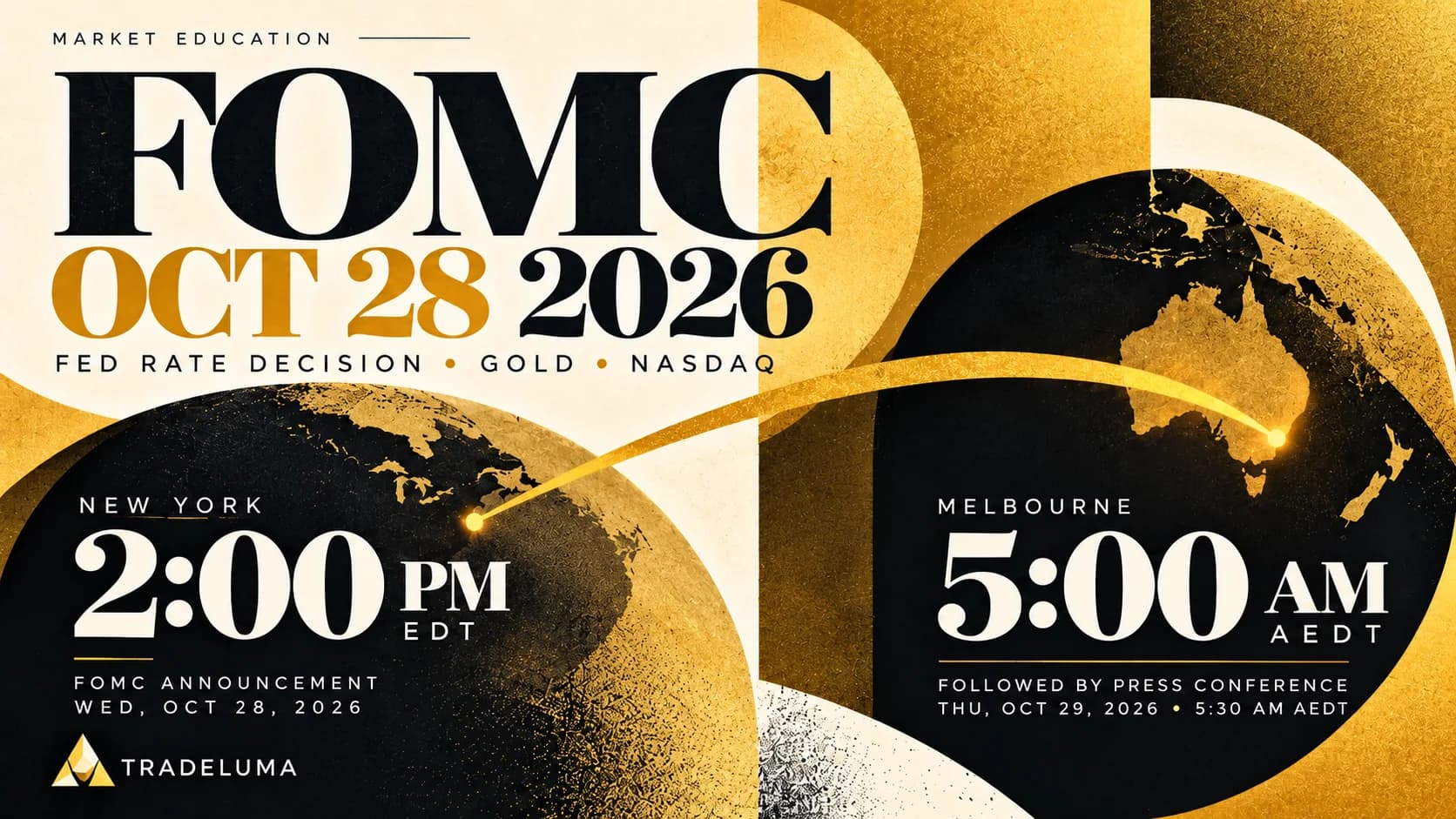
The Federal Open Market Committee (FOMC) meets October 27–28, 2026, with a scheduled policy statement on Wednesday, October 28 at 2:00 p.m. New York daylight time—5:00 a.m. Thursday, October 29 in Melbourne. The Fed Chair’s press conference follows at 2:30 p.m. EDT, or 5:30 a.m. AEDT. This guide explains what traders need to know before the announcement, how to interpret a cut, hold or hike relative to expectations, and why gold, Nasdaq and Treasury futures can reverse even after the initial headline. The decision had not been released at this article’s October 27 publication date; no outcome or market reaction is assumed.
FOMC October 2026: the quick answer
The Federal Reserve calendar lists a two-day FOMC meeting on Tuesday and Wednesday, October 27–28, 2026. The scheduled decision is Wednesday, October 28 at 2:00 p.m. US Eastern Daylight Time (EDT); the press conference begins at 2:30 p.m. EDT. The statement and press conference are separate sources of market-moving information.
In Melbourne, which is on Australian Eastern Daylight Time (AEDT) during October, the policy statement falls on Thursday, October 29 at 5:00 a.m. and the press conference at 5:30 a.m. The dates matter: it is Wednesday afternoon in New York but Thursday morning in Melbourne.
FOMC decision time: New York, London and Melbourne
For the scheduled October 28 announcement, 2:00 p.m. EDT equals 18:00 UTC, 6:00 p.m. London time (GMT after the UK clocks changed on October 25), and 5:00 a.m. AEDT on Thursday in Melbourne. The 2:30 p.m. EDT news conference is 18:30 UTC, 6:30 p.m. London and 5:30 a.m. in Melbourne.
These conversions apply to this particular October 2026 meeting. US, UK and Australian daylight saving dates differ, so do not save a fixed US-to-Australia offset for all future FOMC events. Check the published event time and current time zones again for each meeting.
What does FOMC stand for?
FOMC means Federal Open Market Committee, the Federal Reserve body responsible for setting the stance of US monetary policy. The Committee’s decisions influence the target range for the federal funds rate and the conditions under which the Fed implements that policy.
Markets respond because expected short-term rates affect Treasury yields, credit costs, the US dollar and the discount rates applied to risky assets. The FOMC does not set prices for gold, stocks or futures; those prices reflect traders collectively reassessing many factors after the announcement.
What exactly is the Fed deciding?
The headline decision usually concerns whether the Committee will raise, lower or maintain the target range for the federal funds rate. The accompanying implementation note explains operational tools used to keep the effective funds rate aligned with policy. A policy statement also discusses employment, inflation, economic conditions and risks.
The rate target is a range, not a single guaranteed overnight transaction rate. Other rates such as the 2-year Treasury yield, the 10-year yield and mortgage rates can move differently, especially when the statement changes the expected policy path months or years ahead.
Does the October 2026 meeting include a dot plot?
According to the Federal Reserve’s published 2026 calendar, the quarterly Summary of Economic Projections is associated with the March, June, September and December meetings. The October 27–28 meeting is not marked as a projections meeting. Traders therefore should not assume a new October dot plot accompanies the scheduled decision.
That does not make the event unimportant. The wording of the statement, any dissenting votes and the Chair’s remarks can change the path investors anticipate for December and later meetings, even without a new quarterly projection document.
Rate cut, hold or hike: three outcomes, many interpretations
A cut reduces the policy target range; a hike increases it; a hold maintains it. Traders often discuss changes in basis points, with 25 basis points (bps) equal to 0.25 percentage point. But an identical decision can generate opposite market responses under different expectations.
Consider a hypothetical market that overwhelmingly prices a hold: an actual hold may produce little immediate repricing, while a surprise hike could push short-dated yields higher. Alternatively, if the statement hints that future hikes are unlikely, a hold can be interpreted as dovish. These are examples, not an October decision forecast.
The actual decision versus the market expectation
A crucial question before a meeting is what was already discounted by futures, bond yields and currency prices. A supposedly positive headline may fail to move markets if investors had fully expected it; an unanticipated change in tone can matter more than the target rate itself.
For example, imagine traders assign a high probability to a 25-bps cut but the Committee holds. That is a surprise relative to pricing. Conversely, a widely anticipated cut paired with warnings about inflation could send yields upward and weigh on risk assets. The comparison is always actual communication versus the prior expectation, not simply up versus down.
How to read CME FedWatch probabilities before the meeting
CME FedWatch estimates rate-decision probabilities from prices of 30-Day Federal Funds futures. Those contracts embed expectations about the average effective federal funds rate over a calendar month; the tool uses assumptions to derive possible meeting outcomes. The percentages can shift quickly as markets digest economic data.
FedWatch percentages are model-implied market estimates, not votes, promises from the Fed, or a guarantee of the next decision. A screenshot taken earlier in the week may be stale. Use the live CME tool and note its timestamp if reporting an actual probability.
Worked example: when a 25-bps cut is already priced
Assume—purely for illustration—that traders assign 80% odds to a 25-bps cut and 20% to a hold, with no other scenarios considered. The weighted expected move is 0.80 × (-25 bps) + 0.20 × (0 bps) = -20 bps. That is a simplified scenario calculation, not a full reproduction of CME’s FedWatch model.
If the Committee actually cuts 25 bps, the announcement differs from that simple expectation by only -5 bps. The communication about what happens next could dominate the headline move. Real trading also incorporates a wider probability distribution, meeting timing, futures conventions, changing risk premiums and other news.
What to look for in the FOMC statement
Read the statement for the policy target, the decision’s rationale and changes in the wording about inflation, labour-market balance, growth and risks. Compare it line by line with the preceding statement rather than treating an isolated word as a decisive signal. The Fed may convey a less restrictive or more restrictive stance without changing the rate that day.
Be particularly careful with omissions and context. A sentence removed from one statement may reflect new data or updated drafting, not an automatic directional trading signal. The relevant question is how the entire communication alters expectations for future policy.
Hawkish versus dovish: what traders mean
A hawkish interpretation implies relatively greater concern about inflation or a preference for tighter monetary conditions than markets previously expected. Dovish describes relatively greater willingness to ease, or concern about slowing activity and employment. Both words describe interpretation, not formal categories in a Fed release.
An unchanged rate accompanied by warnings of persistent inflation may look hawkish. An unchanged rate accompanied by confidence in cooling inflation or downside labour-market risks may look dovish. Always relate the interpretation to current expectations and acknowledge ambiguity.
Why the Chair’s 2:30 p.m. press conference matters
The press conference starts 30 minutes after the scheduled statement. Opening remarks and journalists’ questions may clarify which risks are most important, whether the Committee views policy as sufficiently restrictive, and how it interprets incoming data. That can either confirm or challenge the market’s first reading.
A common trading mistake is to regard the initial 2:00 p.m. spike as the complete reaction. Another leg, or a full reversal, may unfold during the subsequent question-and-answer session. News sensitivity can extend beyond the first half hour, particularly in thin or disorderly markets.
FOMC votes and dissents explained
The FOMC statement records the Committee’s decision and voting information. A dissent means a voting participant preferred a different action or policy formulation. It can show disagreement about inflation, growth or the appropriate timing of a policy change.
However, a dissent does not mean the Fed is certain to reverse course at the next meeting. Voting membership, the minority’s rationale and the broader statement all matter. A single split vote should never be treated as a stand-alone price prediction.
Why gold futures may rise or fall after the Fed
Gold has no contractual coupon, so changes in real yields and the opportunity cost of holding a non-yielding asset can influence demand. A lower-than-expected path for real rates may support gold, while higher real yields or a stronger US dollar may pressure it. But safe-haven demand, positioning and liquidity also influence price.
Suppose a dovish Fed communication drives real yields and the dollar lower: gold could strengthen. Yet if investors interpret the same message as evidence of serious economic stress, cross-asset hedging could produce unusual price action. Direction is not guaranteed, and the size of a move depends on what was already priced.
Why Nasdaq futures can react differently from gold
Long-duration growth equities can be sensitive to discount-rate expectations. Falling projected rates may lift valuations, which can help Nasdaq-100 futures, but concerns about weak earnings or economic growth can offset that benefit. Conversely, stronger growth expectations may support equities even if yields rise.
For NQ and MNQ traders the best starting point is to separate the rate reaction, the dollar reaction and the growth interpretation. A knee-jerk rally after a cut can reverse if the press conference hints at additional inflation pressure or deteriorating activity.
ES, MES, NQ and MNQ contract risk during FOMC
E-mini S&P 500 (ES), Micro E-mini S&P 500 (MES), E-mini Nasdaq-100 (NQ) and Micro E-mini Nasdaq-100 (MNQ) can experience abrupt changes in spread, depth and volatility around policy announcements. Micro contracts have smaller dollar-per-point values but are not intrinsically protected against slippage or gaps.
Contract sizing should use the actual contract multiplier and stop distance, plus a potential slippage allowance. No stop order guarantees a fill exactly at the trigger price. Brokers can increase margin requirements or restrict certain orders during market stress.
Treasury futures and the bond-yield reaction
Short-dated Treasury yields often respond strongly to shifts in the anticipated Fed path, while long-dated yields incorporate growth, inflation, term-premium and supply considerations. Treasury futures prices and yields generally move inversely, though individual contracts require duration and conversion-factor analysis.
A 2-year yield move tells a different story from a 10-year yield move; the 2s10s spread can steepen or flatten for multiple reasons. Avoid assuming that a rate cut always sends every Treasury yield lower or that all Treasury futures respond equally.
Why the US dollar matters for Fed-day trading
The dollar may strengthen when US rate expectations rise relative to those in other currencies, and weaken when the expected rate advantage narrows. But global risk sentiment, intervention, capital flows and positioning can complicate that relationship.
Gold quoted in US dollars can react to currency moves as well as to real yields, creating overlapping channels. For a clean post-FOMC review, record dollar movement, Treasury yields and gold or Nasdaq futures side by side instead of attributing everything to one headline.
Common FOMC market reaction patterns
One pattern is an immediate spike and reversal: automated headline readers move first, then investors reprice the message during the press conference. Another is a relatively quiet statement followed by a large move after a specific answer on inflation or the next meeting.
A third pattern is a trend sustained by multiple markets—rates, dollar and futures moving coherently. These are descriptive patterns, not a backtested edge. Trade entry and exits still depend on liquidity, spreads, position risk and a strategy with evidence from similar conditions.
FOMC versus CPI, PCE and NFP: how they connect
CPI and PCE measure inflation using different methods; nonfarm payrolls and other employment indicators help describe the labour market. Policymakers assess these releases along with financial conditions and a broad range of other information before setting the rate target.
For traders, a data surprise can move CME FedWatch probabilities before a meeting. The FOMC may then validate, challenge or reframe those market expectations. Understanding all four topics is more useful than treating each event in isolation.
October 2026 calendar: what is confirmed and what is not
As of publication on October 27, the confirmed schedule is the meeting on October 27–28, the Wednesday decision at 2:00 p.m. EDT and the press conference at 2:30 p.m. EDT. The official October statement and any market response had not yet been published at that point. The next regularly scheduled meeting on the Fed calendar is December 8–9, 2026.
Do not confuse speculative rate probabilities, commentary or draft headlines with the actual October vote. When the announcement is released, confirm the target range, the vote and the statement through the official Federal Reserve release, then update any article that discusses the outcome.
Is the October 2026 meeting a projections meeting?
The Federal Reserve’s meeting calendar marks March, June, September and December 2026 as meetings associated with a Summary of Economic Projections. October is not marked in that way. In particular, a “dot plot today” search should not lead readers to a September or December chart labelled as a new October release.
Market expectations can nevertheless change sharply at a non-projections meeting. The Fed Chair may discuss economic conditions and risks, but those remarks are not the same as a new, jointly published quarterly dot plot.
A practical pre-announcement checklist
Before the release, confirm the calendar and time zone, the currently priced policy scenarios, your broker’s session hours and margin settings, and the correct tradable contract month. Check whether your stop and limit orders can execute as intended and whether a strategy has positions or pending orders already live.
Decide in advance whether to pause entries, reduce size or remain flat through the news. Mark the event in your trading journal. A rule defined before 2:00 p.m. EDT is more reliable than improvising after the first volatile tick.
Risk management during the first minutes
At the announcement, bid/ask spreads may widen, visible order-book depth can change and the first available fill may be far from the last quoted price. A stop-market order prioritises execution rather than price; a stop-limit can fail to fill if the market moves through its limit.
This is why a nominal 10-point stop does not always cap a realised loss to ten points during a jump. Account for commissions, spreads, slippage and position size; set account-level loss limits where possible, and understand broker-side risk checks before trading an event.
Automated trading safeguards for FOMC volatility
Automated systems can use an economic-calendar guardrail that blocks fresh entries during a pre-defined window, an order TTL to reject stale signals, maximum size and exposure caps, and cancellation logic for old working orders. These controls are not a guarantee, but they reduce avoidable execution errors.
Recovery matters as much as prevention: a disconnected bridge can miss acknowledgements or leave an unknown order state. Reconcile orders and positions against the broker before restarting signals. Never send a second close or reverse order solely because a first acknowledgement arrived late.
A simple hypothetical MNQ risk calculation
Assume a trader holds one MNQ contract, whose multiplier is $2 per Nasdaq-100 index point. A 40-point adverse move equates to $80 before fees. If unusually volatile execution adds another 15 points of adverse slippage, the realised loss becomes $110 before fees in this example.
The lesson is not that MNQ will move 55 points at the next meeting. It is that an intended stop distance and the actual executed distance can differ. Apply the multiplier for the exact instrument traded and stress-test the chosen size against plausible but non-guaranteed worse-than-expected fills.
Backtesting FOMC setups without look-ahead bias
A legitimate historical event strategy needs timestamped statement releases, accurate economic-calendar times, tick or high-resolution market data and execution assumptions that reflect spreads near the release. Do not label an entire minute with the news outcome if the trade would have entered before publication.
Separate the initial statement window from the press conference. Account for contract rollovers, daylight-saving transitions, broker outages and changing market regimes. A strategy that appears profitable using mid-price bars can fail after realistic fills and commissions.
Where to check the official October 2026 outcome
Use the Federal Reserve’s FOMC meeting calendar and policy-statement page for the official policy decision, voting record and implementation materials. The Federal Reserve also publishes the press conference and later meeting minutes. CME FedWatch can be used to inspect updated futures-implied probabilities, but it does not replace the Fed’s statement.
This page was written on October 27, before the scheduled decision. Treat any post-decision numbers from other articles, social posts or screenshots as claims that need timestamp and source verification. The meeting-specific material should be updated after the actual release rather than silently inventing the outcome.
When are FOMC minutes released?
Minutes are a later account of the policy discussion, not the live decision announcement. The Federal Reserve generally publishes minutes roughly three weeks after a scheduled meeting. For October 27–28, 2026, its published calendar indicates November 18 as the minutes date.
Minutes can change investors’ interpretation of the discussion, but their release does not mean the policy rate has been reset again. Separate the meeting date, the statement release, the press conference and the minutes release in any trading calendar.
FOMC SEO quick-reference: key times and terms
October 2026 FOMC meeting: October 27–28. Scheduled Fed rate decision: Wednesday October 28, 2:00 p.m. EDT (18:00 UTC). Scheduled Fed Chair press conference: 2:30 p.m. EDT (18:30 UTC). Melbourne equivalents: Thursday October 29, 5:00 a.m. and 5:30 a.m. AEDT. Time-zone conversions are specific to this meeting.
Key concepts: FOMC, federal funds target range, 25 basis points, hold/cut/hike, hawkish/dovish, CME FedWatch, statement, dissent, press conference and later minutes. None of these terms alone yields a reliable long or short signal without comparing the communication to market expectations.
Final takeaway: react to surprises, not headlines
The most useful question on FOMC day is not simply whether the Fed cut, held or raised rates. It is what the decision and communication changed relative to expectations, and whether the cross-asset response persists after liquidity and the press conference are considered.
For TradeLuma readers, a disciplined approach is to know the time, validate the source, recognise changing risk, monitor orders and positions, and avoid treating uncertain market reactions as promises. This is educational information, not investment advice or a signal to place a trade.
Frequently asked questions
When is the FOMC meeting in October 2026?+
The scheduled Federal Reserve FOMC meeting is October 27–28, 2026. The policy announcement is scheduled on the second day, Wednesday October 28.
What time is the Fed rate decision on October 28, 2026?+
The scheduled announcement is at 2:00 p.m. US Eastern Daylight Time (EDT), or 18:00 UTC, Wednesday October 28, 2026.
What time is the October Fed decision in Melbourne?+
It is scheduled for 5:00 a.m. AEDT on Thursday October 29, 2026. The associated press conference starts at 5:30 a.m. Melbourne time.
What time is the FOMC press conference?+
The scheduled press conference is at 2:30 p.m. EDT Wednesday October 28, equivalent to 5:30 a.m. AEDT Thursday October 29 in Melbourne.
Is the October 2026 Fed decision already known?+
No outcome is asserted here. This article was prepared on October 27, before the scheduled October 28 policy statement. Check the official Federal Reserve release for the actual decision.
Will the Fed cut rates in October 2026?+
The outcome is uncertain before the official decision. CME FedWatch displays market-implied scenarios, not a guarantee or a statement from the Fed.
Is there a new dot plot at the October 2026 FOMC meeting?+
October is not scheduled as a Summary of Economic Projections meeting on the Fed’s 2026 calendar. March, June, September and December are marked for projections.
Does a Fed rate cut always make gold rise?+
No. Gold also responds to real yields, the US dollar, risk sentiment and how much easing was already priced in. A widely anticipated cut can accompany a fall in gold.
Why might Nasdaq fall after a Fed rate cut?+
A cut can be interpreted as a response to weakening growth, or accompanied by unexpectedly hawkish guidance. Expected earnings, bond yields and positioning can outweigh a simple lower-rate narrative.
What does hawkish mean in an FOMC statement?+
Hawkish generally means relatively more emphasis on inflation or tighter policy than expected. It is an interpretation of the communication, not a label officially assigned to the decision.
What does dovish mean?+
Dovish generally means relatively more openness to easing or concern about slowing activity and employment. The interpretation depends on expectations and the full statement.
What is the difference between the FOMC statement and minutes?+
The statement announces the decision immediately after the meeting; the minutes are released weeks later and provide more discussion detail. The October 2026 minutes are scheduled for November 18.
How does CME FedWatch calculate rate probabilities?+
CME derives model-implied outcome probabilities from prices of 30-Day Federal Funds futures and assumptions about the effective federal funds rate. The probabilities are estimates, not forecasts issued by the Fed.
What are 25 basis points in interest rates?+
Twenty-five basis points are 0.25 percentage point. For example, a move from 4.00% to 3.75% is a 25-bps decrease.
Should an automated trading strategy pause around FOMC?+
It depends on the tested system and risk tolerance. Many systems use pre-defined news windows, reduced exposure, order expiries and reconciliation checks because spreads, slippage and reversals can be unusually severe.
Does a stop-loss guarantee my exit price during FOMC?+
No. A stop-market order can execute away from the stop trigger during a rapid move; a stop-limit order may not fill. Review broker order types and the actual liquidity environment.
How do I trade MNQ or MES on FOMC day?+
Start by understanding the contract multiplier, quote quality, broker margin, permitted order types and maximum loss. Avoid assuming a directional edge from a headline; use only a tested plan and protective risk limits.
Where can I read the actual FOMC result?+
The Federal Reserve’s official FOMC calendar and monetary policy press releases publish the decision. CME FedWatch and market commentary are secondary tools for interpreting expectations.
Futures workflows
Explore the strategy side of TradeLuma.
Browse TradeLuma's futures strategy catalogue and the chart, rollover, and reference methodology used for each published strategy.
Explore futures strategies →Continue learning
Related guides.
CME FedWatch Tool Explained: How Rate Cut Probabilities Work
Learn how CME FedWatch calculates Fed rate-cut probabilities from Fed Funds futures, read upcoming FOMC outcomes, and interpret changing odds for gold, stocks and bonds.
Nonfarm Payrolls (NFP) Explained: Why Jobs Data Moves Gold & Nasdaq
Learn what US nonfarm payrolls, wages, unemployment and revisions mean, and why NFP surprises can move gold, Nasdaq and Treasury futures.
CPI vs PCE Inflation Explained: Why Gold, Nasdaq & Futures React
Learn how US CPI and PCE inflation differ, what headline and core readings reveal, and why surprises can move gold, Nasdaq and Treasury futures.