
Futures
MCL vs CL Futures: Why Contract Size Changes Everything for Oil Traders
Compare Micro WTI and standard WTI crude oil futures, tick values, settlement, position sizing and automated execution.
On this page+

Micro WTI and standard WTI futures both offer exposure to US crude oil, but they are not interchangeable instruments. One MCL contract represents 100 barrels while one CL represents 1,000 barrels. The smaller contract changes the amount of money at stake on every price movement and the choices available when sizing a trade. It does not make the market predictable. This guide compares the economics, expiration mechanics and operational decisions using hypothetical numbers rather than promises of trading performance.
First-party commercial research · hypothetical backtests
Historical futures strategy performance comparison
Public commercial references reviewed 28–29 November 2026. Positive historical net profit does not guarantee future profitability. These are individual simulations, not live account returns or a portfolio ranking. All amounts in USD.
Crude Oil MCL Long & Short Pro
MCL 4H · Long + Short · reference reviewed 28 November 2026
- Historical net profit
- $24,065.00
- Max intrabar drawdown
- $1,087.50
- Profit factor
- 3.507
- Win rate
- 57.64%
- Closed trades
- 144
- Largest closed loss
- $539.00
- 2025 closed-trade net
- Not supplied
- 2026 YTD closed-trade net
- Not supplied
Backtest window: Jul 12, 2021, 08:00 — Nov 28, 2026, 06:00. Published chart basis: back adjustment ON.
Methodology: USD 100,000 simulated initial capital, one contract, four-hour candles, USD 2.50 commission per fill. The nine 29 November exports use zero additional simulated slippage; MCL retains its commercial 28 November reference with one tick. The adjustment setting is the published chart requirement, not independently identified by the nine exports. Yearly net figures group closed trades by exit date; no annual split is available for the separate MCL commercial reference. Different history windows and contract multipliers limit comparisons. Drawdown is not a maximum possible loss. TradingView simulation is not independent live verification. Actual fills, costs and results can differ; futures losses can exceed initial margin.
Compare all ten historical futures strategy backtestsContract size and tick value
The outright minimum price increment is one US cent per barrel for both contracts. A one-tick change is therefore worth US$1 per MCL and US$10 per CL. A move of one dollar per barrel produces a gross gain or loss of US$100 on one MCL or US$1,000 on one CL, depending on the direction of the position. These are exposure calculations, not margin quotations. When the oil price changes, the notional amount represented by the contract changes, but the dollar sensitivity to a one-cent tick remains constant.
Why one tenth of the size matters
Assume a hypothetical oil strategy defines an exit 40 cents away from its entry. Before fees and slippage, the planned price exposure is US$40 for one MCL and US$400 for one CL. A trader using the larger instrument cannot purchase a fraction of a futures contract to achieve a US$40 exposure. The smaller contract permits finer whole-contract adjustments. However, entering ten MCL restores the same barrel exposure as one CL, so the risk reduction comes from choosing smaller total exposure, not simply choosing a product with the word micro in its name.
Margin is not the amount at risk
Futures margin is a performance bond rather than the purchase price of the underlying barrels. Exchange requirements and broker house requirements can change with market conditions, account type and holding period. A quoted intraday margin is not a maximum loss, and it may differ from the margin required when a position remains open outside the designated session. An apparently affordable position may be much too large for the account. Calculate potential loss independently from collateral, include a buffer, and consider what happens when protective orders cannot be filled at the requested price.
Settlement and expiration are different
Standard CL is a physically deliverable contract under its exchange rules, while MCL is financially settled and ordinarily expires one business day before the corresponding CL contract. This distinction matters to anyone holding positions near expiry. Physical delivery obligations and broker liquidation deadlines can arise before a trader expects them. Financial settlement also has a prescribed calculation; it is not a promise that a trader can always exit at the most recent screen price. Check the broker's deadline and the specific month instead of relying on a continuous chart or assuming both products stop trading at the same time.
Compare liquidity and costs per barrel
A smaller contract can have a different order book, spread, commission schedule and fill behaviour from its larger benchmark. Ten small contracts may incur more transaction fees than one large contract even though they represent equivalent gross exposure. Conversely, one small contract can avoid the excess exposure of an unnecessarily large position. Record spreads and fills at the times the strategy actually trades, not only during a quiet demonstration. Measure the combined commission, exchange and clearing charges, plus slippage, in both dollars per round trip and dollars per barrel. The more expensive route is not necessarily the one with the higher nominal per-contract fee.
Oil reports and unexpected gaps
Weekly inventory announcements, producer policy and unexpected supply disruptions can change the price rapidly. Both products are exposed to the same broad economic drivers, although the available depth and execution behaviour may differ. A stop order is not a guarantee of a fill at its trigger. For example, if a hypothetical exit intended to limit a loss to 40 cents executes 65 cents away from entry, the realised price loss is US$65 per MCL, or US$650 per CL, before costs. The extra loss belongs in a stress test, not in an assumption that the protective mechanism has failed whenever a price is different.
What automated traders must configure
A continuous symbol such as MCL1! is useful for research but is not itself the dated exchange contract a broker needs to execute. Confirm the active contract, mapping rules, direction and permitted quantity. A test with CL must not silently become ten MCL unless the sizing and execution workflow explicitly supports that conversion. Check how existing positions and working orders are handled around rollover; switching the symbol on a chart does not close or transfer a position. Paper trading should include order rejects, partial fills and mismatched broker positions rather than only a successful entry.
Evaluating TradeLuma's Micro WTI strategy
TradeLuma offers a commercial Micro WTI strategy and has a financial interest in its subscriptions. Review the published product information, documented settings, fees and risk disclosures before evaluating suitability. Compare a strategy on its intended market with its intended settings, then assess the impact of execution costs and drawdown on an independently defined budget. A backtest is historical simulation and cannot establish the outcome of live orders. Neither the availability of automation nor the smaller contract guarantees positive returns. If the minimum whole-contract exposure does not fit the budget, remaining flat is a valid alternative.
A practical decision worksheet
Write down the intended number of barrels, stop distance, tick value, estimated execution charges, required collateral and possible gap loss. Repeat the calculation for MCL and CL using the same price move. Compare the resulting dollar exposure with account equity and with existing positions in correlated energy markets. A strategy whose expected gross result is small relative to fees may not remain viable at a different contract size. Review actual observed performance separately from simulated price moves. A sensible choice depends on the trader's objectives, evidence and tolerance for loss rather than a universal ranking of the products.
Frequently asked questions
How many MCL equal one CL?+
Ten MCL represent the same 1,000-barrel gross exposure as one CL, but execution costs, settlement and liquidity are not necessarily equivalent.
What is one MCL tick worth?+
The outright tick is US$0.01 per barrel, equal to US$1 per contract.
What is a one-dollar move worth in CL?+
US$1,000 per contract before fees and slippage, positive or negative according to direction.
Is MCL physically delivered?+
No. MCL is financially settled; CL is physically deliverable under its specifications.
Does smaller margin guarantee lower loss?+
No. Total quantity, actual price movements and execution determine loss, and futures losses can exceed posted margin.
Can CL backtests be copied directly into MCL?+
Not without reviewing contract sizing, fees, liquidity, data and execution assumptions.
Futures workflows
Explore the strategy side of TradeLuma.
Browse TradeLuma's futures strategy catalogue and the chart, rollover, and reference methodology used for each published strategy.
Explore futures strategies →Continue learning
Related guides.

MBT vs BTC Futures: Micro Bitcoin vs Standard Bitcoin
Compare CME Micro Bitcoin and Bitcoin futures: 0.1 versus 5 BTC, outright tick values, cash settlement, 24/7 trading and position sizing.
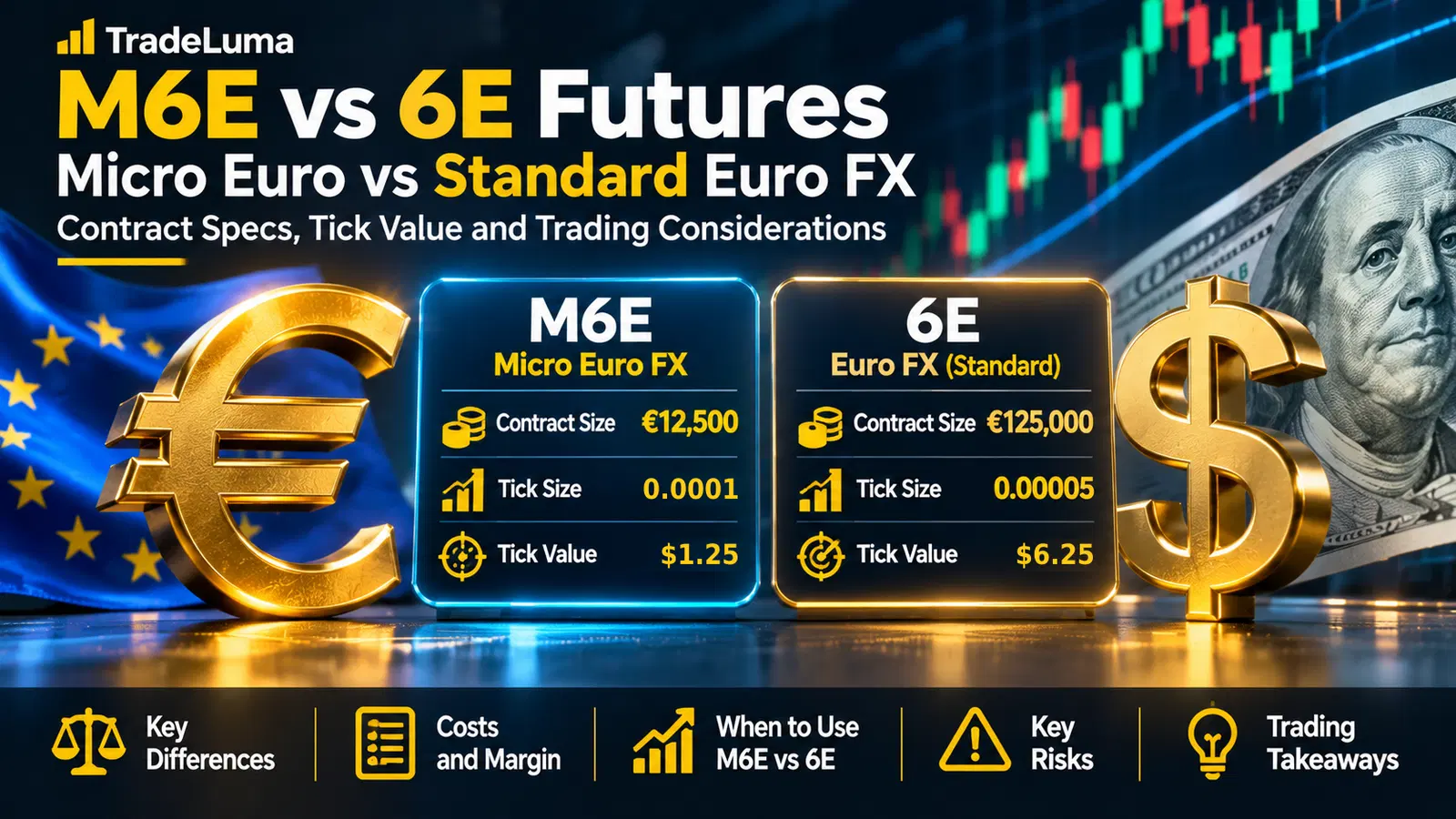
M6E vs 6E Futures: Micro Euro vs Standard Euro FX
Compare Micro EUR/USD M6E and Euro FX 6E futures contract sizes, USD tick values, currency exposure, physical delivery and position sizing.
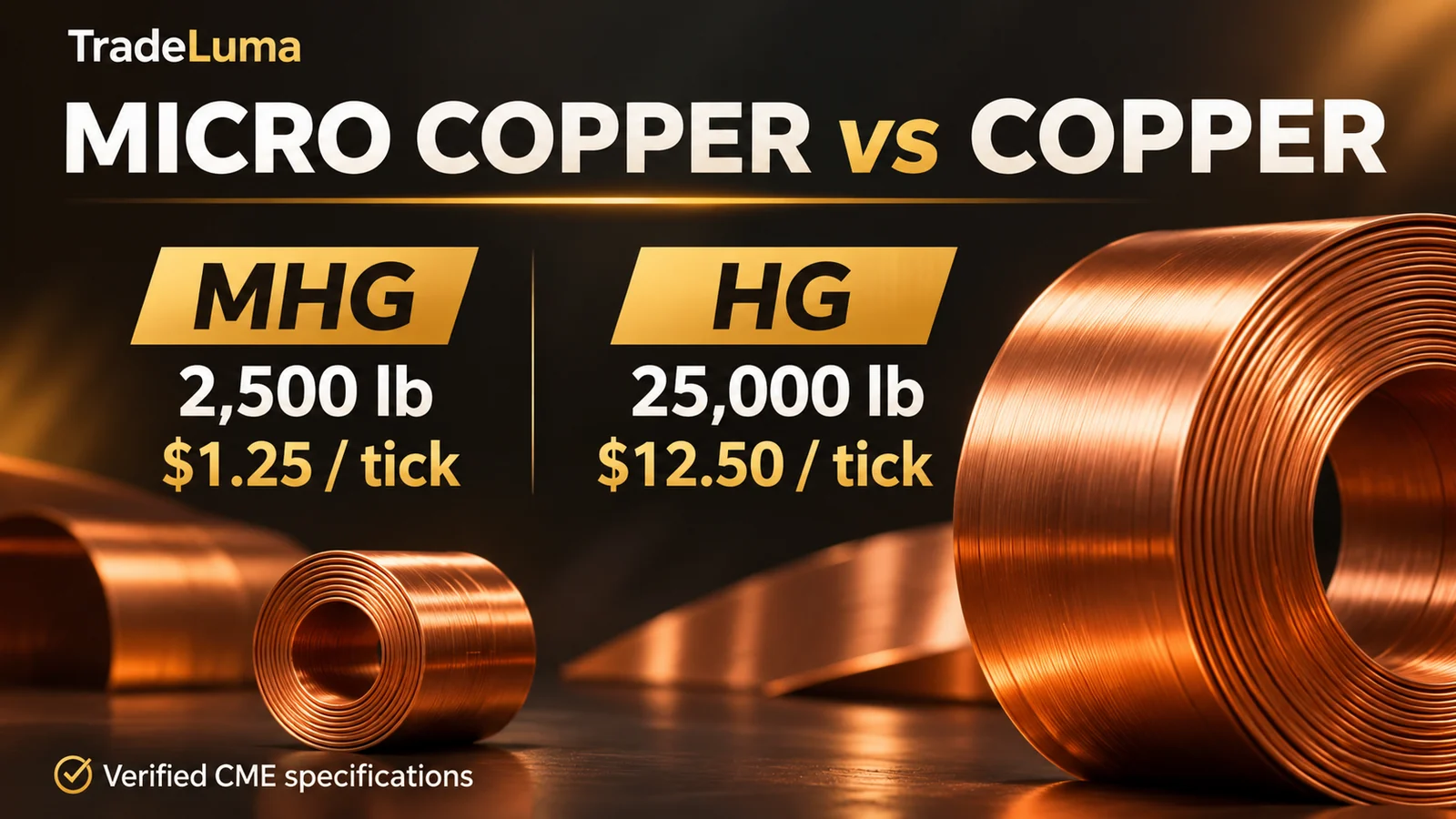
Micro Copper vs Copper Futures: MHG vs HG Explained
Compare MHG and HG copper futures contract sizes, tick values, settlement, position sizing and execution costs with worked examples.