
Futures
CBOT Trading Hours: When Do Corn, Wheat and Soybean Futures Trade?
Regular CME Globex trading sessions for CBOT corn, Chicago wheat and soybeans, including Melbourne time conversions and breaks.
On this page+

Corn, Chicago wheat and soybean futures have distinct agricultural market sessions with a morning break and a longer afternoon closure in Chicago time. Traders familiar with equity index futures sometimes assume grain futures follow an almost identical timetable, but that can cause missed alerts or rejected orders. This guide covers the normal electronic sessions for ZC, ZW and ZS, the Australian time conversion and practical checks for holiday schedules and expiring contracts. It does not apply to every product listed on the Chicago Board of Trade.
Regular electronic grain futures hours
For standard corn (ZC), Chicago soft red winter wheat (ZW) and soybean (ZS) futures, the ordinary CME Globex timetable consists of a night session from 7 pm to 7:45 am US Central time, beginning Sunday evening for Monday's trading day, and a daytime session on weekdays from 8:30 am to 1:20 pm Central time. There is a 45-minute break between the morning close and the daytime reopening. The next regular evening session begins Sunday through Thursday; there is no ordinary Friday evening reopening. Holidays and contract-specific exceptions can alter these times.
CBOT does not have one universal timetable
The Chicago Board of Trade lists a range of instruments, including agricultural and Treasury futures. Their electronic market sessions and settlement rules need not be the same. A schedule for corn should not be applied to a US Treasury contract merely because both belong to CBOT. Even agricultural products can have different specifications, special order arrangements or trading termination rules. Identify the exact exchange product and order type first. The three standard grain contracts in this guide share the usual hours, but those hours are not a general statement about every product on the exchange.
Melbourne conversion during November and December
When Chicago is on Central Standard Time (UTC minus six) and Melbourne is on Australian Eastern Daylight Time (UTC plus eleven), Melbourne is seventeen hours ahead. A Sunday 7 pm Chicago reopening is Monday noon in Melbourne. The 7:45 am Chicago session end is 12:45 am Melbourne on the next calendar day. The 8:30 am daytime reopening corresponds to 1:30 am the following Melbourne day, and 1:20 pm Chicago corresponds to 6:20 am the following day. These are conversions of ordinary sessions under the specified offsets, not holiday timetables.
Why daylight saving creates changing offsets
The United States and Australia adjust clocks on different dates, and their seasons are opposite. During periods when Chicago observes daylight time and Melbourne observes standard time, the difference is generally fifteen hours rather than seventeen. During intervening transition weeks the difference can be sixteen hours. An automated rule tied to a constant local time can therefore shift relative to the actual exchange session. Store the exchange timezone as America/Chicago and the Melbourne timezone as Australia/Melbourne in software that understands timezone transitions. Test session boundaries across the changes instead of hardcoding a permanent offset.
The trading day versus the local date
A Sunday evening Chicago trade can belong to the Monday trading session. Its Melbourne calendar date may already be Monday. A dashboard grouping trades by local midnight may therefore disagree with an exchange trading-day report. Use a consistent definition when calculating daily loss limits, statistics or scheduled resets. When an order remains working across a session break, its eligibility depends on the order type, time in force and broker rules. A chart with a daily bar labelled Monday is not proof that every transaction occurred during Monday's local daylight hours.
What can happen during the session breaks
The underlying physical commodity market and relevant news do not stop changing simply because electronic futures trading pauses. Weather developments, export news and reports can change expectations while the order book is closed. On reopening the available prices may differ from the previous trade. A resting stop does not guarantee execution at its trigger, and a limit order may remain unfilled. Automated workflows need an explicit rule for signals that arise outside a tradable session. A delayed order submitted after reopening should not be assumed equivalent to an order at the original signal price.
Holiday schedules and special trading arrangements
Exchange holiday schedules may shorten sessions or remove one of the regular openings. Trading at settlement, sometimes abbreviated TAS, also has its own product rules and can have a different end time from outright trading. Broker interfaces may show additional order acceptance or maintenance windows that do not represent continuous matching. Check the current CME schedule and the product-specific specifications before a holiday week. Do not infer the status of a particular order from the presence of a price chart, and confirm whether the broker has acknowledged, queued or rejected the instruction.
Contract month and delivery risk
Standard grain futures are physically deliverable under their respective contract rules. Trading in an expiring contract ends according to its own timetable, which can differ from the normal close. First notice day and a broker's own liquidation deadlines also matter. A continuous chart may roll its data reference before the contract reaches those deadlines. Confirm the actual contract identifier held in the account and review working orders before changing months. A strategy that only tracks the continuous chart can miss obligations associated with a dated position.
A practical session-testing checklist
Record the exact symbol, exchange timezone, ordinary session windows and current holiday exceptions. Test at the night opening, morning closure, daytime reopening and Friday close using a paper workflow before relying on automation. Verify how the broker reports session status and whether scheduled loss limits reset according to the intended trading day. Maintain separate timetables for other asset classes rather than copying the grain session to unrelated markets. Correct trading hours are an operational requirement, not evidence that a strategy is profitable; suitability still depends on the strategy and the account.
Frequently asked questions
When do CBOT corn futures open?+
The ordinary Sunday electronic reopening is 7 pm Chicago time; verify holiday exceptions.
Are wheat and soybean hours the same?+
The standard ZW and ZS contracts normally share the ZC electronic windows described here.
Is there a morning break?+
Yes. Normally 7:45 am to 8:30 am Central time on weekdays.
What time do grains reopen in Melbourne in December?+
Monday noon for the regular Sunday Chicago evening reopening, when the offset is seventeen hours.
Do CBOT Treasury futures follow this timetable?+
No. Check each product separately.
Are grain futures physically delivered?+
Standard ZC, ZW and ZS have physical delivery rules; check the exact expiry and broker deadlines.
Futures workflows
Explore the strategy side of TradeLuma.
Browse TradeLuma's futures strategy catalogue and the chart, rollover, and reference methodology used for each published strategy.
Explore futures strategies →Continue learning
Related guides.

Thanksgiving 2026 Trading Hours: CME Futures, CBOT, ES, NQ, Gold, Oil & US Stocks
Thanksgiving 2026 US futures and stock market holiday hours: CME/CBOT early halts, Nov 26–27 NYSE schedule, ES/NQ, CL, GC and Melbourne time conversions.
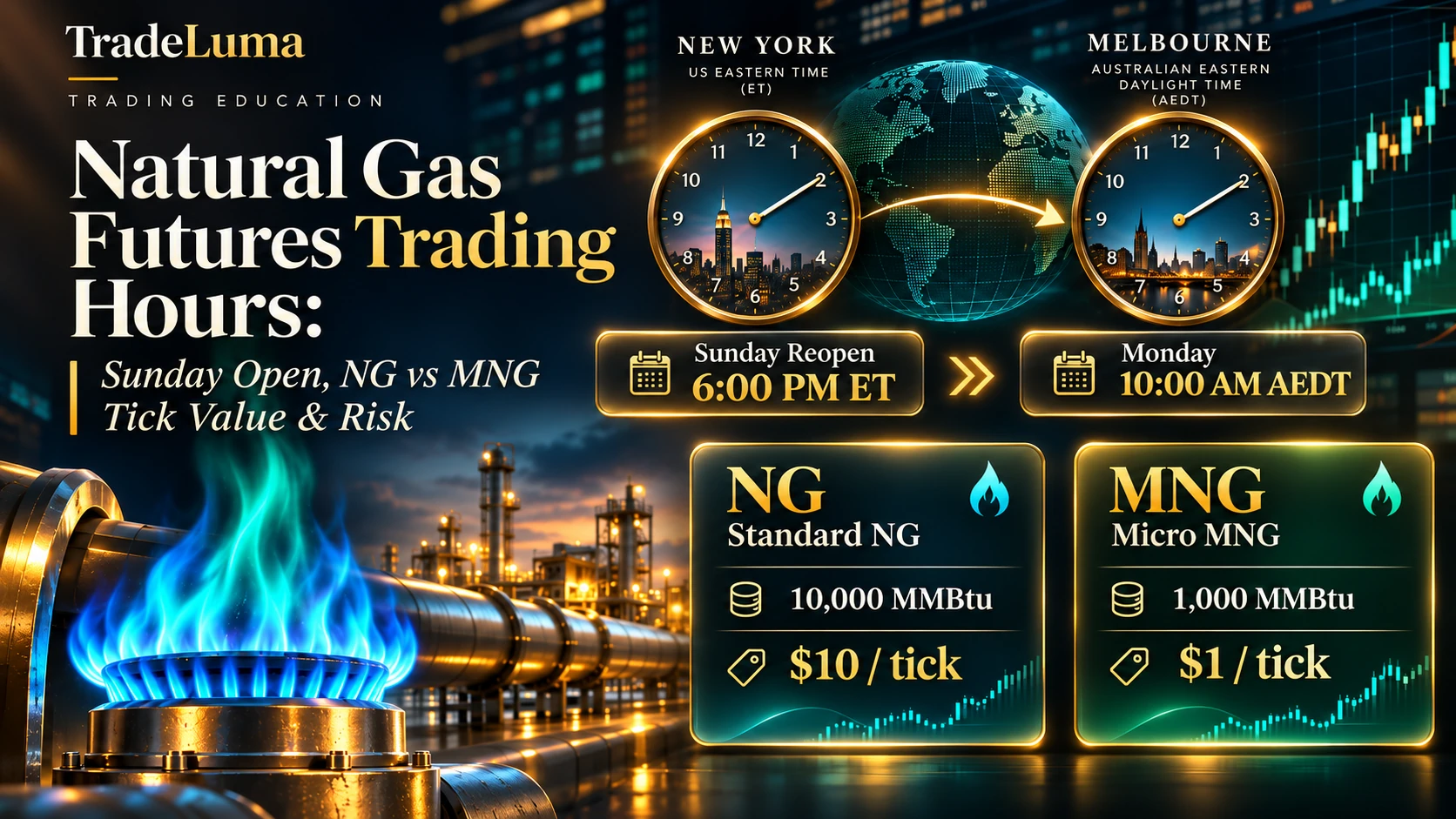
Natural Gas Futures Trading Hours: Sunday Open, NG vs MNG Tick Value & Risk
When do natural gas futures reopen Sunday? Compare CME NG and Micro MNG session times, tick values, contract sizes, expiry and Melbourne time conversions.

Yen Carry Trade Explained: Bank of Japan Rates, USD/JPY & Nasdaq Risk
What is the yen carry trade? Learn how borrowing yen works, why BOJ rate hikes and a stronger yen can trigger global selling, and how Nasdaq futures may react.