
Futures
M6E vs 6E Futures: Micro Euro vs Standard Euro FX
Compare Micro EUR/USD M6E and Euro FX 6E futures contract sizes, USD tick values, currency exposure, physical delivery and position sizing.
On this page+
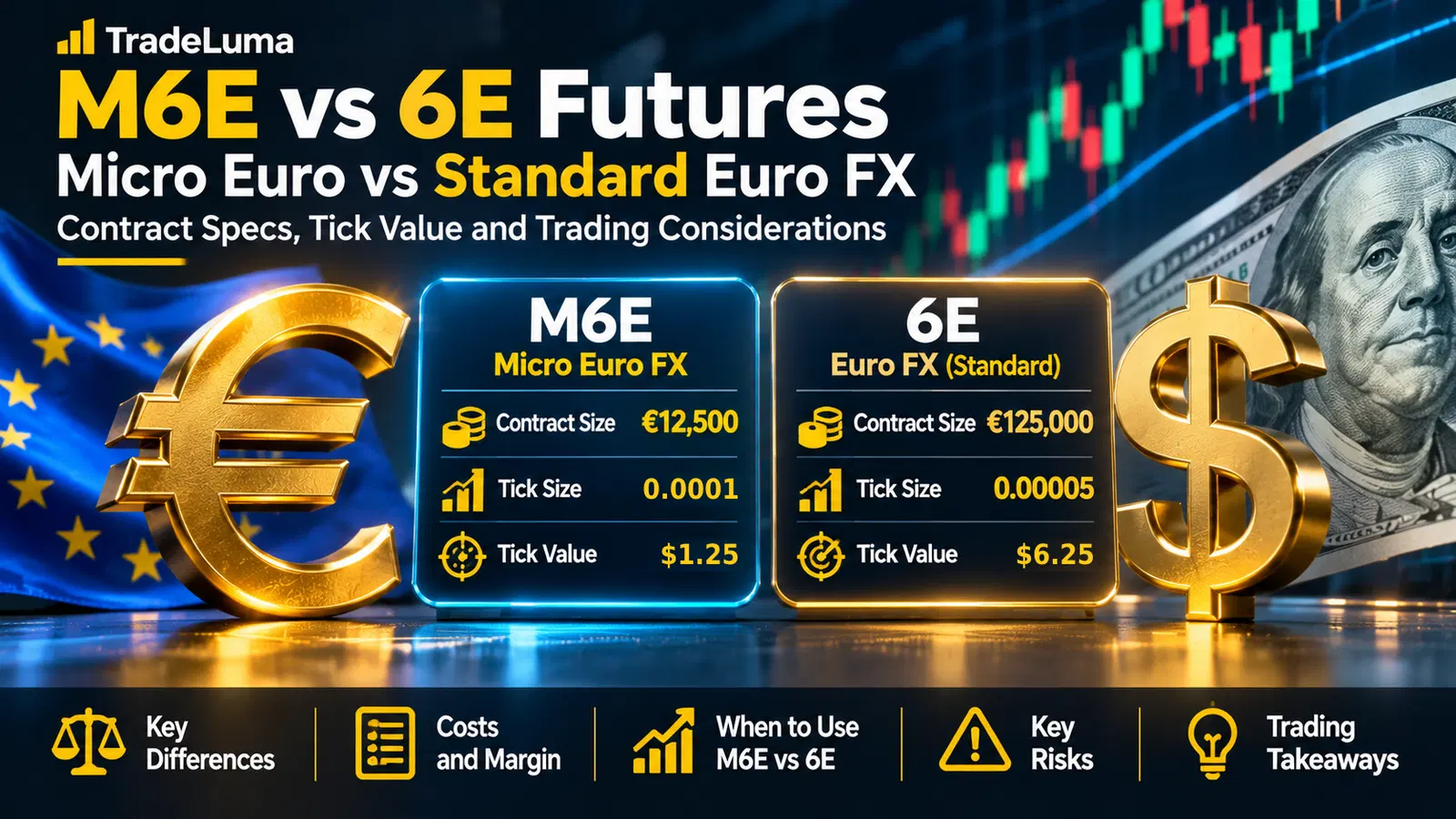
M6E and 6E are CME currency futures quoted in US dollars per euro. Micro Euro FX represents 12,500 euros and standard Euro FX represents 125,000 euros. Although their notional sizes differ by a factor of ten, their ordinary outright minimum price increments differ as well. Consequently, multiplying the micro tick value by ten does not produce the standard contract's tick value. This guide shows how to compare the two instruments without confusing their quote currency, price increments or contract months.
Contract units and quotation convention
Both products express the futures price in US dollars per euro. A quote of 1.1000 means US$1.10 per euro for the relevant contract month; it is not the dollar value of the whole contract. Multiplying that price by 12,500 gives a hypothetical M6E notional of US$13,750, while multiplying by 125,000 gives a 6E notional of US$137,500. Neither amount is the required margin. A trader long either instrument benefits from a rise in the quoted futures price before costs, while a short benefits from a decline. Do not infer the direction of a futures trade from an unrelated USD/EUR chart with the inverse quotation convention.
Minimum increments are not identical
The ordinary Globex outright increment for M6E is 0.0001 USD per euro. Multiplying by 12,500 euros gives US$1.25 per tick. For 6E, an outright increment of 0.00005 USD per euro multiplied by 125,000 gives US$6.25. The tenfold contract-size ratio therefore translates into a fivefold outright tick-value ratio because the standard contract trades on a finer price grid. Special spreads, clearing transactions and final settlement can have different price increments. A price accepted by 6E may be rejected for M6E if copied without validating the micro grid. Tick values here are in US dollars, not euros; that distinction matters when estimating account risk.
A worked exchange-rate move
Assume a futures price increases from a hypothetical 1.1000 to 1.1050. That is a movement of US$0.005 per euro, equivalent to fifty standard currency pips of 0.0001. One long M6E would gain US$62.50 gross, while one long 6E would gain US$625 gross. The move represents fifty outright micro ticks or one hundred outright standard ticks. A short position would lose the same gross amount. These figures exclude commissions, spread and any currency conversion. The example also shows why comparing tick counts alone is misleading: both positions experienced the same underlying exchange-rate movement even though the tick count and dollar result differ.
Position sizing and rounding
Consider a hypothetical rule allocating US$200 to price risk with a stop 0.0040 USD per euro from entry. One M6E represents US$50 of planned price risk, while one 6E represents US$500. Four micro contracts would use the full illustrative budget before execution costs, leaving no allowance for slippage. A smaller position or no position may be appropriate under a conservative version of that rule. The important step is to multiply the intended price distance by the contract quantity before checking collateral. Do not narrow a stop solely to fit a larger contract if that alters the tested strategy. A stop does not guarantee the stated loss.
Futures versus retail spot forex
A retail spot forex position may be quoted through a dealer or broker under its own lot sizes, financing rates and execution arrangements. Exchange-listed Euro FX futures are standardised contracts with a defined expiry, exchange matching and clearing procedures. Their price can differ from the spot exchange rate due to interest-rate differentials and the remaining period until settlement. A spot chart may be useful for context, but it is not a substitute for futures quotes when selecting a limit price. Compare financing, rollover, spread, execution permissions and data requirements rather than assuming the products have identical costs. The legal structure and client protections also depend on the account and jurisdiction.
Why futures prices can differ from EUR/USD spot
Under a simplified covered-interest relationship, the currency forward price depends on the two currencies' interest rates and the time remaining until delivery. If US-dollar rates exceed comparable euro rates, the theoretical forward quotation in dollars per euro may exceed spot, all else equal. Real markets can depart from a simple model because of funding conditions, contract characteristics and execution costs. A trader holding different maturities may see different quoted levels even when both are exposed to the same exchange-rate direction. Keep the spot price and dated futures basis separate in a dataset. A change in the futures basis is not necessarily evidence that the charting feed is broken.
Physical settlement and expiry management
The CME specifications provide for physical currency delivery under the applicable Euro FX contract arrangements. A trader who does not intend to participate in delivery must understand when the broker requires the position to be closed or rolled. The broker's deadline may precede the exchange's final trading time. Do not rely on automatic chart rollover to close a real contract. Establish the intended replacement month and verify the actual working orders on the old month. If rolling is required, account for the bid-ask spread and price difference between months. A dated contract with a valid quote is not necessarily eligible for a new opening order in every brokerage account.
European and US session liquidity
Euro FX responds to macroeconomic information from both currency areas. Scheduled European Central Bank announcements, US employment releases and inflation data can alter the relative rate outlook. The period when European and US activity overlap may offer different liquidity from a quiet Asian session, but no trading hour guarantees narrow spreads. Check the exchange calendar and broker access, particularly around holidays and maintenance. Record the time zone of the economic release rather than assuming every data calendar uses local time. When researching a strategy for Australian hours, account for daylight-saving changes in the United States, Europe and Australia. A fixed clock-time rule can drift relative to an event.
Automated price validation and fills
A system receiving a signal for 6E cannot safely submit the same raw quantity and limit to M6E without mapping the contract, recalculating the exposure and checking the applicable tick grid. For instance, 1.10005 is on the standard outright grid but not the micro outright grid. A buy limit rounded down preserves the original maximum willingness to pay; a sell limit rounded up preserves its minimum, subject to the strategy's documented rules. Protective stops need separate logic. Confirm accepted order prices and quantities through broker acknowledgements. Test rejected, partially filled and timed-out orders without assuming that repeated webhooks are harmless. An order identifier and position reconciliation are essential parts of the workflow.
A side-by-side research plan
Begin with matching delivery months and comparable historical intervals, then measure price changes in dollars per euro. Run one simulation at equivalent euro exposure and another at account-appropriate integer contract quantities. Apply real commission assumptions and compare spread costs relative to exposure. Include periods of central bank announcements and less liquid sessions to evaluate sensitivity to fills. Record whether the strategy uses futures settlement data, spot data or continuous chart adjustments. Keep funding currency and margin utilisation separate from signal performance. Paper-test the actual orderable product and verify broker permissions before enabling any live workflow. The choice is about execution suitability and manageable exposure, not simply which ticker has a lower margin requirement.
Frequently asked questions
How many M6E equal one 6E?+
Ten M6E contracts represent the same nominal 125,000-euro exposure as one 6E. Fees and order-book behaviour may differ.
What is the M6E tick value?+
The standard outright price increment is 0.0001 USD per euro, worth US$1.25 for one M6E contract.
What is the 6E tick value?+
The usual Globex outright price increment is 0.00005 USD per euro, worth US$6.25 per contract.
Why is the tick value ratio only five to one?+
The standard contract is ten times larger but its outright tick increment is half the micro increment.
Do Euro FX futures settle in dollars only?+
The contract has physical currency delivery arrangements. Check the exchange specifications and broker deadlines to avoid unintended delivery.
Is M6E the same as EUR/USD spot?+
No. It is a dated exchange-listed derivative. Its price incorporates the futures basis and its execution rules differ from retail spot trading.
Can I use the same alert quantity for both contracts?+
Not without checking risk. Equal quantities represent very different euro exposure, and the order price grids also differ.
Futures workflows
Explore the strategy side of TradeLuma.
Browse TradeLuma's futures strategy catalogue and the chart, rollover, and reference methodology used for each published strategy.
Explore futures strategies →Continue learning
Related guides.
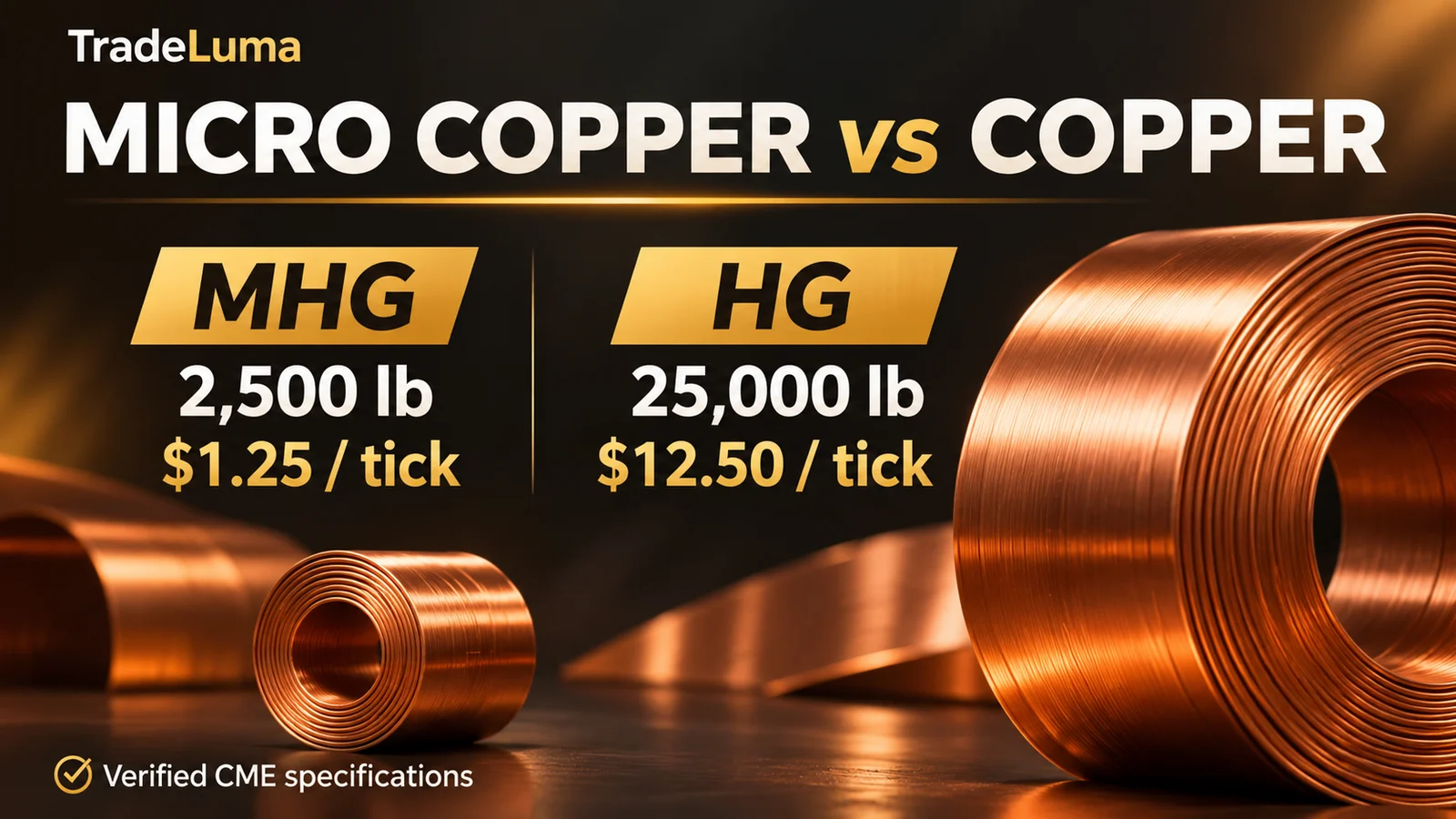
Micro Copper vs Copper Futures: MHG vs HG Explained
Compare MHG and HG copper futures contract sizes, tick values, settlement, position sizing and execution costs with worked examples.

MCL vs CL Futures: Why Contract Size Changes Everything for Oil Traders
Compare Micro WTI and standard WTI crude oil futures, tick values, settlement, position sizing and automated execution.

Natural Gas Futures Trading Hours: Sunday Open, NG vs MNG Tick Value & Risk
When do natural gas futures reopen Sunday? Compare CME NG and Micro MNG session times, tick values, contract sizes, expiry and Melbourne time conversions.