
Market News
Swiss National Bank December 2026: Could the Swiss Franc Shake Global Markets?
Preview the 10 December 2026 SNB monetary policy assessment, the 0% starting rate, franc strength, inflation, foreign exchange and safe-haven risk.
On this page+
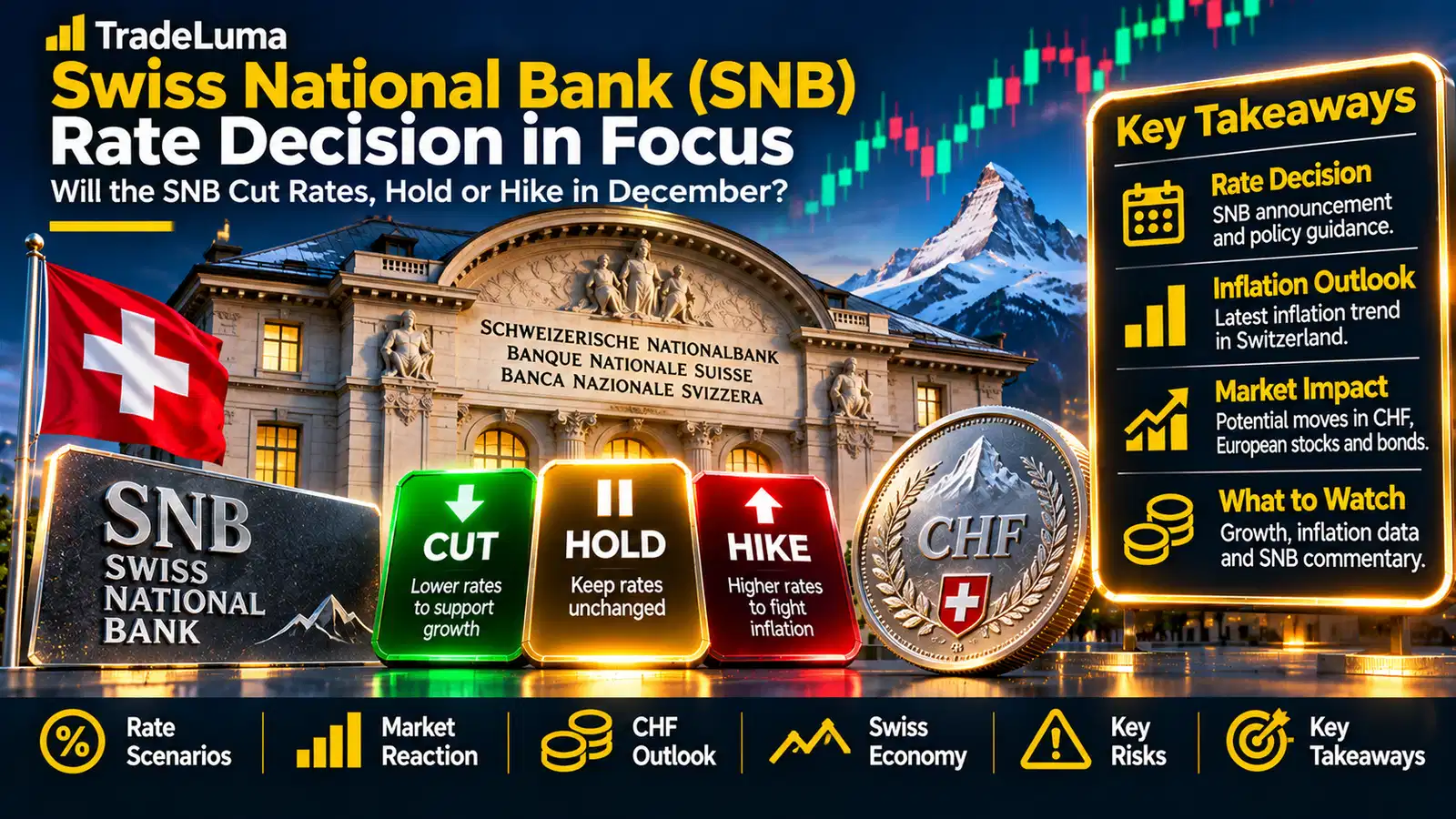
The Swiss National Bank is scheduled to publish its next quarterly monetary policy assessment on 10 December 2026 at 9:30 am Swiss time. The previous September assessment maintained the SNB policy rate at 0%. Traders interested in foreign exchange and gold will examine the decision alongside the central bank's inflation outlook and communication about the franc. This is a conditional market preview, not a prediction that the Swiss currency or policy rate will move in a particular direction.
What is different about the Swiss policy setting?
Switzerland is a relatively small open economy with close trade and financial links to other currency areas. The central bank assesses price stability in light of domestic developments and the external environment. The franc can influence the domestic prices of imported goods, while international demand for Swiss assets can affect financial conditions. The SNB's policy assessment therefore matters even to traders whose main instruments are not Swiss stocks. The relevance is usually through relative interest rates, currency movements or broader risk sentiment rather than a direct mechanical link to every market. Review the actual statement instead of assuming that a small central bank decision must always produce a small market reaction.
The September decision as the baseline
The SNB maintained its policy rate at zero percent in September 2026. The summary of that meeting discussed uncertainty from international developments, energy prices and expectations for interest rates elsewhere. Those observations establish the context available from the previous assessment, not a fresh December result. A new assessment can alter the balance of risks even if the nominal policy rate stays unchanged. Traders should separate the starting rate from market expectations about the next change and the likely duration of the current stance. An unchanged rate at zero is not the same as a guarantee that negative rates will never be considered again or that rates will necessarily rise in the coming quarter.
Inflation and imported price effects
When the franc appreciates against a supplier's currency, imported goods can become less expensive in Swiss-franc terms, all else equal. The actual impact depends on contracts, pricing decisions, commodity markets and the extent to which businesses pass exchange-rate changes through to consumers. A global energy shock can raise imported costs even when the currency strengthens. Domestic prices can also behave differently from internationally traded goods. Assess the SNB's conditional inflation forecast and its underlying assumptions, rather than deriving a policy decision from one consumer-price observation. A forecast is a conditional assessment of the economy, not a promise of an exact inflation rate or policy path.
How the currency quotation works
USD/CHF expresses Swiss francs per US dollar. If the pair moves from a hypothetical 0.9000 to 0.8700, one US dollar purchases fewer francs, so the franc has strengthened relative to the dollar. EUR/CHF offers a different comparison with the euro area. A long USD/CHF position loses from the illustrated fall before financing and costs, whereas a long franc exposure expressed through a different product could benefit. Futures or other currency instruments may use a different quotation convention. Verify the base currency, quote currency and multiplier before interpreting any direction. The exchange-rate figures here are invented examples and are not current market quotations.
Scenario one: an unchanged policy rate
A hold at the previous zero-percent setting could leave traders focusing on the SNB's description of the inflation outlook and the external economy. If markets had already priced unchanged policy, a shift in communication might matter more than the rate itself. A statement suggesting that currency appreciation is materially affecting inflation could have different implications from a statement focusing on renewed international price pressure. Compare the response in USD/CHF and EUR/CHF rather than expecting every franc cross to move equally. Relative monetary policy elsewhere can dominate the response. The unchanged-rate scenario is one possible outcome, not an assessment that the decision is predetermined.
Scenario two: a reduction in the policy rate
A move below the prior rate could cause market participants to reconsider the return available on franc-denominated assets and the outlook for funding conditions. The currency might weaken if the decision is more accommodative than expected. It could nevertheless strengthen during a broad risk-off episode, depending on investor demand and positioning. Negative nominal policy rates have historical precedent in Switzerland, but that history does not establish that the SNB will choose them in December. Consider the actual rationale, accompanying guidance and response across bond and currency markets. A trader should not assume that policy direction alone determines the immediate exchange-rate move or that one currency relationship is guaranteed.
Scenario three: tighter monetary policy
If the SNB raises rates unexpectedly, the franc could benefit from a shift in expected relative returns. The reaction may be smaller or even different in direction if investors already anticipated the move or if other central banks tighten more than expected. A higher nominal policy rate also changes borrowing conditions, which can affect demand and asset valuations. Watch how short-term interest-rate expectations adjust rather than inferring the entire reaction from the announced number. A tighter decision linked to persistent inflation risks can convey a different message from one linked to a more favourable growth assessment. These hypothetical mechanisms help prepare for market repricing without claiming a specific forecast.
Safe-haven demand and gold
The franc is often discussed as a potential safe-haven currency. That description reflects observed behaviour in some episodes, not a rule that applies to every financial shock. Gold may also attract demand during uncertainty, but its response depends on real yields, the US dollar, positioning and liquidity. Suppose gold remains at a hypothetical US$4,000 per ounce while USD/CHF falls from 0.9000 to 0.8700. The same dollar price converts from CHF 3,600 to CHF 3,480, a decline in franc terms despite unchanged dollar gold. This illustrates why the return from a currency-hedged or local-currency gold position may differ from the internationally quoted metal price.
Event timing and practical execution
The published assessment is scheduled for 9:30 am Central European Time on Thursday 10 December. In Melbourne, the equivalent is 7:30 pm AEDT on that date. Check the schedule for changes before configuring an alert or planning an event study. European currency markets and listed futures have different execution arrangements, and the availability of a particular order type depends on the account and broker. Around the release, spreads may widen and quoted liquidity can change. Record any existing correlated positions, including those expressed through gold or other currency pairs. Reconcile order acknowledgements and positions if an execution response is missing. A successful notification does not establish that the broker filled an order at the expected price.
Build a balanced post-release assessment
Create a worksheet containing the pre-meeting policy rate, contemporaneous market expectations, recent inflation indicators and the most relevant international policy events. At publication, record the actual decision and the changes in conditional forecast or communication. Compare franc crosses and nearby rates over predetermined intervals and document other announcements occurring at the same time. A longer-term research project should examine several assessments rather than optimise a rule around a single shock. Use realistic transaction costs and identify differences between broker session hours and chart timestamps. The objective is to distinguish evidence from inference and to understand how a relatively small currency area can influence international risk through financial links.
Frequently asked questions
When is the SNB December 2026 decision?+
The monetary policy assessment is scheduled for Thursday 10 December at 9:30 am Swiss time.
What time is that in Melbourne?+
9:30 am CET is 7:30 pm AEDT on 10 December. Confirm the published schedule before the event.
What was the previous SNB policy rate?+
The September 2026 assessment left the rate at 0%, which is the starting point for this preview.
Does the Swiss franc always rise during uncertainty?+
No. Safe-haven behaviour varies with positioning, funding conditions, relative policy and the nature of the shock.
Can a stronger franc reduce Swiss inflation?+
It can reduce some imported-price pressure, all else equal, but pass-through is incomplete and other factors matter.
Would a rate cut automatically make gold rise?+
No. Gold's response depends on the currency of measurement, broader real yields and other sources of demand.
Is the cover a prediction of the rate decision?+
No. It shows cut, hold and hike as illustrative scenarios rather than asserting an outcome.
Put it into practice
Use the risk maths next to the guide.
Open TradeLuma's free position-size, risk/reward, expectancy, and drawdown tools to test the numbers behind a risk-management decision.
Open free trading calculators →Continue learning
Related guides.

Bank of Japan December 2026: Could a Rate Hike Trigger Another Global Sell-Off?
Preview the December 17–18 Bank of Japan meeting, yen carry trade risk, policy scenarios and possible effects on global futures markets.
Bank of Canada December 2026: Interest Rates, Oil and the Canadian Dollar
Preview the December 9 Bank of Canada announcement, policy-rate scenarios, CAD, oil sensitivity and trading risks.

Broadcom December 2026 Earnings: Could AVGO Trigger the Next AI Stock Rally?
Preview Broadcom's 9 December 2026 quarterly results, custom AI silicon, networking, infrastructure software, margins, guidance and Nasdaq scenarios.