
Market News
Bank of Canada December 2026: Interest Rates, Oil and the Canadian Dollar
Preview the December 9 Bank of Canada announcement, policy-rate scenarios, CAD, oil sensitivity and trading risks.
On this page+
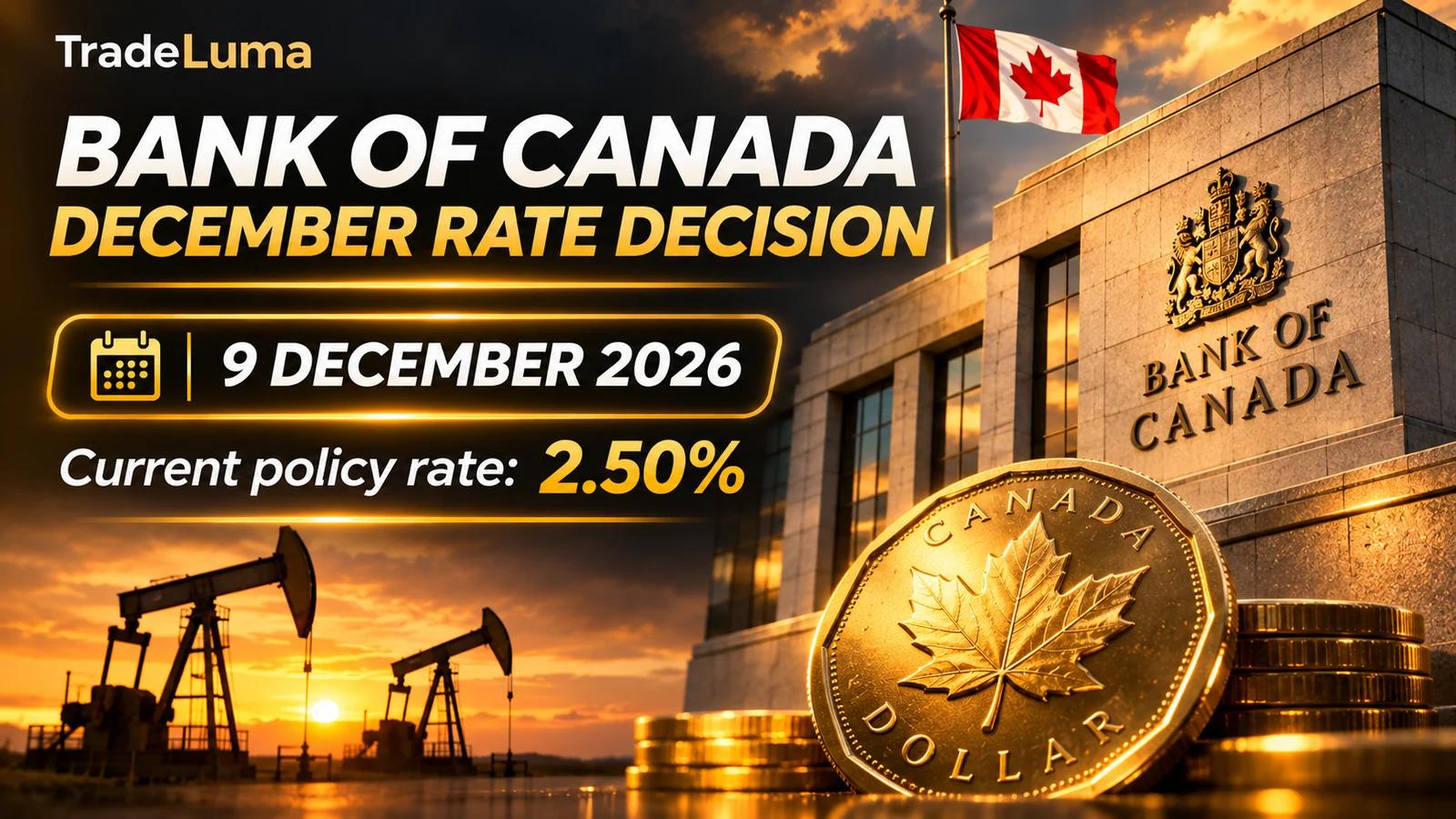
The Bank of Canada has scheduled its next interest-rate announcement for 9 December 2026 at 9:45 am Eastern Time. In its October 28 decision it raised the overnight rate target to 2.50%. This preview considers how a change or hold, and the accompanying guidance, could affect the Canadian dollar and oil-linked assets.
The starting point
The Bank of Canada's October announcement increased the overnight target by 25 basis points to 2.50%. December's scheduled announcement does not itself imply another increase. Investors will compare the decision and statement with inflation, activity and labour-market evidence as well as what the market has already priced.
How a hawkish surprise could affect CAD
A higher rate than expected or more restrictive forward guidance could increase the relative attractiveness of Canadian-dollar assets and support CAD. In USD/CAD notation a stronger Canadian dollar means a lower exchange rate, all else equal. Relative US rates and global risk conditions may counteract that effect.
A hold or dovish surprise
If the Bank holds rates and signals a more cautious approach than markets expect, Canadian yields or CAD could weaken. A hold can also be hawkish if the statement suggests rates will stay elevated longer. Avoid interpreting an unchanged rate as automatically neutral.
Why oil matters, but imperfectly
Canada is a major energy exporter. Higher oil prices can improve export revenues and support parts of the economy, potentially benefiting CAD. However, different grades, transportation constraints, currency hedging and the cause of a crude price move affect the relationship. A supply shock can raise energy prices while simultaneously worsening global risk sentiment.
The wider central bank calendar
The Fed's December meeting and the Bank of Japan's December 17–18 meeting may change currency and rate expectations around the Canadian release. Compare policy surprises across countries rather than evaluating Canada in isolation. SOFR futures offer one lens on expected US short-term financing rates.
Preparing for the event
Identify the actual tradable contract, quote conventions, order permissions and margin before the announcement. Review the MCL versus CL guide for crude exposure and avoid assuming an oil move translates one-for-one into FX returns. With automated execution, test valid orders and reconcile positions before increasing risk. This is education, not a directional recommendation.
The economic indicators behind the rate announcement
Canadian inflation, employment, household consumption, credit conditions and the broader growth outlook are important inputs into policy analysis. The headline consumer price index can be influenced by energy costs, while core measures aim to help identify more persistent inflation pressures. Labour-market weakness may point to spare capacity, but the policy implications depend on productivity, wage growth and the inflation outlook. Review the latest available releases and their publication dates rather than extrapolating from an older data point. The Bank's October decision provides the starting policy setting, not a commitment to a particular December outcome. Compare the new statement with earlier communication and note whether policymakers emphasise inflation risk, growth risk or uncertainty about the path of activity. Do not present a market-implied outcome as an official promise.
How to read USD/CAD correctly
USD/CAD is expressed in Canadian dollars per one US dollar. If the exchange rate moves from a hypothetical 1.4000 to 1.3800, one US dollar purchases fewer Canadian dollars, which means CAD has strengthened relative to USD. A trader long USD/CAD would experience the opposite directional exposure from someone long CAD against USD. Currency futures may use a different quotation convention, so the chart's direction cannot be copied blindly into an order ticket. Confirm the symbol, base and quote currencies and multiplier before calculating a potential gain or loss. If the trading account is denominated in a third currency, such as AUD, exchange-rate translation can introduce further differences between the instrument's gross result and the account statement. All example rates here are illustrative.
Oil prices and the terms-of-trade channel
A rise in the price of an exported commodity can improve the amount of imported goods and services that a country can purchase with its exports, other factors unchanged. For Canada, energy prices are therefore relevant to some companies, government revenues and national income. But the economic effect depends on production volumes, regional price differentials, transport costs and how long the price increase lasts. A global demand boom and a temporary supply disruption can both raise oil prices while creating very different outlooks for the Canadian economy. When evaluating CAD alongside crude futures, compare WTI with relevant Canadian energy price measures and avoid treating the two instruments as a perfect hedge. Central bank policy may react differently if higher oil prices create persistent inflation or reduce real purchasing power.
Plan a release-day comparison rather than a prediction
Record the December announcement time in Eastern Standard Time and convert it to your local time zone before configuring session filters. On the day, identify the expected policy outcome from contemporaneous information, then compare it with the published decision and guidance. Monitor USD/CAD, short-term Canadian yields, US yields and the relevant oil contract over consistent windows. Because other scheduled events can occur during the same session, label overlapping releases instead of attributing every price move to Canadian monetary policy. Check how spreads, slippage and working orders behave around the event. If you study a systematic response, use several independent announcements and keep the rule unchanged during evaluation. The goal is to measure market behaviour under defined assumptions, not to claim certainty about a central bank's next decision.
Frequently asked questions
When is the Bank of Canada decision?+
December 9, 2026, at 9:45 am Eastern Time.
What is that in Melbourne?+
1:45 am AEDT on December 10.
What was the October policy rate?+
The October 28 decision set the target at 2.50%.
Does higher oil always strengthen CAD?+
No. Other economic and financial factors can dominate.
Is another hike guaranteed?+
No. This is a preview, not a policy forecast.
Does a Bank of Canada hike necessarily strengthen CAD against every currency?+
No. Exchange rates depend on relative policy surprises, risk appetite and other information. CAD may strengthen against one currency while weakening against another.
Is WTI a precise proxy for Canadian energy exports?+
No. WTI is an important benchmark, but Canadian crude grades, local price differentials, transportation and export conditions can create materially different revenues.
Put it into practice
Use the risk maths next to the guide.
Open TradeLuma's free position-size, risk/reward, expectancy, and drawdown tools to test the numbers behind a risk-management decision.
Open free trading calculators →Continue learning
Related guides.

Bank of England December 2026 Rate Decision: Will Interest Rates Surprise Markets Again?
Preview the 17 December Bank of England decision from a 4.00% Bank Rate, with conditional sterling, gilts, gold and equity-market scenarios.
Swiss National Bank December 2026: Could the Swiss Franc Shake Global Markets?
Preview the 10 December 2026 SNB monetary policy assessment, the 0% starting rate, franc strength, inflation, foreign exchange and safe-haven risk.

Broadcom December 2026 Earnings: Could AVGO Trigger the Next AI Stock Rally?
Preview Broadcom's 9 December 2026 quarterly results, custom AI silicon, networking, infrastructure software, margins, guidance and Nasdaq scenarios.