
Market News
Bank of England December 2026 Rate Decision: Will Interest Rates Surprise Markets Again?
Preview the 17 December Bank of England decision from a 4.00% Bank Rate, with conditional sterling, gilts, gold and equity-market scenarios.
On this page+
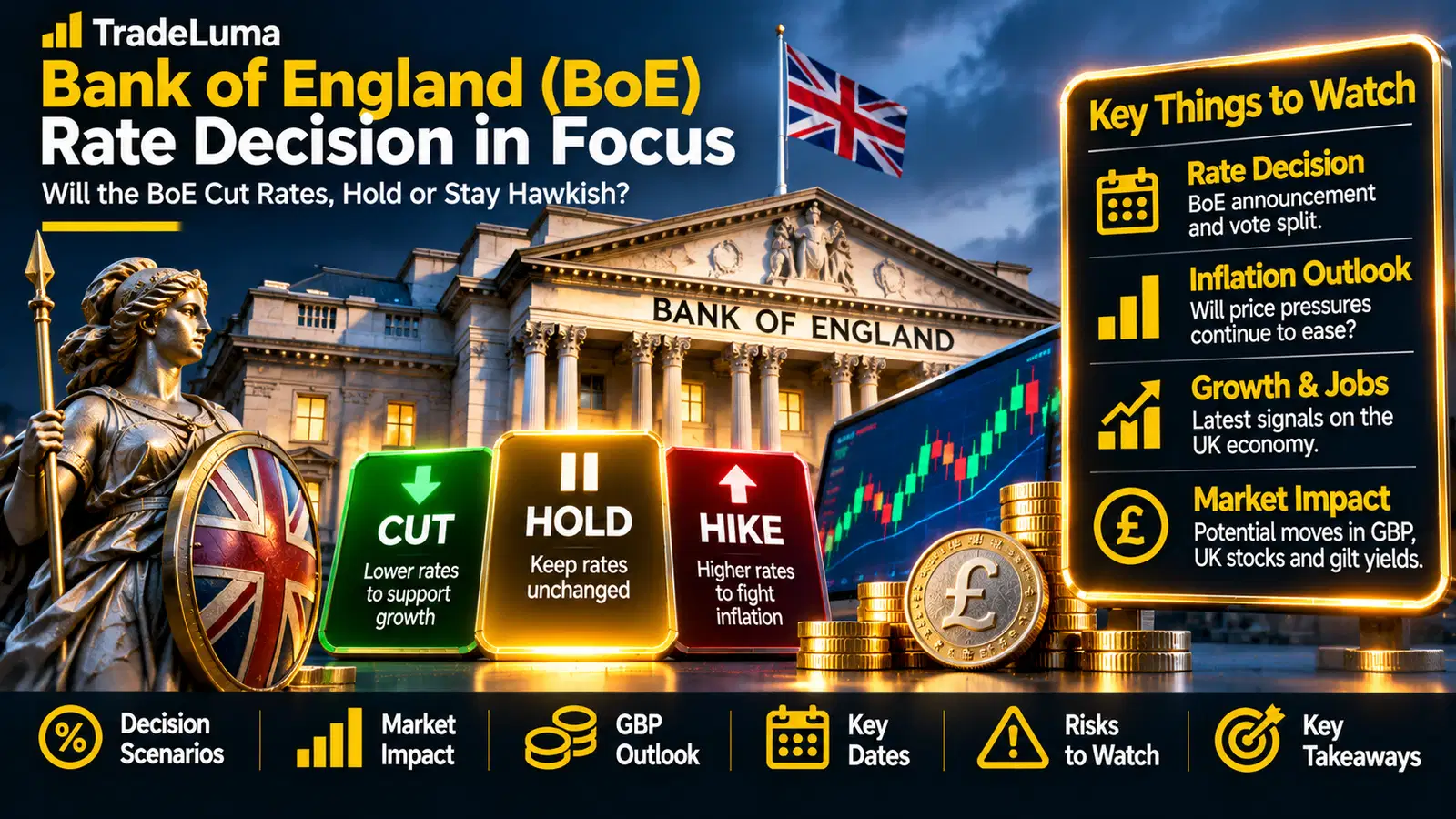
The Bank of England's Monetary Policy Committee is scheduled to publish its next monetary policy decision and minutes on 17 December 2026. The starting point is a Bank Rate of 4.00% following the November increase from 3.75%. A December hold, cut or further increase would have different implications depending on what markets have already priced and how the committee explains its outlook. This preview describes conditional reactions rather than asserting that one decision is certain.
Why December is a distinct event
The previous meeting established the current policy setting, but each new decision incorporates information available since then. Investors will assess whether the November increase is described as sufficient, whether risks have shifted and how the committee views the persistence of inflation. The December publication includes the policy summary and minutes, which allow readers to inspect the reasoning beyond the headline rate. A repeat of the existing rate is not necessarily a repeat of the November message. Different voting patterns or guidance about future conditions can affect expectations even if Bank Rate is unchanged. This guide focuses on the forthcoming December meeting rather than retelling November's announcement as though it were new.
What the November starting point tells us
The Bank increased its policy rate from 3.75% to 4.00% in November 2026. This establishes the level against which the December decision will be compared. It does not establish the next move. A November survey published by the Bank showed a median expectation of 4.00% for the December meeting, but survey responses reflect information at the time and do not represent a committee commitment or a live probability. Before the announcement, compare more recent market expectations with that earlier baseline. When reading the new minutes, distinguish language about the current level from language about how long that level may need to be maintained. A change in the expected duration of restrictive policy can matter substantially.
Inflation and domestic price pressures
Headline inflation includes components that can move rapidly, particularly energy-related prices. Policymakers also assess persistent domestic pressures, including service prices, wages and the relationship between demand and productive capacity. A temporary change in an imported commodity can affect the outlook differently from sustained domestic price acceleration. Examine the latest data release dates so that an older annual rate is not presented as a new reading. A central bank may respond to forecasts of future inflation even when the latest published observation is moving in the opposite direction. Markets can therefore focus on the committee's assessment of persistence rather than the headline consumer-price figure alone.
Employment, wage growth and economic activity
Labour-market conditions influence household income, demand and the outlook for service-sector costs. Weak employment growth may indicate that spare capacity is increasing, but wage measures, productivity and participation can complicate the interpretation. Economic growth can also slow for reasons that affect inflation differently, such as a supply disruption rather than weaker demand. When assessing the December decision, identify which developments the committee considers important rather than treating one employment release as a mechanical rate signal. Revisions to data are another reason to use information available at the time. A research dataset should store initial published values separately from later revised figures to avoid hindsight in event studies.
Scenario one: Bank Rate remains at 4.00%
An unchanged decision could be consistent with policymakers waiting for the previous increase to work through the economy. The market response would depend on expectations and communication. If investors anticipated a hold, the vote and future policy guidance might dominate the reaction. A statement highlighting persistent inflation risks could raise expected future rates even without an immediate increase. Alternatively, greater concern about demand and employment could lower expected rates despite the unchanged headline. These scenarios are conditional. Record sterling and short-dated gilt movements in relation to the publication and distinguish them from broader moves caused by US or European events. A hold is not automatically a neutral market outcome.
Scenario two: an unexpected reduction
A cut from the November level could prompt investors to reconsider the expected path of UK rates, particularly if it was not widely anticipated. Sterling could weaken if expected UK returns fall relative to other currencies, but the response would also depend on risk sentiment and whether the cut improves confidence in the growth outlook. Shorter-dated gilt yields might fall, while longer maturities could respond differently if inflation or fiscal concerns rise. Gold priced in pounds could move differently from gold quoted in dollars because of currency conversion. Treat the result as a policy surprise relative to expectations, not as a guaranteed trade in any of these instruments.
Scenario three: further tightening
An unexpected increase could support sterling and push short-term rate expectations higher if investors interpret the decision as a stronger commitment to containing inflation. However, a more restrictive stance can also raise concerns about growth, corporate funding and household borrowing. The longer end of the gilt curve may react differently from short maturities. An increase accompanied by language indicating that additional tightening is unlikely could produce a different market response from an increase paired with a more restrictive outlook. Evaluate the statement and the vote before attributing directional significance to the headline. A hypothetical hike is a scenario for risk planning rather than a statement about the December outcome.
How to read gilts and currency markets together
UK government bond prices and yields generally move in opposite directions for a given security, while exchange rates reflect the relationship between two currencies. GBP/USD can strengthen because UK rate expectations rise or because US rate expectations fall. EUR/GBP provides a different relative-policy comparison and has the opposite quotation direction for sterling strength. Compare UK short-maturity yields with the relevant foreign benchmarks, and observe whether the moves begin at the decision timestamp. If global yields rise at the same moment, domestic policy may explain only part of the change. For traders examining gold or Nasdaq, treat UK policy as one input within a wider set of global financial conditions.
An announcement-day execution plan
Check the Bank's published calendar and the precise announcement time before configuring an alert or event filter. The UK is on Greenwich Mean Time in December while Melbourne observes daylight-saving time, so a UK midday release would be 11 pm AEDT on the same date. Verify the actual publication time and product-specific trading availability rather than relying on the example conversion. Review existing positions and protective orders across currencies, rates, metals and equities. An order that appears safe in ordinary conditions can fill differently when liquidity changes around a major release. If an automated submission times out, reconcile actual orders and positions before sending a replacement. No risk-control procedure eliminates market gaps.
A repeatable decision-review worksheet
Before the meeting, record the current Bank Rate, contemporaneous expected outcome, relevant economic releases and your own conditional scenarios. At publication, capture the decision, voting distribution and changes in the committee's description of risks. Compare short-window market reactions with the later session, separating observable prices from inferred explanations. If developing an event-based rule, use several meetings, avoid changing the observation window after seeing the outcome and include spreads and slippage. Store the original release information so a later revision cannot introduce look-ahead bias. This disciplined process can improve understanding of monetary-policy reactions without implying that the next announcement will be profitable to trade.
Frequently asked questions
When is the December 2026 Bank of England decision?+
The MPC policy summary and minutes are scheduled for Thursday 17 December 2026.
What is the Bank Rate before the December meeting?+
It is 4.00% following the November 2026 increase from 3.75%, as of this preview.
Does a hold mean sterling will not move?+
No. Changes in the vote, guidance or expected duration of the current setting can move currency markets.
Would a rate cut always weaken GBP?+
No. It depends on the pre-release expectation, relative overseas policy and other market information.
Why watch gilt yields?+
Different gilt maturities provide information about expected policy, inflation, growth and risk premiums. Their moves can help interpret sterling's response.
Can UK monetary policy affect gold?+
Yes, indirectly through currency movements and global yield expectations, although US-dollar gold is also influenced by many other factors.
Is the illustrated hold scenario a forecast?+
No. The cover depicts conditional rate scenarios. The decision had not occurred when this article was prepared.
Keep learning
Continue through the TradeLuma research library.
Browse practical guides across trading, automation, execution, futures, technical analysis, and risk management.
Browse all guides →Continue learning
Related guides.
Bank of Canada December 2026: Interest Rates, Oil and the Canadian Dollar
Preview the December 9 Bank of Canada announcement, policy-rate scenarios, CAD, oil sensitivity and trading risks.

Bank of England Raises Rates to 4% in November 2026: Why GBP, Gold and Markets Care
The Bank of England raised Bank Rate to 4% on 5 November 2026. Explore its 8–1 vote, UK inflation outlook, GBP/USD, gilts and implications for gold and Nasdaq.

Bank of Japan December 2026: Could a Rate Hike Trigger Another Global Sell-Off?
Preview the December 17–18 Bank of Japan meeting, yen carry trade risk, policy scenarios and possible effects on global futures markets.