
Macro & Markets
Bank of England Raises Rates to 4% in November 2026: Why GBP, Gold and Markets Care
The Bank of England raised Bank Rate to 4% on 5 November 2026. Explore its 8–1 vote, UK inflation outlook, GBP/USD, gilts and implications for gold and Nasdaq.
On this page+
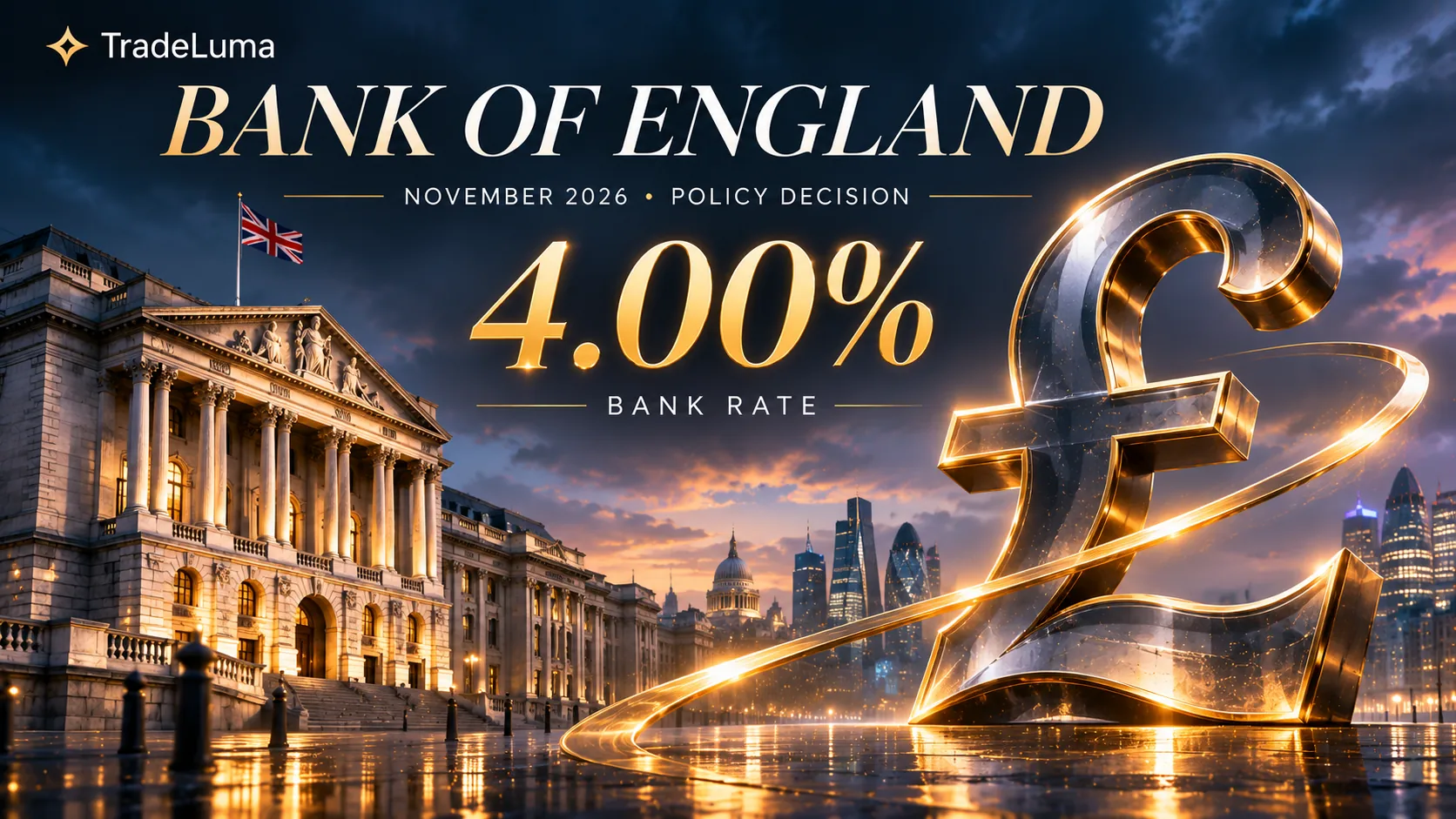
The Bank of England raised its benchmark Bank Rate by 25 basis points to 4.00% on Thursday, November 5, 2026. Eight members of its Monetary Policy Committee supported the quarter-point rise; one member preferred a larger half-point increase. The decision was driven by an unusually persistent global energy shock, UK inflation of 3.5% in September and the Bank’s expectation that inflation could climb towards 5% by mid-2027. For market participants, the important question is not only why rates rose. It is how the decision changes expectations for future UK interest rates, gilt yields, the pound against the dollar, and wider assets including gold and Nasdaq futures. This guide separates the official decision from conditional market mechanisms and trading assumptions.
The 5 November 2026 Bank of England rate decision at a glance
The Bank of England’s Monetary Policy Committee met over the period ending November 4 and announced its decision on Thursday, November 5, 2026. It increased Bank Rate by 25 basis points to 4.00%, an increase from 3.75%. The eight-to-one majority favoured the quarter-point move. Catherine L Mann dissented because she preferred a larger increase to 4.25%.
The result was not a unanimous forecast of further tightening. The MPC emphasised that monetary policy is not on a preset path and that its next steps depend on whether higher energy costs become sustained wage and pricing pressures. That nuance is crucial for traders: the surprise relative to expectations, rather than the absolute level of Bank Rate alone, usually drives the immediate market reaction.

Why did the Bank of England raise rates again?
The Bank identified the protracted disruption to global energy supply and transport as the dominant challenge to UK inflation. Oil and natural-gas prices had risen materially, creating near-term pressure on household energy bills, fuel prices and firms’ operating costs. Those costs can eventually feed into prices beyond energy if businesses pass them on.
The MPC also noted that UK economic activity had held up better than expected. A more resilient economy can make it harder for demand weakness to restrain pricing pressure. Even though evidence of broader second-round wage and price effects remained limited at the meeting, policymakers judged the inflation risks large enough to justify an additional 25 basis points of restriction.
Bank Rate 4.00%: what does a 25-basis-point hike mean?
Bank Rate is the Bank of England’s primary short-term monetary-policy rate. One basis point is one hundredth of a percentage point, so 25 basis points equals 0.25 percentage points. A move from 3.75% to 4.00% is a quarter-percentage-point rise, not a 25% relative rise.
Bank Rate affects funding costs throughout the economy. Commercial banks do not have to pass on every change identically or immediately, but mortgage pricing, savings returns, business borrowing costs, short-term sterling yields and expectations for future policy are linked to it. The transmission usually takes time and depends on each financial product’s terms.
The 8–1 MPC vote: what was the disagreement?
Eight MPC members supported an increase of 0.25 percentage points to 4.00%. Catherine L Mann preferred a 0.50-point increase to 4.25%, arguing for a stronger response to the risk that inflation expectations become embedded in wage and price-setting. This was a disagreement over the size of the hike, not a vote to keep rates unchanged.
The rest of the committee regarded the quarter-point move as an appropriate response to inflation pressures, given the competing risks of persistent energy costs and weaker growth. A decision that appears hawkish in headline form can contain cautious language about what follows. Read the vote split and meeting minutes together rather than relying on a single headline.
UK inflation at 3.5% and a forecast close to 5% in 2027
UK annual CPI inflation reached 3.5% in September 2026, above the Bank’s 2% target. In the November assessment, the Bank expected inflation to rise towards about 5% by the middle of 2027, largely reflecting the impact of elevated energy costs. The projection was conditional on assumptions about future energy prices and economic conditions, not a guaranteed outcome.
It is important to separate headline inflation driven directly by energy from longer-lasting domestic inflation. The Bank cannot produce more oil or gas by changing interest rates. Its policy aims to reduce the likelihood that the initial cost shock is amplified by repeated price increases and higher wage demands elsewhere in the economy.
Energy prices and second-round inflation: the key risk
An energy shock initially raises petrol, transport, gas or electricity costs. Over time, businesses that face higher expenses may raise the prices of other goods and services. Workers may seek larger wage settlements to maintain purchasing power. If those adjustments recur, inflation can stay higher even after the initial energy-price jump fades.
The November MPC discussion emphasised that there was still limited evidence of a broad second-round effect at that point. However, policymakers feared that the prolonged scale of the shock made future persistence more likely. Monitoring wage growth, services inflation and firms’ pricing behaviour is therefore as important as watching the oil price itself.
Does a Bank of England rate hike make GBP/USD rise?
Higher UK interest rates can make sterling-denominated deposits and short-term assets more attractive relative to comparable foreign assets. If a Bank of England decision pushes expected UK yields higher than investors anticipated, GBP/USD may strengthen, all else equal. Interest-rate differentials, forward points and the expected future rate path matter more than one day’s policy level.
But a well-anticipated hike may already be embedded in sterling prices. If the Bank’s statement reduces expectations for further tightening, the pound could weaken even after a rate increase. GBP/USD is also a dollar pair: US Federal Reserve expectations, US yields and global risk appetite can dominate the move. A higher Bank Rate does not guarantee a stronger pound.
UK gilt yields: why the short and long ends can react differently
UK government bonds are known as gilts. The short end of the yield curve is particularly sensitive to expectations for near-term Bank Rate decisions. Longer-dated yields also reflect future inflation, growth prospects, term premia and global bond-market conditions.
A hawkish surprise could lift short-term yields, while longer yields respond differently if investors believe tighter policy will eventually reduce inflation and demand. Similarly, a higher inflation forecast can push long yields up even when near-term expectations hardly change. Watch two-year and ten-year gilt yields separately rather than treating all UK bonds as the same trade.
What does the UK rate increase mean for gold prices?
Gold is priced globally, typically in US dollars, and does not pay interest. Rising real yields increase the opportunity cost of holding a non-interest-bearing asset; falling real yields can reduce it. UK policy can affect global interest-rate sentiment and currency flows, but US real Treasury yields, the broad dollar, central-bank demand and geopolitical risks are often more direct drivers of dollar-denominated gold.
A Bank of England hike might coincide with stronger sterling and a softer US dollar, potentially providing support to gold. It could also coincide with a wider global tightening repricing that increases yields and pressures gold. There is no dependable one-to-one rule. Traders should monitor UK yields, US yields, GBP/USD, the dollar index and gold together.

Could the UK decision affect Nasdaq and US stocks?
Nasdaq-100 valuations can react to changes in US discount rates and global risk appetite. A UK-only monetary policy move is usually a less direct driver than Federal Reserve policy, US earnings or the US labour market. However, coordinated changes in global bond yields, inflation fears or liquidity can amplify volatility across equity index futures.
The same UK hike can be interpreted as stabilising inflation expectations or as adding pressure to household and business demand. Those narratives have different implications for equities. Do not attribute a Nasdaq move to the Bank of England merely because the events occurred on the same day; compare US yields, earnings headlines and the broader macro calendar.
Why the Bank stressed that future rates are not on a preset path
The MPC’s November message made the coming rate path explicitly conditional. It would assess energy prices, the evolution of wage settlements, firms’ pricing behaviour, economic slack and the outlook for the 2% inflation target. The committee did not promise a fixed number of subsequent increases.
A forward market curve represents the pricing of many possible outcomes, including risk premia, rather than a guaranteed policy forecast. For positioning, distinguish the Bank’s conditional guidance from what traders assume will happen next. That gap can create volatility when new information arrives.
The next meeting and economic data to watch
The next scheduled Bank of England MPC decision following November 5 was Thursday, December 17, 2026. Between those dates, traders could reassess the inflation outlook using UK CPI, labour-market data, wage measures, services prices and surveys of business costs and expectations.
Global oil and gas developments remained unusually important. Signs that energy supply disruption was easing could reduce near-term inflation pressure; renewed disruptions could create the opposite risk. Both the direction of the data and the difference from consensus expectations matter more than a single observation.
Bank of England versus Federal Reserve: why international traders compare both
The Bank of England sets monetary policy for the United Kingdom and targets UK CPI inflation, while the Federal Reserve sets policy for the United States under a dual mandate. The countries can face different mixes of inflation and employment risks, so the direction and pace of policy need not match.
For GBP/USD, the spread between expected UK and US interest rates can be more informative than either bank’s rate in isolation. For gold and Nasdaq, the Fed’s rate path and US real yields generally have more direct transmission channels. That is why the same BoE decision can matter greatly for sterling traders but only indirectly for US equity-index futures.
A practical rate-decision checklist for currency, gold and futures traders
Before a central-bank announcement, record the decision time, consensus rate expectation, the prevailing policy path priced by money markets and the relevant two-year yields. Map scenarios for a hold, an expected hike, a larger-than-expected move and a decision accompanied by unexpectedly cautious guidance. Prepare maximum position exposure and event-risk controls before the release.
After the announcement, separate the headline rate decision, vote breakdown, updated inflation projections and guidance. Compare GBP/USD with sterling crosses to distinguish pound-specific news from a dollar move. Observe short gilt yields, real Treasury yields and gold before claiming a causal relationship. For leveraged futures, account for gaps, spread widening and order slippage around announcements.
Bottom line: 4% Bank Rate is a policy response, not a trading signal
The November 5 decision reflected an unusually difficult trade-off: an energy-driven inflation risk amid an economy that had proved more resilient than expected. The MPC opted for a quarter-point hike to 4.00% while keeping future decisions conditional on evidence.
For traders, the useful signal is whether incoming evidence changes expectations relative to what is already priced. Interest rates, currencies and global assets can react differently to the same headline. This article is an educational explanation of macroeconomic mechanisms, not a recommendation to trade GBP, gold or Nasdaq in any particular direction.
Frequently asked questions
Did the Bank of England raise interest rates in November 2026?+
Yes. On Thursday, November 5, 2026 the Bank of England increased Bank Rate by 25 basis points to 4.00%.
What was the Bank of England interest rate before the November 2026 hike?+
The rate rose from 3.75% to 4.00%, an increase of 0.25 percentage points.
How did the Monetary Policy Committee vote?+
The committee voted 8–1 for an increase to 4.00%. Eight members backed a 25-basis-point rise; Catherine L Mann preferred a larger 50-basis-point increase to 4.25%.
Why did the Bank of England raise rates?+
The Bank pointed to a sustained global energy-price shock, the risk of persistent inflation and economic activity that had been stronger than expected.
What did the Bank forecast for UK inflation in 2027?+
The November assessment expected CPI inflation to rise from 3.5% in September 2026 towards approximately 5% by mid-2027, conditional on its assumptions.
Will the November 2026 UK rate hike make the pound rise?+
Not necessarily. Sterling is affected by the rate surprise, expected future policy, US interest rates, positioning and broader risk sentiment. An anticipated hike can already be priced in.
Will higher UK interest rates make gold fall?+
No fixed direction is guaranteed. UK rate moves may affect yields and currencies, but US real yields, the dollar, risk demand and other factors often dominate gold.
When was the next Bank of England rate decision scheduled?+
The next scheduled Monetary Policy Committee announcement after November 5 was Thursday, December 17, 2026.
What is the difference between a basis point and a percentage point?+
One basis point is 0.01 percentage point. A 25-basis-point hike is 0.25 percentage point: for example, 3.75% to 4.00%.
Did the Bank of England promise more rate hikes after November 2026?+
No. The Monetary Policy Committee said that monetary policy was not on a preset path and would depend on inflation, wages, energy prices and economic conditions.
Keep learning
Continue through the TradeLuma research library.
Browse practical guides across trading, automation, execution, futures, technical analysis, and risk management.
Browse all guides →Continue learning
Related guides.

US CPI November 2026 Preview: Why October's Annual Inflation Data Are Missing—and What Gold and Nasdaq Traders Should Watch
US October 2026 CPI arrives 10 November. Learn why most annual CPI rates will be unavailable, what monthly inflation shows, and the implications for gold, Nasdaq and Fed rates.
US Jobs Report October 2026: Why 165,000 Payrolls Moved Gold, Nasdaq and Fed Expectations
October 2026 nonfarm payrolls rose 165K, unemployment fell to 4.1% and wages grew 0.4%. Understand the November 6 jobs report and its effects on gold and Nasdaq.
Gold Price vs Real Yields: How the US Dollar and Fed Rates Move Gold
Understand why gold reacts to real Treasury yields, the US dollar, inflation and Fed rate expectations—and when the usual relationships fail.