
Macro & Markets
US CPI November 2026 Preview: Why October's Annual Inflation Data Are Missing—and What Gold and Nasdaq Traders Should Watch
US October 2026 CPI arrives 10 November. Learn why most annual CPI rates will be unavailable, what monthly inflation shows, and the implications for gold, Nasdaq and Fed rates.
On this page+

On Tuesday, November 10, 2026, the US Bureau of Labor Statistics is scheduled to release October's Consumer Price Index at 8:30 a.m. Eastern Time. This CPI report comes immediately after an unexpectedly firm October jobs report and will be closely watched for signals about inflation and Federal Reserve policy. But this release is unusually difficult to compare with previous years: because the 2025 federal government shutdown prevented collection and publication of most October 2025 CPI indexes, the BLS says it will not publish October 2026 12-month percentage changes for most affected series. That does not mean there will be no CPI report or that inflation is zero. Monthly inflation figures, index levels and component details remain important. This pre-release guide explains how to read the data properly, why some annual comparisons will be missing, what energy and core services could reveal, and how changes in interest-rate expectations may affect gold, the US dollar and Nasdaq futures.
When is the October 2026 US CPI report released?
The Bureau of Labor Statistics has scheduled the October 2026 Consumer Price Index for Tuesday, November 10, 2026, at 8:30 a.m. Eastern Time. US clocks returned to standard time on November 1, making this 12:30 a.m. AEDT on Wednesday, November 11 for Australian traders in Melbourne. The scheduled release time matters for positions in XAU/USD, GC and MGC gold futures, Treasury futures and Nasdaq futures because spreads and volatility can increase around macroeconomic announcements.
This article is dated November 7, before the October CPI figures are published. Consequently, it does not present any October figure as an actual result. Revisit the official BLS release on November 10 for the reported monthly numbers, component details and any technical footnotes.
The unusual twist: October 2026 may not have official year-on-year CPI figures
For most CPI series, the BLS could not publish the underlying index observations for October 2025. The BLS explains that this prevents it from calculating and publishing 12-month percentage changes for October 2026 where the necessary October 2025 base values are unavailable.
Not every index is necessarily affected. Some categories use administrative or other nonsurvey data that were later recovered. But a headline claim that October 2026 annual inflation has risen or fallen should be checked against the official tables: most missing year-on-year comparisons must remain marked as unavailable, not invented.
What happened during the 2025 US government shutdown?
During the lapse in federal appropriations from October 1 to November 12, 2025, most CPI price collection stopped. The BLS could not retroactively collect October 2025 survey prices for the many goods and services it normally samples. For many categories, it used documented carry-forward imputation internally to maintain an index calculation, but it did not publish the usual October 2025 CPI estimates.
This is a statistical limitation, not a claim that households faced no inflation in October 2025. The shutdown interrupted observations of what prices actually did during that reference period. A year later, the gap matters because standard year-over-year calculations require a published or otherwise valid comparable index 12 months earlier.
Why missing annual data does not mean the October 2026 CPI report is cancelled
The October 2026 report is still scheduled to contain useful price information. The missing comparison concerns mainly the 12-month percentage changes that would normally compare October 2026 with October 2025. Monthly changes use September and October 2026 observations instead, allowing traders to assess whether prices rose faster or slower than a month earlier.
The distinction also matters for headlines and machine-readable feeds. A dash, unavailable marker or footnote does not represent 0.0% inflation. Automated parsers and trading systems should be designed to distinguish unavailable year-over-year data from a reported zero. Otherwise the absence of data could be misread as a dramatic disinflation surprise.
What was the latest confirmed US CPI before the November release?
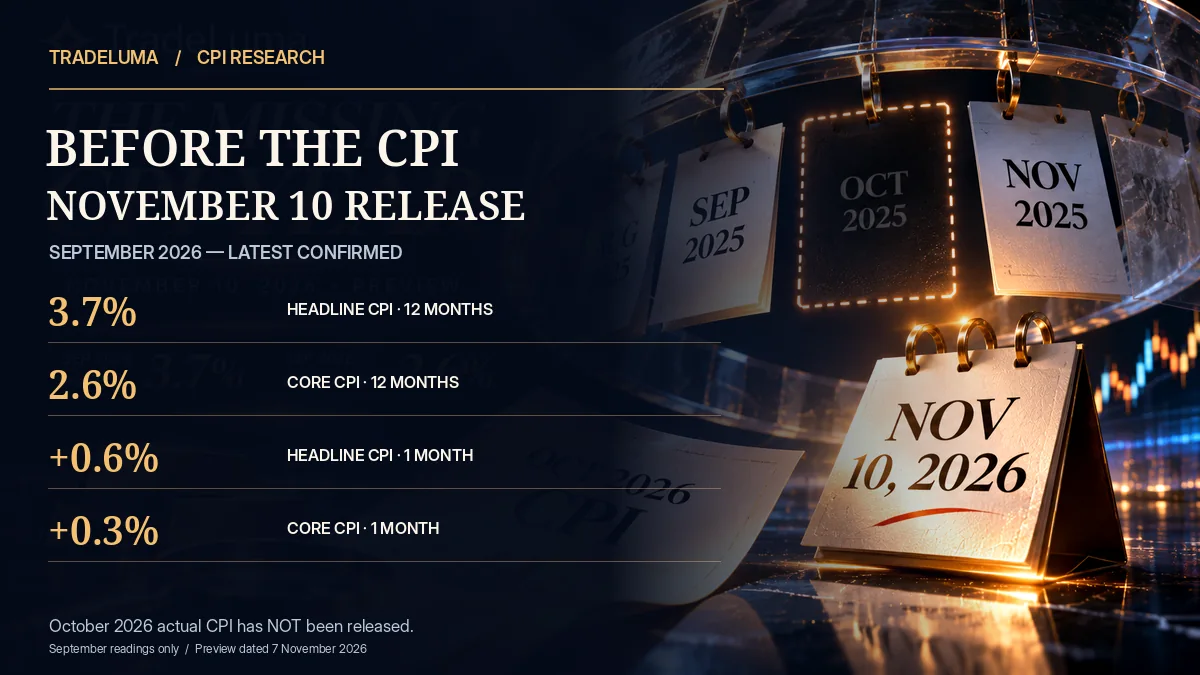
The BLS reported September 2026 headline CPI increasing 0.6% seasonally adjusted from August and 3.7% over the preceding 12 months. The headline acceleration was driven significantly by energy: the gasoline index rose 9.1% in September, contributing more than half the overall monthly headline increase, while the broader energy index increased 5.2%.
Core CPI, which excludes food and energy, rose 0.3% month on month and 2.6% over 12 months in September. Shelter rose 0.4% on the month. These are historical reference points. September's annual rates cannot be mechanically carried forward and labelled October annual rates, especially when October 2025 comparisons are unavailable.
Headline CPI versus core CPI: which is more important for November 10?
Headline CPI includes all sampled consumer categories, including volatile energy and food. Core CPI removes food and energy to reveal a less volatile measure of broad price momentum. Neither measure is a direct forecast of the Federal Reserve's preferred PCE inflation measure. Both can matter for household purchasing power and market pricing.
When energy prices rise sharply, headline CPI can accelerate even if core inflation is comparatively stable. Conversely, sticky services and shelter inflation can keep core readings elevated when oil prices retreat. The relative surprise to expectations in each component usually matters more than a simple 'hot' or 'cool' label.
Monthly CPI becomes especially important when annual comparisons are missing
A monthly inflation rate compares an index with the preceding month, usually using seasonally adjusted values. If October headline CPI rises less than September's 0.6% monthly gain, that could show deceleration, though it would not prove inflation has returned to target. A monthly core reading also helps assess whether underlying pressure is broadening or easing.
Traders should compare a released monthly value with the consensus estimate available immediately before the release and with several earlier months. Annualising a single month by multiplying by 12 can be misleading due to compounding, seasonality and volatility. An illustrative three-month annualised trend can be useful, but it must be clearly labelled and not presented as the missing official year-on-year reading.
Pre-release market expectations are forecasts, not facts
As of the November 7 publication date, economic previews were generally looking for roughly 0.3% month-on-month headline inflation and 0.2% for core in October, compared with 0.6% and 0.3% respectively for September. Different providers may publish different estimates, and consensus can change before November 10.
A 0.3% estimate is not the observed inflation rate. If the actual CPI is 0.3%, that outcome may be largely priced in; if the result differs materially, bond yields and the dollar may adjust. Cross-check the final pre-release median, read the details and avoid portraying a forecast as an official BLS figure.
Oil, gasoline and energy are the first CPI details to watch
September's 9.1% monthly gasoline increase and 5.2% overall energy increase made energy an unusually large driver of headline CPI. Changes in crude oil prices, refining costs, distribution, seasonality and supply disruptions can influence the next monthly readings, but retail fuel prices do not move perfectly with futures prices or with one month's oil change.
An energy-led upside CPI surprise can complicate Federal Reserve communications if it also raises inflation expectations. At the same time, policymakers may look through a temporary fuel shock if broader pricing and wage dynamics remain stable. The persistence of higher costs matters more than a single print.
Shelter, core services and goods inflation could change the interpretation
Shelter is a large CPI component and often reacts slowly to changes in current housing-market rents. The September shelter index increased 0.4% monthly, making October's shelter readings worth examining. Core goods, transportation services, vehicle prices, medical costs and travel-related categories can also contribute to shifts in the aggregate.
A stronger core CPI driven by a few volatile categories has a different implication from a broad acceleration across shelter and services. Reading the contributions and the detailed BLS table is therefore important, particularly in a month when the missing annual rates reduce the usefulness of the usual headline comparisons.
Why the Federal Reserve cares about CPI after strong payrolls
The October employment report released on November 6 showed a stronger-than-expected gain in payrolls, providing evidence of resilient labour demand. A firm CPI report following strong jobs data could raise investor expectations for tighter monetary policy or a longer period of high rates. Softer monthly inflation could challenge that assessment even if headline inflation remains above the target-consistent pace.
The Federal Reserve targets inflation measured by the Personal Consumption Expenditures price index, not CPI directly. Still, CPI provides an early and influential signal for future PCE readings. A single CPI release does not mechanically determine the December Federal Reserve decision; wages, employment, inflation expectations and financial conditions also matter.
How hotter-than-expected CPI can affect Treasury yields and the dollar
If October's monthly CPI is stronger than the prevailing forecast, investors may price a higher path for Federal Reserve rates, particularly at shorter maturities. That repricing can lift nominal Treasury yields and may also influence inflation-adjusted yields. A stronger expected US rate differential can support the dollar against other currencies.
These are conditional mechanisms, not guarantees. A CPI surprise dominated by temporary energy prices may affect inflation breakevens differently from real yields. Risk-off flows can also strengthen the dollar for reasons unrelated to interest-rate carry. Traders should examine two-year yields, ten-year yields, inflation expectations and the broad dollar rather than assuming one transmission channel.
Gold prices: why the real-yield response matters more than a headline
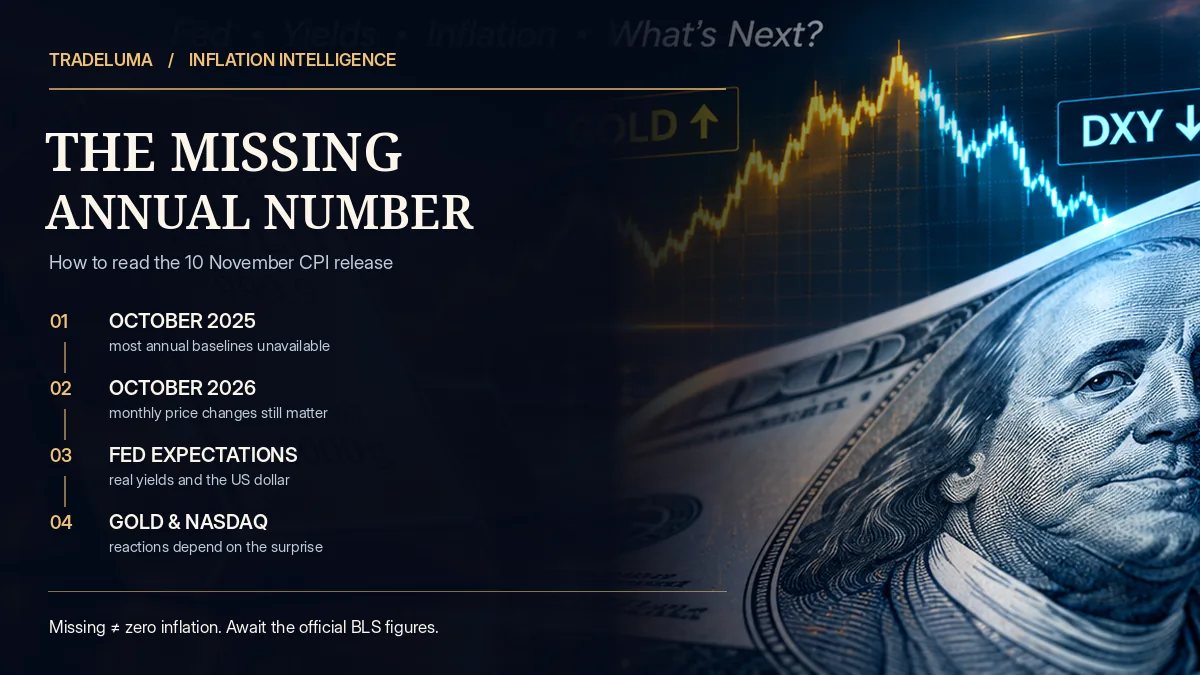
Gold pays no coupon or dividend. Higher expected real interest rates can increase the opportunity cost of holding gold and pressure prices, while lower real yields can provide support. A firmer dollar may also reduce the attractiveness of gold priced in dollars for non-US investors. This is why gold traders often monitor US TIPS real yields and currency changes alongside CPI.
Gold can nevertheless rise on a hot inflation print if investors become more worried about purchasing-power risk, fiscal uncertainty or geopolitical instability. Central-bank buying, physical demand and leveraged positioning add further influences. The familiar 'hot CPI equals gold down' rule is too simplistic to use as a standalone trade.
Nasdaq: higher discount rates versus resilient growth
Nasdaq futures and growth stocks can be sensitive to rising real yields because the present value of future earnings declines when discount rates increase. A CPI surprise that makes further tightening seem more likely can therefore pressure technology valuations. But strong demand or higher expected corporate earnings may sometimes offset the valuation drag.
A softer inflation print could support equities by lowering expected rates, yet it might be ignored if earnings or economic-growth fears are dominant. The same CPI release can produce very different outcomes for gold, US stocks and the dollar, depending on what was already priced into markets.
A release-day checklist for XAU/USD, gold futures and Nasdaq futures
Before 8:30 a.m. ET, confirm the event clock in your timezone, the most recent consensus for monthly headline and core CPI, the previous values, and current positioning in short-term rates. Distinguish a confirmed BLS print from headlines that mistake missing year-on-year data for zero. Check liquidity and potential price gaps.
After the release, compare actual versus expected monthly figures, examine shelter and energy drivers, and watch yields, real yields and the dollar before attributing market moves to a single cause. For an automated strategy, risk limits, order expiry, slippage and maximum exposure should be defined in advance rather than adjusted during a fast-moving candle.
Bottom line: the missing annual figure makes careful interpretation more important
The October 2026 CPI release is scheduled for November 10, and the most unusual detail is the missing October 2025 base data left by the federal shutdown. Most October 2026 12-month inflation changes therefore will not be published. Monthly headline and core CPI, together with the underlying details, remain informative.
For TradeLuma readers, the practical takeaway is to focus on the numbers BLS actually reports, the surprise versus expectations, and the reaction in real yields and the US dollar. An unavailable annual inflation number is not an inflation collapse and not an excuse to invent a figure. This is educational market analysis, not a directional trading recommendation.
Frequently asked questions
When will the October 2026 US CPI report be released?+
The US Bureau of Labor Statistics scheduled it for Tuesday, November 10, 2026 at 8:30 a.m. Eastern Time (12:30 a.m. AEDT on Wednesday, November 11 in Melbourne).
Why will year-over-year October 2026 CPI figures be missing?+
The 2025 government shutdown prevented BLS from publishing most October 2025 indexes. Without a comparable October 2025 value, most October 2026 12-month percent changes cannot be published.
Does missing annual CPI data mean US inflation is zero?+
No. Missing means the required comparison data are unavailable. It does not mean prices were unchanged, or that October 2026 CPI will not be released.
Will headline and core monthly CPI still be published?+
The BLS has scheduled the October CPI release and indicated the missing observations affect mainly 12-month comparisons. Traders should consult the official November 10 tables for the available monthly figures.
What was the last confirmed annual US headline CPI rate?+
For September 2026, headline CPI increased 3.7% over 12 months. That September figure is not an October result.
What was the last confirmed US core CPI rate?+
September 2026 core CPI increased 0.3% on the month and 2.6% over 12 months.
What are economists forecasting for October 2026 CPI?+
As of early November, previews commonly expected approximately 0.3% monthly headline and 0.2% monthly core CPI, but estimates can change. These are forecasts, not the BLS results.
Will higher CPI always make gold fall?+
No. Higher expected real yields and a stronger dollar can pressure gold, but inflation fears and safe-haven demand can produce the opposite reaction.
How can an October 2026 CPI surprise affect Nasdaq?+
CPI can change expected Federal Reserve rates and real yields, affecting growth-stock valuations. The net move also depends on earnings, growth expectations and market positioning.
Should traders calculate the missing October 2026 annual inflation figure themselves?+
A private estimate can be labelled as an estimate, but it should not be presented as the official BLS 12-month CPI rate. BLS will leave most affected annual comparisons unavailable.
Futures workflows
Explore the strategy side of TradeLuma.
Browse TradeLuma's futures strategy catalogue and the chart, rollover, and reference methodology used for each published strategy.
Explore futures strategies →Continue learning
Related guides.

US Jobs Report October 2026: Why 165,000 Payrolls Moved Gold, Nasdaq and Fed Expectations
October 2026 nonfarm payrolls rose 165K, unemployment fell to 4.1% and wages grew 0.4%. Understand the November 6 jobs report and its effects on gold and Nasdaq.
CPI vs PCE Inflation Explained: Why Gold, Nasdaq & Futures React
Learn how US CPI and PCE inflation differ, what headline and core readings reveal, and why surprises can move gold, Nasdaq and Treasury futures.

Bank of England Raises Rates to 4% in November 2026: Why GBP, Gold and Markets Care
The Bank of England raised Bank Rate to 4% on 5 November 2026. Explore its 8–1 vote, UK inflation outlook, GBP/USD, gilts and implications for gold and Nasdaq.