
Macro & Markets
US Jobs Report October 2026: Why 165,000 Payrolls Moved Gold, Nasdaq and Fed Expectations
October 2026 nonfarm payrolls rose 165K, unemployment fell to 4.1% and wages grew 0.4%. Understand the November 6 jobs report and its effects on gold and Nasdaq.
On this page+
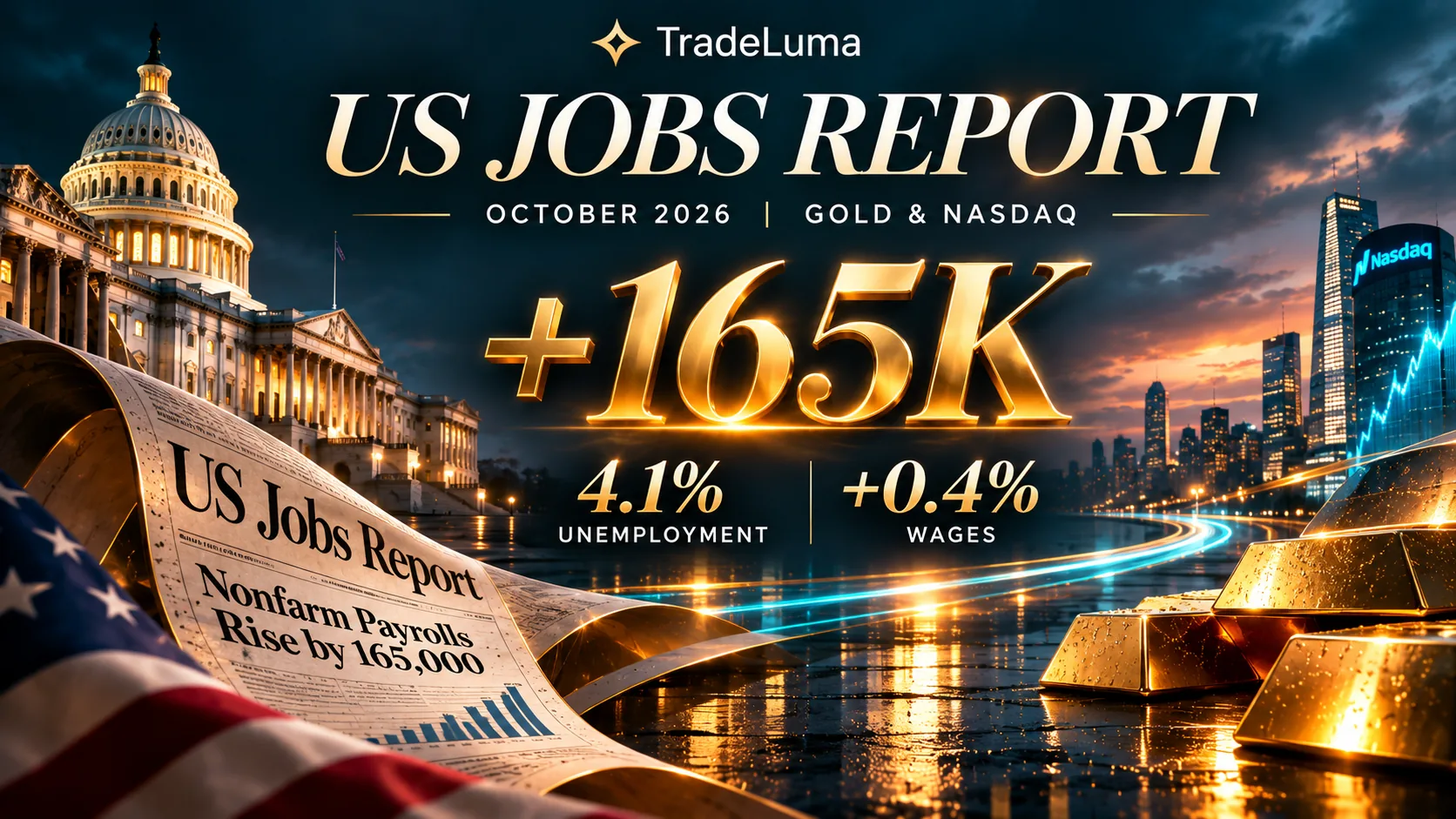
The United States added 165,000 nonfarm payroll jobs in October 2026, the Bureau of Labor Statistics reported on Friday, November 6, at 8:30 a.m. Eastern time. The unemployment rate edged down to 4.1% from 4.2%, and average hourly earnings increased 0.4% for the month and 3.1% over a year. August and September payrolls were revised upward by a combined 84,000 jobs, adding weight to the report's surprisingly firm picture of hiring. These figures mattered because traders were already debating whether inflation and the labour market would prompt another Federal Reserve increase in interest rates. This guide separates the official employment statistics from market interpretations, explains why Treasury yields and the dollar reacted, and shows why gold and Nasdaq do not always trade in opposite directions after NFP.
October 2026 nonfarm payrolls: what the November 6 release actually showed
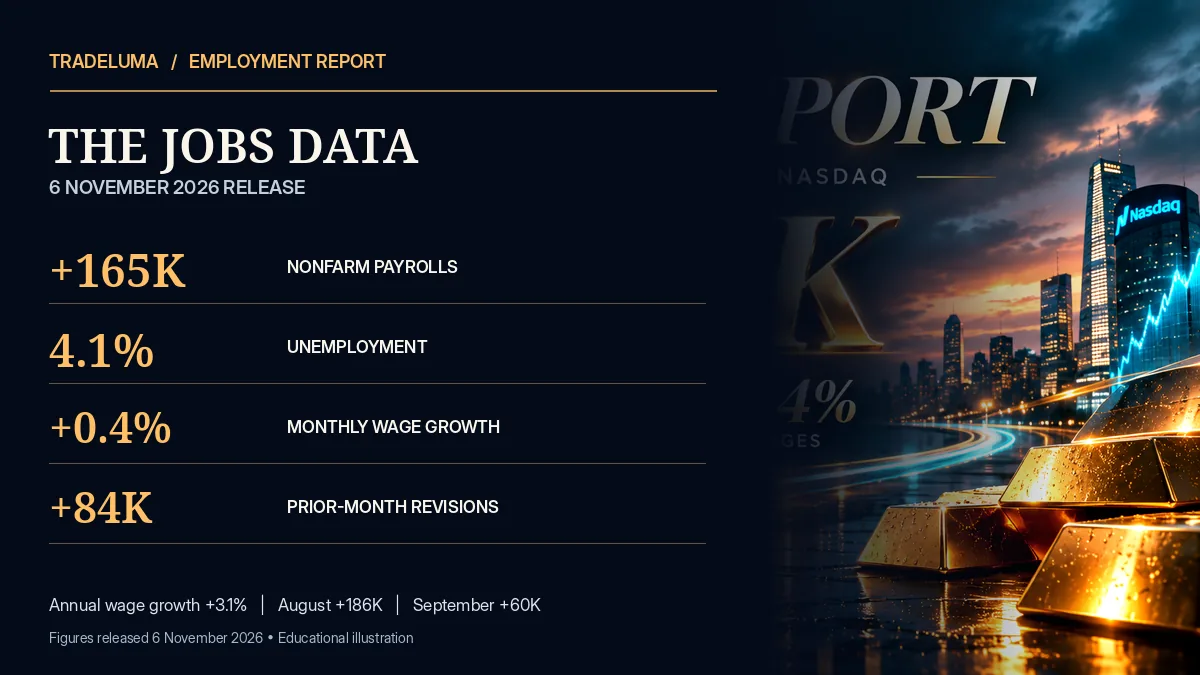
Total nonfarm payroll employment rose by 165,000 in October, according to the US Bureau of Labor Statistics. This followed a revised increase of 60,000 in September and 186,000 in August. The unemployment rate, which comes from a separate household survey, was 4.1%. The report was released on Friday, November 6, 2026, at 8:30 a.m. New York time.
Market surveys had broadly looked for a substantially smaller gain, around 60,000 to 65,000 jobs, although estimates differed by source. Consequently, the important market signal was not merely that employment rose: the increase was far above what many investors had priced. Wage growth and revisions made the broader message more significant.
What does a 165,000 payroll gain mean?
Nonfarm payrolls, commonly called NFP, estimate the change in the number of paid employees at US businesses and government agencies, excluding certain categories such as farm workers and the self-employed. It is not a count of every new job advertisement or a measure of how many people entered the workforce. The establishment survey and its seasonal adjustments are designed to track broad employment trends.
The 165,000 gain was well above the previous 12-month average monthly increase of 48,000. That comparison indicates an acceleration relative to the recent trend, but one month is not evidence of a permanent hiring boom. Revisions, sector concentration, population dynamics and later releases can change the interpretation.
Unemployment at 4.1%: why payrolls and the jobless rate are different
The headline unemployment rate eased by 0.1 percentage point to 4.1% from 4.2% in September. It is measured using a household survey rather than the employer survey used for payrolls. A person can be unemployed under the survey's definition if they are not working, are available for work and have actively sought employment within the relevant period.
Employment growth and unemployment can sometimes move in seemingly inconsistent directions because the two surveys measure different concepts and have sampling error. The participation rate stood at 61.9% in October. Read these indicators together rather than expecting them to produce identical messages each month.
Why average hourly earnings at +0.4% mattered for inflation expectations
Average hourly earnings increased 14 US cents, or 0.4%, to $38.00 for private nonfarm employees during October. Over the year, earnings were up 3.1%. The average weekly workweek was unchanged at 34.4 hours. These measures help investors gauge labour-cost pressure alongside hiring levels.
A single strong monthly wage number does not mean consumer prices will rise by the same amount. Wages can reflect changing employment composition, productivity and bargaining conditions. However, if stronger earnings growth persists without offsetting productivity gains, markets may judge the path back to the Federal Reserve's 2% inflation goal to be more challenging.
The overlooked part of the report: August and September revisions
August's payroll estimate was lifted from 133,000 to 186,000, an upward revision of 53,000. September was revised from 29,000 to 60,000, an increase of 31,000. Together, the revisions added 84,000 jobs to the previously published total for those two months.
Revisions can matter almost as much as the new headline because central banks assess trends rather than isolated points. An already-firm current-month result paired with improvements to prior figures can challenge a narrative of labour-market deterioration. But upward revisions in one release do not guarantee the estimates will never change again.
Which US industries were hiring in October?
Professional and business services added about 70,000 jobs, including growth in professional, scientific and technical services and administrative support. Health care gained 42,000 jobs, including hospitals and home health care. Transportation and warehousing expanded by about 25,000, with couriers and messengers a significant contributor.
Manufacturing continued to trend higher, adding approximately 19,000 jobs in October. Gains concentrated in several industries can still support the overall economy, but they are different from an evenly distributed increase across every sector. Traders should distinguish cyclical hiring from structural demand for health services or logistics workers.
How the employment report changes Federal Reserve interest-rate expectations
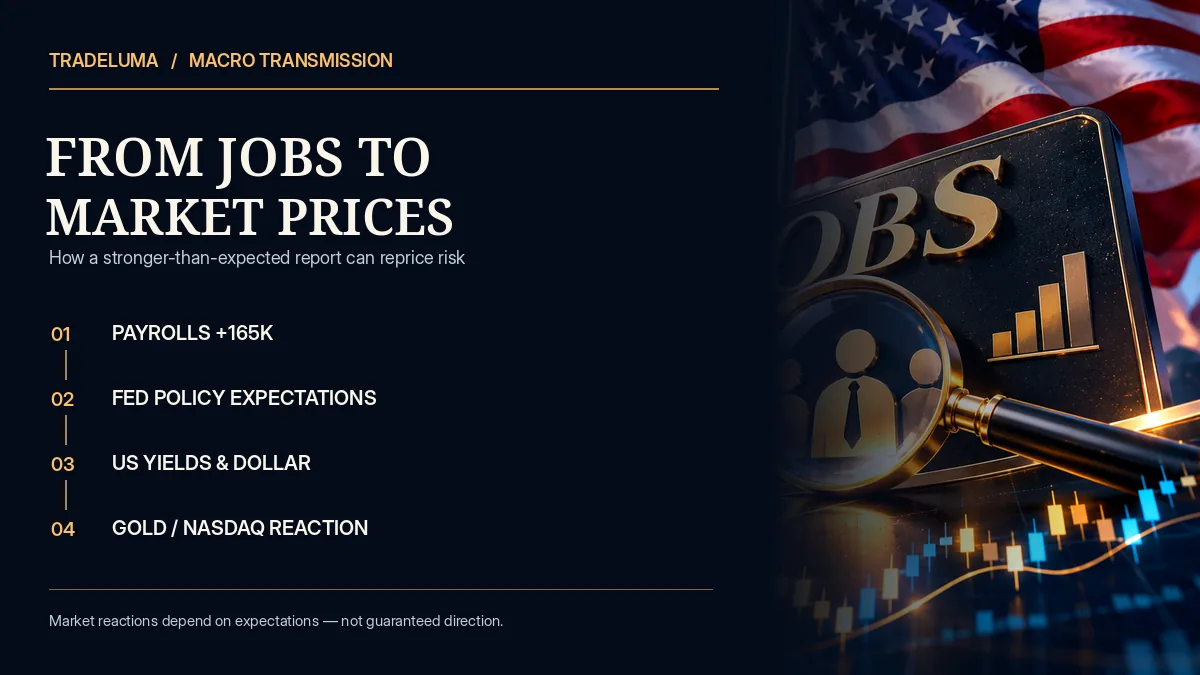
The Federal Reserve has a dual mandate: maximum employment and stable prices. A stronger jobs report may reassure policymakers that the labour market can withstand tighter monetary policy and give more weight to inflation risks. Investors can respond by revising the expected probability, timing or magnitude of future rate moves.
That does not mean the Federal Reserve is compelled to hike because payrolls exceeded forecasts. Policymakers also examine CPI, PCE inflation, labour-force participation, wage measures, financial conditions and many other indicators. The policy outlook is conditional; a market-implied probability is a snapshot of pricing, not a promise from the Fed.
Treasury yields and the dollar: the transmission mechanism
When markets expect tighter future monetary policy, shorter-maturity Treasury yields can rise, and changes may also influence longer-dated nominal and inflation-adjusted yields. The dollar can strengthen if US interest-rate differentials widen relative to other economies, but foreign policy developments and safe-haven flows can complicate the picture.
Following the November 6 report, bond yields and the dollar rose as traders assessed a higher probability of additional tightening. There is no mechanical fixed-size response: it depends on the surprise, what was priced beforehand, other market news and how different parts of the yield curve reprice.
Why gold can fall after a stronger-than-expected NFP
Gold does not pay interest. If a strong employment surprise pushes real yields higher, the opportunity cost of holding gold can increase. A stronger US dollar may also reduce the dollar price of gold for a given level of foreign-currency demand. These are common reasons traders look first at real Treasury yields and the dollar when gold reacts to payroll data.
However, gold can behave differently when geopolitical risks, central-bank purchases, physical demand or a sharp deterioration in risk sentiment dominates. The first minute after NFP can contain liquidity shocks and reversals. A strong headline should never be treated as a guaranteed sell signal for XAU/USD or gold futures.
Why Nasdaq may rise even when a strong jobs report pushes yields up
Technology and other long-duration growth stocks can be sensitive to the discount rates used to value future cash flows. Higher real yields may weigh on those valuations. But an improving labour market can simultaneously support consumption, corporate revenue and earnings expectations, creating an offsetting influence.
On November 6, technology shares rebounded even as Treasury yields firmed, demonstrating the competing forces. Individual earnings, the earlier technology sell-off and expectations about policy and regulation also matter. Investors should not equate a rising Nasdaq with proof that the market interpreted payrolls as dovish.
How NFP differs from JOLTS, ADP and weekly jobless claims
The establishment-survey NFP number estimates payroll employment changes. The household-survey unemployment rate provides a separate picture of people seeking work. JOLTS measures job openings, hires, quits and separations, while weekly initial unemployment claims monitor new applications for unemployment insurance.
These measures can lead or lag one another. An increase in vacancies without a corresponding increase in hires may not translate immediately into payroll growth. It is useful to compare several reports over time and account for their definitions, coverage and revision characteristics.
Why the first five minutes of NFP trading can be misleading
The opening reaction after a major data release often reflects thin liquidity, automated headline parsing, repricing of rates futures and positioning. The first price spike in gold or Nasdaq futures is not necessarily the market's settled interpretation. Large bid-ask spreads, slippage and price reversals can occur before the bond and currency markets digest the details.
Rather than chasing the headline, compare the release to consensus and check the revisions, unemployment rate, wage growth, Treasury yields and dollar response. If trading an automated strategy, set exposure caps, loss limits, order-entry expiry and escalation rules before the announcement. Historical data cannot guarantee how a future release will trade.
What to watch after the October jobs report
The October CPI release was scheduled for Tuesday, November 10, 2026, and would provide another important input into the inflation outlook. The next US Employment Situation release, for November, was scheduled for Friday, December 4, 2026. Market participants would also monitor claims, PCE inflation, central-bank communications and the December Federal Reserve meeting.
Future data could reinforce or reverse the November 6 interpretation. For example, sustained wage pressure and stubborn inflation might support a restrictive rate path, while falling inflation or employment deterioration could shift the balance. Markets update continuously as information arrives.
A practical checklist for gold and Nasdaq traders around payrolls
Before the release, record the report time in your local trading timezone, consensus payroll and wage forecasts, the prior month's published figures and the expected policy path in rates markets. Identify whether the trading thesis depends primarily on real yields, the US dollar, earnings expectations or a combination of them.
After the release, compare actual versus expectations, inspect prior-month revisions, and distinguish the establishment survey from household measures. Observe two-year and ten-year Treasury yields, real yields and the dollar before interpreting moves in gold or Nasdaq. A defined maximum risk and a willingness not to trade are legitimate outcomes.
Bottom line: the payroll surprise matters more than any simplistic rule
The November 6 report showed October employment growing by 165,000, unemployment easing to 4.1%, wages rising 0.4% month on month and prior-month payroll estimates revised up 84,000. The combination supported the view that the US labour market was more resilient than many investors had expected.
For gold and Nasdaq, the relevant transmission runs through changing Federal Reserve expectations, bond yields, the dollar and company earnings prospects. Those channels can conflict, especially during geopolitical uncertainty or technology-sector volatility. The numbers are meaningful economic context, not an automatic instruction to buy or sell.
Frequently asked questions
What was the US nonfarm payrolls result for October 2026?+
The Bureau of Labor Statistics reported an increase of 165,000 nonfarm payroll jobs for October 2026, published on November 6, 2026.
When was the October 2026 jobs report released?+
Friday, November 6, 2026 at 8:30 a.m. US Eastern time.
What was the October 2026 unemployment rate?+
The US unemployment rate was 4.1%, compared with 4.2% in September.
How much did US wages increase in October 2026?+
Average hourly earnings rose 0.4% month on month, or 14 cents to $38.00, and were 3.1% higher than a year earlier.
Were earlier US payroll numbers revised?+
Yes. August was revised up to 186,000 and September to 60,000, adding 84,000 to their previous combined estimates.
Does stronger NFP data automatically make gold fall?+
No. Higher real yields or a stronger dollar can pressure gold, but safe-haven demand, positioning and other forces can outweigh those relationships.
Is a strong jobs report bullish or bearish for Nasdaq?+
It can support earnings expectations while pushing discount rates higher. Nasdaq's reaction depends on the surprise, yields and broader market conditions.
What is the difference between nonfarm payrolls and JOLTS?+
NFP estimates monthly payroll job changes. JOLTS estimates job openings, hires, quits and other separations.
What employment report follows the October 2026 release?+
The BLS scheduled its November 2026 Employment Situation release for December 4, 2026 at 8:30 a.m. Eastern time.
Does a 165,000 payroll gain mean unemployment fell by 165,000?+
No. The payroll gain and the unemployment rate come from different surveys and use different definitions.
Put it into practice
Use the risk maths next to the guide.
Open TradeLuma's free position-size, risk/reward, expectancy, and drawdown tools to test the numbers behind a risk-management decision.
Open free trading calculators →Continue learning
Related guides.
Nonfarm Payrolls (NFP) Explained: Why Jobs Data Moves Gold & Nasdaq
Learn what US nonfarm payrolls, wages, unemployment and revisions mean, and why NFP surprises can move gold, Nasdaq and Treasury futures.

US CPI November 2026 Preview: Why October's Annual Inflation Data Are Missing—and What Gold and Nasdaq Traders Should Watch
US October 2026 CPI arrives 10 November. Learn why most annual CPI rates will be unavailable, what monthly inflation shows, and the implications for gold, Nasdaq and Fed rates.

JOLTS Job Openings Explained: Why Labour Data Moves Gold, Nasdaq and Fed Expectations
Understand the US JOLTS report, September 2026 job openings, quits and layoffs, and how labour-market surprises affect Fed rates, gold and Nasdaq.