
Macro & Markets
SOFR Futures Explained: How Traders Price Future Interest Rates
Learn how SR3 futures convert price to implied rates, how cash settlement works and why SOFR expectations differ from FedWatch.
On this page+
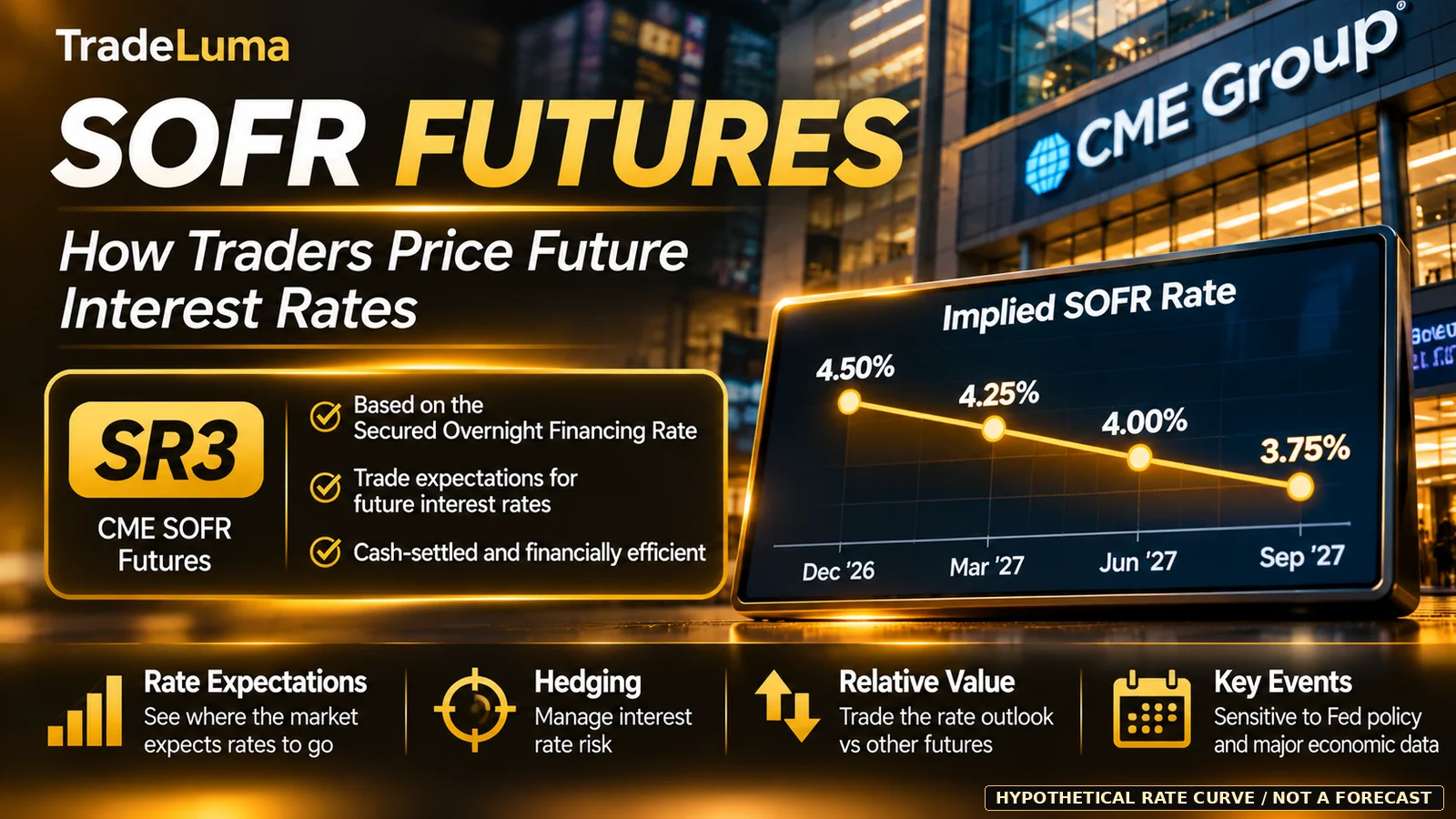
Three-Month SOFR futures, known by the CME symbol SR3, provide a market-based view of expected short-term US dollar financing rates. A futures price can be converted into an implied annualised rate, but it should not be mistaken for a guaranteed Federal Reserve decision.
What SOFR actually measures
The Secured Overnight Financing Rate measures overnight cash borrowing secured by US Treasury collateral. It is a transaction-based benchmark published by the New York Fed. The Federal Reserve's target range influences financing conditions, but SOFR is not the federal funds target rate.
The 100 minus rate formula
Subtract the contract price from 100. An illustrative quote of 96.25 implies 3.75%; a quote of 95.75 implies 4.25%. A price increase therefore corresponds to a decline in the implied rate. The rate applies to the defined reference period, not necessarily the calendar month written next to the symbol.
How SR3 settles
CME settles the contract financially using the compounded daily benchmark over the reference quarter, annualised under the exchange methodology. During the quarter, some observations are already known and others remain uncertain. A futures rate is therefore not simply the expectation for the last day of the contract.
Reading a strip of futures
Comparing consecutive reference quarters can reveal how short-term rates are priced over time. A declining implied-rate curve may suggest anticipated easing, but risk premiums, liquidity and funding conditions matter. The illustration accompanying this article uses hypothetical rates, not actual current market pricing.
SOFR versus FedWatch
FedWatch uses federal funds futures and meeting assumptions to estimate probabilities of policy outcomes. SOFR futures reflect secured financing rates over their own periods. Comparing the two can reveal differences in what is priced, but treating each SOFR contract as a direct meeting probability is incorrect.
Why equity and metals traders monitor rates
A change in financing expectations can influence Treasury yields, the dollar and equity valuations. Compare SOFR futures with ZN, ZB and UB rather than assuming all rates instruments move identically. Gold or Nasdaq reactions can differ depending on why rates change. Backtesting any cross-market rule requires aligned timestamps and realistic execution assumptions.
How a price change translates into dollars
A three-month SOFR contract has a standard value of $25 per basis point of the annualised rate. In a hypothetical trade, buying at 96.25 and selling at 96.35 produces a 0.10 price-point gain, equivalent to ten basis points and $250 per contract before fees. Selling first and buying back at the higher price would produce the opposite result. The quoted minimum increment can depend on the contract's proximity to the reference period and exchange rules, so distinguish the dollar value of a basis point from the minimum permitted tick. Do not multiply the quoted index by a stock-style share quantity. Before using an order ticket, verify the precise product and applicable market rule. Interest-rate futures are leveraged instruments even when their numerical quotes change by small amounts.
Why the reference quarter matters
Three-month contracts refer to a defined accrual period rather than an arbitrary three-month forecast starting today. As the period progresses, the settlement calculation increasingly reflects benchmark observations that have already occurred. For illustration, consider a simplified quarter in which funding rates are near four percent during the first half and near three and a half percent during the second half. An approximate simple average would be 3.75 percent, although the official settlement uses compounded daily rates and the prescribed day-count treatment. A policy decision near the end of the reference period therefore affects fewer days than a similar decision near its beginning. To interpret contract pricing around central bank meetings, first locate the reference dates and the number of days affected by each possible policy change.
Different contracts answer different questions
One-month SOFR futures and three-month SOFR futures use different reference periods and settlement calculations. A short-dated contract can be useful for evaluating expected funding conditions near a particular month, while a quarterly contract blends a longer interval. Federal funds futures refer to a different overnight benchmark, and Treasury futures reflect longer-duration deliverable securities. These distinctions are essential when comparing an implied rate with a Federal Reserve target range. A quoted 3.75 percent on one contract is not a direct statement that policymakers will set the target exactly at that number. Compare the full strip of relevant contracts, document the basis between benchmarks, and examine which scheduled decisions fall inside each reference period. If markets price uncertainty, a single observed number can be consistent with multiple future paths.
Using the curve as a research input
Collect historical closing or settlement quotes for successive contracts at consistent times. Convert each to an implied annualised rate and calculate changes over a chosen observation window. Avoid using a continuous series that jumps from one reference quarter to another without accounting for the change in underlying horizon. A useful hypothesis might ask whether unexpected increases in implied rates coincide with weaker growth-stock returns over the following session. Define the observation timestamp, transaction assumptions and benchmark before running that test, then assess whether the result survives out-of-sample validation. A change that reflects economic strength can have a different equity effect from a change driven by unexpected inflation or funding stress. If the hypothesis fails, the curve can still provide informative macro context rather than a stand-alone entry signal.
Frequently asked questions
What does a price of 96 mean?+
An implied annualised contract rate of 4%.
Does SOFR equal the Fed policy rate?+
No. It measures secured overnight funding conditions.
Are SR3 futures physically delivered?+
No. They are cash settled under CME rules.
Does a higher SR3 price imply higher rates?+
No. The 100-minus-rate quotation implies lower rates.
Can SOFR futures guarantee future rate cuts?+
No. Pricing changes as information and market conditions evolve.
Is a basis point the same thing as an SR3 tick?+
No. A basis point is 0.01 percentage point in an annualised rate. The permitted minimum futures price increment may be a fraction of that unit under the applicable exchange rules.
What happens when part of the SOFR reference period has already elapsed?+
Past benchmark observations contribute to final settlement, so the remaining uncertainty relates to the future portion of the period and its compounding. Check the actual contract dates rather than using the entire quote as a fresh forecast.
Futures workflows
Explore the strategy side of TradeLuma.
Browse TradeLuma's futures strategy catalogue and the chart, rollover, and reference methodology used for each published strategy.
Explore futures strategies →Continue learning
Related guides.
December 2026 Fed Rate Decision: FedWatch Probabilities, Gold, Nasdaq & FOMC Scenarios
Preview the Dec 8–9, 2026 FOMC decision: FedWatch futures probabilities, current 3.75–4% Fed rate, a hawkish vs dovish outcome and gold/Nasdaq scenarios.
Bank of England Raises Rates to 4% in November 2026: Why GBP, Gold and Markets Care
The Bank of England raised Bank Rate to 4% on 5 November 2026. Explore its 8–1 vote, UK inflation outlook, GBP/USD, gilts and implications for gold and Nasdaq.
Gold Price vs Real Yields: How the US Dollar and Fed Rates Move Gold
Understand why gold reacts to real Treasury yields, the US dollar, inflation and Fed rate expectations—and when the usual relationships fail.