
Macro & Markets
December 2026 Fed Rate Decision: FedWatch Probabilities, Gold, Nasdaq & FOMC Scenarios
Preview the Dec 8–9, 2026 FOMC decision: FedWatch futures probabilities, current 3.75–4% Fed rate, a hawkish vs dovish outcome and gold/Nasdaq scenarios.
On this page+
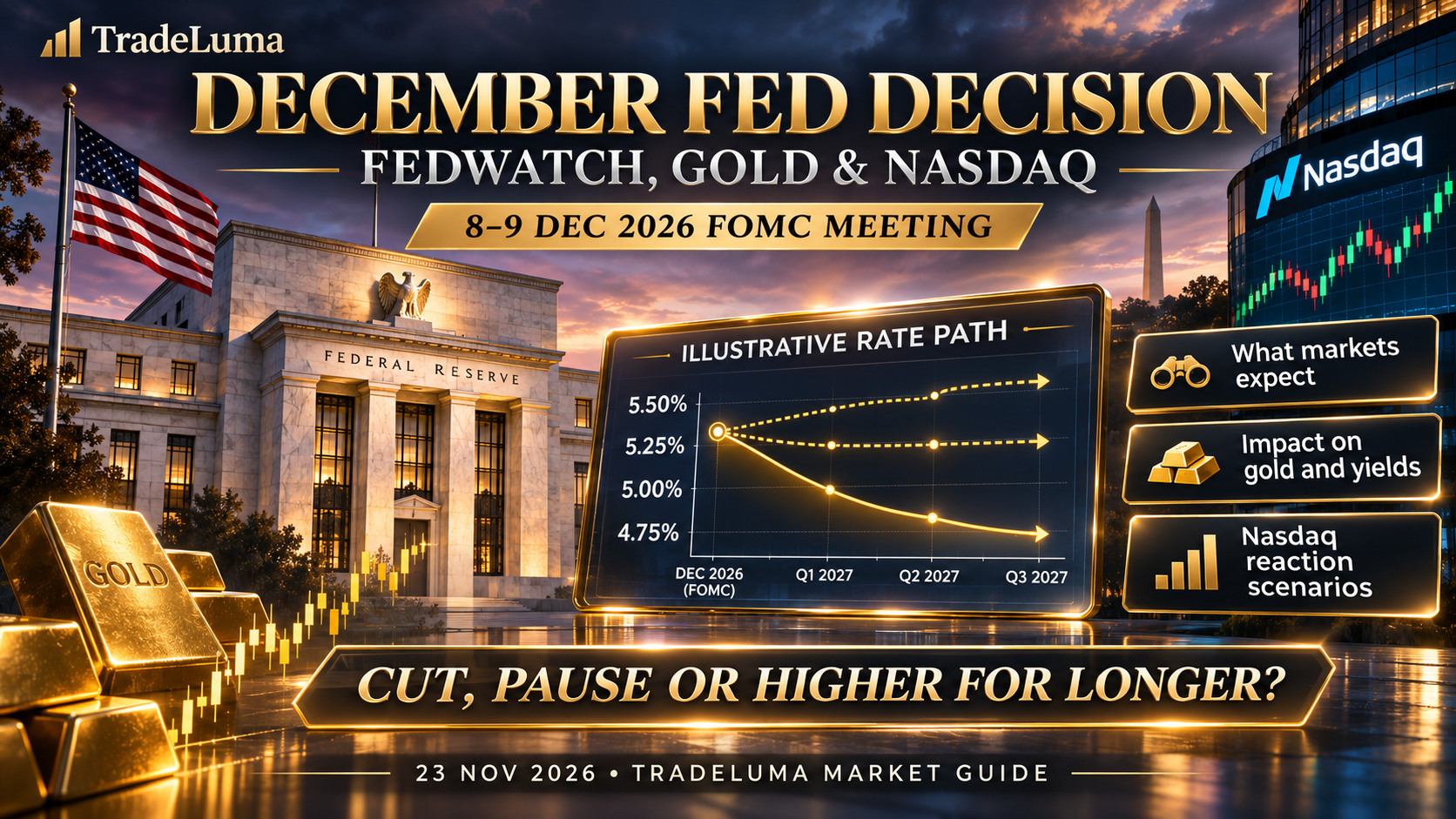
The next Federal Open Market Committee meeting is scheduled for 8–9 December 2026, with the rate decision and statement due Wednesday 9 December at 2:00 p.m. Eastern Time and the press conference at 2:30 p.m. Eastern. Following its 28 October meeting, the Federal Reserve's target range stood at 3.75%–4.00%. The minutes published 18 November showed growing concern about persistent inflation and discussion of whether additional tightening would be appropriate, making the approaching decision a potential catalyst for US Treasury yields, the dollar, gold and Nasdaq futures. The CME FedWatch Tool translates 30-Day Fed Funds futures into probabilities for policy-rate outcomes, but those probabilities change with market prices and are not a prediction guaranteed to come true. This 23 November TradeLuma preview focuses on confirmed meeting dates, official Fed communications, scenarios and practical ways to read the market without inventing a live FedWatch percentage.
When is the December 2026 Federal Reserve decision?
The Fed's published calendar lists a two-day FOMC meeting on Tuesday 8 and Wednesday 9 December 2026. The policy statement is scheduled for 2:00 p.m. US Eastern Time on Wednesday, with the accompanying press conference at 2:30 p.m. Eastern. These are scheduled release times, not evidence that a particular rate decision has already been made.
This meeting is especially relevant because it is the final scheduled FOMC meeting of 2026, and the regularly scheduled year-end economic projections can put the near-term decision in the context of longer-run inflation, growth, employment and interest-rate expectations. Check the official Fed website for any change in timing.
The latest confirmed Fed policy range entering the meeting
At the October 27–28 meeting, the FOMC maintained the target federal funds rate at 3¾% to 4%. The Federal Reserve's 28 October statement is the authoritative record of that decision. A rate of 3.75%–4.00% is a target range; it is not the interest rate on every mortgage, Treasury bond or savings account.
The October minutes were released on 18 November. They described policymakers' concerns about inflation persistence and included discussion of the possible need for further tightening. Those statements are evidence about the committee's deliberations in October, not a binding vote for what the committee will choose in December.
What does CME FedWatch measure?
CME FedWatch takes market prices in 30-Day Federal Funds futures and derives an implied distribution of possible target-rate outcomes for upcoming FOMC dates. The contracts reflect expectations for the average effective federal funds rate over a calendar month. The methodology uses assumptions about 25-basis-point policy increments and the relationship between the target range and effective rate.
FedWatch probabilities are market-implied estimates under a model, not polling results, an official Fed forecast or promises from traders. A displayed percentage can change intraday following economic data, statements, Treasury moves or trading activity. Always record the observation date and time before quoting one.
Why this preview does not invent a 2026 hike probability
An image showing rate paths or a past news article citing odds should not be read as the live current FedWatch distribution. Without a directly timestamped feed, TradeLuma will not treat an illustrative 60%, 75% or 90% number as current fact. The useful question is how the probabilities change between comparable snapshots and which alternative outcomes the market has already priced.
For practical use, open CME's current FedWatch page, select the December meeting and note the indicated target bands and timestamp. Compare those odds with the most recent economic releases. A rise in the implied chance of a hike indicates a change in pricing, not certainty that the Fed will act.
Three rate-decision scenarios for 9 December
Scenario one: the Fed holds the target at 3.75%–4.00% but signals future increases remain possible. This can still be perceived as hawkish if investors expected a softer statement. Scenario two: a standard 25-basis-point increase takes the range to a hypothetical 4.00%–4.25%; the market response depends on whether it was already anticipated and how the Fed describes further action.
Scenario three: an unexpectedly forceful move or message could reprice the entire front end of the Treasury curve. A larger-than-usual change or a distinct shift in projections should be analysed against the committee's published decision and accompanying explanation. These scenarios are analysis tools, not forecasts of what will occur.
Hawkish and dovish outcomes are relative to expectations
A hawkish surprise can occur even without a rate rise. If traders expected imminent easing, a steady rate paired with language emphasising persistent inflation might lift short-term yields. Likewise, a 25-basis-point hike that is widely expected could be followed by lower yields if policymakers clearly communicate that further hikes are unlikely.
The relevant market variable is the difference between prior expectations and new information. Comparing the FOMC decision solely with an outdated policy-rate forecast misses changes in language, inflation projections, unemployment assumptions and the pace of potential future policy moves.
Gold: real yields, dollar and risk appetite
Gold has no contractual coupon. When real interest rates rise, the opportunity cost of holding a non-yielding asset may increase, potentially weighing on gold prices. A stronger US dollar can also reduce foreign-currency demand at the margin. A hawkish Fed surprise therefore often puts pressure on gold in the simplest textbook framework.
However, this relationship is not mechanical. A sufficiently alarming inflation outlook can lift demand for inflation hedges; a financial-stability shock can attract safe-haven interest despite a strong dollar; and positioning can dominate short-term moves. Analyse real Treasury yields, the dollar, market expectations and actual GC/MGC futures trading rather than assuming gold must fall after every hike.
Nasdaq 100 and NQ futures: valuation versus earnings
Nasdaq-100 constituents include many businesses whose valuations depend on expectations for future earnings and long-duration cash flows. Higher expected interest rates or bond yields can pressure those valuations when other assumptions are unchanged. NQ futures can therefore move rapidly around a Fed statement, sometimes ahead of or independently from the cash Nasdaq market.
But the Nasdaq is not a pure interest-rate instrument. Positive growth news can raise yields and support earnings expectations at the same time. A decision can also influence semiconductor and data-center valuations differently from defensive shares. Examine the two-year Treasury yield, broad equity reaction, volatility and sector leadership rather than using a one-variable rule.
What changes if the dot plot shifts?
At meetings that include economic projections, the Fed's Summary of Economic Projections can show policymakers' individual assessments of appropriate future rates, inflation, growth and unemployment. The median projected path can shift even when the current rate decision is unchanged. Dots are participants' projections, not promises or a committee-approved rate schedule.
A higher median future policy path may signal a willingness to maintain restrictive conditions for longer. Markets can respond to changes in the expected 2027 or 2028 path more strongly than to an already anticipated December decision. Compare each projection round to the prior one and consider the dispersion of views, not just the median.
The December meeting and the yield curve
The front end of the Treasury curve tends to be sensitive to near-term Fed policy expectations, while ten-year and longer yields also reflect inflation expectations, term premium, fiscal conditions and broader supply-demand. A hawkish Fed statement might lift two-year yields more than ten-year yields; it could also produce different effects if recession fears rise.
Therefore, a single 10-year yield move cannot explain the complete policy surprise. Compare two-year and ten-year rates, real yields, the US dollar and Fed futures pricing together. For futures traders using Treasury contracts, keep the different interest-rate sensitivities of ZT, ZF, ZN and ZB in mind.
Melbourne, Sydney and Australian trading times
During the meeting on 9 December 2026, New York is on Eastern Standard Time (UTC−5), while Melbourne and Sydney are on Australian Eastern Daylight Time (UTC+11). The time difference is 16 hours. The scheduled 2:00 p.m. EST statement on Wednesday converts to Thursday 10 December at 6:00 a.m. AEDT; the 2:30 p.m. press conference is 6:30 a.m. AEDT.
An automated schedule should use America/New_York and Australia/Melbourne time zones rather than a permanent UTC offset. This conversion is specifically for December 2026; when either country changes daylight saving the same ET clock time corresponds to a different Australian local time.
Trading volatility around the statement and press conference
A market can move quickly on the 2:00 p.m. statement, reverse during the 2:30 p.m. press conference, and continue repricing as bond liquidity develops. Stop orders are instructions, not guaranteed execution prices, and a stop-limit may remain unfilled if the market trades through its specified limit.
For NQ, ES, GC or MGC positions, check product-specific tick value, available margin, spread and the liquidity of the actual contract month before entry. A TradingView alert's timestamp and the broker's order acknowledgement are separate events. If a connection drops during a high-volatility release, reconcile existing orders before retrying.
How to use FedWatch without confusing probability and advice
Document the tool snapshot time, meeting selection, possible target ranges, and the distinction between probabilities of individual outcomes versus cumulative chances of a hike or cut. If the rates can change by 25 basis points, some paths can involve multiple meetings and assumptions about the average effective rate for the relevant futures month.
FedWatch does not answer whether a particular gold or Nasdaq trade offers positive expected value. An implied central-bank outcome may already be embedded in market prices, so a profitable strategy requires an independent view on positioning, catalysts, risk and execution costs.
What to watch between 23 November and 9 December
Review scheduled US inflation releases, labour-market figures, fiscal and tariff news, financial conditions and official Federal Reserve communications. The November 18 October-meeting minutes are already public, while the December statement and press conference are future events. Distinguish a confirmed historical release from a projection when writing a time-sensitive headline.
Around the meeting, watch how the market's interpretation changes across FedWatch, two-year yields, DXY, spot gold and liquid equity-index futures. Updating an article after the decision should clearly mark the update date and compare expectations with the actual announcement instead of silently replacing the original November 23 preview.
Sources of truth and limits of this pre-meeting guide
The Federal Reserve's 2026 calendar is the source for the FOMC date and release times. Its 28 October statement and 18 November minutes provide the confirmed policy baseline. CME Group's FedWatch and methodology documents explain how futures-implied market probabilities are calculated. These records are distinct from commentators' expectations and illustrative chart pathways.
This article is a dated educational preview for 23 November 2026; it does not claim to know the December decision in advance, it does not state an unverified live FedWatch percentage, and its market-outcome scenarios are not investment advice. If the Fed reschedules a release or CME updates its methodology, the relevant official notice controls.
Frequently asked questions
When is the December 2026 Fed rate decision?+
The FOMC meets December 8–9, with the decision scheduled Wednesday December 9 at 2:00 p.m. US Eastern Time.
What is the current Fed target rate before December 2026?+
The most recent completed decision on October 28 set a 3.75%–4.00% target range, as of November 23, 2026.
What are the FedWatch odds of a December rate hike?+
They change as federal funds futures prices change. Check a timestamped CME FedWatch snapshot rather than relying on a number printed in an illustrative chart.
What would a 25-basis-point hike mean?+
A hypothetical increase from 3.75%–4.00% would bring the Fed's target range to 4.00%–4.25%.
Will gold rise or fall after the December Fed meeting?+
Not deterministically. Real yields, the dollar, inflation concerns, positioning and the difference between expected and actual policy all matter.
How might a hawkish Fed decision affect Nasdaq futures?+
It may raise discount rates and weigh on valuations, but the actual NQ reaction depends on expectations and simultaneous growth and earnings news.
What time is the December Fed decision in Melbourne?+
Thursday 10 December 2026 at 6:00 a.m. AEDT, with the press conference at 6:30 a.m. AEDT.
Is the FedWatch chart the Fed's official forecast?+
No. It is a market-implied probability model derived from federal funds futures, not an official FOMC decision or prediction.
Will the December meeting include economic projections?+
It is a regularly scheduled projection meeting; check the Fed's official release materials for the published Summary of Economic Projections and policy statement.
Put it into practice
Use the risk maths next to the guide.
Open TradeLuma's free position-size, risk/reward, expectancy, and drawdown tools to test the numbers behind a risk-management decision.
Open free trading calculators →Continue learning
Related guides.
October 2026 FOMC Decision: Fed Held Rates, Minutes & Next Meeting
October 28, 2026 FOMC results: Fed held at 3.75%-4.00%, two dissents, November minutes, December 8-9 meeting and gold/Nasdaq implications.
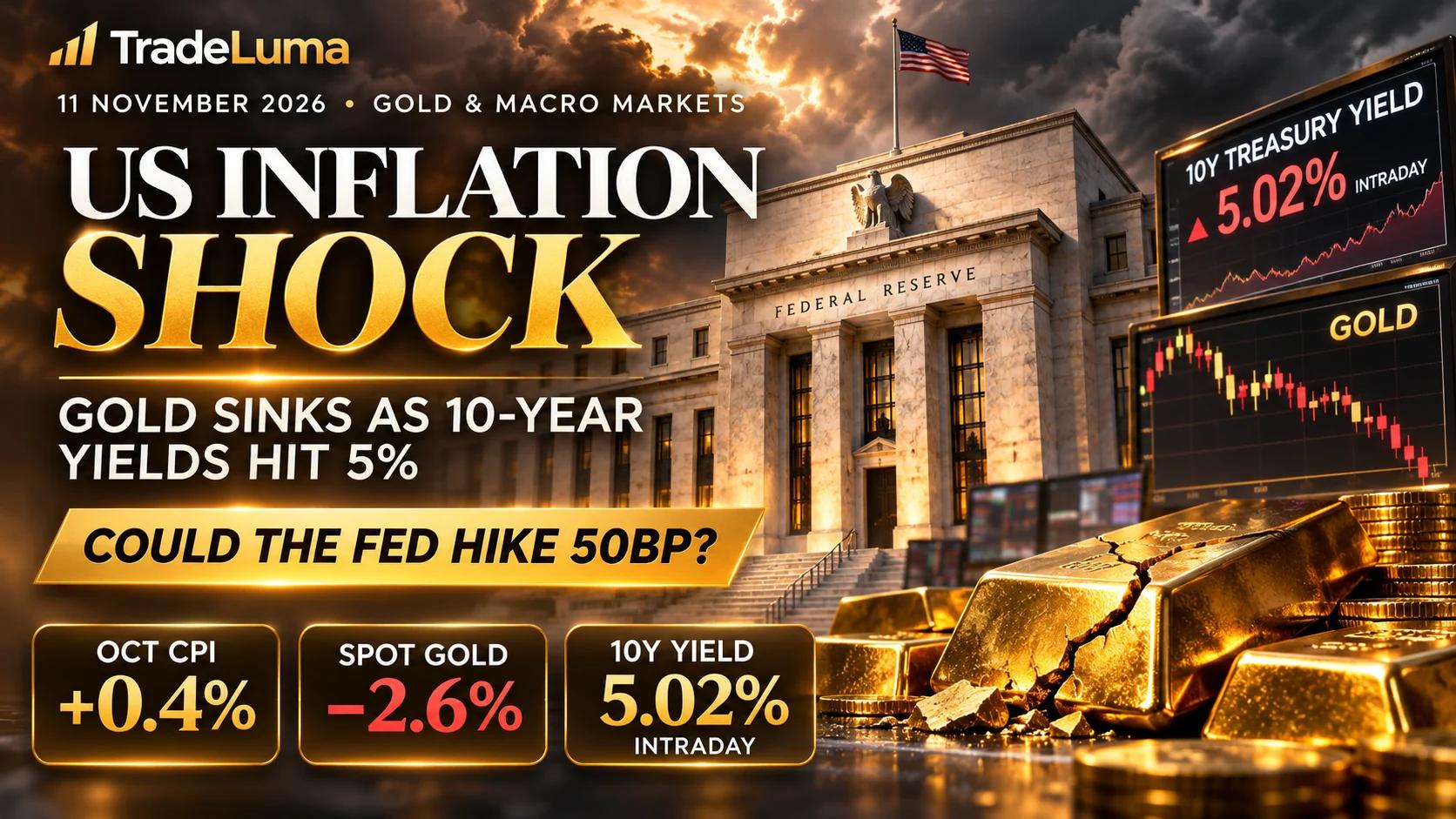
US Inflation Shock: Gold Sinks as Treasury Yields Hit 5% — Will the Fed Hike 50 Basis Points?
October US CPI beat forecasts, gold slid 2.6%, the 10-year yield briefly topped 5%, and the Nasdaq fell. Could a 50bp Fed hike follow?
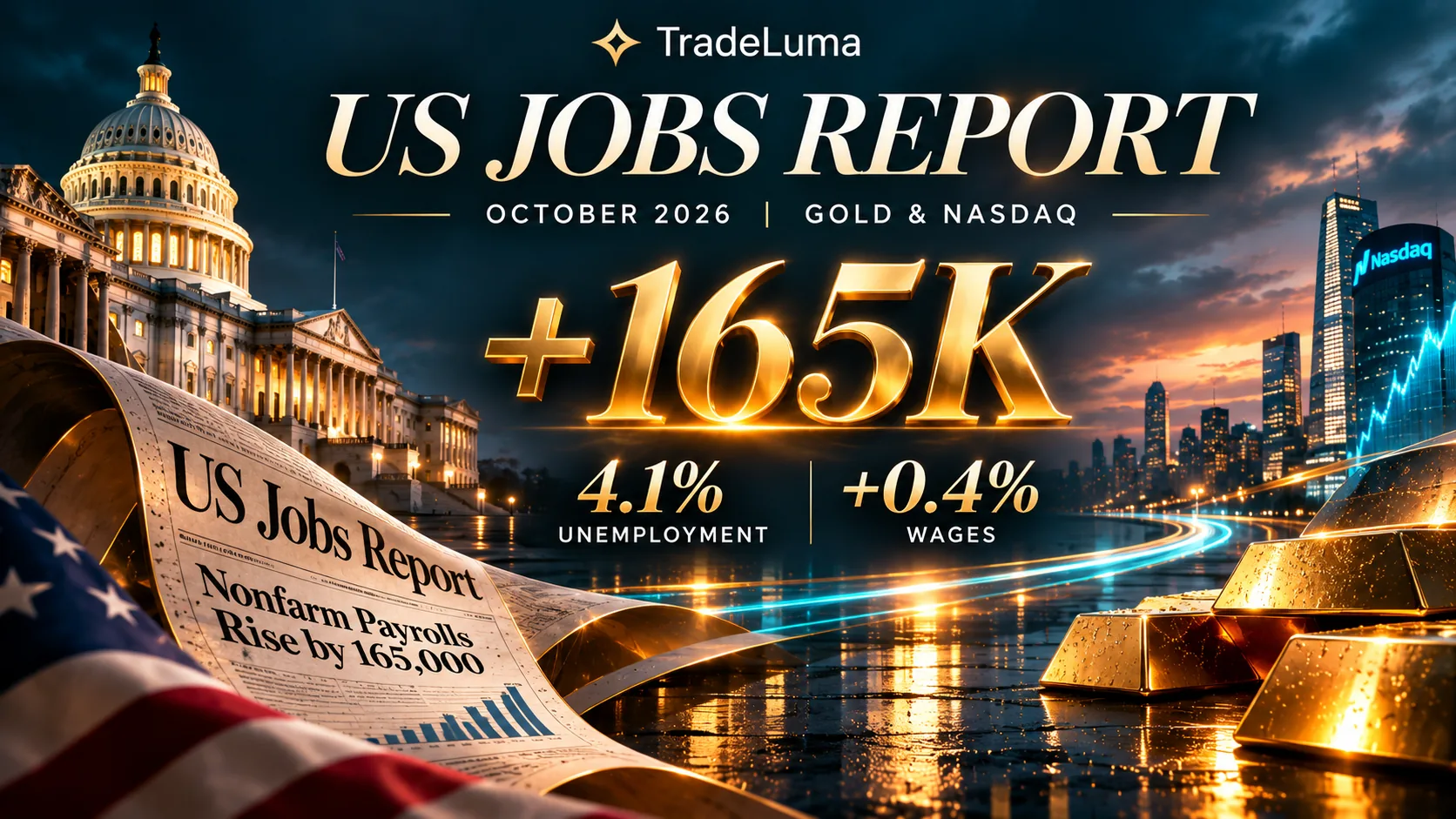
US Jobs Report October 2026: Why 165,000 Payrolls Moved Gold, Nasdaq and Fed Expectations
October 2026 nonfarm payrolls rose 165K, unemployment fell to 4.1% and wages grew 0.4%. Understand the November 6 jobs report and its effects on gold and Nasdaq.