
Futures
Futures Margin Explained: Initial, Maintenance, Intraday & Overnight Margin
Learn how futures margin works, including initial margin, maintenance margin, intraday and overnight requirements, margin calls, leverage and liquidation risk.
On this page+
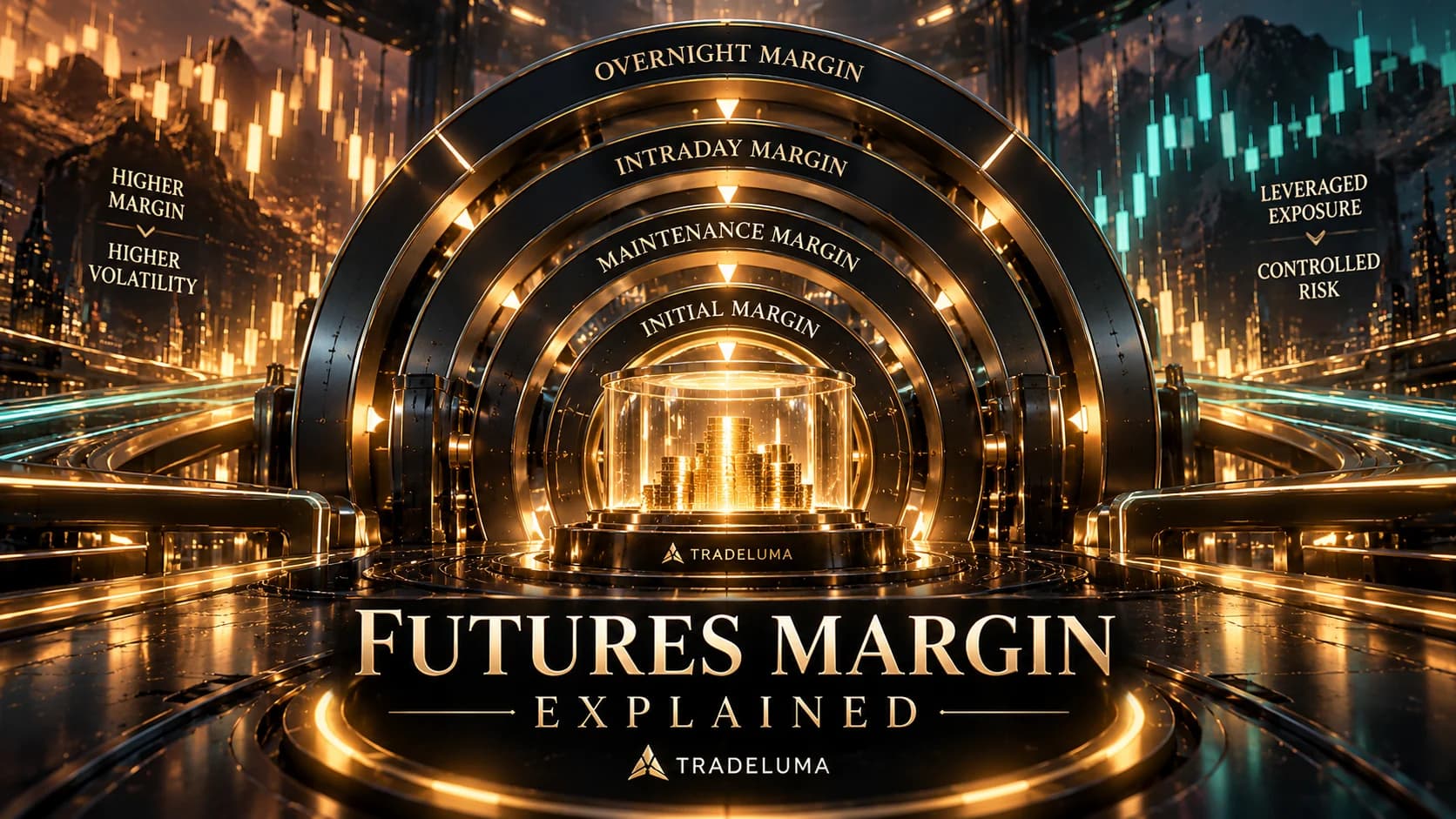
Futures margin is the collateral a trader must keep available to open and maintain a leveraged futures position. It is not the purchase price of the contract, and unlike stock margin it is not simply money borrowed to buy an asset. The exchange clearing system sets core performance-bond requirements, while brokers can add their own house rules, intraday requirements and liquidation thresholds. This guide separates initial, maintenance, intraday and overnight margin, explains how margin calls and mark-to-market losses work, and shows why available margin should never be mistaken for sensible position size.
What is futures margin?
Futures margin is collateral held to support the obligations created by a leveraged futures position. The trader controls a contract whose notional market exposure can be much larger than the cash posted as margin, which is why a relatively small market move can produce a meaningful change in account equity.
The margin deposit is not the contract's purchase price. It is better understood as a financial buffer that helps the clearing and brokerage system absorb losses as positions are marked to market. When the position is closed, unused margin becomes available again, while trading gains or losses remain in the account.
Futures margin is different from stock margin
The word margin causes confusion because it means different things across markets. In securities trading, buying shares on margin often involves borrowing part of the purchase price from the broker. Futures do not work that way. The trader does not borrow the remainder of the contract's notional value in order to own the underlying asset.
Instead, futures margin functions as a performance bond or collateral requirement. The contract creates leveraged exposure, and the account must continue meeting the required margin as prices move.
Initial margin: what you need to open the position
Initial margin is the amount that must be available when a new futures position is established. Clearing organisations determine core requirements using risk models, and a broker may require more than the exchange minimum through its own house-margin policy.
If an account does not have enough available margin, the broker can reject the order before the position is opened. The required amount is contract-specific and can change as volatility, concentration or market conditions change.
Maintenance margin: what you need to keep the position
Maintenance margin is the minimum margin level that must continue to be supported after the position is open. It is usually lower than the initial requirement, although the exact relationship depends on the contract, clearing rules and broker policy.
If losses reduce account equity below the applicable maintenance requirement, the account may need additional funds or reduced exposure. Brokers can also act more aggressively than a textbook margin-call process and may liquidate positions according to their risk policy.
Initial margin vs maintenance margin
The simplest distinction is that initial margin is the opening threshold and maintenance margin is the keep-open threshold. Suppose, purely as an illustration, a contract requires $2,200 of initial margin and $2,000 of maintenance margin. The account must satisfy the higher opening requirement to establish the position, then remain above the maintenance threshold while the trade is held.
If losses push the account below the maintenance requirement, the broker may require the account to be restored to the required level, reduce the position, or liquidate it. The actual calculation is performed at the account level and can include multiple positions, cash balances and broker-specific rules.
What is intraday or day-trading margin?
Intraday margin is a reduced margin requirement some brokers offer when a futures position is opened and closed inside a defined trading window. It is often marketed as day-trading margin. This is generally a broker-level concession rather than a separate universal exchange margin category.
Reduced intraday margin can create very high effective leverage. A trader may be permitted to control a large contract with comparatively little cash, but the dollar value of every tick remains unchanged. Lower margin does not make the contract itself less volatile or reduce the loss produced by an adverse move.
What is overnight margin?
Overnight margin usually refers to the fuller margin requirement that applies when a position remains open outside the broker's reduced intraday window. Brokers may transition the account from a lower day-trading requirement to the full applicable requirement at a defined time before the session close or maintenance period.
A trader who has enough buying power for an intraday position may therefore be unable to hold the same quantity overnight. If the account cannot meet the higher requirement when the broker's cutoff arrives, the trader may need to close or reduce the position before that time.
Exchange margin and broker margin are not always the same
The clearinghouse sets core performance-bond requirements, but the broker remains responsible for the risk in its customer accounts. A broker can therefore impose a higher house margin, different intraday terms, extra concentration requirements or special rules around volatile events.
This is why a margin number found on an exchange website may not equal the buying-power requirement shown in a specific brokerage account. The execution system should use the broker's live requirement for the exact account and contract rather than assuming one published figure applies everywhere.
Why futures margin requirements change
Margin is designed to reflect risk, so it is not permanently fixed. Clearinghouses can raise requirements when volatility increases or when risk models indicate larger potential price moves. Requirements can later fall when market conditions justify it.
Brokers can also change their own requirements, sometimes quickly. News events, concentrated positions, thin liquidity, contract expiry and exceptional volatility can all lead to higher house margins or the temporary removal of reduced intraday rates.
Mark-to-market and variation margin
Futures positions are marked to market, meaning gains and losses are regularly reflected in account equity as the contract price changes. A losing position therefore consumes financial capacity while it remains open rather than waiting until final expiry for the economic effect to appear.
Variation margin describes the cash movement associated with those gains and losses through the clearing process. For a retail trader, the practical point is simpler: falling account equity can reduce excess liquidity and create a margin problem before the trader reaches a planned stop.
What is a futures margin call?
A margin call occurs when the account no longer satisfies the required margin and additional funds or reduced exposure are needed. Traditional explanations describe the trader depositing enough money to restore compliance, but modern brokers may not always wait for a manual response.
Depending on the broker and market conditions, positions can be automatically reduced or liquidated. A trader should therefore know the broker's liquidation rules before relying on the assumption that there will always be time to transfer funds after a warning.
Margin is not the maximum amount you can lose
One of the most dangerous misunderstandings is treating the margin requirement as if it were the trade's maximum loss. Margin only determines the collateral required to support the position. The contract can continue moving against the trader beyond that amount, especially during gaps, fast markets or liquidation at an unfavourable price.
Risk should be calculated from the contract multiplier, tick value, stop distance, quantity and realistic slippage. Margin belongs in the account-capacity calculation, not in place of the stop-loss calculation.
A worked margin example
Assume a hypothetical futures contract requires $2,200 initial margin and $2,000 maintenance margin. A trader with sufficient excess equity opens one contract. After entry, adverse price movement reduces account equity and eventually leaves the account below the required maintenance level.
At that point, the trader may need to deposit funds, close the position or reduce exposure. If the broker's liquidation rules permit automatic action, the broker may close positions without waiting for the trader's preferred exit. Notice that none of those thresholds tells us the trade's original stop distance or maximum market loss; those must be planned separately.
Micro futures reduce contract size, not the need for margin discipline
Micro futures such as MES, MNQ, M2K, MGC and MCL usually carry much smaller dollar exposure per contract than their larger counterparts. That can make position sizing more granular and reduce the cash effect of each tick.
The smaller contract does not eliminate leverage or margin risk. A trader can still over-leverage by using too many Micro contracts simply because the margin per contract appears inexpensive. Quantity should be chosen from planned cash risk first, then checked against available margin.
Why low day-trading margin can be misleading
A very low intraday requirement can make a contract look affordable while hiding how much money one ordinary market move can gain or lose. The contract multiplier and tick value do not shrink simply because the broker temporarily requires less collateral.
A better question is not 'How many contracts will the broker let me open?' but 'How many contracts fit the maximum loss I am willing to accept at my actual stop distance?' The second question produces a risk-based quantity rather than a margin-maximised quantity.
Margin across multiple positions
An account with several futures positions is managed as a portfolio, not as a collection of isolated trades. Correlated contracts can create much larger directional exposure than each position appears to have on its own, while certain recognised spreads may receive different margin treatment because their risks partially offset.
Traders should monitor total account margin usage, not only the requirement shown beside the newest trade. One additional position can reduce the buffer available to absorb losses across every other open position.
Margin around news, volatility and expiry
High-impact economic releases, exceptional volatility or contract-specific events can change the risk environment quickly. Brokers may respond by increasing requirements, reducing permitted leverage or withdrawing intraday concessions. Liquidity can also deteriorate at exactly the time the account has the least spare capacity.
Expiry creates another operational risk. Delivery-sensitive contracts may be subject to stricter broker deadlines, and margin behaviour can change as a contract approaches expiration. Rollover planning should therefore include both the correct tradable contract and the margin implications of holding it.
How automated trading systems should handle margin
An automated strategy should not infer available buying power from a hard-coded margin number. Broker requirements can change, and the same contract may have different intraday and overnight treatment. Where the broker provides live margin or account-liquidity information, execution controls should use the current state rather than stale assumptions.
Automation should also separate a margin check from a risk check. Passing the broker's margin requirement only confirms that the order may be financially eligible. The strategy still needs position-size limits, daily-loss controls, symbol exposure limits and a plan for higher overnight requirements.
Common futures margin mistakes
Common errors include treating margin as a trading cost, treating it as the maximum possible loss, sizing positions from maximum buying power, assuming intraday margin lasts all session, and assuming exchange margin is identical to the broker's requirement.
Other mistakes include carrying a day-trading-sized position through the overnight cutoff, ignoring margin increases during volatility, and forgetting that several correlated positions can consume account capacity together.
A practical futures-margin checklist
Before entering a futures trade, confirm the exact contract, current initial and maintenance requirements, the broker's intraday window, the overnight requirement, any event-related margin notices and the account's available excess liquidity.
Then calculate the trade independently from margin: stop distance, tick value, dollar risk per contract, quantity, estimated costs and worst-case slippage. Margin answers whether the account can support the position; the risk plan answers whether the position belongs in the account at all.
Frequently asked questions
What is futures margin?+
Futures margin is collateral or a performance bond required to open and maintain a leveraged futures position. It is not the full contract value and is not the maximum amount that can be lost.
What is the difference between initial margin and maintenance margin?+
Initial margin is the amount required to establish a position. Maintenance margin is the minimum level that must continue to be supported while the position remains open.
What is intraday margin in futures?+
Intraday margin is a reduced requirement some brokers apply to positions opened and closed within a defined day-trading window. It is broker-specific and may be changed or withdrawn.
What is overnight futures margin?+
Overnight margin generally refers to the fuller requirement that applies when a position remains open outside the broker's reduced intraday period.
Is futures margin borrowed money?+
Not in the same sense as buying stocks on margin. Futures margin is primarily collateral supporting a leveraged contract rather than a loan used to purchase the underlying asset.
Can futures margin requirements change?+
Yes. Clearinghouses and brokers can raise or lower requirements as volatility, concentration and market conditions change. Brokers can also impose requirements above exchange minimums.
What happens if I fall below maintenance margin?+
The account may need additional funds or reduced exposure. Depending on broker policy, positions may be liquidated automatically rather than waiting for the trader to respond manually.
Is margin the maximum I can lose on a futures trade?+
No. Margin is a collateral requirement. Losses are determined by price movement, contract size, quantity and execution, and can exceed the amount originally posted as margin.
Why is day-trading margin lower than overnight margin?+
Some brokers offer lower intraday requirements because the position is expected to be closed within a controlled time window. Holding beyond that window exposes the account to additional session and gap risk, so fuller requirements usually apply.
Should position size be based on available margin?+
No. Position size should primarily come from the amount of cash risk allowed at the planned stop distance. Available margin is then checked to confirm the account can support that risk-based quantity.
Futures workflows
Explore the strategy side of TradeLuma.
Browse TradeLuma's futures strategy catalogue and the chart, rollover, and reference methodology used for each published strategy.
Explore futures strategies →Continue learning
Related guides.

Micro E-mini Futures Explained: MES vs MNQ vs MYM vs M2K
Compare MES, MNQ, MYM and M2K Micro E-mini futures by index, multiplier, tick value, trading hours, expiry, settlement and risk.
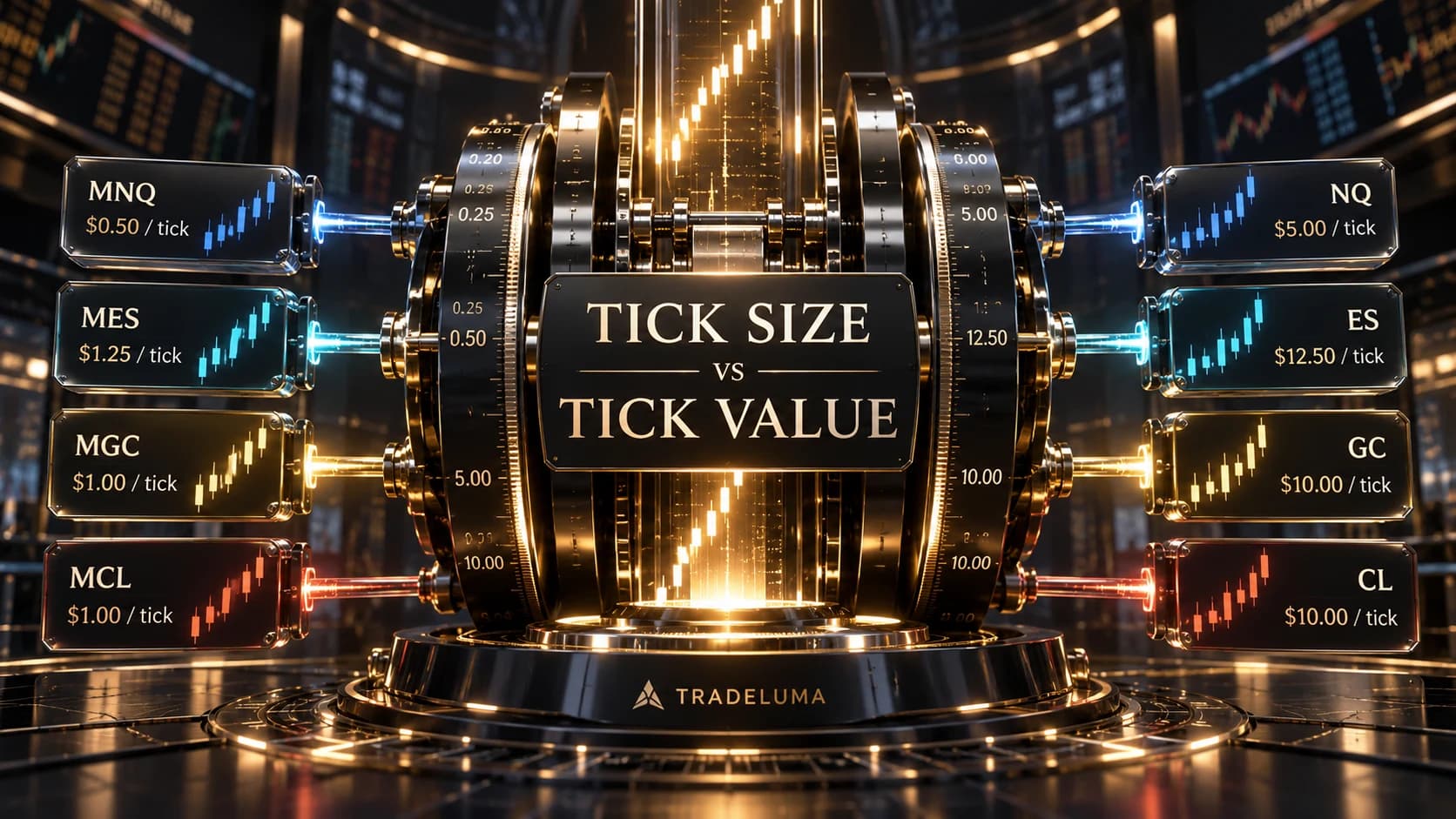
Tick Size vs Tick Value in Futures: ES, NQ, MES, MNQ, Gold & More
Learn the difference between futures tick size and tick value, with current ES, NQ, MES, MNQ, Gold, Micro Gold, WTI and Micro WTI examples.

1-Ounce Gold Futures vs Micro Gold (MGC) vs Gold (GC): 2026 Guide
Compare 1-Ounce Gold (1OZ), Micro Gold (MGC) and Gold (GC) futures by contract size, tick value, trading hours, settlement, expiry and risk.