
Futures Options
CME Futures Options Symbols Cheat Sheet: ES, NQ, MES and MNQ
Decode CME equity futures option families, quarterly and weekly codes, month letters, strikes, settlement types and broker symbol differences.
On this page+
A futures symbol identifies an underlying market; an option contract needs more information. The same underlying can have several option families distinguished by expiry and settlement. This guide focuses on CME Globex product codes, not a universal broker order syntax. This educational guide is not personalised investment advice; trading can result in losses.
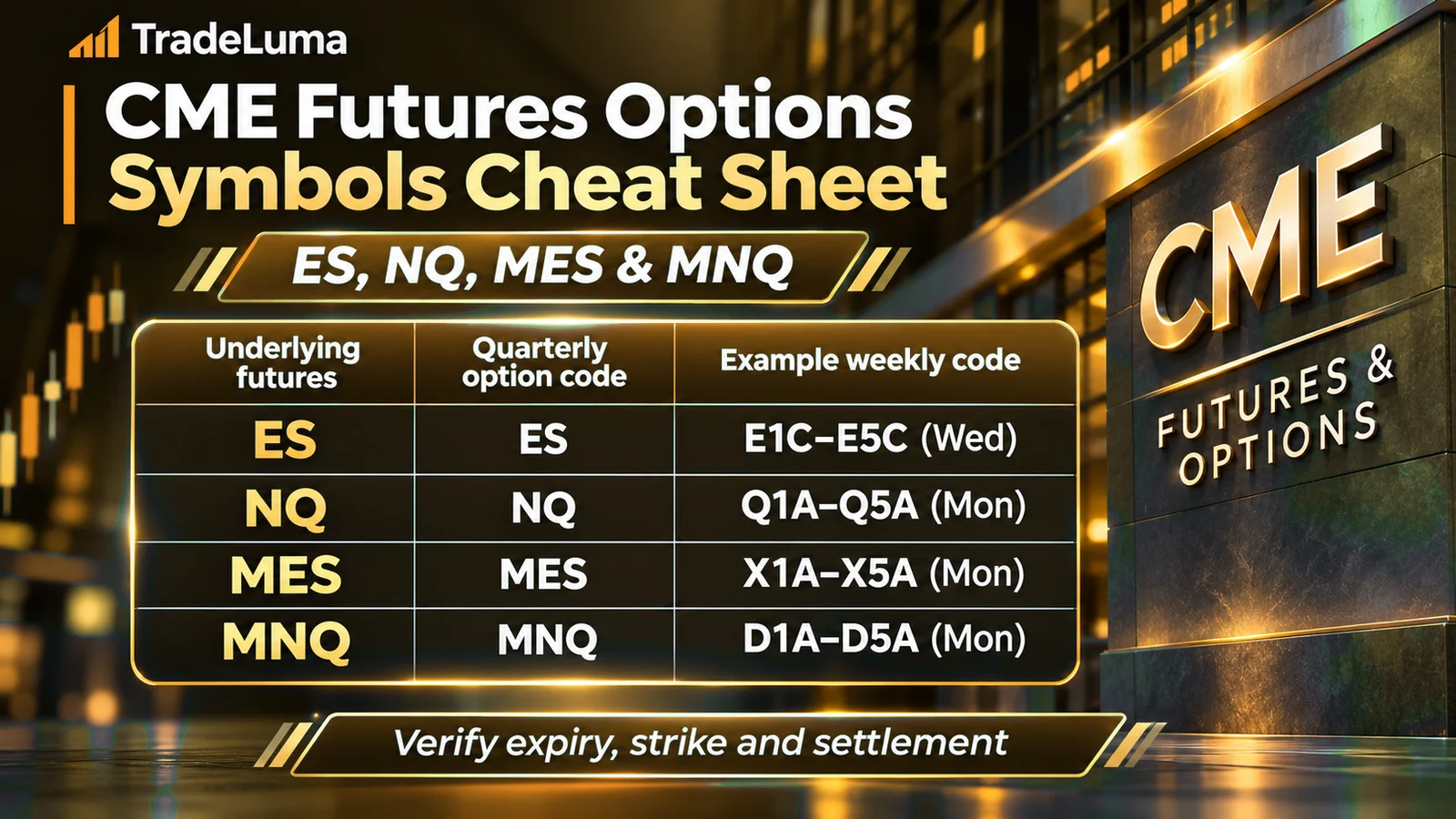
Quarterly and weekly code cheat sheet
For conventional quarterly equity options, the Globex roots are ES for E-mini S&P 500, NQ for E-mini Nasdaq-100, MES for Micro E-mini S&P 500 and MNQ for Micro E-mini Nasdaq-100. Examples of weekday weekly families: ES Wednesday E1C–E5C; NQ Monday Q1A–Q5A; MES Monday X1A–X5A; MNQ Monday D1A–D5A.
Friday weekly codes use different patterns, such as EW1–EW4, QN1–QN4, EX1–EX4 and MQ1–MQ4 respectively. End-of-month families include EW, QNE, EX and MQE. These are product families; not every possible series is necessarily listed on a particular date.
Month letters and full identifiers
The standard futures month letters are F January, G February, H March, J April, K May, M June, N July, Q August, U September, V October, X November and Z December. Quarterly futures commonly use H, M, U and Z.
A complete option selection also needs expiration date, call or put, strike, exchange and underlying futures month. Do not construct a tradable identifier simply by concatenating these letters; the broker's symbology and contract lookup determine the supported format.
Settlement is not interchangeable
Conventional weekly options may exercise into a futures position, whereas separately listed financially settled Micro E-mini weekly families use different product codes and cash settlement. AM and PM settlement can reference different fixings, and option tick rules can differ from the underlying futures tick.
An option premium multiplied by the relevant contract multiplier gives the premium amount before costs. Check exercise style, last trading time and settlement before choosing an option, especially a same-day expiry.
Broker lookup and automation
Use the broker's option chain and contract details to resolve the exact expiry, strike, right, multiplier and settlement. Verify order permission and available margin. A market data display symbol is not necessarily the identifier an execution API expects.
Do not send a continuous futures chart symbol as an option order. Preserve the broker contract identifier and order acknowledgement so rejected orders and partial fills can be reconciled.
Frequently asked questions
Are ES and ES options the same instrument?+
No. ES is an underlying futures root and also a quarterly option family root; an individual option additionally requires expiry, strike and right.
What is the MNQ Monday weekly family?+
D1A–D5A for conventional Monday weeklies; verify the actual listed expiry.
Are all Micro E-mini options cash-settled?+
No. Separate financially settled families exist alongside conventional options.
Futures workflows
Explore the strategy side of TradeLuma.
Browse TradeLuma's futures strategy catalogue and the chart, rollover, and reference methodology used for each published strategy.
Explore futures strategies →Continue learning
Related guides.

Micro WTI Options: CME's New Five-Day Weekly Expiries Explained
CME added Monday–Thursday Micro WTI weekly options in October 2026, extending Friday expiries to five trading weekdays. Learn 100-barrel size, $1 ticks and risk.

Futures Tick Value Cheat Sheet: MGC, MNQ, SIL, PL, MES and MCL
Six CME futures contract tick values and multipliers in USD, with practical stop-distance and dollar exposure examples.
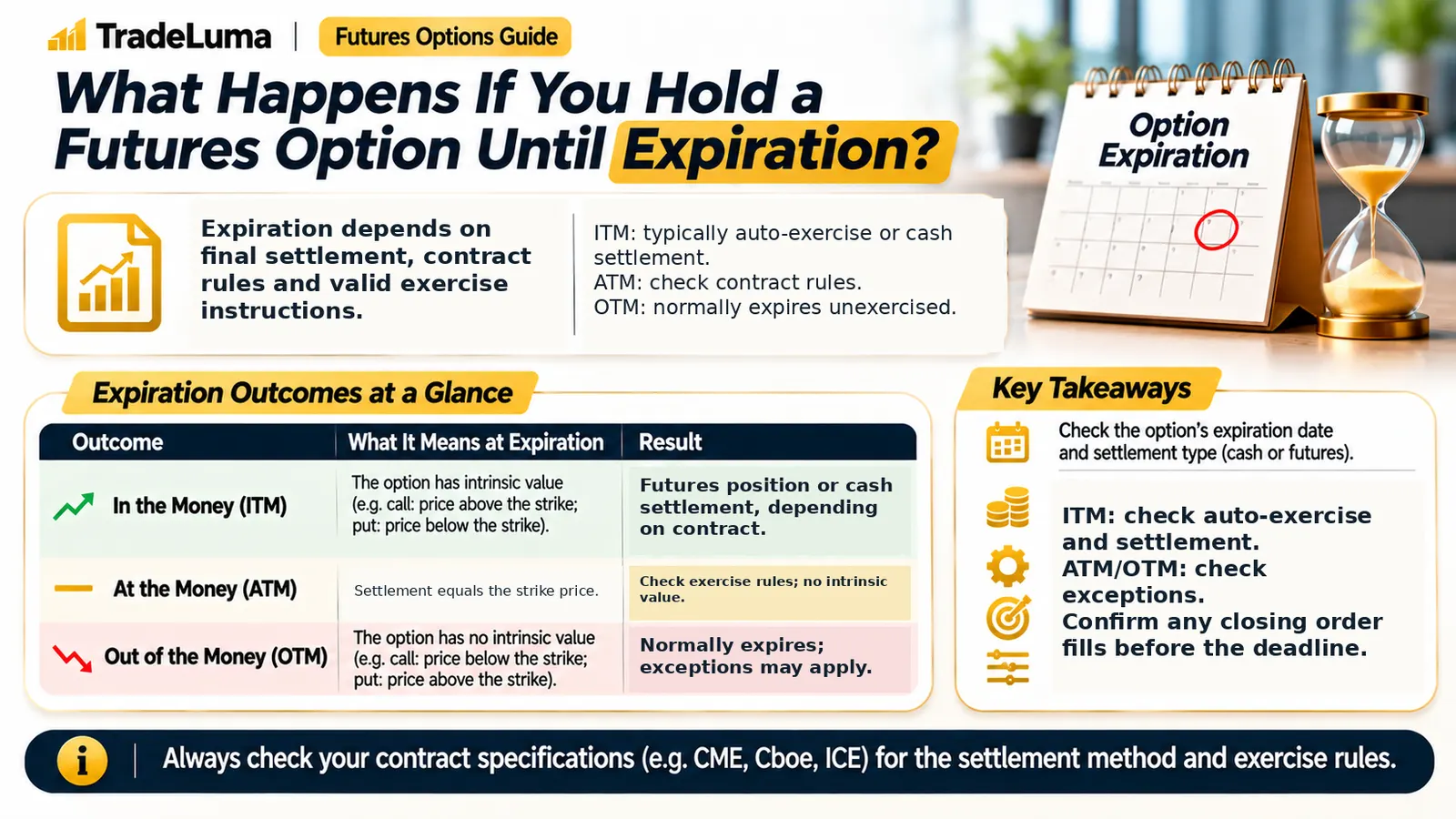
What Happens If You Hold a Futures Option Until Expiration?
Learn ITM, ATM and OTM outcomes, cash settlement, futures assignment and broker deadline risks.