
Futures
Micro WTI Options: CME's New Five-Day Weekly Expiries Explained
CME added Monday–Thursday Micro WTI weekly options in October 2026, extending Friday expiries to five trading weekdays. Learn 100-barrel size, $1 ticks and risk.
On this page+

CME Group broadened Micro WTI crude oil weekly options in October 2026, introducing Monday, Tuesday, Wednesday and Thursday expirations alongside the existing Friday weekly series. This allows listed weekly expiry choices on all five trading weekdays where the exchange's listing and holiday rules permit. The Micro WTI options contract represents 100 barrels—one-tenth the standard 1,000-barrel WTI contract—and is financially settled rather than delivering physical crude oil. The expansion creates more targeted ways to hedge short-lived price risk around energy data, geopolitical developments or macroeconomic events, but greater choice is not the same as assured liquidity or reduced risk. This 23 November 2026 TradeLuma guide explains the product codes, contract multiplier, option premiums, tick value, time decay, trade examples and expiration rules, and distinguishes the Micro WTI futures root MCL from option-series identifiers that must be selected explicitly at your broker.
What CME changed in October 2026
CME Clearing notice 26-308 announced the initial listing of Micro Crude Oil Monday, Tuesday, Wednesday and Thursday Weekly Options effective for trade date Monday 5 October 2026. This expanded the established Micro WTI weekly suite that already included Friday expirations. CME's late-2026 product page describes weekly option expiry choices now available on all five weekdays.
The practical change is a wider selection of maturity dates, not an all-new underlying commodity or a guarantee that every strike and week is continuously liquid. Exchange product identifiers and the list of valid expirations must still be confirmed in the live option chain. When a holiday falls on the usual expiration date, CME listing rules can omit or modify a series.
What are Micro WTI crude oil options?
A Micro WTI option is an exchange-listed derivative whose value depends on the WTI crude oil benchmark and its relevant reference futures contract. A call gives defined payoff exposure to a price above a specified strike at expiry, while a put provides exposure to a price below the strike. The product's cash-settlement method is part of the contract terms and differs from taking delivery of physical crude oil.
An option premium varies with the referenced market, time to expiration, strike, volatility, rates, the contract's payout structure and bid-ask supply. A premium quoted in US dollars per barrel must be multiplied by 100 barrels to obtain its gross US dollar cost per Micro WTI option.
Five expiry days: Monday through Friday
The newly introduced series include Monday, Tuesday, Wednesday and Thursday expiries in addition to Friday weekly expiries. An active trader can therefore select a listed option whose lifespan ends closer to the release of US crude inventory data, a Federal Reserve event or a major geopolitical deadline.
But a longer menu of possible expiry days does not mean a daily expiring option is available during every exchange holiday, nor that all strikes have comparable depth. Look up the exact week number, expiration date, option style and current bid/ask spread rather than routing an order based solely on a weekday label.
The 100-barrel multiplier and comparison with CL
Micro WTI options represent 100 barrels. Standard-sized WTI futures, commonly shown with the CL root, represent 1,000 barrels. Therefore one unit of price change of US$1.00 per barrel corresponds to US$100 of notional price movement for one Micro option contract's underlying reference size, versus US$1,000 for a standard CL future.
That size comparison does not mean options have linear payoff equal to the underlying futures. The option's premium changes with delta, implied volatility, time to expiry and other option sensitivities. It also does not mean ten Micro option contracts perfectly replicate a single standard option in every trading or margin circumstance.
The US$1 option tick value
CME's published Micro WTI option specification uses a minimum tick of US$0.01 per barrel. With 100 barrels per contract, the minimum outright premium increment is US$1 per contract. A displayed call premium changing from US$1.25 to US$1.26 would therefore represent US$1 of gross premium value change on one contract, ignoring fees and other circumstances.
Do not confuse this with the tick value of every WTI-related instrument. Micro WTI MCL futures and conventional CL contracts have different multipliers, and option chains can use different strike-price increments from their minimum premium increment. Check the live instrument's official specification before computing order risk.
Worked example: buying a weekly Micro WTI call
Suppose, purely hypothetically, a Micro WTI weekly call with a US$74 strike is offered at US$1.25 per barrel. One contract costs US$125 in premium: 1.25 × 100. Add any exchange and broker fees to the cash outlay. If that European-style call expires out of the money, the premium can be lost in full.
If at cash-settled expiry the relevant reference price is US$77 per barrel, intrinsic value would be US$3 per barrel, corresponding to US$300 gross settlement value for the option. Against the US$125 initial premium, that is US$175 gross profit before fees and other adjustments, under the simplified payoff assumptions. Actual settlement uses CME's specific official reference price and rules.
Worked example: a weekly Micro WTI put hedge
Imagine a small oil-exposed portfolio whose value tends to decline when WTI falls. A trader buys a hypothetical Micro WTI put with a US$70 strike for US$0.85 per barrel, or US$85 premium for one 100-barrel option contract before fees. If the expiry reference is US$66, the simplified put intrinsic payoff is US$4 per barrel, or US$400.
The option's gross gain relative to premium would be US$315 under those assumptions, but the true net hedge result depends on the underlying portfolio's exposure, basis risk, strike, settlement date and transaction costs. Hedging is not automatically perfect just because both assets are connected to oil prices.
Why shorter maturities increase theta and gamma considerations
An option's time value generally decreases as expiration approaches, other factors equal; this sensitivity is commonly called theta. A very short-dated option can lose a substantial percentage of premium if the expected oil move does not arrive quickly enough. Gamma—the sensitivity of delta to a change in underlying price—can also become large near the strike near expiry.
More expiration days provide timing precision, but concentrating in one-day or two-day contracts can produce severe percentage changes from modest crude moves. The lower contract size reduces notional scale, not the probability of a 100% loss for a long option or the large downside risk that certain short-option strategies can carry.
Cash settlement and European exercise
CME's Micro WTI monthly and weekly options specifications identify the product as financially settled and European style. The cash flow at expiration follows the designated settlement process rather than a physical delivery obligation for crude oil. European style concerns the timing of exercise; it does not prevent selling an open option to close before expiry when a liquid market exists.
Always distinguish an expiring option position from a futures position. Some brokers impose stricter close-out or exercise handling than the exchange minimum. If the expected contract payout or settlement time is unclear, review the particular listed product's current CME rulebook and broker notice before holding a position into expiration.
MCL futures, MCO monthly options and weekly product codes
MCL is the exchange root commonly used for Micro WTI Crude Oil futures. CME's original Micro WTI option specifications name MCO for monthly options and distinct weekly option codes, while the October 2026 listing created additional day-specific series. Depending on the platform, the visible orderable symbol may combine the week, expiration, strike and call/put designation.
Do not type a continuous MCL future chart symbol into an options order and expect an automatic substitution. Use the broker's actual option-chain lookup and verify the exchange, product group, expiration date, strike, put/call side, multiplier and cash settlement. Order rejection may reflect a missing options trading permission rather than a problem with the underlying WTI quote.
The holidays and listing exceptions
Micro weekly expirations are subject to NYMEX listing procedures. CME notices indicate that a weekly series may not be listed if its expiry would fall on an exchange holiday. Product-specific rules also apply when weekly dates overlap with the monthly option expiration. A generic Monday–Friday calendar banner is therefore an overview, not a five-per-week guarantee in every calendar week.
Before a trade, consult CME's live options calendar and any clearing notice for the exact date. For example, Thanksgiving week can create atypical session timing and settlement arrangements. A trader who uses expiration purely by weekday label may be surprised when the intended contract does not exist.
What the options chain actually tells you
A real options chain should show expiry date, underlying reference, strike, put or call, bid, ask, recent volume, open interest and relevant implied volatility metrics. Its prices can be delayed and many near-date options have uneven liquidity. An apparent cheap premium may hide a wide bid-ask spread or low fill probability.
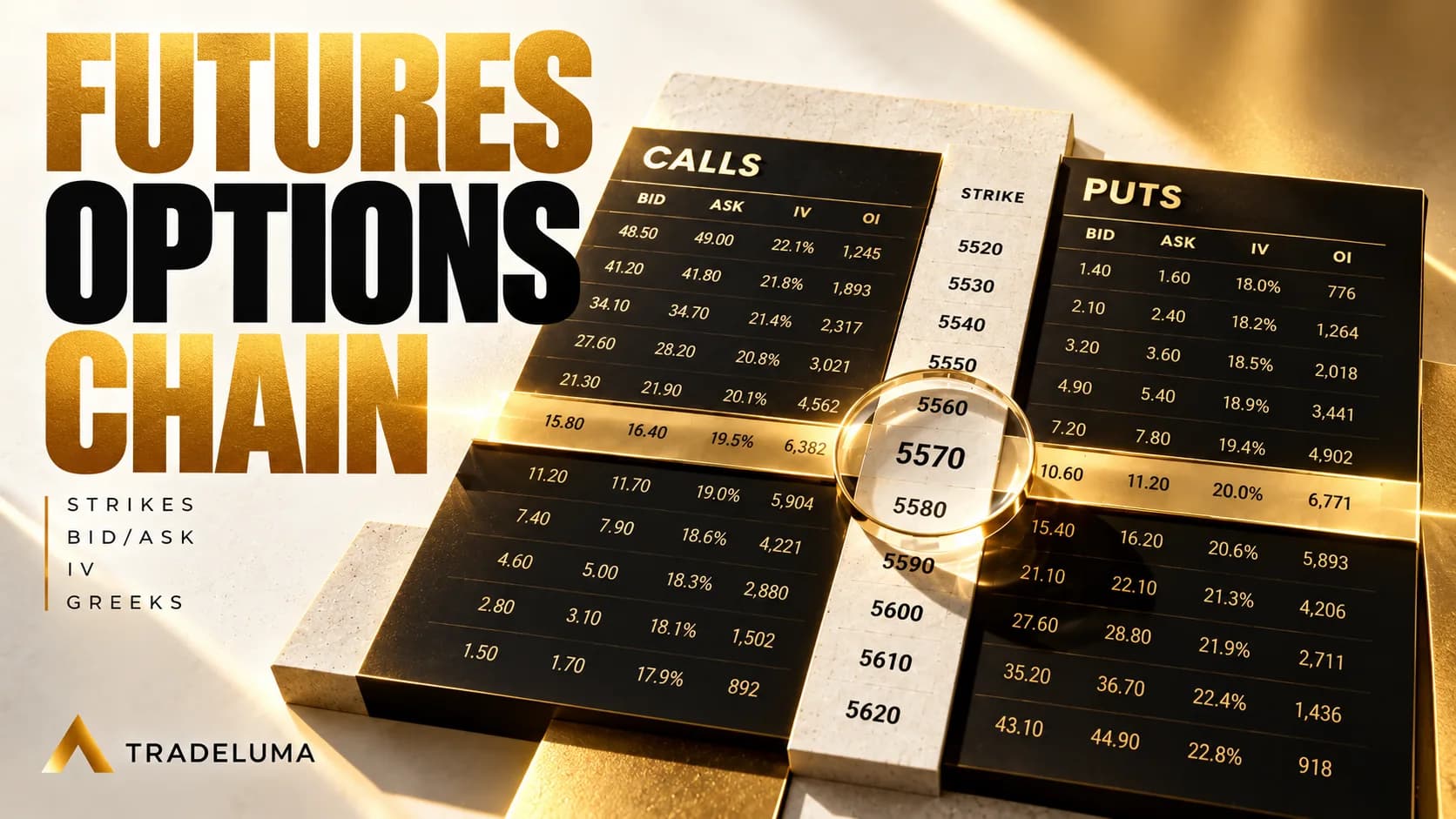
The approved TradeLuma cover includes a stylized option chain for educational illustration. Its quoted prices are not a historical CME order book for 23 November 2026 and must not be used to place trades. The text and product rules, rather than fictional illustration prices, provide the educational basis.
Spreads, commissions and transaction costs
Even with a US$1 minimum option tick, a US$0.05-per-barrel bid-ask spread is worth US$5 per Micro contract before fees. Multiple-leg spreads can multiply commissions and create execution risk between legs, and the tick size itself does not mean the trading spread will be one tick.
Margin and risk treatment depend on option side, broker, strategy, volatility and portfolio arrangements. Buying an option normally requires payment of its premium. Selling an uncovered option can require substantial collateral and can lose far more than the premium received. A small nominal contract should not be mistaken for a small guaranteed risk.
Micro WTI weeklies compared with standard options and futures
Standard WTI futures carry 1,000-barrel exposure; MCL futures carry 100 barrels. Micro WTI weekly options offer nonlinear, defined-premium exposure for buyers and expiry selection across the five weekdays. Standard WTI options can also offer multiple weekly and monthly expirations, but contract size and available exercise or settlement features may differ.
Deciding among them depends on the market view, desired maximum premium risk, preferred expiration, delta, expected volatility, liquidity and brokerage support. Traders should not assume an option will replicate the P&L of holding the same number of barrels in a futures contract.
A cautious checklist before trading the new weekly expiries
Identify the specific Micro WTI weekly option series and verify that it is currently listed for the chosen Monday–Friday date. Confirm the 100-barrel multiplier, correct strike and side, contract's official last trading and financial settlement rules, and the broker's exercise or closing restrictions.
Evaluate the live bid-ask spread, implied volatility, probability of complete premium loss, potential margin requirement if writing options, and realistic fill assumptions. The weekly calendar is a flexibility tool—not evidence that a particular trade has positive expected value. This guide was prepared 23 November 2026 and is not personalised financial advice.
Frequently asked questions
Are Micro WTI weekly options now available Monday through Friday?+
Yes. CME added Monday–Thursday series effective for the October 5, 2026 trade date alongside existing Friday weekly expirations, subject to holiday and listing rules.
How many barrels are in a Micro WTI option?+
100 barrels per option contract, one tenth of the standard 1,000-barrel WTI product size.
How much is one tick in Micro WTI options?+
CME lists a US$0.01-per-barrel premium tick, worth US$1 for one 100-barrel option contract.
Are Micro WTI options physically delivered?+
No. CME's published Micro WTI option specifications describe financial cash settlement at expiration.
Are Micro WTI options American or European style?+
CME's product specifications identify Micro WTI options as European style, meaning exercise is tied to expiration under the relevant rules.
Is MCL the symbol for every Micro WTI weekly option?+
No. MCL is the Micro WTI futures root. Monthly and weekly options have distinct instrument identifiers and include expiry, strike and call/put information.
What happens if a Monday expiration falls on a holiday?+
Exchange listing rules can omit or alter the weekly series; consult CME's actual product calendar rather than assuming an option will exist.
What is the maximum loss when buying a Micro WTI weekly call?+
For a straightforward fully paid long call, the entire premium and transaction costs can be lost; writers of options can face much larger losses.
Do the premiums on the approved TradeLuma visual represent market quotes?+
No. The options chain is illustrative, not a live market-data or historical order-book feed.
Futures workflows
Explore the strategy side of TradeLuma.
Browse TradeLuma's futures strategy catalogue and the chart, rollover, and reference methodology used for each published strategy.
Explore futures strategies →Continue learning
Related guides.

Options on Futures Explained: Calls, Puts, Premium & Risk
Learn how options on futures work, from calls, puts and premium calculations to exercise, cash settlement, margin, expiry and trading risks.

Cash-Settled Micro E-mini Options: MES, MNQ & 0DTE Explained
Explore CME’s new cash-settled Micro E-mini S&P 500 and Nasdaq-100 options: MES/MNQ multipliers, 0DTE expiries, fixing prices, option codes and settlement risk.
How to Read a Futures Options Chain: Strikes, Bid/Ask, IV & Greeks
Learn how to read an options chain on futures: calls and puts, strike prices, bid/ask, liquidity, implied volatility, Greeks and MES/MNQ premium examples.