
Futures
Futures Calendar Spreads Explained: Near vs Deferred Contracts
Learn how futures calendar spreads work, how to calculate near-vs-deferred spread P&L, why margin offsets vary, and how to manage two-leg execution risk.
On this page+
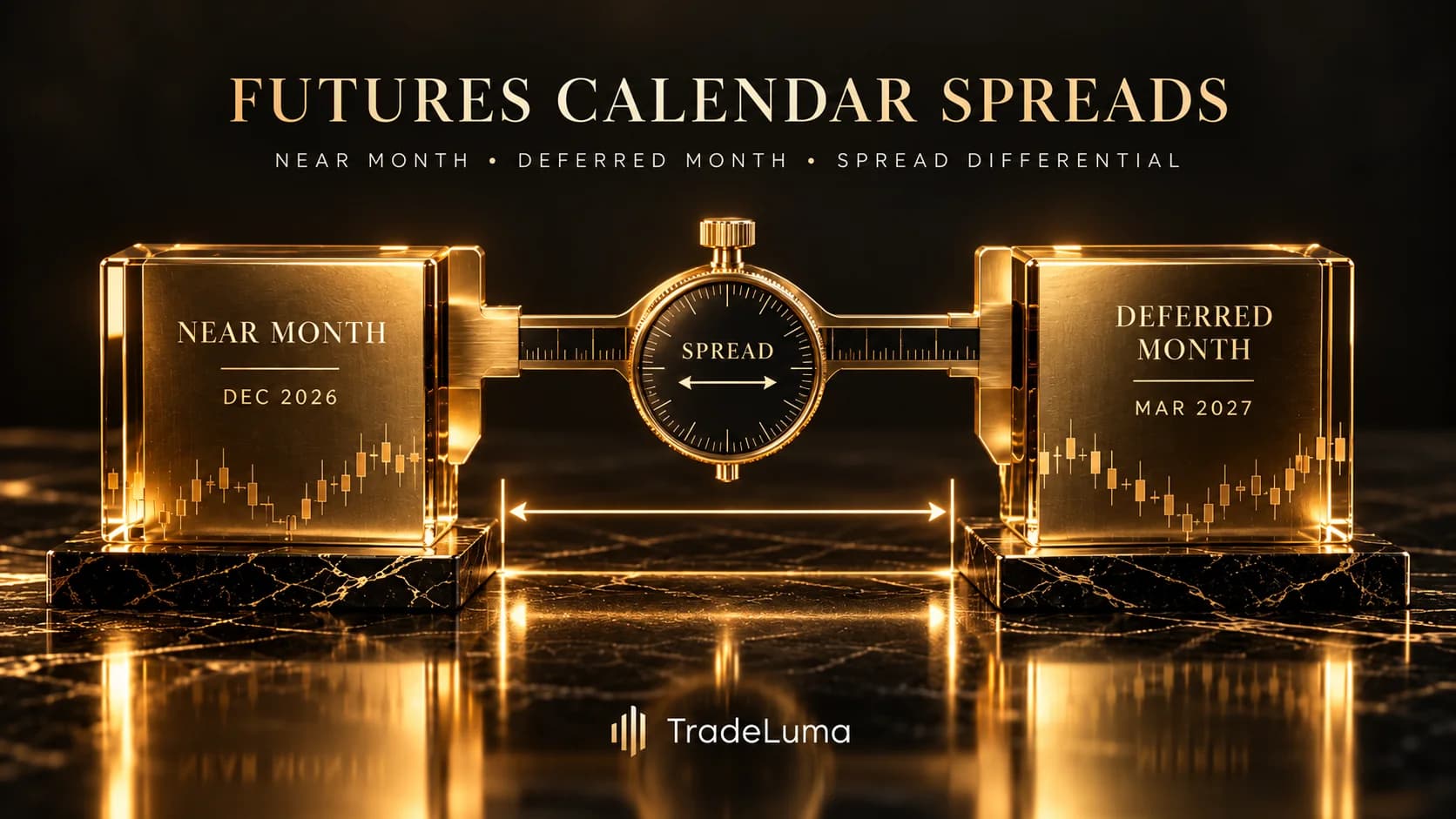
A futures calendar spread lets a trader buy one expiry month and sell another in the same market. Instead of taking a simple view that crude oil, gold or a stock index will rise or fall, the position targets the changing price relationship between two contract months. That sounds straightforward, but a correct trade requires understanding the near-versus-deferred quote, the spread sign, the exchange-listed strategy, margin offsets, both legs' expiry dates and the costs of execution. This guide explains all of those mechanics with worked E-mini S&P 500 and WTI crude oil examples, and shows why an intermonth spread is different from rolling a futures position forward.
What is a futures calendar spread?
A futures calendar spread, also called an intramarket or time spread, is a position in two expiration months of the same underlying futures market: long one month and short another. The trade expresses a view on how those months will move relative to each other, rather than a pure directional view on the overall market. Both contracts must be real, specifically identified expiries; a generic continuous chart cannot substitute for either leg.
For example, buying the December E-mini S&P 500 (ES) contract and selling the following March ES contract is one calendar spread. Both legs reference the S&P 500 but settle in different months. If December strengthens more than March, the near-minus-deferred spread rises. If December weakens relative to March, the spread falls.
The quick answer: near month versus deferred month
The near month is the earlier expiry in the comparison; the deferred month expires later. Near is not necessarily the most liquid front month at every date, and deferred is not simply a back-adjusted chart. A properly labelled spread includes the exact market, month, year and direction of both positions.
Under the near-minus-deferred convention, spread price = nearby futures price - deferred futures price. Under the opposite convention, every sign reverses. A platform may quote a calendar spread using its exchange-defined leg order, so always confirm the buy-side leg and price-sign convention instead of relying on a visual arrow.
How buying and selling a calendar spread works
Buying the near-minus-deferred spread means long the nearby contract and short the deferred contract in equal standardised quantities when the exchange strategy specifies a one-to-one ratio. Selling the spread reverses both legs: short nearby and long deferred. Profit or loss depends on the change in the difference between those two contract prices.
A calendar spread does not mean holding a long position without a corresponding short, and it is not an options calendar spread. Some exchange-listed spreads use product-specific leg ratios or alternate quoting rules. Confirm the spread instrument specification, quantity and contract multiplier before entering orders.
Calendar spread formula and sign convention
Let N be the near-month futures price and D the deferred-month futures price. Define spread S = N - D. The change in spread is ΔS = (N_exit - N_entry) - (D_exit - D_entry). For a one-to-one calendar spread in contracts sharing a multiplier M, approximate pre-cost P&L for a long spread equals ΔS × M × number of spreads.
This simple formula assumes equal contract multipliers and no position-size mismatch. It also assumes both legs are completed at actual execution prices. Some markets quote the reverse order, different settlement units or exchange-defined spread ticks; for those instruments, apply the exchange specification rather than blindly importing the ES example.
Worked example: December versus March ES futures
Assume December ES trades at 6,000 points while March ES trades at 6,025. These hypothetical prices imply a December-minus-March spread of -25 points. You buy one December ES and sell one March ES. Later, December trades at 6,020 and March at 6,035; the spread becomes -15 points.
The spread widened upward by 10 points under the near-minus-deferred convention, producing a theoretical $500 gross gain because one ES point is $50. This is before two-leg transaction costs, fees, possible slippage and financing effects. Crucially, both outright futures rose: profit came from December outperforming March by 10 points, not from a bet that all futures prices would fall.
Worked example: crude oil calendar spread in dollars per barrel
Imagine one WTI crude oil (CL) December contract quoted at $70.00 per barrel and a later CL March contract at $71.50. The December-minus-March spread is -$1.50 per barrel. If the nearby contract later becomes $72.00 and deferred becomes $72.90, the difference changes to -$0.90, a +$0.60 move in the spread.
One standard CL contract represents 1,000 barrels, so a fully filled one-lot long calendar spread gains a theoretical $600 before costs in this illustration. In a standard one-to-one CL calendar spread the outright exposure of the two matched legs mostly offsets, but the trader retains meaningful risk from changes in the curve, liquidity and delivery calendars. Values here are examples, not live quotes.
Calendar spread P&L when both prices fall
Consider a near contract that drops from 100 to 96 and a deferred contract that drops from 103 to 95. The near-minus-deferred spread changes from -3 to +1: the near contract fell by four points while the deferred contract fell by eight. A long spread gains four points even though both outright contracts lost value.
The opposite outcome is also possible. If the deferred month holds up better than the nearby month, a long spread can lose money during an overall rally. Calendar spread trading is relative performance trading; assuming the short leg always hedges every risk can lead to a dangerous underestimation of losses.
Is a calendar spread the same as contango or backwardation?
No. Contango and backwardation describe the term structure of prices observed across futures expiries. A calendar spread is a trade, or quoted price difference, involving two of those expiries. A market can be in contango while a long calendar spread profits if the nearby-minus-deferred difference rises from -3 to -1.
Contango often produces a negative near-minus-deferred spread and backwardation a positive one, given identical units and the convention used here. Neither condition guarantees how the spread will move next. Read the separate TradeLuma contango and backwardation guide for the economics of curve shape; this guide focuses on actually trading the intermonth relationship.
Why calendar spreads move: supply, demand and inventory
Commodity time spreads reflect when a unit of the underlying commodity is valuable. Immediately available supply can command a premium when inventories are low, supply disruptions emerge or near-term demand spikes. Later delivery can trade more richly when storage, financing and insurance make future supply more expensive.
A spreading trader therefore watches inventory data, expected production, transport constraints, seasonality and delivery terms instead of looking only at the outright price chart. For equity-index futures, interest rates, expected dividends and the time remaining to expiry are central economic drivers rather than the physical storage costs of a commodity.
How cost of carry affects the near-to-deferred relationship
For storable commodities, the cost-of-carry framework links spot and futures prices through financing, storage and insurance, offset by the economic benefit of possessing the commodity when it is needed (often called convenience yield). This helps explain why later maturities may command a premium over the front contract.
Those components evolve, so the intermonth spread can change even if spot prices seem quiet. For share-index futures, interest and expected dividend carry typically create a positive or negative maturity premium. A spread is therefore an exposure to changing carry and market expectations, not an effortless method of collecting a guaranteed yield.
What is the difference between a calendar spread and rolling a futures contract?
A calendar spread is two opposing futures legs held together to capture a changing price relationship. A rollover is a portfolio-maintenance transaction: close the expiring contract and open a later contract, usually preserving the same overall long or short direction. Traders often execute a roll through a listed calendar-spread market because it links both legs in one transaction.
The economics and objectives are different. A trader who is already long December and sells December while buying March is shifting an existing outright exposure forward; afterwards the trader normally owns March only, not a stand-alone long calendar-spread position. Contract rolls also need deliberate expiry and delivery procedures. See the existing futures rollover and contract expiry guide for that workflow.
Exchange-listed spread order versus two separate outright orders
Where supported, an exchange-listed calendar spread can match the two legs as one defined strategy, helping reduce the risk that one contract fills while the other remains unfilled. The displayed spread price and available depth can differ from the two outright order books, and a matched spread still has its own bid-ask spread and transaction cost.
Building the spread through two independent orders introduces legging risk: the first side can fill before the second, leaving a temporary naked futures position exposed to sharp moves. Not all brokers, order interfaces or products support every exchange-listed spread. Verify the exact spread symbol, contract months, tick increment and order-handling model.
Calendar spread margin: why offsets may apply
Because the two legs reference the same underlying market, their outright directional risks often partially offset. Exchanges and clearing firms may therefore recognise lower portfolio margin on eligible intermonth combinations than the sum of margins for separate outright positions. This is not a universal discount, a fixed percentage or an assurance that every broker will apply it.
Actual requirements depend on the product, exact month pair, clearing methodology, stress scenarios and broker-specific house rules. If one leg is rejected, cancelled or removed, the remaining naked leg can require substantially more margin. Never size a spread using a published intraday margin number for a different instrument or assume spread margin equals maximum loss.
Why futures calendar spreads can still be risky
An intermonth spread reduces some common-price exposure but retains curve-shape risk. Unexpected supply shortages, policy changes, inventory releases, delivery pressures, interest-rate changes and liquidity shocks can move nearby and deferred months very differently. The relationship can change faster than a trader expects, particularly near expiry.
Important additional risks include two-leg execution, spread stop slippage, widened bid-ask quotes, broker liquidation, contract substitution errors and underestimated settlement obligations. Even if the legs are highly correlated historically, a spread can experience sharp losses and an automated risk limit may not execute at its intended price.
Choosing which expiry pair to trade
Begin with a market whose contract calendar and delivery rules you understand, then compare available maturities, actual volume, open interest and quoted spread depth. Nearby pairs may have more trading interest but can also become vulnerable to delivery or expiry events. Distant pairs may respond differently to interest rates or seasonal expectations.
An apparent bargain based solely on a big price gap is not enough. Evaluate the spread relative to the historical behaviour of that exact month pair, days-to-expiry and time of year. A December–March relationship is not necessarily interchangeable with March–June, even for the same futures family.
Calendar spreads in gold and silver futures
Gold calendar spreads commonly relate different COMEX delivery months. Financing, vault costs, lease markets and changes in metal availability can influence the relative values. Silver can behave differently because its supply chain and industrial demand affect the curve, and micro contracts may not share every spread listing or broker permission with standard contracts.
A trade description must use valid listed futures expiry codes, matching exchange specifications and the correct metal quantity. A dollar change per troy ounce translates into very different cash exposure for GC, MGC, SI and SIL. Confirm contract size and permitted spreads before inferring profit or loss from a chart measured only in price units.
Calendar spreads in crude oil and energy futures
WTI and Brent forward curves respond to storage economics, refinery demand, inventory reports, pipeline constraints and geopolitical supply shocks. The nearby oil contract can swing sharply relative to distant months when an immediate supply or demand disruption affects the front of the curve. Calendar spread quotations therefore carry meaningful fundamental information.
Delivery logistics matter more than they do for a cash-settled stock-index spread. CL is physically settled, and an expiring leg requires attention to broker deadlines and permitted holding periods. A trader should not infer that a hedged two-leg position is exempt from contract expiry or physical-delivery controls.
Calendar spreads in ES, MES, NQ and MNQ
Quarterly equity-index futures permit comparisons between expiries such as December and March, with economic differences linked to financing and expected dividends. A trader may express a view that a nearby contract will strengthen or weaken relative to a later expiry, rather than taking a broad outright long or short position in the index.
The E-mini and Micro E-mini versions have different contract multipliers. While an economic idea can be similar across contract sizes, the orderable spread instruments, quoting increment, available depth and broker-specific margin permissions must be checked for ES, MES, NQ or MNQ separately. Do not mix point values when calculating leg exposure.
Term structure, calendar spreads and seasonal effects
Markets that face seasonal production or consumption cycles may price one delivery month very differently from another. Agricultural contracts can separate old-crop and new-crop expectations; natural gas often reflects heating and cooling demand; energy storage dynamics may change with maintenance seasons. These influences can persist even during sideways outright markets.
Seasonal tendencies are hypotheses, not guaranteed price patterns. Compare identical contract-month pairs across history, account for structural market changes and adjust for calendar differences. Using a continuous futures series that silently switches expiry can create false spread signals at rollover boundaries.
Using open interest and volume to assess spread liquidity
A large outright contract volume does not mean the exact intermonth spread is always liquid. Inspect the listed spread market, its quoted bid and ask, order-book depth and the active roll window. Liquidity can migrate as participants transition from one expiry to the next, so the same pair may trade quite differently a week later.
Open interest measures outstanding positions; it is not a substitute for tradeable spread depth at a specific price. Review our open-interest-versus-volume guide for those data limitations. When two legs are entered independently, examine the liquidity of both legs and the risk of a partial fill.
How to calculate real spread trading costs
Calculate fees for the underlying two contract legs and the entry and exit activity, using the broker and exchange schedule applicable to the selected product. Add the bid-ask spread of the listed strategy, or the actual expected slippage of independently executed legs. A calendar spread with a narrow theoretical target can lose its entire edge to trading costs.
Backtests should model contract-specific tick sizes, commission per side, exchange and regulatory fees, realistic limits on fill size and possible latency. The existence of offsetting positions does not cancel fees. Refer to the TradeLuma futures trading fees guide for the distinction between explicit charges and implicit execution costs.
How to backtest a futures calendar spread correctly
Construct a time-aligned two-leg price series using specific contract identifiers, not a stitched front-month continuous chart alone. Use the same timestamp, consistent quote and settlement conventions and an explicit spread price formula. Apply the actual contract multiplier and confirm that the direction of the long and short legs matches the backtest signal.
Test trading costs, rollover dates, expiry cutoffs and the possibility that a spread quote existed only in thin size or not at all. Any historical spread with only end-of-day settlement prices requires conservative assumptions about execution. Avoid mistaking a change caused by switching underlying contract months for a real tradable spread profit.
Automating calendar spread execution safely
Automation needs explicit identification of both expiries, the intended spread side, the leg ratio, account permissions and exchange product. A listed spread order may be preferable to two unrelated alerts because it can reduce legging exposure, but it does not eliminate broker rejections, connectivity loss or spread liquidity risk.
Before sending a live order, check current contract mapping, session availability, margin capacity, existing related positions and duplicate-signal controls. After execution, reconcile broker positions for both legs and confirm that the desired net spread exists. If only one leg is filled, recovery logic must treat the remaining outright exposure as urgent rather than assuming that the hedge was established.
Calendar spread trading checklist before placing an order
Write down the underlying product, near and deferred months, long and short leg, ratio, quoted spread convention, contract multiplier and expiry deadlines. Then verify that live spread depth exists at the price you intend to trade and that broker and exchange requirements permit the structure in your account.
Calculate the net cash exposure per spread-point move, worst plausible curve move, two-leg fees, slippage assumptions, and maintenance requirements. Set a maximum loss that your order controls can realistically manage, and decide in advance how to close, roll or reduce each leg if volatility, broker errors or a market halt prevent an ordinary exit.
Common calendar spread mistakes and how to avoid them
The most common mistakes are reversing the near-minus-deferred sign, using a continuous series instead of real expiry contracts, assuming reduced margin means little risk, and comparing a live spread quote with stale leg prices. Traders also confuse calendar-spread positions with roll transactions that leave only one net outright position.
Another serious error is holding physical-delivery months beyond a broker liquidation cutoff while assuming the offsetting leg protects against delivery. Use the correct listed instruments, watch both contract calendars, and check actual fills—not merely signals or theoretical charts—before concluding the position is hedged.
Frequently asked questions
What is a futures calendar spread?+
It is a position in two expiry months of the same futures market, normally buying one month and selling another, with returns driven primarily by how their relative prices change.
What is the difference between the near month and deferred month?+
The near month expires earlier and the deferred month expires later. Both must be explicitly identified by product, month and year; the deferred month is not a synthetic continuation of the front contract.
How do you calculate a calendar spread price?+
A common convention is near-month futures price minus deferred-month futures price. Exchange strategies may quote the opposite leg order, so confirm the instrument specification before applying a sign.
What does it mean to buy the calendar spread?+
Under the near-minus-deferred convention, buying the spread means long nearby and short deferred. The long spread benefits when near-month pricing improves relative to deferred-month pricing.
Can a calendar spread make money when futures prices fall?+
Yes. If the deferred contract falls more than the nearby contract, the nearby-minus-deferred spread rises. The outcome depends on relative movement, not solely on the overall market direction.
Are futures calendar spreads less risky than outright futures?+
They may have reduced common-price exposure, but retain significant curve, liquidity, execution, event, margin and expiry risks. They are not risk-free and can lose money rapidly.
Is spread margin always lower?+
No. Eligible positions may receive margin offsets, but the benefit is product-, expiry-, account- and broker-dependent and can change. Ask your broker about the exact calendar-spread instrument.
What is the difference between calendar spread and rollover?+
A calendar spread is a long-and-short relationship between two expiries. A rollover normally closes an existing expiry and replaces it with a later expiry, preserving the portfolio’s outright direction.
Is a futures calendar spread the same as an options calendar spread?+
No. An options calendar spread combines options with different expirations and introduces options Greeks. A futures calendar spread normally combines two futures expiries of the same market.
What happens when a calendar spread widens?+
Widening depends on the quote convention. Under near minus deferred, moving from -25 to -15 is an increase of 10 points and benefits a long near-minus-deferred spread.
Can I trade CL crude oil calendar spreads?+
Many WTI contracts offer intermonth spread markets. Confirm eligible months, contract size, settlement and broker permissions; CL has physical-delivery risk near expiry.
Can I trade ES and MES calendar spreads?+
Calendar structures exist in major equity-index futures, but eligible exchange strategy listings and broker permissions must be verified for the exact product and month pair.
Does a calendar spread protect against a price limit or trading halt?+
Not necessarily. One or both legs may be restricted, exchange spread matching may behave differently, and a two-leg position may become difficult to exit.
Should I use a continuous futures chart for a spread backtest?+
Use specific synchronized tradable expiries. A continuous front-month series can shift contract months and back-adjust prices, distorting the true historical difference between the two selected legs.
What is legging risk?+
It is the exposure created when one leg of a proposed multi-leg trade fills but the other does not fill at the intended quantity or price. A listed exchange spread can reduce, but does not remove, other execution risks.
Do calendar spreads pay roll yield automatically?+
No. A position earns or loses according to subsequent spread-price movement and executed costs. Contango or backwardation alone does not deliver guaranteed realised roll profit.
Which futures contracts are best for beginners to spread?+
Begin with understanding the exchange rules and risk rather than choosing a universal best contract. The suitable product depends on liquidity, permissions, contract size, expiry mechanics, margin and the trader’s objectives.
Futures workflows
Explore the strategy side of TradeLuma.
Browse TradeLuma's futures strategy catalogue and the chart, rollover, and reference methodology used for each published strategy.
Explore futures strategies →Continue learning
Related guides.
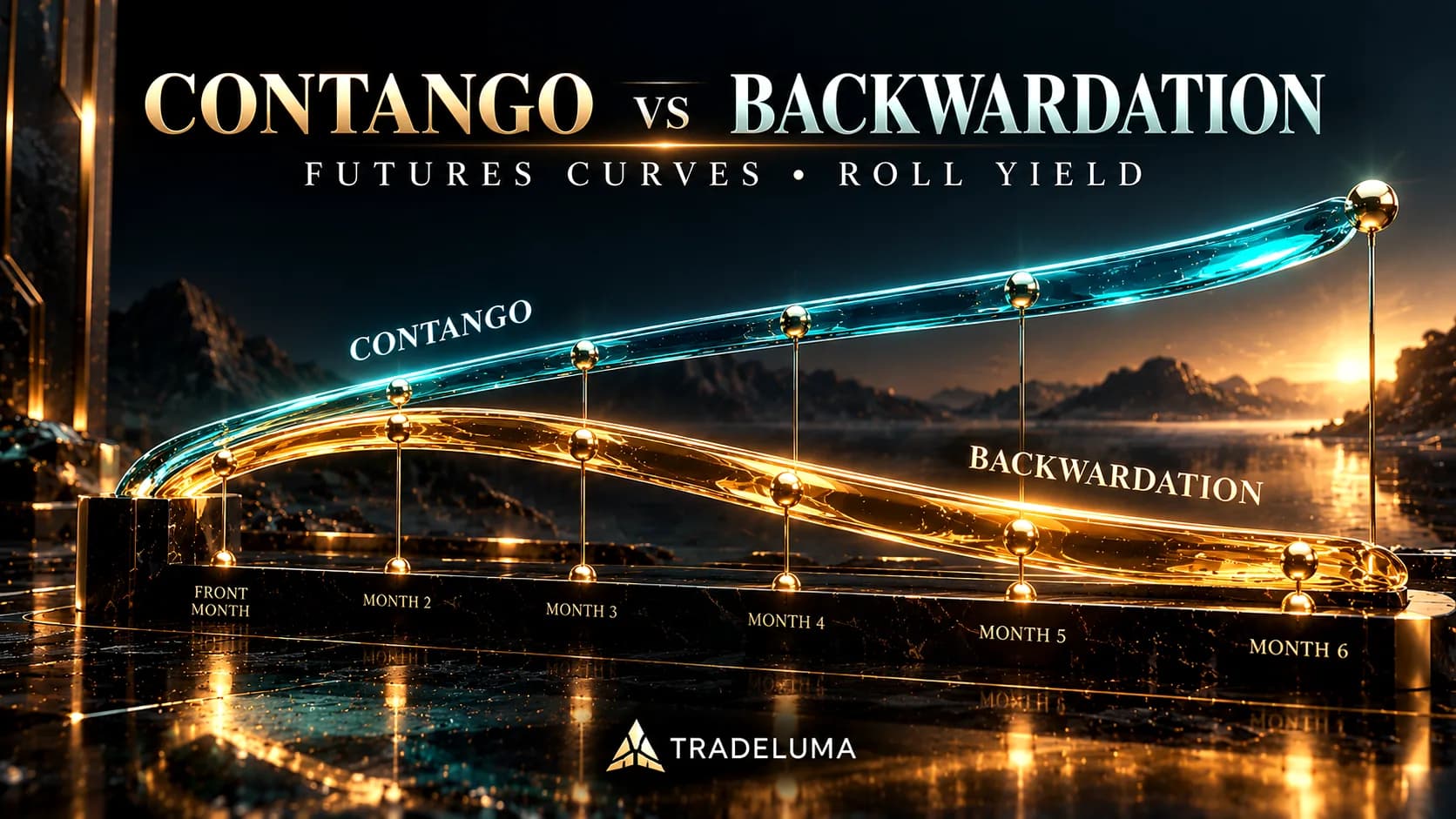
Contango vs Backwardation in Futures: Curves, Roll Yield & Examples
Understand contango and backwardation in futures, why curves slope up or down, how roll yield works, and what it means for oil, gold and rollover.

US Treasury Yields Explained: 2-Year vs 10-Year, Yield Curve Inversion & Market Impact
Understand US 2-year vs 10-year Treasury yields, yield curve inversion, real yields and the potential impact on gold, Nasdaq and Treasury futures.
Nonfarm Payrolls (NFP) Explained: Why Jobs Data Moves Gold & Nasdaq
Learn what US nonfarm payrolls, wages, unemployment and revisions mean, and why NFP surprises can move gold, Nasdaq and Treasury futures.