
Automation
Why Trading Bots Fail: 7 Mistakes Traders Should Avoid
Seven common automated trading failure modes, from overfitting and unrealistic expectations to execution errors and insufficient validation.
On this page+
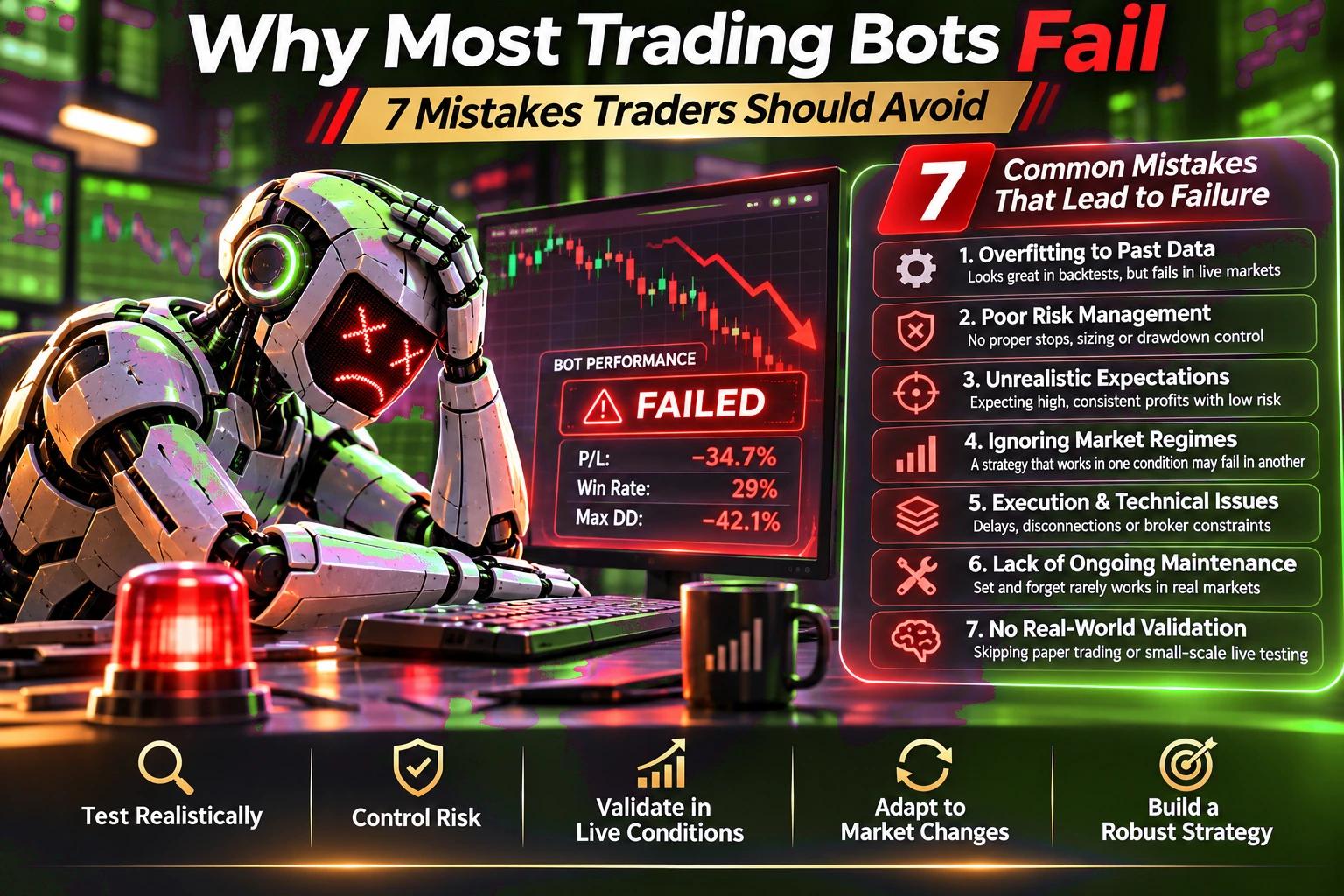
Seven common automated trading failure modes, from overfitting and unrealistic expectations to execution errors and insufficient validation. This TradeLuma educational guide is general information, not personal financial advice. TradeLuma has a commercial interest in its own strategy products and platform. Futures involve leverage and losses can exceed initial margin. Illustrations are conceptual, not performance evidence.
1. Overfitting historical data
A ruleset with many adjustable parameters can fit noise. Freeze the rules before examining an untouched period and compare neighbouring settings. Repeatedly tuning against the test period undermines its independence.
2. Poor risk management
Position sizing and aggregate exposure matter more than an attractive win rate. A stop order may fill beyond its trigger in fast markets. Consider margin, correlated positions and realistic adverse scenarios.
3. Unrealistic expectations
The CFTC warns about automated trading schemes promising unusually high or guaranteed returns. A bot is software, not a source of assured profit. Include trading costs: a hypothetical $4 round-trip expense on 250 trades is $1,000.
4. Ignoring market regimes
A breakout rule can struggle in choppy markets, while a mean-reversion rule can lose during persistent trends. Evaluate different volatility and liquidity environments rather than extrapolating from a single favourable period.
5. Execution and technical issues
A signal is not an accepted order or a fill. Track rejection, partial fill, cancellation and position reconciliation. Duplicate events, stale prices and uncertain broker responses need explicit handling before any live use.
6. Lack of ongoing maintenance
Contract rollover, exchange hours, broker API changes and software updates can alter behaviour. Monitor error logs and keep a versioned record of settings. Pause and investigate unresolved position discrepancies rather than repeatedly resubmitting orders.
7. No real-world validation
Paper trading tests workflow but cannot fully reproduce liquidity or live fills. Compare timestamped intended orders with actual outcomes under appropriate permissions. Never interpret simulated results as a promise.
A checklist for researching a strategy
Compare documented market fit, costs, version, sample, drawdown and execution requirements. TradeLuma's catalogue is first-party commercial information, not an independent quality rating. The cover's loss and win-rate figures are fictional; no population failure rate is asserted.
Frequently asked questions
Do most bots fail?+
No universal failure rate is established here; the seven mechanisms are common risks.
Can AI guarantee profits?+
No.
What is overfitting?+
Optimising a model to historical noise rather than a repeatable relationship.
Is paper trading enough?+
No. It helps test workflows but has simulation limitations.
Why can orders differ from signals?+
Costs, timing, liquidity, rejection and broker constraints can intervene.
How should I review a vendor?+
Check evidence, limitations, permissions, terms and support.
Execution workflow
See how controlled automation is structured.
Explore TradeLuma's execution flow, live and paper modes, broker controls, monitoring, and reconciliation.
See how TradeLuma works →Continue learning
Related guides.

Autotrading benefits and risks: what traders should know
Explore the main benefits and risks of autotrading, from consistency and speed to configuration errors, broker failures, and the need for strong risk controls.
How to build a responsible autotrading workflow from signal to broker
A complete educational framework for strategy rules, paper testing, secure alerts, risk limits, live approval, monitoring, and continuous review.
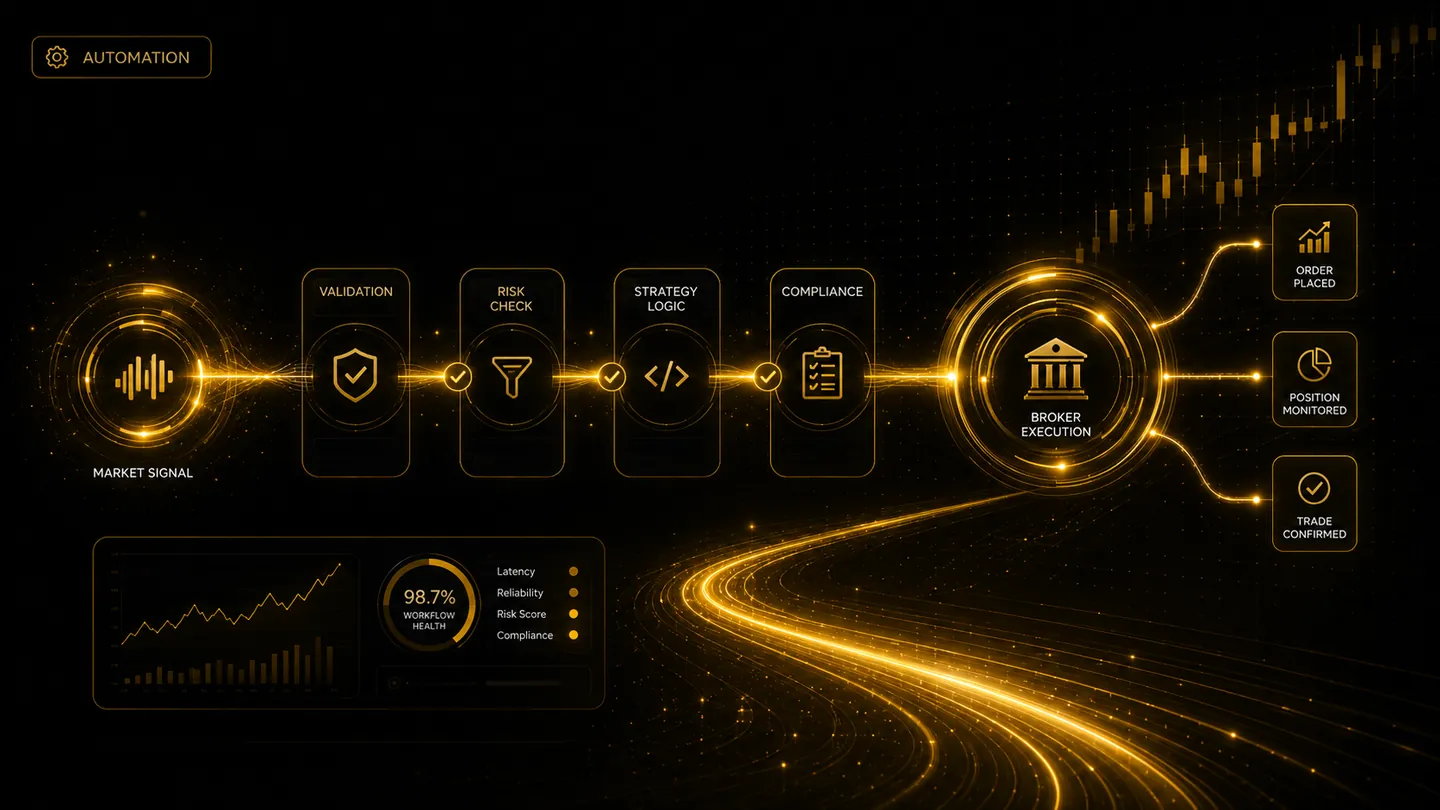
What automated trading infrastructure means for self-directed traders
A practical guide to automated trading infrastructure, broker routing, safety controls, and why execution visibility matters.