
Automation
Autotrading benefits and risks: what traders should know
Explore the main benefits and risks of autotrading, from consistency and speed to configuration errors, broker failures, and the need for strong risk controls.
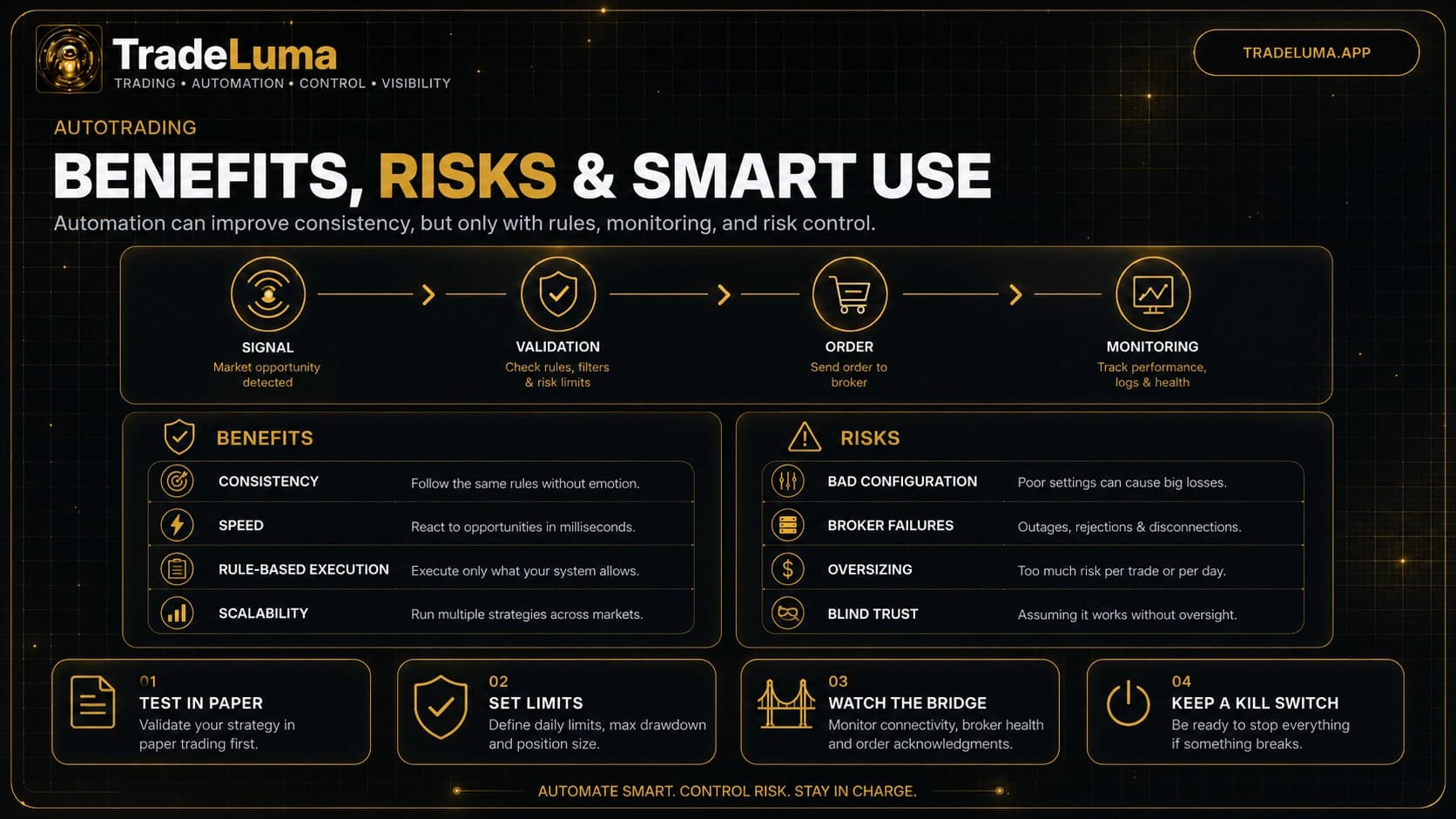
Autotrading can make a trading workflow more consistent, scalable, and easier to supervise, but it also creates its own operational risks. Traders often focus on speed and convenience while underestimating issues such as bad configuration, broker disconnects, duplicate events, and blind trust in a system that has not been tested properly. The right question is not whether autotrading is good or bad. It is whether the workflow is designed, tested, and monitored responsibly.
Why autotrading appeals to active traders
Autotrading is attractive because it can reduce repetitive manual steps between a signal and a broker order. A clear rule set can be translated into a repeatable workflow that receives the signal, validates the instruction, submits the order, and records the result. This can be especially useful for traders who monitor multiple markets or follow time-sensitive setups.
The appeal is not only speed. Many traders use automation because manual execution varies from trade to trade. The same strategy may be followed strictly on one day and loosely on another. Automation can narrow that gap by giving the same type of signal the same decision path each time.
Benefit: consistency and reduced hesitation
One of the strongest benefits of autotrading is consistency. When the rules are defined clearly, the system does not become fearful after a loss or overconfident after a win. That can reduce late entries, skipped signals, and inconsistent sizing. The trader gets a cleaner view of how the underlying strategy behaves because fewer outcomes are distorted by emotion.
Consistency also makes review more useful. If a trade was blocked, the reason can be explicit. If the order went through, the same validation steps should be visible again. This creates a better evidence trail than relying on memory alone.
Benefit: speed, scale, and operational coverage
Automation can react quickly once a valid signal arrives. That matters when the strategy depends on timely execution or when several markets are being followed at once. A trader does not need to manually type the same order details repeatedly, and the system can remain available during sessions that do not match the trader's local working hours.
Autotrading can also support scale. A trader may run several approved strategies with separate limits, schedules, and symbol mappings. That does not mean a larger system should be less controlled. In fact, scale increases the importance of visibility and safeguards.
Risk: bad configuration and unsupported assumptions
Automation will follow the logic it has been given, whether that logic is wise or flawed. A symbol mapped incorrectly, a quantity defined poorly, or a bracket setting not supported by the broker can all create outcomes the trader did not intend. Configuration risk is dangerous because it often looks invisible until the market moves.
This is why paper mode matters. Traders should verify entries, exits, duplicate handling, position sync, and recovery scenarios before any live exposure is allowed. If the configuration is ambiguous, the system can make the ambiguity faster.
Risk: broker failures, disconnects, and stale state
A working automation platform still depends on the broker path. Sessions can disconnect, orders can reject, market data can pause, and positions can be changed manually. The system needs monitoring, reconciliation, and a way to surface broker health clearly. Otherwise the trader may assume that automation is working while the path to the broker is degraded.
Good monitoring includes heartbeat freshness, connection state, recent accepted or blocked alerts, unresolved submissions, working orders, and open positions. Recovery should be a planned process, not an improvised response after something breaks.
Risk: oversizing and blind trust
Automation can make it easier to take more trades or larger trades than intended because the workflow feels efficient. That can create a false sense of safety. Fast execution does not reduce market risk. It only changes how quickly the risk is expressed.
Blind trust is another common mistake. Traders may stop checking logs, stop reconciling positions, or assume that past successful trades prove that the system needs no further supervision. Responsible autotrading means staying involved at the governance level even when the operational steps are automated.
How to use autotrading responsibly
Responsible autotrading starts with a strategy that has clear rules and realistic expectations. It then adds paper testing, risk limits, broker compatibility checks, duplicate protection, and a visible audit trail. Live mode should be a controlled state with explicit approval rather than a casual extension of a paper setup.
Daily loss boundaries, position caps, kill switches, and clear monitoring views all support safer behaviour. The trader should always know whether the bridge is healthy, what orders are working, and what protections are currently active.
The best mindset is controlled automation
The most useful way to think about autotrading is not as a promise of easy profits but as an execution system. Its job is to apply rules more consistently, preserve evidence, and support faster review. The strongest workflow combines automation with oversight, rather than replacing one with the other.
When the benefits are matched by strong controls, autotrading can become a serious operational advantage. When the controls are missing, the same speed and scale that make automation attractive can amplify mistakes.
Frequently asked questions
What are the main benefits of autotrading?
The main benefits include consistency, faster execution, easier scaling across markets, and stronger enforcement of pre-defined rules.
What are the main risks of autotrading?
Common risks include configuration errors, broker disconnects, unsupported order assumptions, oversizing, and insufficient supervision.
Should autotrading be tested in paper mode first?
Yes. Paper mode is the safest place to test alert formatting, routing, limits, duplicate protection, and broker behaviour before live capital is involved.
Does autotrading remove the need for monitoring?
No. Monitoring is essential. Traders still need visibility into broker health, working orders, open positions, and the controls currently active.
Continue learning
Related TradeLuma guides
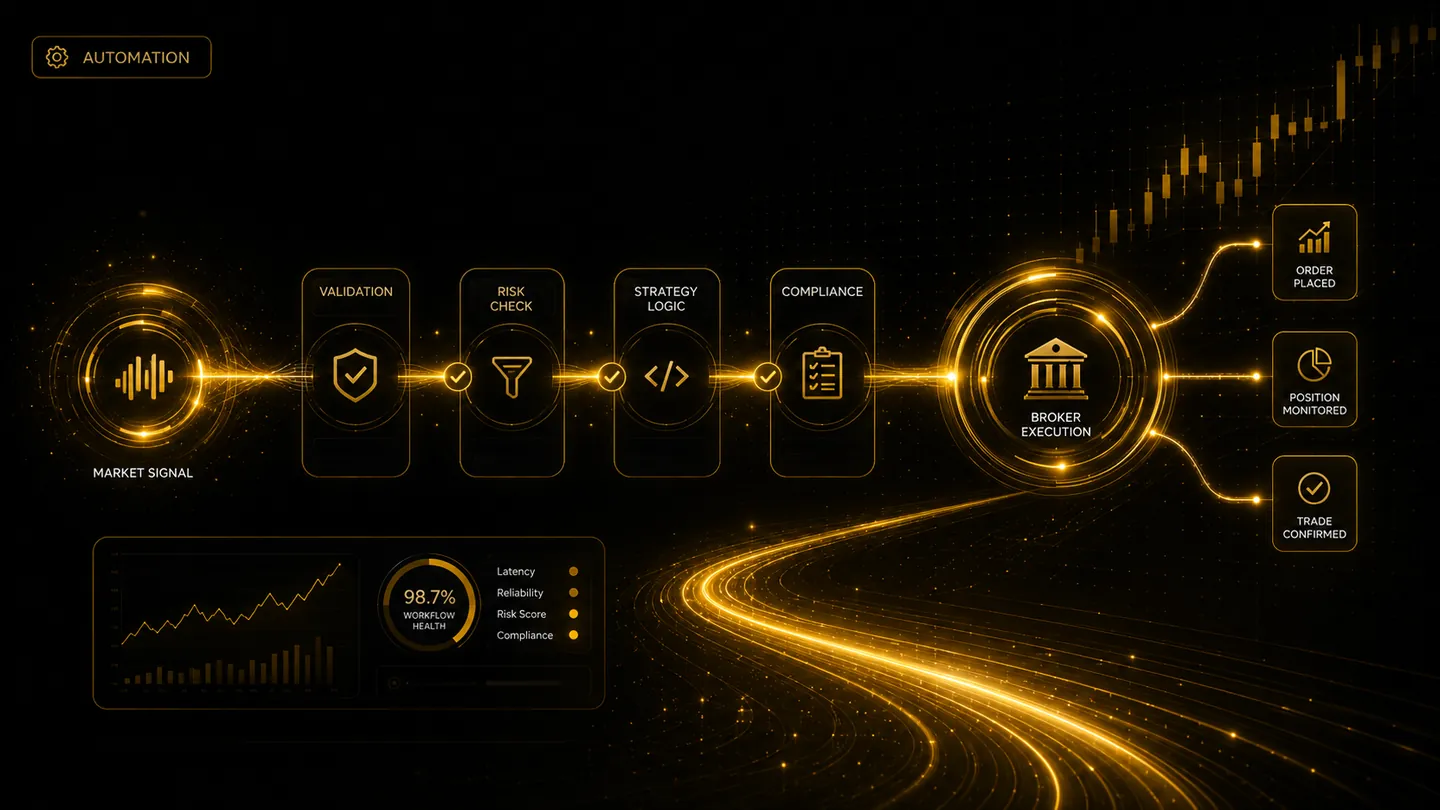
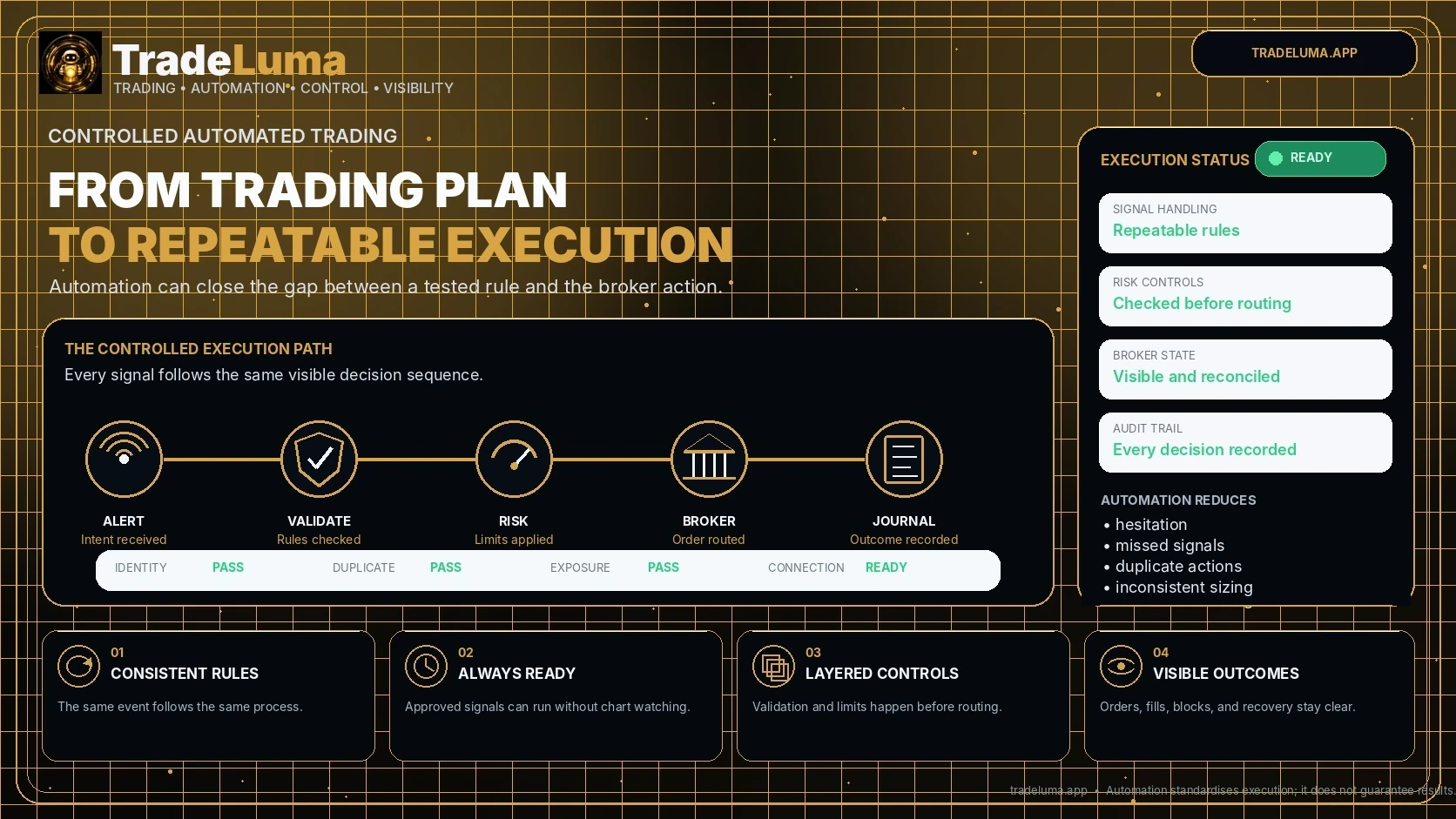
Build a controlled automation workflow with TradeLuma
Configure alerts, test in paper mode, apply execution controls, and follow broker outcomes from one workspace.