
Automation
Why automated trading can solve inconsistent execution
Learn how automated trading reduces hesitation, missed signals, duplicate orders, and inconsistent execution while preserving strategy and risk control.
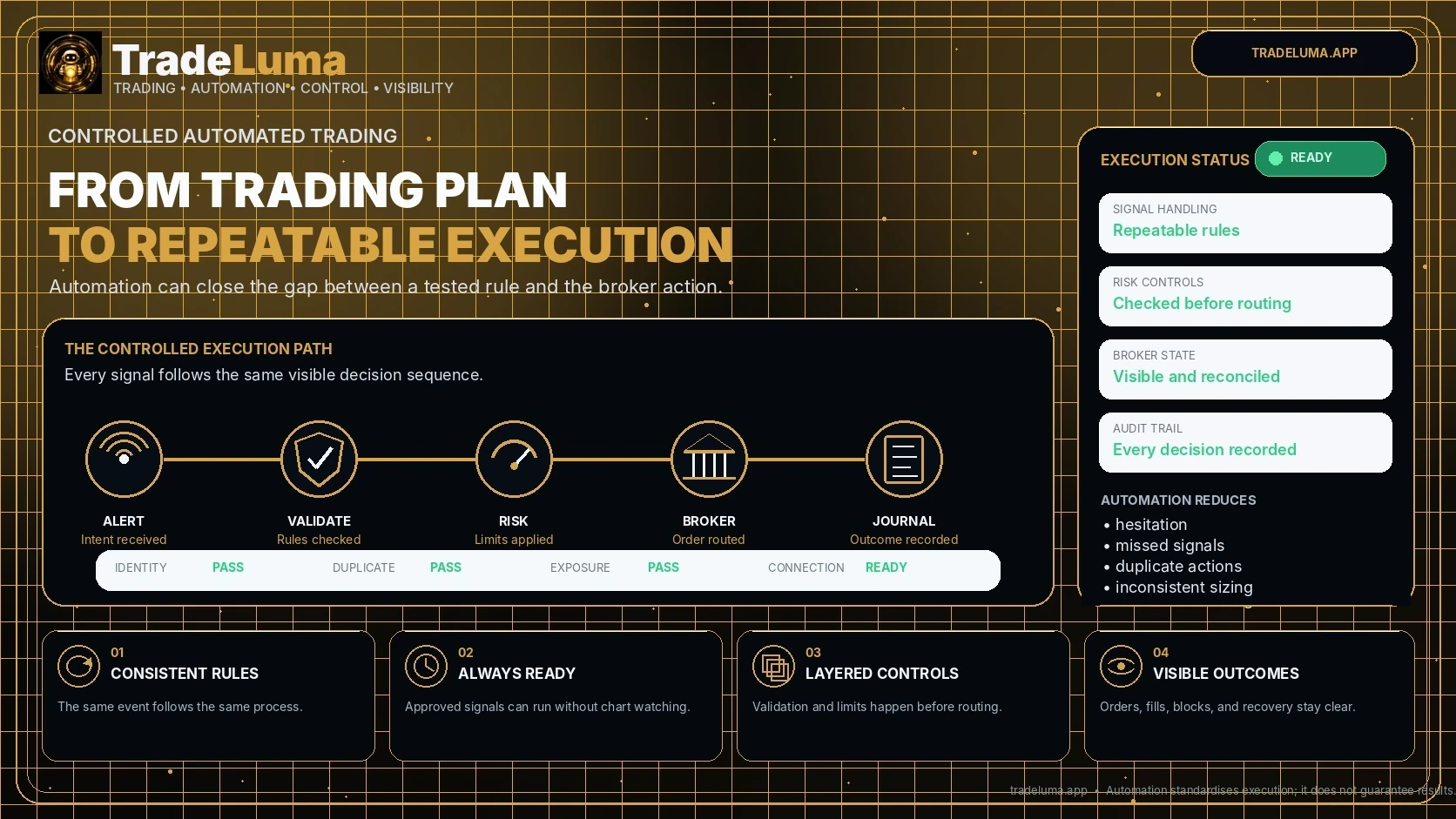
Many trading problems are not caused by a lack of ideas. They come from the gap between the rule a trader intended to follow and the action that actually reached the broker. Signals are missed, entries are delayed, size changes under pressure, exits are handled differently, and repeated alerts create duplicate risk. Automated trading can be a practical solution to that execution gap by turning a defined plan into a controlled, repeatable workflow.
The real problem is often inconsistent execution
A trader can have a reasonable strategy and still produce very different results from the backtest because live execution is inconsistent. One signal is taken immediately, another is ignored, a third is entered late, and a fourth uses a different quantity. Stops may be moved, exits delayed, or trades skipped after a recent loss.
These differences make the strategy difficult to evaluate. When the rules and the execution both change, the trader cannot tell whether performance came from the underlying idea, the market environment, or discretionary decisions made in the moment.
Automation turns explicit rules into repeatable actions
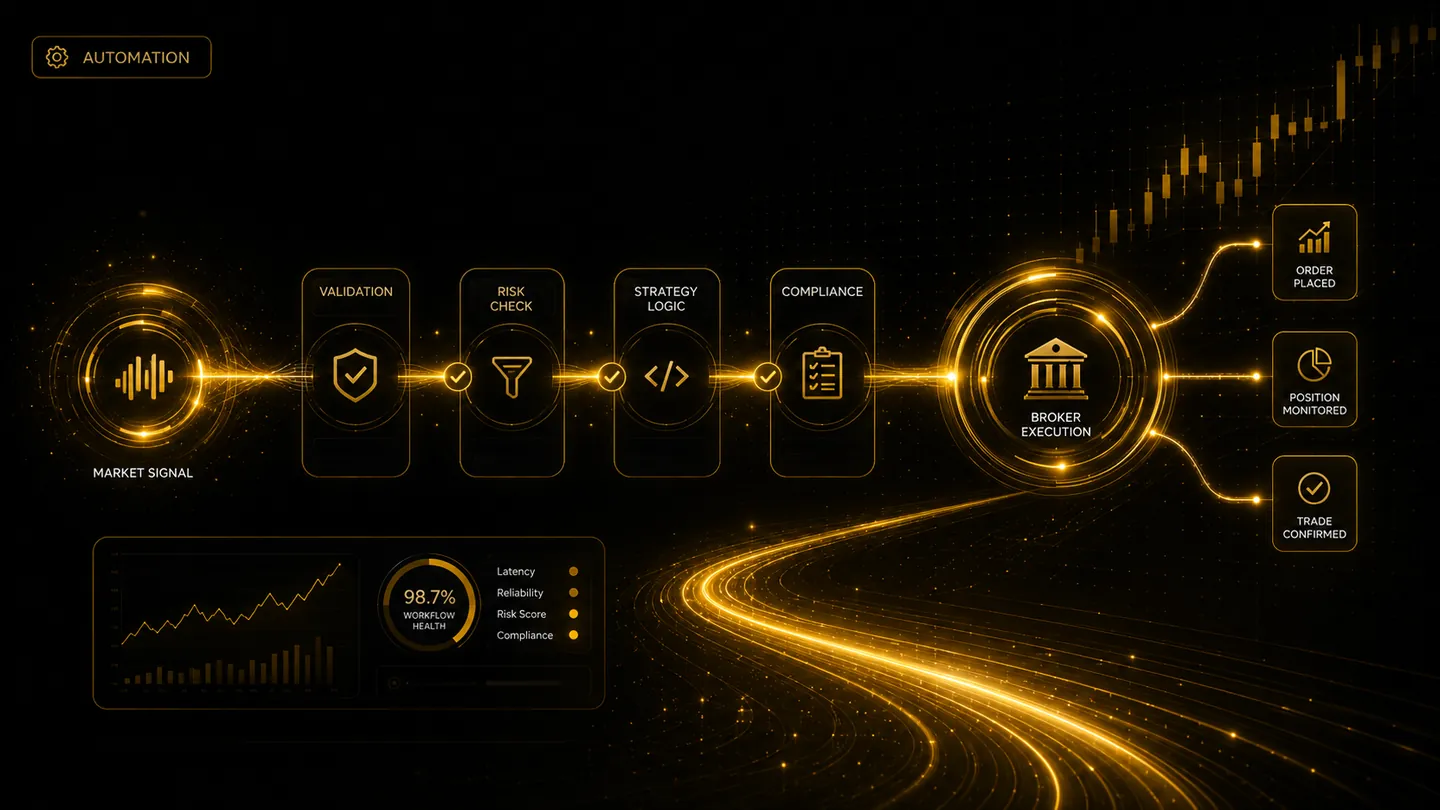
A rule-based system receives a defined signal, validates it, applies the configured controls, creates the broker instruction, and records the outcome. The same type of event follows the same decision path each time. This reduces hesitation and prevents the execution process from depending on attention, mood, or availability.
Repeatability is valuable even when the result is a rejected instruction. A clear blocked reason—such as disabled strategy, duplicate event, exceeded exposure, unavailable broker session, or invalid symbol mapping—is more useful than silent inconsistency.
Automation can respond when the trader is not watching
Markets may move outside the trader's preferred working hours, especially across international sessions. An automated workflow can receive eligible signals and apply pre-defined rules without requiring the user to watch every chart. This can reduce missed opportunities and the fatigue that comes from continuous monitoring.
Availability should not be confused with permission to trade constantly. Session filters, strategy schedules, daily boundaries, and broker readiness still matter. A system that is always online should also know when it is not allowed to create new exposure.
Risk controls become part of execution rather than a reminder
Manual risk rules are easy to reinterpret during a fast market. Automation can check maximum order quantity, open contracts, working entries, symbol concentration, account exposure, daily loss status, strategy direction, and live-account approval before an order is sent.
These controls should distinguish new risk from risk-reducing actions. A loss boundary may block another entry while still allowing a verified close or cancellation. The goal is controlled behaviour, not a blanket lock that prevents the trader from reducing exposure.
Duplicate protection and conflict handling solve machine-speed problems
Alerts can retry, networks can time out, and two strategies can signal together. Those events happen faster than a person can reliably inspect them. A well-designed automation layer uses stable event identity, idempotency, position checks, capacity reservation, and conflict rules so one instruction does not become several unintended orders.
This is one reason a direct alert-to-broker shortcut is incomplete. The solution is not merely faster delivery. It is a stateful process that knows what was already received, what is working, what the broker confirmed, and whether the next action is still valid.
A complete audit trail improves learning and accountability
Automation can preserve the original alert, normalised command, validation decisions, broker request, order identifiers, fills, rejections, cancellations, and reconciliation changes. That evidence makes it easier to investigate a trade without relying on memory or screenshots collected after the event.
The journal can separate strategy timing from platform timing and broker timing. The trader can then ask better questions: Was the signal late? Did the order wait in a queue? Did the broker reject it? Was the fill affected by spread or liquidity? Did a safety rule behave as intended?
Automation is a solution only when the inputs are ready
A strategy should have objective rules, realistic testing, supported symbols, appropriate order types, and a defined risk policy before live automation. If the trader cannot explain exactly what should happen after each signal, the automation may simply make ambiguity faster.
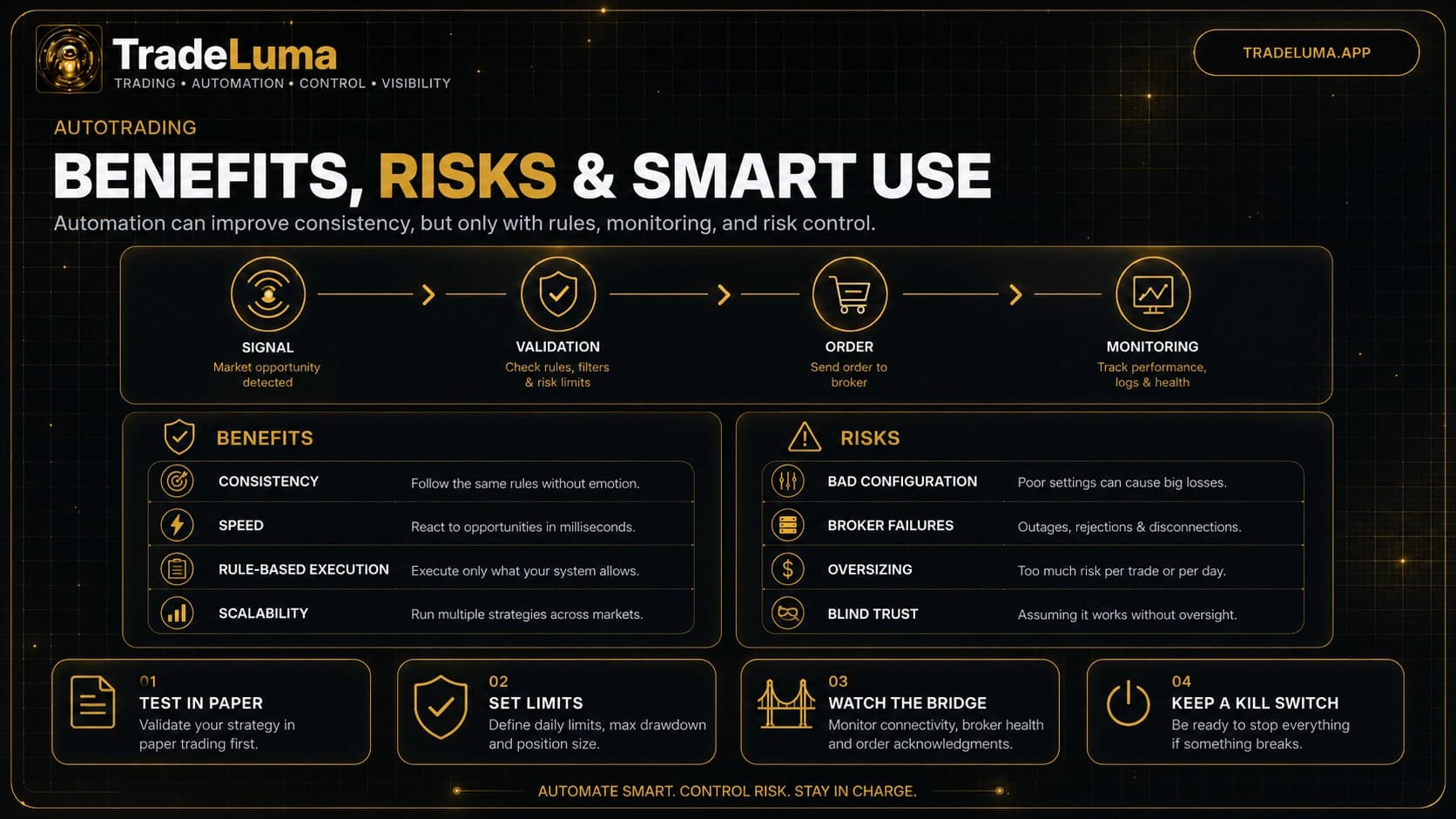
Paper mode is the correct place to test entries, exits, duplicate alerts, partial fills where supported, manual broker changes, session recovery, and emergency controls. The workflow should be understood before real capital depends on it.
Why controlled automation is stronger than unattended automation
Unattended automation suggests that a system can be switched on and forgotten. Controlled automation accepts that broker sessions disconnect, mappings become stale, orders reject, positions change manually, and markets behave differently from tests. Monitoring and reconciliation are therefore part of the solution, not optional extras.
The trader should be able to see connection health, recent heartbeats, accepted and blocked alerts, working orders, open positions, unresolved submissions, and the controls currently active. A kill switch and a documented recovery process should exist before they are needed.
The best outcome is a smaller gap between plan and reality
Automated trading is not valuable because computers can trade. It is valuable because a controlled system can apply a defined process more consistently than a person performing the same repetitive steps under pressure. That consistency makes both risk management and strategy evaluation more reliable.
The strongest workflow keeps the trader responsible for strategy and risk while allowing technology to handle validation, routing, tracking, and evidence. When those roles are clear, automation becomes a practical solution to execution inconsistency rather than a promise of effortless returns.
Frequently asked questions
What problem does automated trading solve?
It can reduce inconsistent execution by applying defined signal, sizing, risk, routing, and tracking rules in a repeatable way. It does not solve poor strategy design or eliminate market risk.
Is automated trading better than manual trading?
Neither method is universally better. Automation suits clear, repeatable rules and frequent operational tasks. Manual discretion may be appropriate when the decision genuinely depends on context that has not been formalised.
Can automated trading miss or duplicate orders?
It can if the system lacks reliable connectivity, event identity, duplicate protection, broker-state tracking, and recovery logic. Those controls are essential parts of a production workflow.
Should a trader go live immediately after automating a strategy?
No. The strategy and the complete execution path should be tested in paper mode, including failures and recovery scenarios, before live-account routing is enabled.
Continue learning
Related TradeLuma guides
Build a controlled automation workflow with TradeLuma
Configure alerts, test in paper mode, apply execution controls, and follow broker outcomes from one workspace.