
Risk Management
Position Sizing in Trading: Risk Per Trade, Stop Distance and Contract Size
Learn how position sizing links account risk, stop distance, point value, leverage, and contract or share quantity into one repeatable risk process.
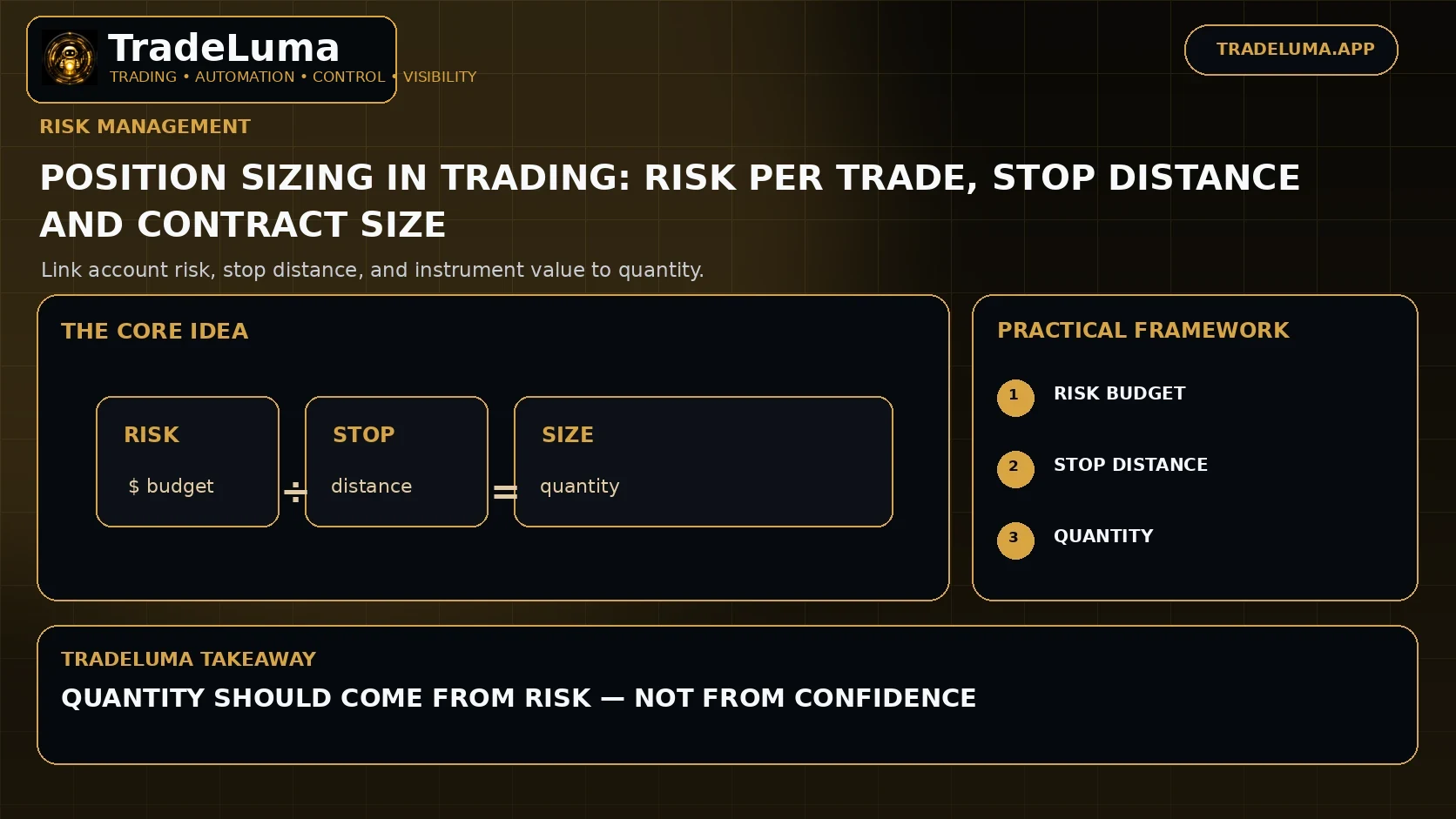
Position sizing decides how much exposure a trade receives. The same entry and stop can be conservative or dangerous depending on quantity. A repeatable sizing process starts with the amount of account equity the trader is prepared to risk, converts the distance between entry and stop into money per unit, and then chooses a quantity that stays within that limit.
The basic position-sizing formula
At its simplest, position size equals the amount of money the trader is willing to risk divided by the money at risk per unit. The unit may be one share, one contract, one lot, or another broker-defined quantity.
For a share position, money at risk per share is usually the entry-to-stop distance. For futures, that distance must be multiplied by the contract's point or tick value.
Choosing risk per trade
Some traders use a fixed percentage of equity while others use a fixed dollar amount or a volatility-adjusted budget. The specific number is a personal risk decision rather than a universal rule.
The key is consistency and survivability. The amount should be small enough that a normal losing streak does not create an unacceptable drawdown or force emotional changes to the strategy.
Stop distance determines quantity
Suppose two setups have identical expected quality but one needs twice the stop distance because volatility is higher. If both are meant to risk the same account amount, the wider-stop trade should use roughly half the quantity, all else equal.
This is why the logical stop should be chosen before quantity. Otherwise the trader may squeeze the stop simply to justify a preferred position size.
Futures contract sizing
Futures require the trader to know the contract multiplier, minimum tick, and tick value. A one-point move can represent very different money across contracts, and micro contracts can provide finer sizing than full-size contracts.
Margin is not the same as risk. A broker may allow a position based on available margin even when the loss to a sensible stop is far larger than the trader's risk budget.
Shares and fractional quantities
For shares, quantity can be calculated from the dollar risk per share. Some brokers support fractional shares, which can make the sizing closer to the intended risk amount.
Liquidity and minimum order rules still matter. A mathematically correct position can be impractical if the instrument is thinly traded or the order is large relative to available volume.
Leverage and effective exposure
Leverage allows a trader to control more notional value with less capital, but it does not reduce the size of adverse price moves. Higher leverage can make a small percentage change in the instrument create a much larger percentage change in account equity.
Position sizing should therefore be based on risk to the stop and total exposure, not only on the broker's margin requirement.
Portfolio and correlation risk
Sizing each trade independently can still create excessive total risk when several positions are highly correlated. Long positions in related equity indices, metals, or technology shares may behave like one larger trade during stress.
Portfolio rules can cap total open risk, sector concentration, asset-class concentration, or same-direction exposure so individual sizing does not hide aggregate risk.
Slippage and gap allowance
The planned stop defines normal risk, but real losses can be larger when price gaps or slippage occurs. Instruments that trade through illiquid periods or around major events may need extra conservatism.
Stress testing with worse-than-expected exits provides a more realistic view of how the sizing plan behaves during abnormal conditions.
How to audit position sizing
For every trade, record account equity, chosen risk amount, entry, stop, value per point or tick, calculated quantity, actual quantity, and realised loss if stopped. This makes sizing errors easy to identify.
Review whether actual losses consistently exceed planned risk because of slippage, fees, overnight gaps, or incorrect contract values. If they do, the sizing model needs adjustment.
Frequently asked questions
How do I calculate position size in trading?
Divide the money you are prepared to risk by the money at risk per unit between entry and stop, then apply the instrument's share, lot, point, tick, or contract value rules.
How much should I risk per trade?
There is no universal percentage. The amount should fit the strategy's expected losing streaks, drawdown tolerance, leverage, and overall portfolio risk.
Is margin the same as risk?
No. Margin is the collateral the broker requires. Trading risk depends on position size, price movement, stop distance, gaps, slippage, and contract value.
Why do correlated positions matter?
Several individually small positions can behave like one large exposure when they move together, so portfolio-level risk can be much higher than each trade suggests.
Continue learning
Related TradeLuma guides
Risk Management
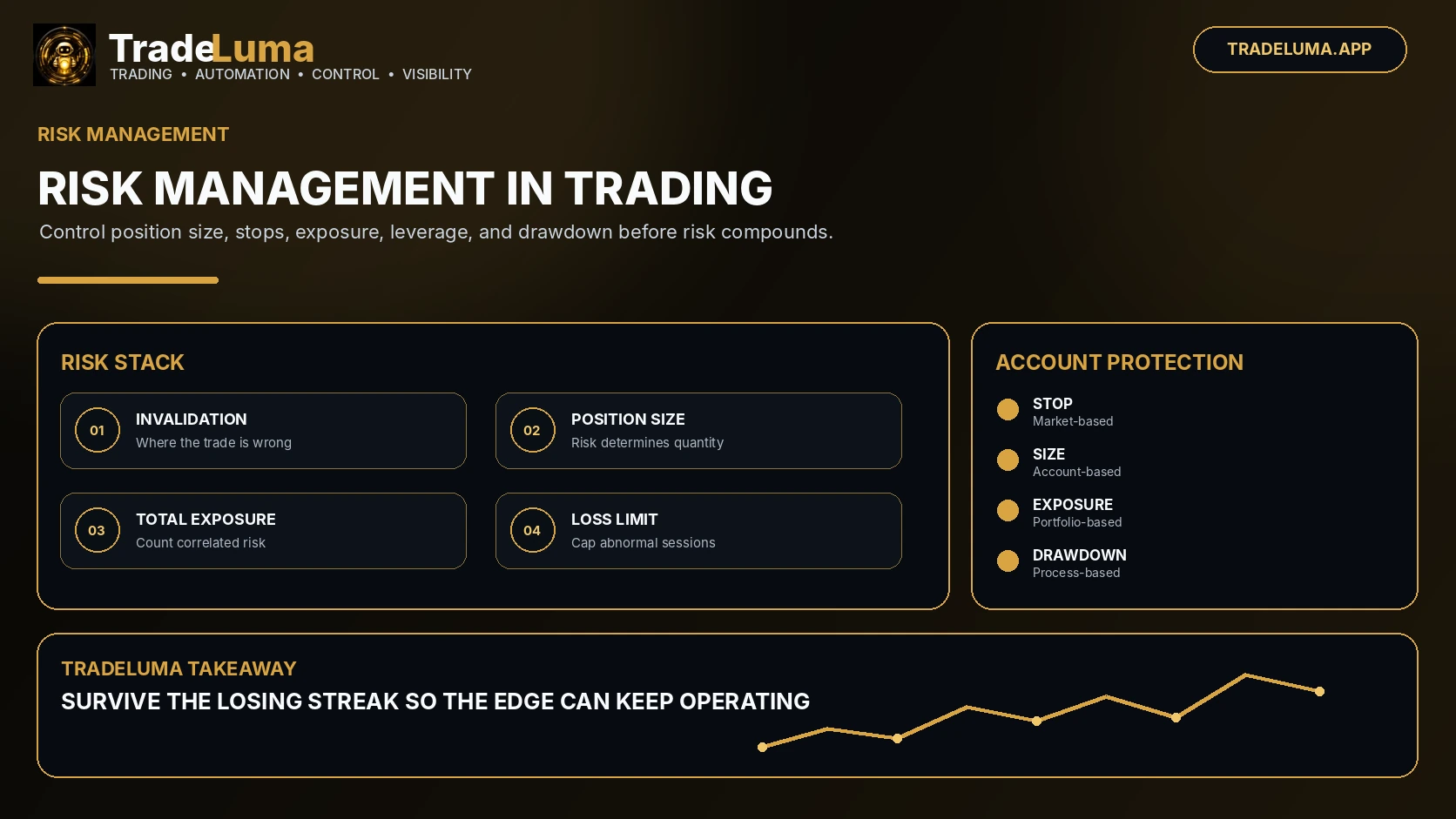
Risk Management in Trading: Position Size, Stops and Drawdown
16 Aug 2026 · 13 min read
Risk Management
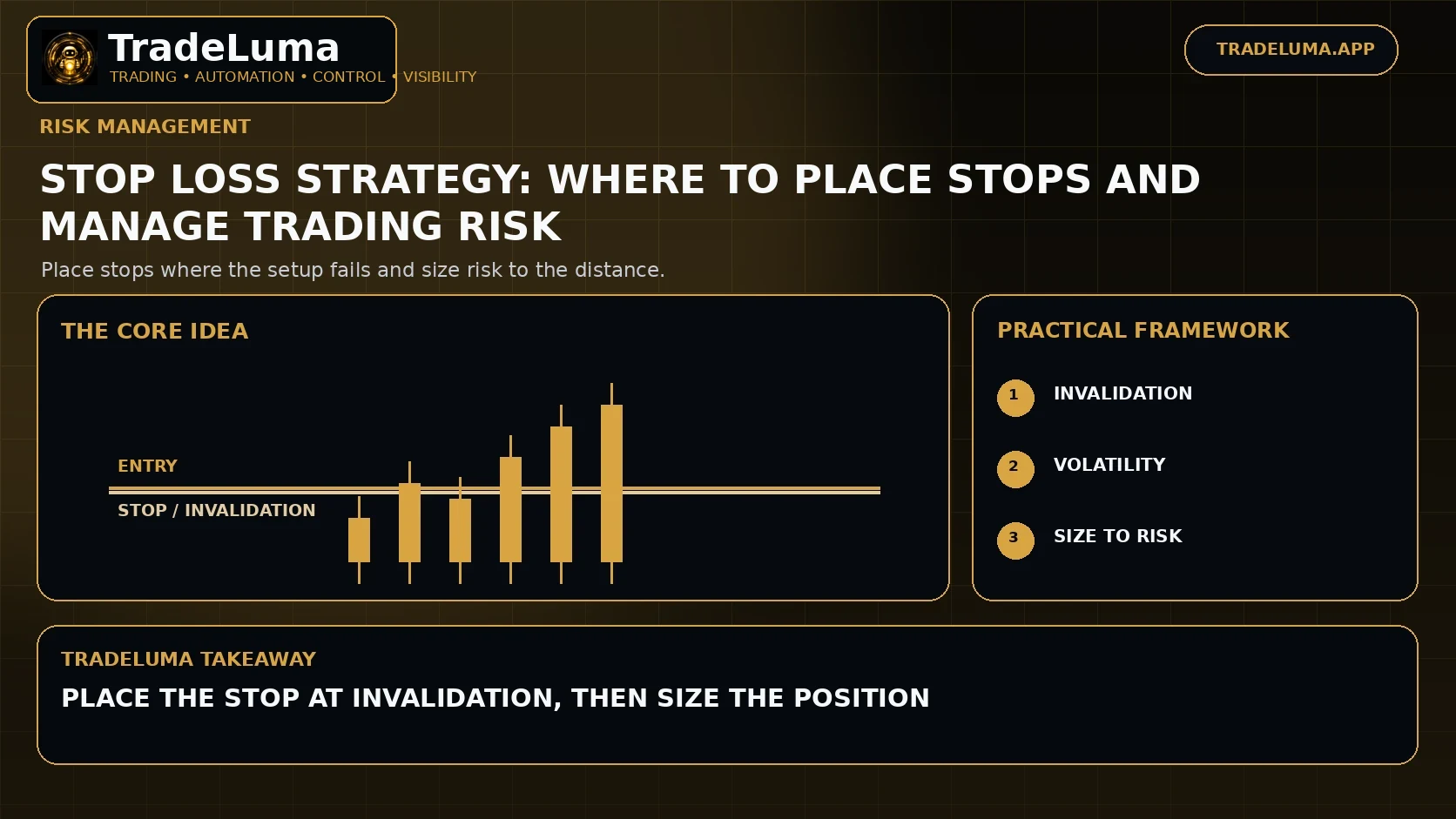
Stop Loss Strategy: Where to Place Stops and Manage Trading Risk
3 Sept 2026 · 12 min read
Risk Management
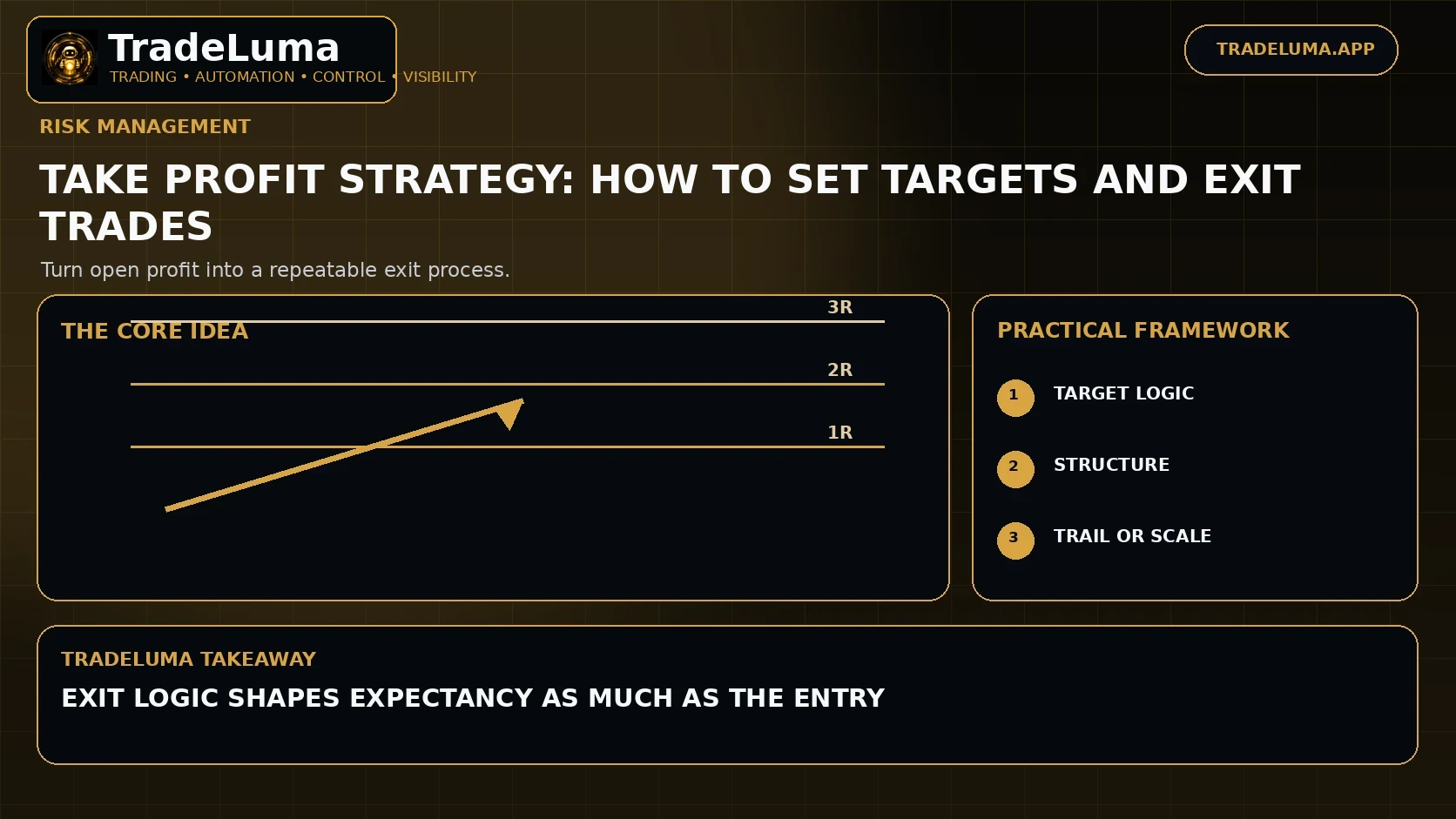
Take Profit Strategy: How to Set Targets and Exit Trades
4 Sept 2026 · 11 min read
Build a controlled automation workflow with TradeLuma
Configure alerts, test in paper mode, apply execution controls, and follow broker outcomes from one workspace.