
Risk Management
Risk Management in Trading: Position Size, Stops and Drawdown
Learn trading risk management through position sizing, stop placement, portfolio exposure, drawdowns, losing streaks, leverage, and risk limits.
On this page+

Risk management determines how much damage a wrong trade can do before the strategy has another chance to work. Even a positive-expectancy method can experience losing streaks, gaps, slippage, and market regimes where its edge weakens. A robust risk framework therefore starts before entry: define the invalidation point, calculate size from that risk, cap total exposure, and decide in advance what happens when drawdown increases.
Why risk management comes before return
Trading performance is path-dependent. Two strategies can produce the same final return but expose the account to very different drawdowns along the way. If losses become too large to tolerate financially or psychologically, the trader may stop before the strategy has a chance to recover.
Risk management aims to keep individual mistakes, unusual market events, and ordinary losing streaks within boundaries the account can survive. The objective is controlled participation, not the elimination of losses.
Start with the invalidation point
A stop should represent the level or condition where the original trade thesis no longer holds. For a breakout, that may be a return inside the prior range; for a trend pullback, it may be a break of structure; for a volatility system, it may be an ATR-based distance.
Placing a stop solely to achieve a preferred dollar loss can distort the setup. A more coherent process defines the market-based invalidation first, then adjusts position size so the monetary risk fits the account rule.
Calculate position size from risk
A simple framework is to choose a maximum amount the account is allowed to lose if the stop is reached and divide that amount by the risk per unit. Futures, options, leveraged products, and contracts with multipliers require the correct point or tick value in the calculation.
The result should also respect minimum lot sizes, broker margin requirements, liquidity, and any maximum contract or share cap. If the correct risk-based size is below the minimum tradable unit, the trade may simply be too large for the account at that stop distance.
Understand risk per trade as a range, not a magic number
There is no universal percentage that is appropriate for every trader, product, or strategy. The suitable amount depends on drawdown tolerance, strategy variance, leverage, account size, trade frequency, and how many correlated positions can be open at once.
Historical testing can estimate losing streaks and drawdowns, but future outcomes can be worse. Conservative sizing leaves room for model error, slippage, gaps, and a sequence of losses that exceeds the backtest.
Control total open exposure
Several individually small positions can create a large combined risk. Account-level controls can cap the number of open trades, total notional exposure, total stop risk, or contracts per connection.
Correlation matters as well. Long positions in several closely related equity indices or metals may behave like one concentrated trade when markets move sharply. Portfolio risk should therefore look beyond symbol count.
Leverage and margin are not the same as risk
Broker margin tells you how much capital is required to hold a leveraged position; it does not tell you how much the position can lose. A highly leveraged position can move far beyond the margin amount if price gaps or volatility expands.
Risk should be measured from price movement, contract value, size, and the planned exit. Margin is an operational constraint that must be respected, but it should not be used as a substitute for a loss calculation.
Plan for losing streaks
A strategy with a healthy long-run expectancy can still produce consecutive losses. The higher the variance and the lower the win rate, the more important it is to model sequences rather than focusing only on the average trade.
Reducing risk during a significant drawdown can slow the rate of further losses, although it also slows recovery if the strategy rebounds. Any drawdown-based sizing rule should be defined and tested in advance rather than invented during stress.
Use daily and session limits carefully
A maximum daily loss can stop new entries after the account has reached a pre-defined boundary. This can be especially useful for high-frequency or intraday approaches where many trades can occur in a short period.
The limit should reflect the normal variance of the strategy. If it is too tight, ordinary losing sequences may repeatedly stop the system before its edge can play out; if it is too loose, it may fail to meaningfully contain abnormal behaviour.
Stress test beyond the backtest
Test what happens when slippage is worse, spreads widen, stops fill beyond the requested level, several correlated trades lose together, or the strategy experiences a longer losing streak than seen historically. Stress testing asks whether the account remains operable when assumptions deteriorate.
Monte Carlo resampling and parameter sensitivity can also help estimate a range of possible equity paths. These tools do not predict the future, but they can expose whether a risk plan depends on an unusually smooth historical sequence.
Review risk separately from strategy signals
A good review should ask both whether the strategy signal was valid and whether the amount of risk was appropriate. A trade can be correctly identified but oversized, or poorly identified but small enough that the damage remains controlled.
Track actual risk, planned risk, slippage, maximum adverse excursion, drawdown, and breaches of risk rules. Over time, these records reveal whether losses come from the strategy itself or from inconsistent sizing and execution.
Frequently asked questions
What is risk management in trading?+
Risk management is the framework used to control position size, stop risk, leverage, combined exposure, drawdowns, and account-level loss limits.
How do traders calculate position size?+
A common approach defines the monetary risk allowed on the trade, determines the distance to the invalidation point, converts that distance using the instrument's unit or contract value, and sizes the position accordingly.
Does a stop loss guarantee the exit price?+
No. Gaps, fast markets, and limited liquidity can cause fills beyond a stop level. Risk plans should allow for slippage and abnormal market conditions.
Can risk management make any strategy profitable?+
No. Risk management can limit the damage from losses, but the underlying strategy still needs positive expectancy after realistic costs.
Put it into practice
Use the risk maths next to the guide.
Open TradeLuma's free position-size, risk/reward, expectancy, and drawdown tools to test the numbers behind a risk-management decision.
Open free trading calculators →Continue learning
Related guides.

Position Sizing in Trading: Risk Per Trade, Stop Distance and Contract Size
Learn how position sizing links account risk, stop distance, point value, leverage, and contract or share quantity into one repeatable risk process.

Stop Loss Strategy: Where to Place Stops and Manage Trading Risk
Learn how stop losses work, where traders place them, how volatility affects stop distance, and why position size should adapt to the invalidation point.
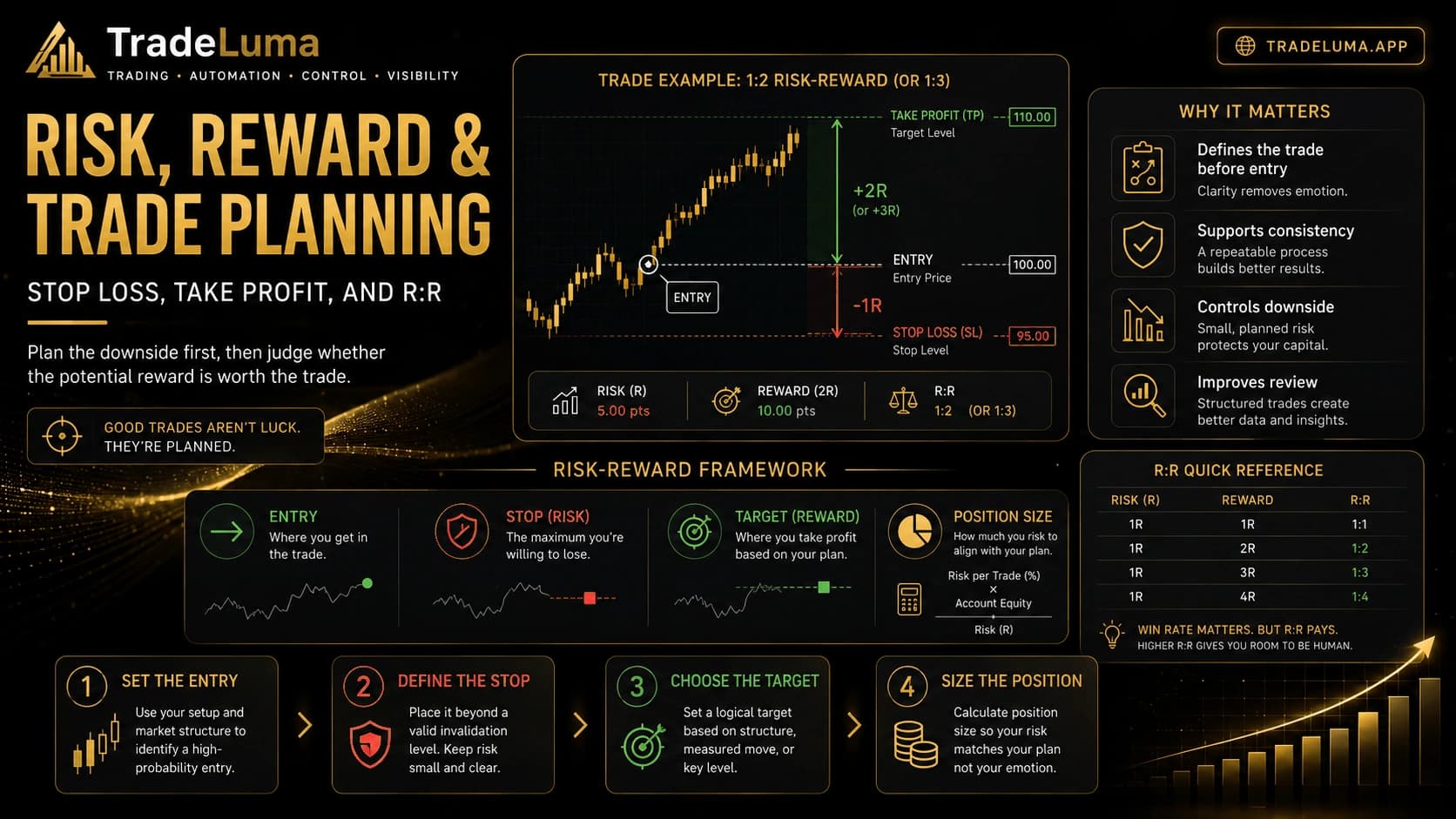
Risk-reward ratio, stop loss, and take profit explained
Learn how risk-reward ratio works, how traders use stop losses and take-profit targets, and why trade planning can improve consistency and review.