
Risk Management
Stop Loss Strategy: Where to Place Stops and Manage Trading Risk
Learn how stop losses work, where traders place them, how volatility affects stop distance, and why position size should adapt to the invalidation point.
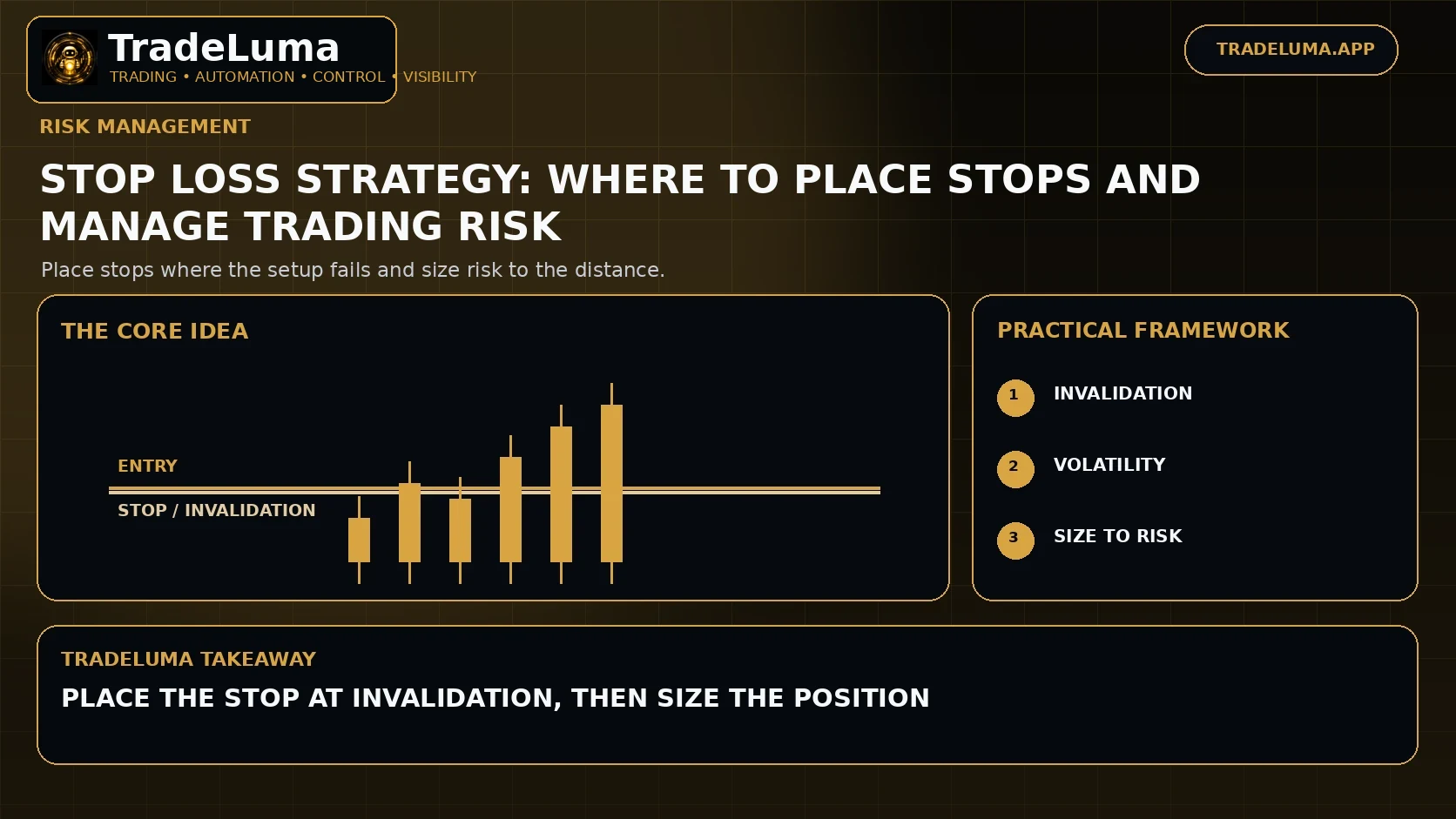
A stop loss is an exit rule designed to limit the damage when a trade no longer matches its original thesis. The most useful question is not how close a stop can be placed, but where the trade is objectively invalidated and how much position size is appropriate for that distance. Stops that are too tight can be triggered by ordinary noise, while stops that are too wide can make a single loss disproportionately large.
What a stop loss is designed to do
A stop defines the point where the trader accepts that the original setup is wrong, late, or no longer worth the risk. It converts an open-ended decision into a planned maximum loss under normal execution conditions.
The purpose is risk control, not perfect timing. A stopped trade can later move in the original direction and still have been a correct execution of the plan.
Structure-based stops
A structure stop sits beyond a swing high, swing low, support zone, resistance zone, breakout level, or other price point that should remain intact if the setup is valid.
This approach links the stop to the trade idea. The weakness is that obvious levels can attract liquidity and temporary probes, so some strategies use a tested buffer beyond the structural point.
Volatility-based stops
Volatility-based stops adapt to how much the instrument is currently moving. ATR is commonly used because it estimates recent average true range. A stop might be set a chosen multiple of ATR away from entry or beyond structure plus an ATR buffer.
The multiplier is not universal. It should be tested by market and timeframe because too small a value can create frequent noise exits while too large a value reduces position size and changes payoff.
Percentage and fixed-distance stops
A percentage stop exits after price moves a fixed percentage against the position. Fixed-point or fixed-tick stops do the same in price units. They are simple and easy to automate.
The drawback is that market volatility changes. A fixed distance that is sensible this month may be too tight or too wide when the instrument's normal range changes materially.
Time stops and thesis stops
Not every invalidation is purely price based. A time stop exits if the expected move does not occur within a defined window. An event-based or thesis stop can exit when the condition that justified the trade disappears.
These rules are especially useful for setups that depend on immediate follow-through, but they need objective definitions to avoid becoming discretionary excuses.
Why position size must follow the stop
If two trades use the same account risk but one requires a wider stop, the wider-stop trade should generally use a smaller position. This keeps the planned loss more stable across different setups and volatility regimes.
Choosing size first and then forcing the stop to fit that size reverses the process and can place the stop inside normal market noise.
Trailing stops
A trailing stop moves in the favourable direction as the trade progresses. It can follow swing structure, a moving average, ATR, percentage distance, or a fixed number of points.
Trailing stops can protect open profit and capture trends, but they also give back some unrealised profit before exiting. A very tight trail can convert a trend strategy into a series of premature exits.
Stop orders, slippage, and gaps
A stop order typically becomes executable when the trigger price is reached, but the final fill can be worse in fast or gapping markets. This is especially relevant around major news, overnight gaps, thin liquidity, and highly leveraged products.
Risk planning should therefore consider realistic execution rather than assuming every stop fills exactly at the trigger.
How to test stop placement
Compare candidate stop methods using the same entries so you can see how each changes win rate, average loss, average win, drawdown, and total expectancy. Include realistic costs and slippage.
Also inspect maximum adverse excursion. It can show whether winners regularly need more room than the current stop allows or whether the strategy is carrying unnecessary risk.
Frequently asked questions
Where should I place a stop loss?
A stop is usually most defensible at the point where the setup is invalidated, such as beyond relevant structure or a tested volatility threshold, with position size adjusted to that distance.
Is ATR good for stop losses?
ATR can be useful because it adapts stop distance to recent volatility, but the ATR multiple should be tested for the specific market, timeframe, and strategy.
Can a stop loss guarantee my exit price?
No. In fast or gapping markets, the fill can be worse than the trigger price because a stop order cannot guarantee available liquidity at one exact price.
Should I move my stop farther away after entry?
Usually that increases risk beyond the original plan. Any rule for widening a stop should be defined and tested before the trade rather than improvised because the position is losing.
Continue learning
Related TradeLuma guides
Risk Management
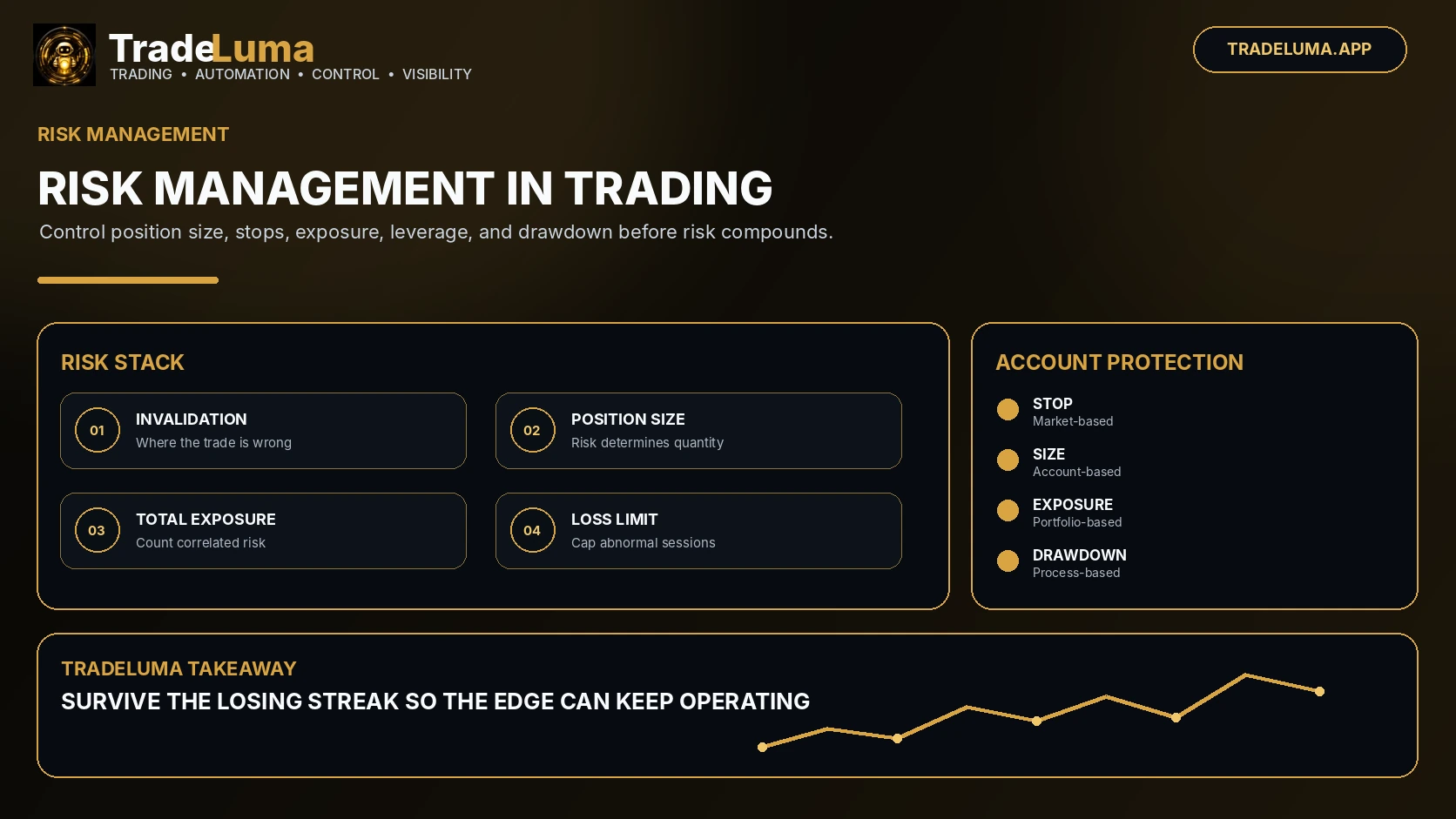
Risk Management in Trading: Position Size, Stops and Drawdown
16 Aug 2026 · 13 min read
Risk Management
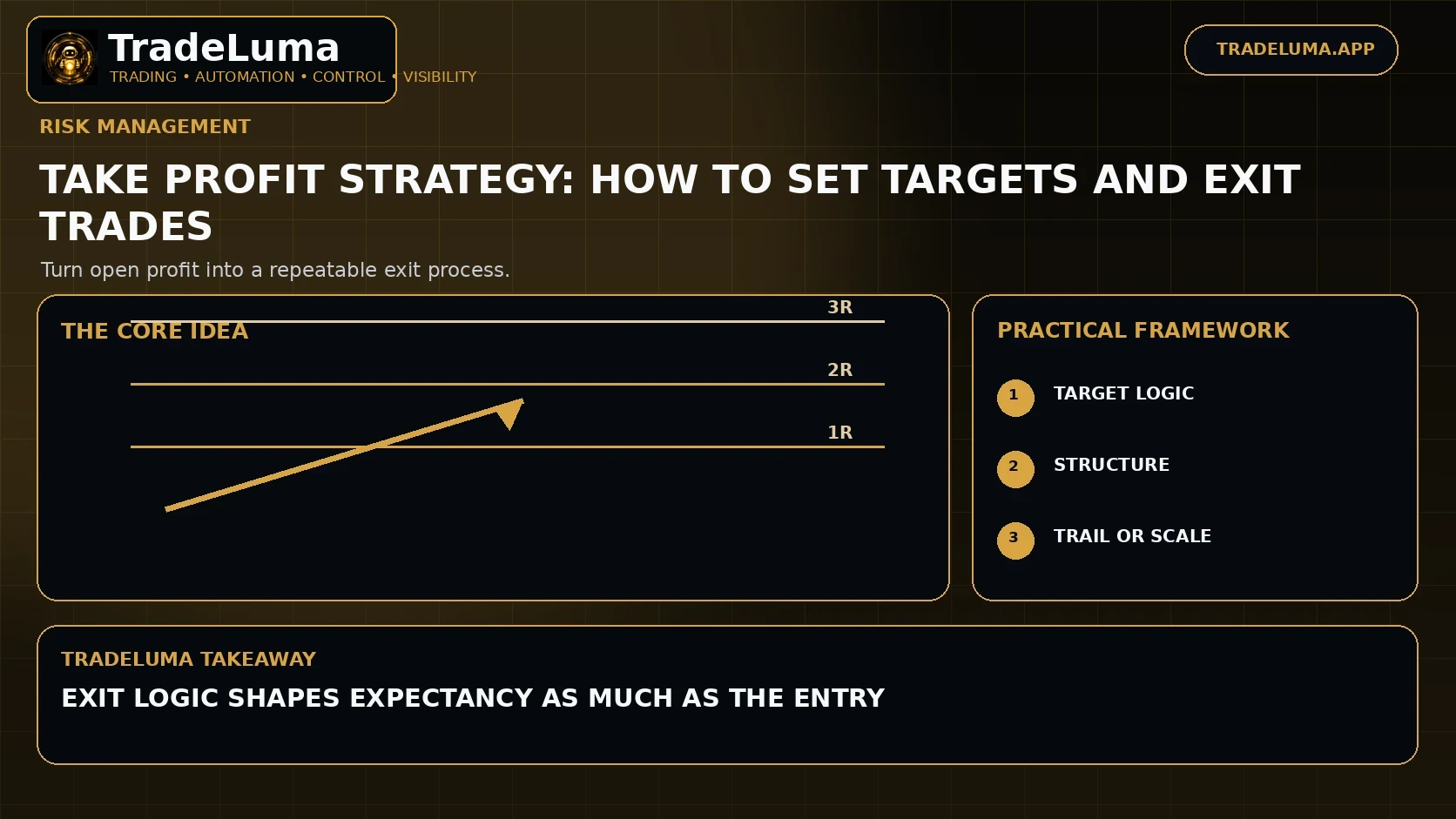
Take Profit Strategy: How to Set Targets and Exit Trades
4 Sept 2026 · 11 min read
Risk Management
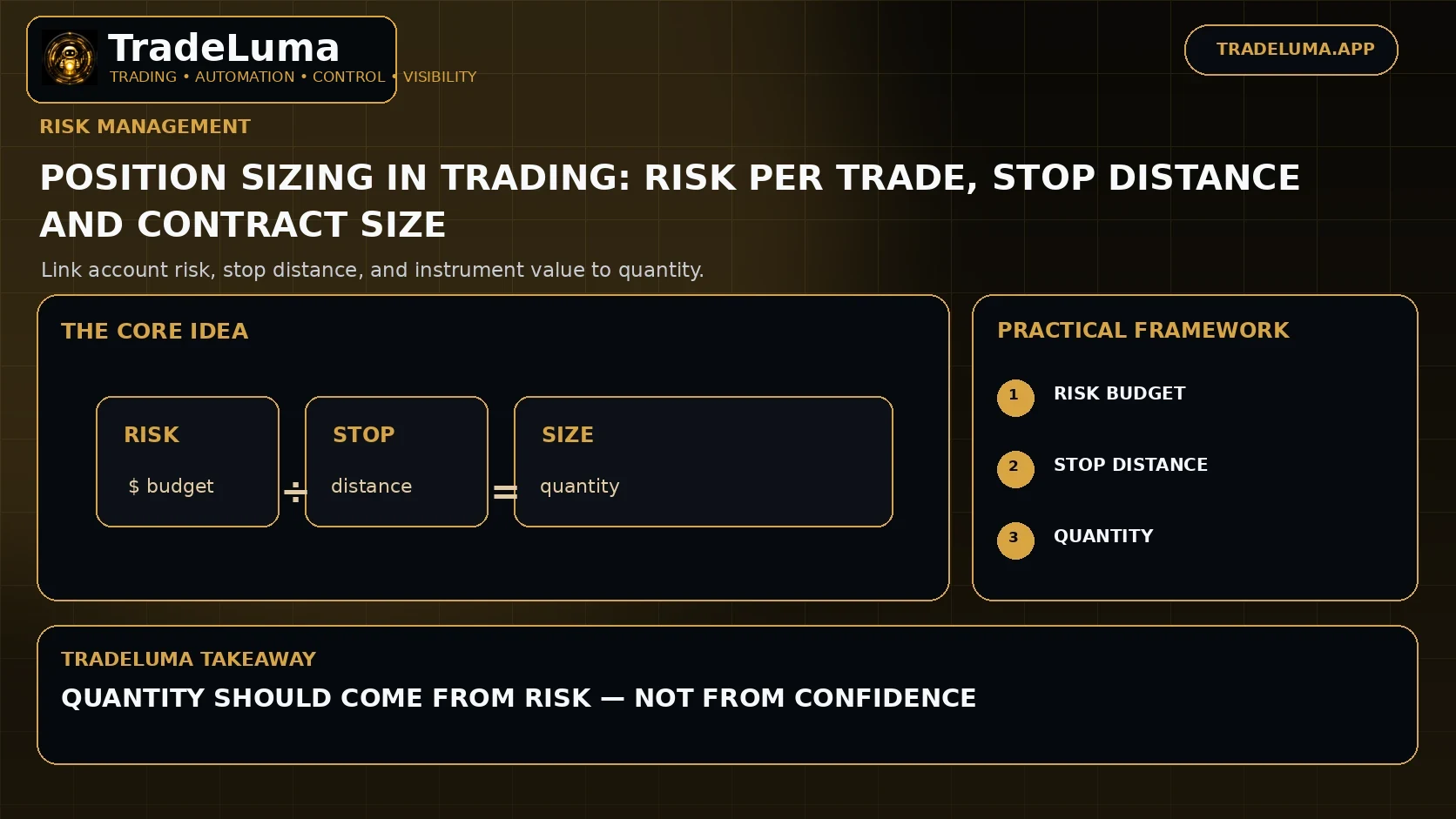
Position Sizing in Trading: Risk Per Trade, Stop Distance and Contract Size
5 Sept 2026 · 12 min read
Build a controlled automation workflow with TradeLuma
Configure alerts, test in paper mode, apply execution controls, and follow broker outcomes from one workspace.