
Risk Management
Take Profit Strategy: How to Set Targets and Exit Trades
Learn how traders set take-profit targets using reward-to-risk, market structure, volatility, trailing exits, and partial profit-taking.
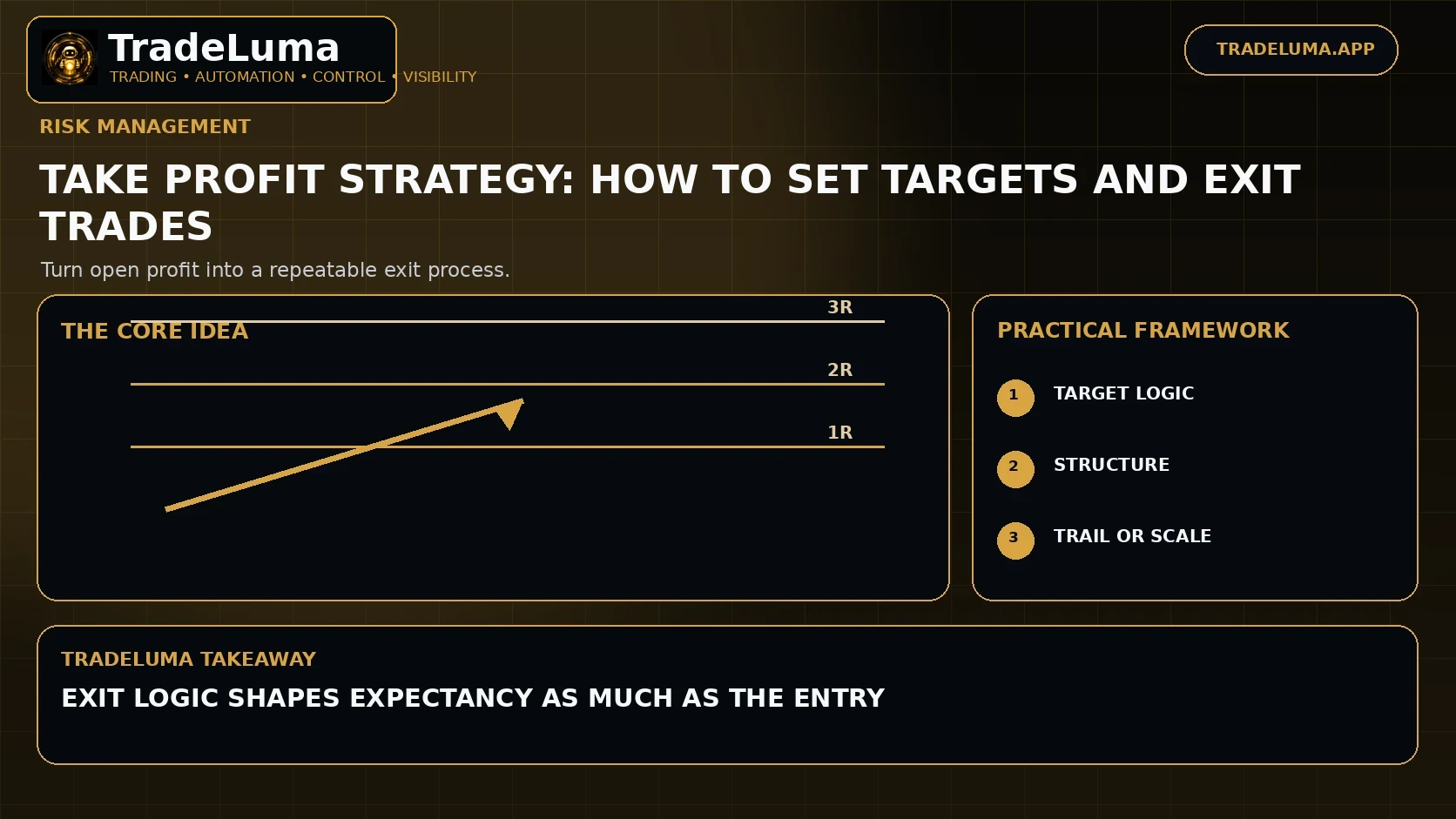
Entry rules receive most of the attention, but exits determine how much of a strategy's edge is actually realised. A take-profit plan decides when open profit becomes closed profit and how much room a winning trade is allowed to develop. Targets can be based on reward-to-risk, market structure, volatility, time, or trailing rules, and each method creates a different balance between win rate and average winner size.
Why exits shape expectancy
Expectancy depends on how often the strategy wins, how much winners earn, and how much losers lose. A small change in exit logic can alter all three. Taking profit very early may raise win rate but reduce the average winner; waiting too long may do the opposite.
A complete strategy therefore tests entries and exits together rather than treating the target as an afterthought.
Fixed reward-to-risk targets
A fixed reward-to-risk target sets the objective as a multiple of the planned risk. If the stop is one unit away, a two-to-one target sits two units in the favourable direction.
This makes outcomes easy to compare, but market structure may not cooperate with the exact ratio. A target beyond major resistance or support may have a lower probability of being reached.
Structure-based profit targets
Structure targets use prior swing highs and lows, range boundaries, support and resistance, gaps, or other visible price references. The logic is to exit where opposing order flow may reasonably increase.
Because levels are zones, some traders place the target slightly before the obvious level to reduce the risk of price turning just short of it.
Volatility-based targets
ATR or another volatility measure can set targets that adapt to changing market speed. A fixed one-point target behaves very differently when normal range is two points versus ten points.
Volatility-based exits should still consider structure. A mathematically neat target can be unrealistic if it sits well beyond a major barrier.
Trailing exits
Trailing exits do not require a fixed final target. The stop follows price as the trade moves favourably using swing structure, moving averages, ATR, channels, or a percentage trail.
This approach can capture unusually large trends, which can be valuable for strategies with many small losses and a few large winners. The trade-off is that some open profit is normally surrendered before the exit triggers.
Partial profit-taking
A partial exit closes part of the position at one target and leaves the remainder open for a larger move. This can reduce exposure while preserving some upside.
However, taking part off early also reduces the size of the position that participates in the biggest winners. Test the full expectancy rather than judging the method only by how comfortable it feels.
Time-based exits
Some setups have a limited opportunity window. If price does not progress within a defined number of bars or by the end of a session, the reason for staying in the trade may weaken.
Time exits are particularly relevant to intraday strategies, event-driven trades, and setups that depend on immediate momentum after a trigger.
Scaling targets to market conditions
Trending markets can justify wider targets or trailing exits, while balanced ranges may favour shorter objectives near the opposite boundary. A single target distance across every regime can leave potential unused in trends and become unrealistic in quiet markets.
If the strategy adapts, the regime classification must be objective enough to test and reproduce.
How to compare exit methods
Run the same entry set through different exit rules and compare net profit, profit factor, average winner, win rate, drawdown, time in market, and sensitivity to costs. Avoid choosing the method that only looks best in one historical window.
Robust exits usually perform reasonably across nearby parameter values instead of depending on one exact target that collapses when moved slightly.
Frequently asked questions
How do traders set a take-profit target?
Common methods include fixed reward-to-risk multiples, support and resistance, prior swing points, ATR or volatility targets, time exits, and trailing stops.
Is a 2:1 reward-to-risk target always best?
No. The useful ratio depends on the strategy's win rate, structure, volatility, and transaction costs. A fixed 2:1 target can be unsuitable for some setups.
Are trailing stops better than fixed targets?
Neither is universally better. Trailing stops can capture large trends, while fixed targets provide more predictable exits. The choice should be tested with the strategy's entries.
Does partial profit-taking improve a strategy?
It can change risk and smooth some outcomes, but it also reduces exposure to large winners. Its effect should be measured on the full strategy rather than assumed.
Continue learning
Related TradeLuma guides

Risk Management
Stop Loss Strategy: Where to Place Stops and Manage Trading Risk
3 Sept 2026 · 12 min read

Risk Management
Position Sizing in Trading: Risk Per Trade, Stop Distance and Contract Size
5 Sept 2026 · 12 min read

Risk Management
Risk Management in Trading: Position Size, Stops and Drawdown
16 Aug 2026 · 13 min read
Build a controlled automation workflow with TradeLuma
Configure alerts, test in paper mode, apply execution controls, and follow broker outcomes from one workspace.