
AI Stocks & Global Markets
Trump's AI Chip War Goes Global: $960 Billion Tech Sell-Off as Five Countries Face New US Restrictions
New US AI-chip export controls target overseas data centres in five countries as tech stocks slump. Understand the $960B estimate, Nvidia, AMD and next risks.
On this page+
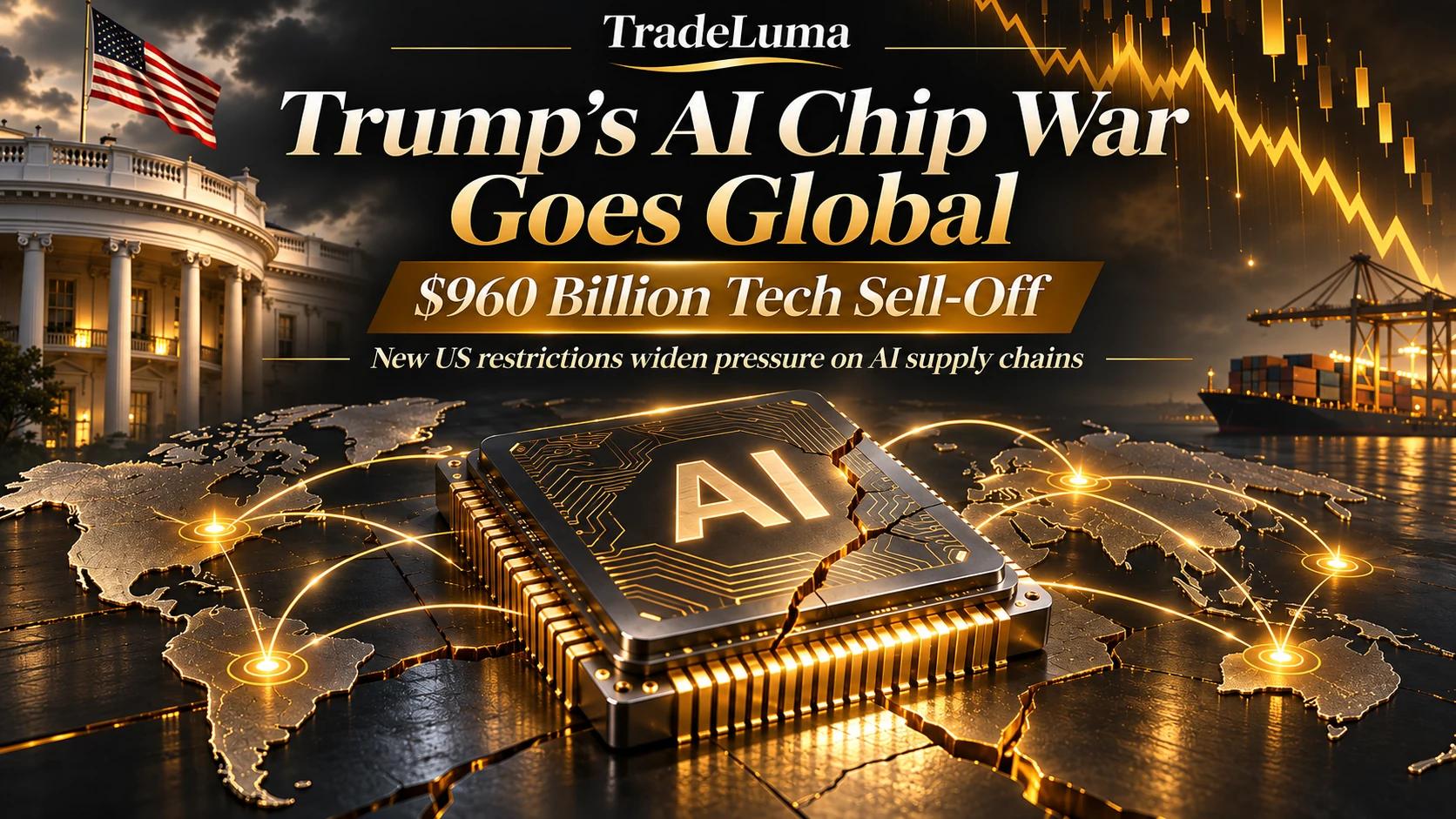
A major new US export-control rule announced on November 16, 2026, has brought the AI-chip trade war into overseas data centres. Washington wants to stop restricted users, especially companies based in China, from renting powerful American computing capacity through third countries rather than importing the processors directly. The Bureau of Industry and Security (BIS) now requires additional licences for specified advanced semiconductor shipments to Singapore, Malaysia, Thailand, Indonesia and Brazil, with a qualifying carve-out for US-headquartered companies and reporting requirements. At the same time, technology shares fell sharply: a Benzinga calculation put the intraday market-capitalisation decline of 19 major US-listed stocks near US$960 billion as of 2:40 p.m. New York time on November 16; the Nasdaq Composite ultimately lost 2.5% that session. Those figures do not mean US regulators directly destroyed US$960 billion of cash or caused the entire sell-off. Nvidia leadership uncertainty, stretched AI valuations, financing risks and broader market weakness were also in play. This November 17 TradeLuma report explains exactly what the rules do, what they do not ban, why five countries matter, and how investors can evaluate the risks for chip designers, foundries, cloud operators and the Nasdaq.
What happened on November 16? Two major events in one trading session
The US Commerce Department announced a new interim final rule aimed at remote access to advanced US chips and server compute from overseas data centres. Instead of only asking where a processor is physically shipped, regulators are looking at who can ultimately use the processing power through cloud contracts, resellers and other indirect arrangements. Companies operating in the AI infrastructure supply chain must now assess whether transactions involving protected technology and certain customers require a licence.
Meanwhile, US technology stocks suffered a broad sell-off. Benzinga calculated a roughly US$960 billion combined decline across 19 large US-listed technology names at 2:40 p.m. Eastern Time. That was a timestamped intraday mark-to-market calculation, not a sum of realised trading losses. The Nasdaq Composite closed down 2.5%, and the S&P 500 lost 1.9%, according to the Associated Press. Multiple market forces contributed, making it inaccurate to call the entire stock-market decline the mechanical consequence of the export controls.
What does the new US AI-chip rule actually restrict?
The rule addresses exports, re-exports and transfers of specified advanced semiconductors, as well as remote provision of substantial US-origin advanced computing power in situations involving entities from designated restricted jurisdictions. This matters because a purchaser may be barred from importing a cutting-edge accelerator into its home country while still being able to rent access to a large overseas cluster running the same hardware.
The Bureau of Industry and Security says its purpose is to prevent sensitive American computing from reaching users who pose national-security and foreign-policy concerns through cloud-based workarounds. The rule is an interim final rule, meaning the text has immediate regulatory significance while public feedback and implementation details can still evolve. A licence requirement means prior government authorisation may be needed; it is not automatically equivalent to a permanent or universal prohibition.
Why Singapore, Malaysia, Thailand, Indonesia and Brazil?
All five destinations were specifically listed for additional licence requirements involving advanced AI semiconductors. The policy rationale is concern over diversion, including processors being shipped to a nominally permitted location before restricted users obtain the chips or their compute. Singapore and Malaysia are important technology, logistics and data-centre hubs; Thailand, Indonesia and Brazil can also serve as infrastructure and regional customer bases.
The inclusion of a country should not be read as a claim that every business operating there has broken US law. Singapore’s government said it was studying the rule, engaging companies and US authorities, and emphasised its commitment to preventing export-control circumvention. Actual commercial exposure will vary by the item, ownership structure, customer, service, intended use and licensing or reporting exception.
Are US-headquartered cloud companies exempt? The key nuance
Singapore’s official response to the rule states that the new five-country destination-based licence requirement does not apply to qualifying chips destined for companies headquartered in the United States, or with an ultimate parent headquartered there, when specified reporting requirements are satisfied. That is a consequential distinction for hyperscale data-centre developers and international subsidiaries of American technology firms.
The carve-out does not establish that every US company can provide unlimited advanced compute to every restricted customer. Remote-access controls, end-use restrictions, customer due diligence and other existing export rules remain relevant. A multinational group should have trade counsel review its actual transactions rather than assuming a US parent overrides every other compliance obligation.
The remote-access loophole: why a rented server can matter as much as a shipped chip
Traditional export controls follow sensitive products as they cross borders. AI has changed the strategic calculation because the economic value of a GPU cluster can be rented remotely, often without the end user taking physical possession of a single chip. A customer can receive computational output from thousands of accelerators in another jurisdiction through an ordinary internet connection. In some situations this could undermine restrictions that focus only on where the hardware is delivered.
The new framework targets high-powered remote compute supplied to users headquartered, or ultimately owned, in Macau or US Country Group D:5. It also anticipates transactions involving brokers and intermediaries. The practical issue for providers is identifying who ultimately receives the compute, how customers are controlled or financed, and whether contracts, access logs and screening systems can support a defensible compliance determination.
What is the 12-million-TPP threshold?
Contemporary reporting on the interim rule describes a 12 million total processing performance threshold in the provisions governing major remote-compute arrangements. TPP is a regulatory measure of aggregate processing capability, not a public-market price or a standard benchmark of every AI model. TechCrunch illustrated the scale as roughly the maximum combined processing power of about 750 Nvidia H100 or H200-class accelerators, depending on specifications and the relevant regulatory calculation.
Thresholds, classifications and exceptions are technical and can change through rule interpretation. They are useful for understanding why large AI training and inference clusters attract scrutiny, but should never be treated as a substitute for the actual export-control rules applicable to a particular product or service.
A 90-day pathway for existing operators does not mean no compliance risk
Coverage of the rule indicates that certain existing data-centre operators already providing covered services may have up to 90 days from the rule’s effective date to obtain required authorisation. That provides a compliance transition for qualifying existing arrangements rather than a blanket exemption from other legal restrictions or a promise of licence approval.
Large data-centre operators may need to examine customers, indirect use, reseller relationships and corporate-control records while updating screening procedures. For listed companies, investors should distinguish upfront compliance costs from actual lost revenue; neither can be quantified reliably without more detailed disclosures.
Why $960 billion is not a $960 billion cash loss
A stock’s market capitalisation is its share price multiplied by the number of shares outstanding. When stock prices fall, the aggregate quoted value of those shares declines. Benzinga measured the combined change in market value across a selected basket of 19 large listed companies by 2:40 p.m. New York time on November 16 and put the total near US$960 billion. The estimate does not represent money withdrawn from corporate bank accounts, government spending or the volume of stock traded.
The calculation is sensitive to the stock universe, baseline prices, share counts and exact observation time. It should not be confused with a final US market close, nor can it establish that new export controls alone caused every valuation change. A sharp sector-wide repricing may reflect investors simultaneously reassessing demand forecasts, profits, interest rates, leadership confidence and the risk of future policy changes.
How the Nasdaq and broader market finished November 16
The Associated Press reported that the Nasdaq Composite fell 2.5% to 24,509.76 on Monday, November 16. The S&P 500 declined 1.9% to 7,416.59, and the Dow Jones Industrial Average fell 1.4% to 51,608.17. Semiconductor and AI-linked stocks were prominent drivers, but the selling spread across sectors. A broad equity decline can reinforce fears about risk appetite without proving a specific semiconductor rule is solely responsible.
When a headline combines a time-stamped intraday US$960 billion estimate with a full-session Nasdaq percentage, readers should understand these were measured at different moments and with different denominators. The 19-stock basket is not the Nasdaq index, and the index move is not the aggregate dollar value of all losses in those 19 names.
Nvidia (NVDA): direct demand risk meets an independent leadership shock
Nvidia sells the accelerator hardware and infrastructure platforms most closely associated with large-scale AI model development. Expanded export restrictions may complicate sales to certain overseas customers, cloud deployments and intermediary arrangements, although the effect on actual Nvidia revenue depends on where chips are destined, the buyers’ ownership and the detailed licence exceptions. It is not justified to assume all international data-centre orders are banned.
Nvidia also faced separate leadership uncertainty after the resignation of CEO Jensen Huang. The company was scheduled to report fiscal-third-quarter results on November 17, with interim CEO Colette Kress expected to speak. Benzinga reported Nvidia was down about 4.4% to US$155.70 by 2:40 p.m. ET on November 16, representing an estimated US$172 billion market-cap decline at that moment; the AP later reported a roughly 4.1% full-session decline. The discrepancy is a reminder to distinguish intraday snapshots from closing data.
AMD, Broadcom, Arm and Micron: why exposure is not identical
AMD (AMD) competes in AI accelerators and server processors, while Broadcom (AVGO) supplies networking and custom-silicon capabilities used in AI infrastructure. Arm (ARM) earns licensing and royalty income from processor intellectual property, and Micron (MU) provides memory vital to advanced AI systems. Their shares may move together during a risk-off event, but the channels through which a particular export rule could affect revenue are different.
Benzinga’s mid-session calculations showed AMD down about 5.3%, Broadcom 4.1%, Micron 7.1% and Arm 7.8% on November 16. These prices were not all closing returns. An investor should look for customer concentration, the role of US-origin technology, regional sales disclosures, product classifications and whether affected customer projects can shift capacity elsewhere.
TSMC, ASML and manufacturing: who bears the second-order risk?
Taiwan Semiconductor Manufacturing Company (TSM) manufactures advanced chips for many leading designers. ASML (ASML) supplies critical lithography tools to semiconductor fabs. Neither company has exactly the same exposure as a cloud provider offering remote AI compute, but global export restrictions can reshape orders, customer plans, production schedules and investment in future manufacturing capacity.
In its 2:40 p.m. snapshot, Benzinga put TSM down approximately 5.8% and ASML down about 5.1%. The fact that chip-manufacturing and equipment shares fell alongside US chip designers is consistent with broader AI-sector repricing, not proof that the new remote-compute rule directly halted those companies’ sales. The next useful evidence comes from actual company guidance, regulatory licences and customer capital-expenditure plans.
What about Amazon, Alphabet, Microsoft and cloud data centres?
Large cloud and AI infrastructure groups often operate across many jurisdictions and sell a mixture of hardware, hosted software and computing services. A new rule involving remote use can therefore raise questions about customer screening, service geography and access controls. It can also favour organisations with mature compliance teams and a clearly documented US-parent structure where the specific destination exemption applies.
Nonetheless, even a hyperscaler with a US headquarters may have customers subject to separate remote-access restrictions. The operational burden may include verifying ultimate parent companies, screening customers and monitoring resellers. Investors should avoid assuming that every cloud company loses the same percentage of revenue or that every cloud deployment in a named country becomes uneconomic.
Does this rule ban all AI chips or all trade with the five countries?
No. The new restrictions address particular advanced semiconductor items and certain remote-compute arrangements. A licensing requirement is an authorisation mechanism, not a declaration that all shipments or digital services to the affected countries are unlawful. The policy also contains a specific conditional accommodation for eligible US-headquartered destination companies, along with technical exclusions for commercial recommendation systems in the remote-compute provisions.
The phrases “chip ban”, “China AI ban” and “five countries blocked” may attract clicks, but they obscure what regulators actually wrote. TradeLuma’s headline describes a global expansion of the chip war; the underlying article makes clear that the legal scope is narrower and depends on technical classification, ownership, use and licensing.
What Singapore’s response tells investors about implementation
On November 16, Singapore’s Ministry of Digital Development and Information and Ministry of Trade and Industry issued a joint statement acknowledging the new US measure. The ministries said they were studying its impact and consulting affected companies and American authorities, including how to facilitate trusted access for Singapore businesses. They also reiterated a policy against export-control circumvention.
This response suggests implementation will involve dialogue, documentation and industry-specific adjustment rather than a simplistic overnight halt of the entire regional data-centre sector. The degree of impact will depend on the text of the US rule, individual licences and whether cloud customers change their contracting arrangements.
Could China retaliate, and what might Washington do next?
China could respond diplomatically, through industrial policy or with changes affecting critical materials, procurement and domestic semiconductor investment. These are scenarios, not retaliation already confirmed by the announcement. A reciprocal escalation could create further uncertainty for global manufacturers, while negotiations could clarify permitted access and reduce some commercial ambiguity.
Reuters reported that the new restrictions coincided with President Trump’s scheduled Asia trip and a planned meeting with President Xi Jinping later in the week. At the November 17 publication date, investors should treat that meeting as a potential catalyst, not describe an agreement, breakdown or concession before it occurs.
Three scenarios for semiconductors after the export-control shock
In a constructive scenario, licensing exceptions and clearer compliance pathways preserve much legitimate hyperscaler demand, while strong earnings and AI orders reassure investors that broader global adoption can continue. Some shares could then recover as uncertainty fades. A middle scenario involves a period of slower deal approvals, higher compliance costs and uneven stock-market trading while companies wait to quantify exposure.
The adverse scenario would combine unexpectedly restrictive licensing decisions, cancelled data-centre projects, renewed China-US tension, weaker hyperscaler spending and disappointing earnings guidance. Even then, stock outcomes would depend on valuations and expectations already priced in. None of these are assured forecasts or probabilities; they provide a framework for interpreting new facts.
What traders should watch on November 17 and after
Monitor Nvidia’s November 17 earnings release and call, especially its outlook, backlog commentary, China exposure and leadership transition. Watch for any further BIS clarification, effective-date guidance, licence outcomes and statements from affected governments. Compare moves in NVDA, AMD, AVGO, MU, TSM, ASML and semiconductor funds such as SMH with the broader Nasdaq rather than extrapolating from one dramatic chart.
Because the story touches regulation and future business plans, both policy announcements and company disclosures can drive gaps when the regular US stock session is closed. TradeLuma’s conceptual cover artwork is not an actual chart or quotation, and its stock-move estimates are dated. Readers should refresh the market data before making any trading decision.
How to manage event risk in chip stocks and the AI trade
Exposure across different AI stocks can appear diversified by ticker while remaining highly correlated to the same capex cycle, geopolitics and interest-rate narrative. Position sizing, predetermined risk limits and understanding after-hours liquidity are particularly important when regulatory announcements overlap with earnings. Options can express event views but carry their own premium decay, volatility and gap risks.
Automated traders should verify order and position states independently of notification delivery, define stale-signal expiry and duplicate-order controls, and keep a documented process for pausing new entries without abandoning live exposure. The aim is to respond robustly to uncertain information rather than claim to know which company will benefit or suffer next.
Bottom line: a genuine policy shock, but several causes behind the market sell-off
Washington has materially tightened the rules governing access to powerful US AI chips and overseas computing capacity, adding licensing requirements for advanced chips involving five destinations and emphasising remote-use restrictions against certain prohibited or restricted customers. The policy shift matters for the geography, economics and compliance design of the AI supply chain.
The US$960 billion figure is a timestamped estimate of combined stock-market value changes among 19 companies, not a government revenue impact or proof of one-cause market destruction. The Nasdaq’s 2.5% November 16 loss, Nvidia’s succession crisis and the forthcoming earnings report are all part of the wider picture. Investors now need verified rule details, company-specific guidance and a clear understanding of risk rather than a misleading narrative of a blanket ban.
Frequently asked questions
Did Trump ban AI chips to Singapore, Malaysia, Thailand, Indonesia and Brazil?+
The US introduced additional licence requirements for specified advanced AI semiconductors exported, re-exported or transferred to those countries. It was not a blanket ban on all chips or all commerce.
When did the new AI chip restrictions get announced?+
The Bureau of Industry and Security issued the interim final rule around November 15–16, 2026, with public coverage and formal governmental responses dated November 16. This article is dated November 17.
Why is remote access to AI servers included?+
Restricted entities can potentially rent computing capacity hosted abroad without importing the hardware directly. US regulators want controls to address that third-country access route.
Are US-headquartered companies exempt from the five-country licence requirement?+
A conditional exception applies to specified chip destinations involving US-headquartered companies or a US-headquartered ultimate parent, with reporting obligations. Separate remote-compute and end-use restrictions can still apply.
Did the new rule cause $960 billion in tech losses?+
Benzinga estimated that 19 large US-listed technology companies were down a combined roughly US$960 billion in market value at 2:40 p.m. ET on November 16. It does not prove the rule was the sole cause, nor does it mean that amount was withdrawn as cash.
How much did the Nasdaq fall on November 16, 2026?+
The Nasdaq Composite closed down approximately 2.5% to 24,509.76, while the S&P 500 declined 1.9%, according to the Associated Press.
How might the rules affect Nvidia stock?+
Licensing and remote-access controls could complicate certain international sales and cloud projects, but impact depends on customers, end uses and exceptions. Nvidia also faced separate leadership uncertainty ahead of November 17 earnings.
Are AMD, TSMC and Broadcom equally exposed?+
No. Chip designers, foundries, networking vendors and infrastructure operators differ in how they earn revenue and how the rules could affect their customers. Investors need company-specific disclosures.
What does a 12 million TPP threshold mean?+
Contemporary analyses of the rule use an aggregate processing-power threshold of 12 million total processing performance units for certain remote-compute provisions. Applicability should be determined from the regulatory text rather than a simplified GPU count.
Can existing overseas data centres continue operating?+
Some existing covered services may have a transitional licensing pathway. That does not exempt operators from other controls, guarantee licences or eliminate customer due diligence.
Will China retaliate after the new restrictions?+
Retaliation is one scenario. This report does not assert that a particular new Chinese countermeasure has already occurred. Actual official statements and regulatory notices should be monitored.
What should semiconductor traders monitor next?+
Watch Nvidia results and leadership updates, BIS guidance, subsequent licence decisions, US-China political developments, hyperscaler spending and risk appetite across semiconductor equities.
Put it into practice
Use the risk maths next to the guide.
Open TradeLuma's free position-size, risk/reward, expectancy, and drawdown tools to test the numbers behind a risk-management decision.
Open free trading calculators →Continue learning
Related guides.

AI’s Pressure-Cooker Week: Nvidia Earnings, Anthropic’s IPO and the Sell-Off Testing Wall Street
Nvidia reports on Nov 17 as Anthropic targets a Nov 19 IPO amid a Nasdaq sell-off. Explore NVDA earnings, ANT valuation, options risk and AI-stock scenarios.
Nvidia Without Jensen Huang: The $108 Billion Earnings Test That Could Shake Wall Street
Historical November 17 Nvidia earnings preview, updated November 24 after Jensen Huang's reinstatement. $108B was guidance, not actual earnings.
Nvidia's $330 Billion Intraday Meltdown: Jensen Huang Board Probe Shakes the AI Trade
Historical November 9 Nvidia selloff and board review, updated November 24 following Jensen Huang's confirmed reinstatement as CEO.