
Futures
China Rare Earth Export Controls 2026: Why Magnets, EVs, Lynas & MP Materials Matter
China rare earth export controls explained: November 2026 deadlines, January 2027 trade truce, magnet supply, Lynas, MP Materials and global stock-market risks.
On this page+
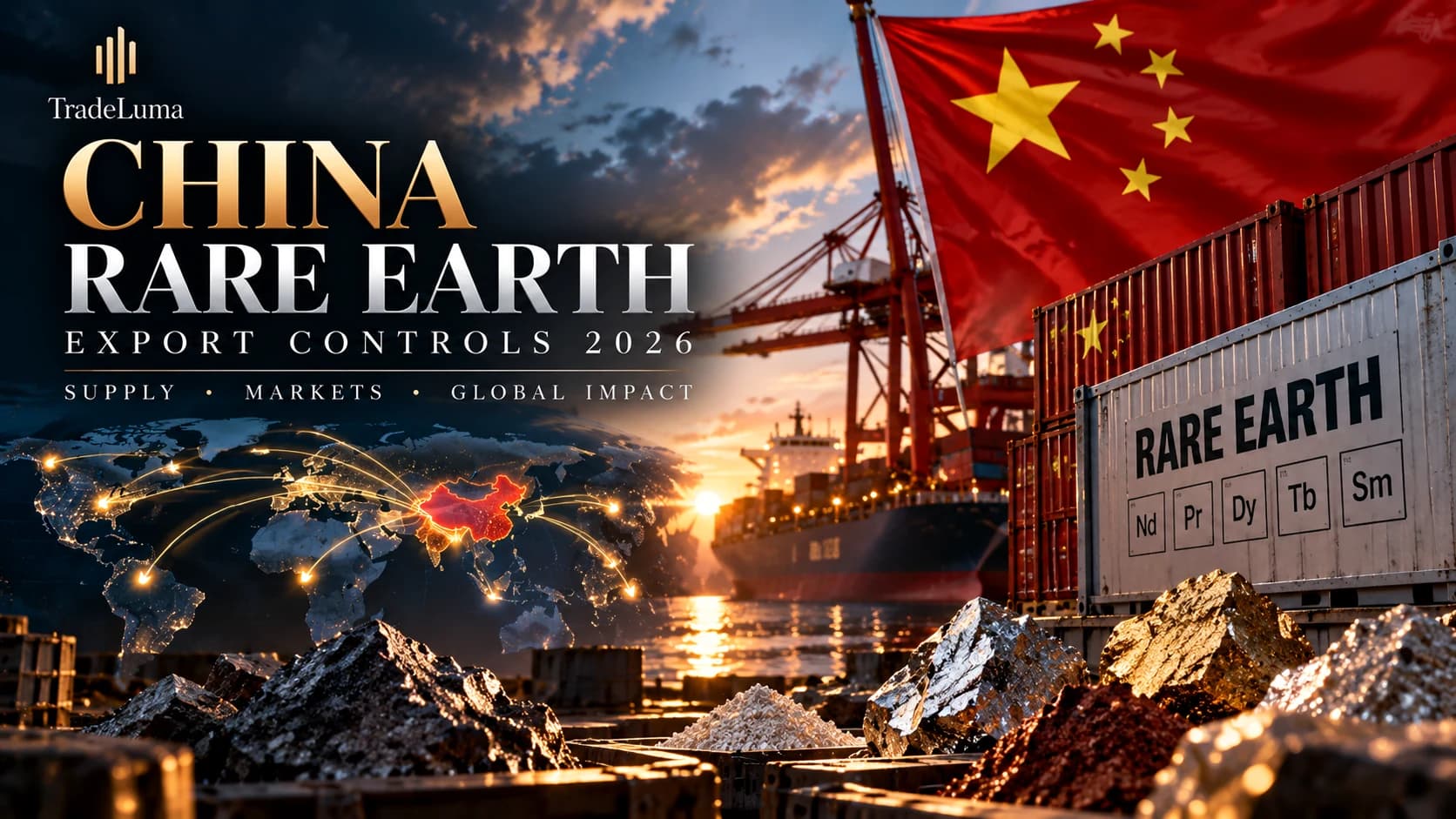
Rare earths have become one of the most closely watched supply-chain issues in the US–China trade relationship. On October 28, 2026, France's top strategic-minerals envoy said the West might achieve meaningful diversification from China in three to five years, while a Malaysian research-export permit announced on October 27 illustrated growing efforts to develop non-Chinese processing expertise. The market question is not simply who owns rare earth deposits: separating ore, refining the elements, producing alloys and manufacturing qualified magnets are different industrial steps. This TradeLuma guide explains how China's licensing rules and trade-truce deadlines interact, which metals actually matter, and how investors can evaluate companies such as Australia's Lynas and the US-based MP Materials without confusing policy headlines with guaranteed earnings.
China rare earth export controls in 2026: the quick answer
China's position in rare earth processing and magnet manufacturing gives it leverage over industrial supply chains, especially when export licensing creates uncertainty about availability or delivery schedules. Not all controls are equal: a licence requirement may allow authorised shipments, while a suspension of a newer rule is not the same as removing older measures.
The headline policy question on October 29, 2026 is whether individual controls and suspension notices will be clearly extended and how consistently exporters can obtain licences. A broader US–China truce has been announced through January 10, 2027, but certain existing legal instruments still carried November 10, 2026 dates. Investors should verify the actual regulatory notice rather than rely on a single headline.
Why rare earths are trending this week
On October 28, French strategic-minerals envoy Benjamin Gallezot told Reuters that Western countries could achieve acceptable supply diversification within three to five years if projects across Europe, Australia, the United States and Asia accelerate. He cautioned that manufacturing magnets could remain a bottleneck even when mines and refineries expand.
On October 27, Reuters also reported that Malaysia approved DTEC Mineral and Metal Technology to export as much as 700 metric tons of rare-earth carbonate to the United States for research. Its first proposed batch was about 30 tonnes. These announcements illustrate real diversification efforts, but neither amounts to a verified near-term replacement for China's established industrial scale.
What are rare earth elements?
Rare earth elements are a group of 17 elements: the fifteen lanthanides plus scandium and yttrium. Examples include neodymium, praseodymium, dysprosium, terbium and cerium. They are not necessarily rare in the Earth's crust, but economically extractable deposits and the ability to separate chemically similar elements can be difficult to develop.
Many readers mix rare earths with all critical minerals. Lithium used in batteries, copper used in electrical systems, and gallium or germanium used in specialised semiconductors are critical minerals, but they are not rare earth elements. That distinction is essential when interpreting policy lists, company resources and the effect of export restrictions.
Which rare earths make powerful permanent magnets?
Neodymium and praseodymium, often discussed together as NdPr, are important components of high-performance neodymium-iron-boron (NdFeB) magnets. Dysprosium and terbium can improve magnet performance at high temperatures for demanding applications. Different specifications may require different amounts or alternative formulations.
These magnets are used in selected electric-vehicle motors, wind turbines, industrial robots, aircraft systems, consumer electronics and defence equipment. Not every EV uses the same motor type, and some applications use ferrite or other magnet technologies. Supply-chain analysis should therefore identify the grade and end use rather than assume every vehicle requires the same rare earth mix.
Why mining more rare earths is not the whole solution
The value chain usually progresses from exploration and mining to concentration, chemical cracking, separation into individual oxides, conversion to metals, alloy formation, magnet manufacture, and component qualification. Each stage requires its own permits, equipment, expertise, environmental controls and customers.
A mine can report substantial mineral resources while the region still imports processed rare earth oxides or finished magnets. Similarly, a new separation plant may produce saleable oxides without having a local metal-making or magnet-manufacturing facility. The economic bottleneck is often farther downstream than the mining headline suggests.
How dominant is China in rare earth supply?
China is highly influential in rare earth mining, separation, refining and magnet manufacturing, though the exact share depends on the year, element and definition. Reuters reported on October 28 that China accounted for as much as 90% of production of some specialised rare earth magnets. That should not be misread as an identical 90% share for every rare earth product.
The US Geological Survey and International Energy Agency publish broader statistics covering production, reserves, refining and geographic concentration. Those datasets often use different measurement boundaries. To evaluate a policy or investment, distinguish mined rare-earth-oxide equivalent tonnage from separated NdPr oxides, heavy rare earths and certified magnet output.
What did China's April 2025 export controls actually do?
China introduced export licensing on a group of medium and heavy rare earth-related items in April 2025, including selected elements, oxides, alloys and magnets. A licence requirement is not necessarily a total ban, but it can add compliance checks and delay shipments or limit customers by end use.
Those April measures were distinct from the expanded package announced in October 2025. Research and policy trackers in October 2026 indicated the older licensing requirements had not simply disappeared when China suspended certain later controls. Businesses must check the precise product classification and current Chinese Ministry of Commerce guidance.
October 2025 controls versus the September 2026 truce extension
An additional set of controls announced in October 2025 expanded potential restrictions on some rare earths, processing technology and overseas products incorporating Chinese-origin material. China later paused parts of that expansion under the late-2025 trade arrangements. The suspension should not be described as a repeal of all Chinese critical-mineral restrictions.
In September 2026 the US and China announced an extension of their broader trade arrangements through January 10, 2027. However, late-October legal analyses noted that an existing Chinese suspension notice still specified November 10, 2026 and awaited a corresponding formal update for those particular measures. This is a policy-document timing distinction; it is not a prediction that exports will automatically stop in November.
The November 10, 2026 deadline: why it matters
A legal suspension end date can matter to exporters, purchasers and compliance teams even when political leaders have publicly announced a later trade-truce date. Companies may require written confirmation of the continuing licence position before shipping, financing or agreeing long-term prices.
As of October 29, 2026, the prudent position is to monitor the published Chinese legal instruments and any new notice extending the relevant suspensions. Likewise, US tariff exclusions and product-specific customs measures can have distinct effective dates. Do not assume that the general January truce announcement automatically amends every separate instrument.
Why a 2027 trade truce does not mean unrestricted supply
A trade truce may reduce the risk of new tariffs or expanded export restrictions, but earlier licence obligations, national-security reviews, end-user conditions and commercial capacity constraints can remain. Even a fully authorised exporter may face expensive processing, limited product availability or complex qualification by overseas manufacturers.
For buyers, regulatory permission and physical supply must be checked independently. Important questions include who can export the product, whether a buyer qualifies, how quickly a licence is approved, whether the material meets specification, and whether shipping and downstream production capacity are available.
Malaysia's October 2026 rare earth permit: what it changes
DTEC's reported permission to export up to 700 metric tons of rare-earth carbonate from Malaysia to the United States was for research into separation and refining techniques. Its CEO expected an initial consignment of approximately 30 tonnes. Malaysia had previously restricted raw rare-earth exports to encourage local processing investment.
The permit is a useful sign of international technology development, not an operating commercial refinery or proof of large saleable NdPr-magnet output. Process testing must establish composition, separation recovery, waste treatment, product purity, production costs and downstream customer qualification before a scalable business can be inferred.
Can the West diversify away from China in three to five years?
France's strategic-minerals envoy expressed optimism on October 28, 2026 that accelerated projects could deliver an acceptable degree of diversification within three to five years. His statement was a policy assessment, not an official certification of future factory output. Progress will depend on financing, permits, metallurgy, building capacity and signed customers.
The International Energy Agency's 2026 outlook highlights the challenge: outside the dominant supplier, existing and announced refining capacity could amount to around two-thirds of expected mined supply by 2035, while planned magnet manufacturing capacity represents only about one-third. Mining is not the only capacity gap.
Why magnet manufacturing may be the hardest link
High-performance permanent magnets need precise chemistry, controlled microstructure, specialised equipment, quality assurance and sometimes patented processes. Making a laboratory magnet does not establish mass-production yield for an automotive motor or defence-grade system.
The IEA highlighted limited specialised equipment suppliers outside China and lengthy capability-building requirements. Industrial policies that finance mines without supporting separation, metals, alloying, magnets and recycling may therefore leave the final dependency largely intact.
Lynas Rare Earths (ASX: LYC): what investors should check
Lynas has established operating experience within the rare earth supply chain, making it different from a pre-revenue explorer. However, ownership of strategic capacity is not a guarantee of high operating margins. Product mix, oxide prices, processing costs, plant performance and capital spending remain central to the earnings outlook.
Check reported NdPr oxide output versus planned capacity, Malaysian and Australian operations, heavy rare earth initiatives, customer and government agreements, and free cash flow. Avoid treating a rising market quotation for a rare earth basket as an automatic improvement in every producer's realised sales price.
MP Materials (NYSE: MP): why US magnet ambitions matter
MP Materials is a major US rare-earth producer associated with the Mountain Pass operation and a strategy to build more domestic downstream capacity. Its economics depend on both extraction and the technically challenging steps required to make separated products and magnets at competitive cost.
Investors should distinguish mine output, qualified oxide sales, metals and magnet production milestones, and any government-backed price support or procurement. A policy-backed project can still experience construction delays, cost overruns or lower-than-planned yields. MP's shares also reflect investor expectations about those future stages.
Are all rare earth mining stocks winners from export controls?
No. New restrictions might support pricing power for certain qualified non-Chinese materials, but they can also raise input costs for a company importing intermediate products. In addition, restrictions can reduce downstream customer production if substitute supply is not ready.
Early-stage developers are especially sensitive to financing and future price assumptions, whereas established producers may benefit sooner from reliable alternative supply. Product specifications, project economics and stock valuation matter more than a generic claim that all rare earths are suddenly scarce.
How do EV manufacturers and wind turbines use magnets?
Some electric-vehicle motors use permanent magnets containing NdPr, with additives suited to thermal requirements. Permanent-magnet wind turbine generators can also use rare earth materials, but motor and generator designs vary, and substitution is possible at the cost of engineering trade-offs.
A magnet shortage can create production delays or price pressure, but a manufacturer may carry inventory, use alternative motor architectures or change sourcing. Do not estimate an automaker's entire earnings decline from a single rare earth spot price without identifying material content and contract structures.
What is the connection to AI chips and semiconductors?
Advanced manufacturing uses many strategically important materials, but the words 'critical minerals', 'rare earths' and 'semiconductor materials' do not mean the same thing. Gallium and germanium can be important for certain compound semiconductors and optical applications, yet neither is a rare earth element. Most advanced AI processors do not simply consist of rare earth magnets.
Rare earths may enter some motors, robotics, equipment and supporting components, while silicon, copper, specialty gases and other materials are also crucial in chip production. TradeLuma's separate AI memory-chip guide covers HBM supply and should not be treated as proof of a direct one-to-one dependency on rare earth mining.
How export rules can affect Nasdaq and global markets
Trade restrictions can alter expected costs, delivery schedules and earnings for companies in autos, defence, industrial automation and technology. They can also shift foreign-exchange risk, subsidy commitments and investor expectations about supply-chain resilience.
However, the Nasdaq-100 is not a pure rare earth index. Large software, cloud, consumer and semiconductor firms have different exposures, and interest rates or earnings may dominate trading on any given day. A rare earth headline is a contextual risk factor, not a mechanical signal to buy or sell NQ or MNQ futures.
What drives the price of NdPr and rare earth oxides?
Supply-demand factors include separated-oxide output, magnet orders, inventories, licensing access, quality, contract terms, currency and processing cost. Rare earths do not trade like a single globally fungible exchange-listed barrel of oil. Prices for NdPr oxide, dysprosium oxide and terbium oxide can diverge materially.
A robust valuation should match the specific chemical form, purity, region and transaction basis. Do not apply a high quote for scarce heavy rare earth material to a mine whose production is primarily lower-value light rare earth elements.
Can recycling or alternative motor designs solve the problem?
Magnet recycling can recover valuable metals from manufacturing scrap and end-of-life equipment, potentially diversifying supply. But collecting products, separating components and producing material that meets tight specifications requires industrial investment.
Alternative motors and reduced rare-earth intensity can help mitigate dependence, yet their efficiency, size, performance and cost vary by application. Recycling and substitution are meaningful options, not immediate replacements for all new extraction and processing.
Seven metrics worth monitoring after October 2026
First, check new Chinese Ministry of Commerce licence and suspension notices. Second, monitor actual export volumes by element and product. Third, track benchmark NdPr and heavy rare earth prices using consistent units. Fourth, check separation yield and plant utilisation outside China. Fifth, monitor customer-qualified magnet capacity, not just mine announcements. Sixth, review long-term supply agreements and price floors. Seventh, compare companies' capex and cash flows with delivery milestones.
Treat political deadlines and project forecasts as dates to re-check, not proof that a price move is imminent. An investment process should identify what was known before the event, what changed, and whether the new information was already anticipated.
Risk checklist for investors and futures traders
Before trading, distinguish a draft policy announcement from a legally effective measure, confirm whether the affected material is actually a rare earth, and identify the company's direct exposure. For equities, assess valuation, liquidity, cost overruns, capital raising and government support that may be conditional.
For index futures or automated strategies, account for sudden headline volatility, spread widening, gaps, correlation and stale signals. Position limits, stop handling, trade expiry, loss caps and broker-position reconciliation remain important. No policy announcement guarantees a profitable trade.
Bottom line: the real rare earth contest is downstream
China's export-control framework and industrial scale demonstrate why strategic mineral security is about much more than opening a new mine. Diversified supply needs chemical separation, refiners, metal producers, magnet factories, qualified customers and reliable regulations.
The October 2026 news supports long-term interest in rare earth investments, but it also highlights uncertainty in legal deadlines and technology ramps. For traders, separate the verified policy details from speculative stock predictions and analyse the entire industrial chain rather than buying the headline.
Frequently asked questions
What are China's rare earth export controls in 2026?+
They include ongoing export licensing for certain rare earth-related products introduced in April 2025 and a separate expanded October 2025 package that was suspended under subsequent trade arrangements. Check product-specific rules and updated notices.
Did China ban all rare earth exports?+
No. Export licensing and restrictions are not equivalent to a blanket ban on all rare earth material. Product classifications, end uses and licences matter.
When do China's rare earth restrictions expire?+
Different instruments have different dates. The broader US–China trade-truce extension was announced through January 10, 2027, while some individual Chinese suspension notices still stated November 10, 2026 as of late October.
Why is November 10, 2026 important for rare earths?+
Some legal notices suspending October 2025 controls retained November 10 as their end date; separate updated implementation notices need to be checked rather than assuming a general truce announcement changes everything.
What are rare earth elements?+
They are the fifteen lanthanides plus scandium and yttrium, used across magnets, catalysts, polishing, optics and other technologies.
Are lithium and copper rare earth metals?+
No. Lithium and copper are important industrial or critical minerals, but neither is part of the 17 rare earth elements.
Is gallium a rare earth element?+
No. Gallium is strategically important to some semiconductor technologies but is not classified as a rare earth.
Which rare earths are used in EV magnets?+
Neodymium and praseodymium are common in high-performance NdFeB magnets; dysprosium or terbium may be added for thermal performance depending on the design.
Why does China dominate rare earth magnets?+
It has established refining, alloy and magnet manufacturing capacity, expertise, equipment and supply relationships that are difficult to recreate rapidly.
Can the West diversify rare earth supply within five years?+
A French official expressed optimism in October 2026 about meaningful diversification in three to five years, but it is a forecast contingent on new processing and magnet capacity becoming operational.
What happened with Malaysia's October 2026 rare earth export permit?+
DTEC was reported to have received approval to ship up to 700 tonnes of rare earth carbonate to the US for research into separation and refining, with an initial shipment of roughly 30 tonnes planned.
Is Lynas a rare earth company?+
Yes. Lynas Rare Earths is an established Australian rare earth business. Its performance depends on operations, product mix, prices, investment and cash flow, not just geopolitics.
What does MP Materials do?+
MP Materials operates a major US rare earth mine and is developing downstream separation and magnet capabilities. Investors should assess actual completed capacity separately from plans.
Why might rare earth stocks rise after China tightens controls?+
Investors may expect stronger demand for alternative suppliers or higher prices, but company valuations, costs, liquidity and the market's prior expectations can offset those effects.
Do rare earths power all AI chips?+
No. Rare earths have roles in selected industrial and electronic applications, but they are not synonymous with gallium, germanium or HBM memory, and not all AI processors require rare earth magnets.
What is NdPr?+
NdPr is an industry shorthand for neodymium and praseodymium, materials important in certain high-performance permanent magnets.
Why can a rare earth mine exist without a magnet factory?+
Mining, chemical separation, metal making, alloying and magnet manufacturing are separate capital- and expertise-intensive stages.
How do rare earth restrictions affect Nasdaq?+
They can change expected costs and production capacity for exposed companies, but broad indexes also respond to rates, earnings and many other forces. No direction is guaranteed.
Is the January 2027 US–China trade truce a permanent deal?+
No. It was an announced extension of certain arrangements, not a permanent removal of all trade controls. Monitor formal notices and subsequent negotiations.
Should investors buy Lynas or MP Materials after rare earth news?+
A policy headline alone cannot determine the right investment. Review project economics, product mix, cost structure, cash flow, funding and valuation, and consider your own risk tolerance.
Futures workflows
Explore the strategy side of TradeLuma.
Browse TradeLuma's futures strategy catalogue and the chart, rollover, and reference methodology used for each published strategy.
Explore futures strategies →Continue learning
Related guides.

Why Are Oil Prices Rising in 2026? Brent vs WTI, Strait of Hormuz & the $100 Oil Shock
Why are oil prices above $100 in October 2026? Understand Brent vs WTI, Strait of Hormuz supply risks, crude inventories, inflation and CL/MCL futures.
AI Memory Chip Shortage 2026: HBM, SK Hynix, Micron & Nvidia Explained
Why are AI memory chips in short supply? Explore HBM3E vs HBM4, SK Hynix's October 2026 results, Micron, Nvidia, DRAM prices and Nasdaq risk.

Yen Carry Trade Explained: Bank of Japan Rates, USD/JPY & Nasdaq Risk
What is the yen carry trade? Learn how borrowing yen works, why BOJ rate hikes and a stronger yen can trigger global selling, and how Nasdaq futures may react.