
Markets & Technology
AI Stock Crash 2026: Why Nasdaq Fell 5.5% and $2.5 Trillion Vanished
Why did Nasdaq plunge 5.5% in November 2026? Explore the AI stock sell-off, data-centre backlash, Nvidia, AMD, valuations and what traders should watch.
On this page+
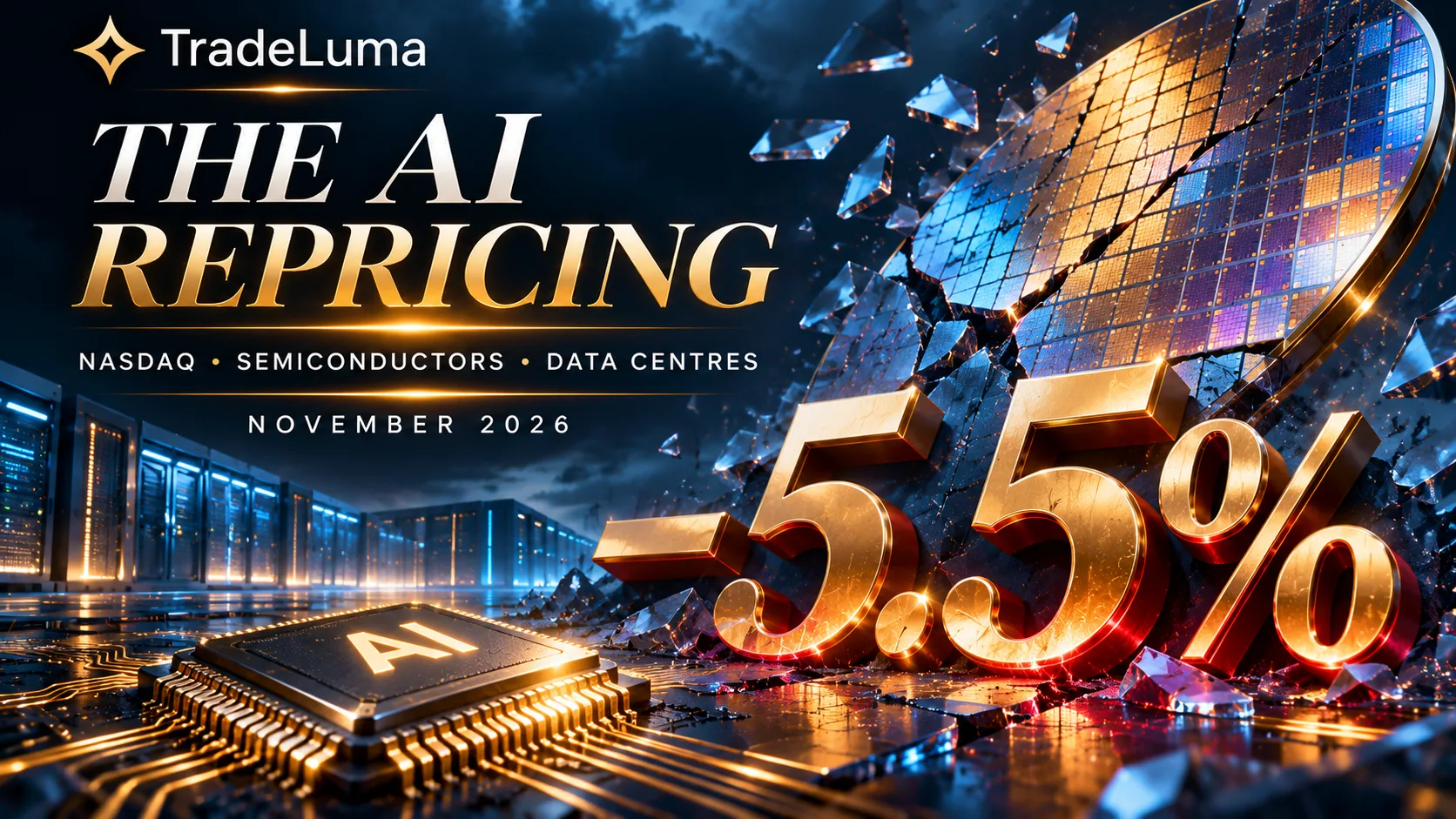
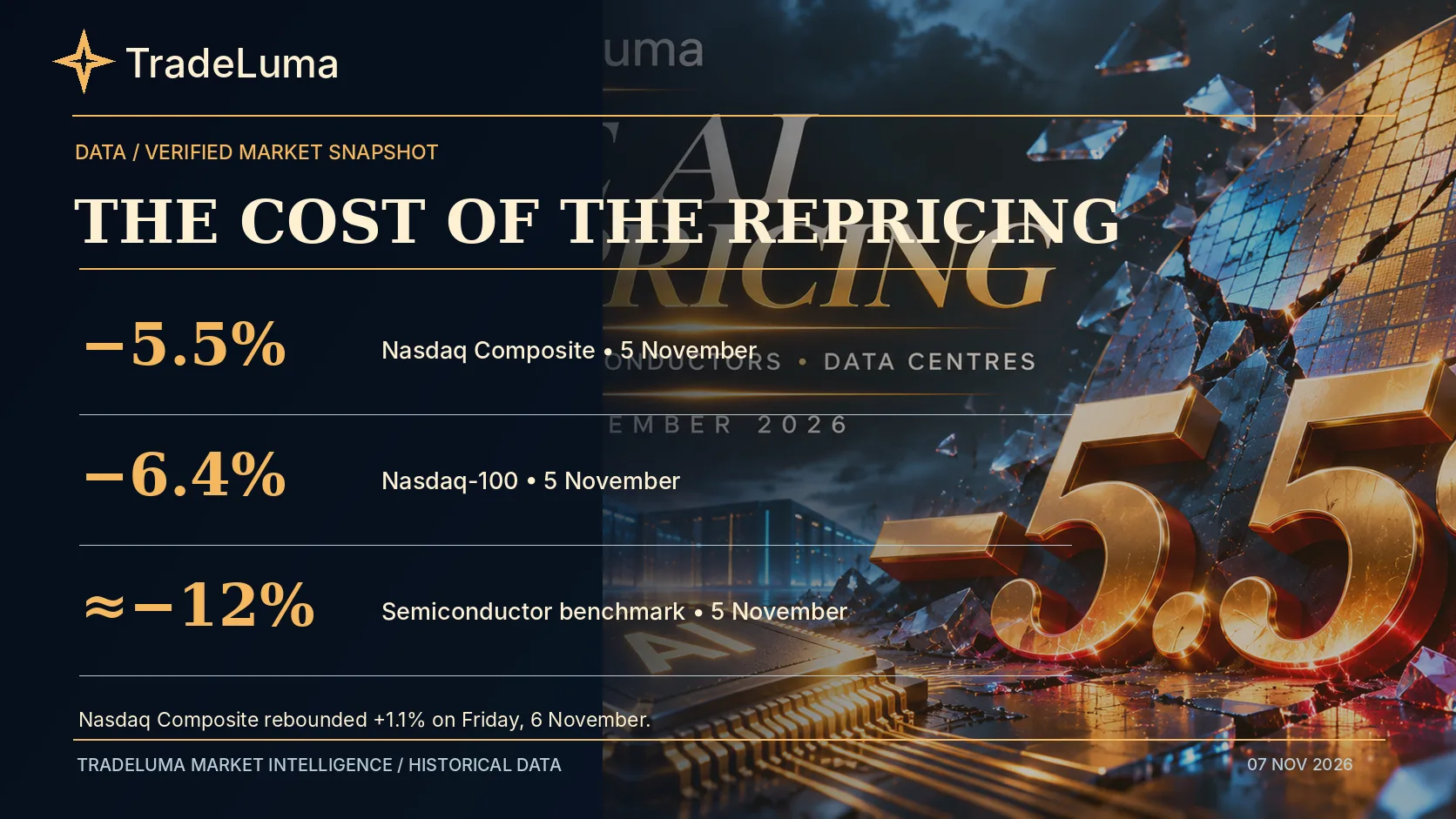
AI and semiconductor shares suffered an extraordinary shock on Thursday, November 5, 2026. The Nasdaq Composite fell 5.5% and the Nasdaq-100 dropped about 6.4%, while the Philadelphia Semiconductor Index lost about 12%. Roughly $2.5 trillion in Nasdaq market value evaporated in one session, according to contemporary market reporting. Political uncertainty after the US midterm elections added to existing worries about artificial-intelligence valuations, energy demand, data-centre permitting and debt-financed expansion. The Nasdaq recovered 1.1% on Friday, November 6, yet finished the week 3.4% lower. Was the crash a verdict on AI itself, an overdue valuation reset, or a costly problem for the financing of new computing capacity? Here is a careful look at the mechanisms, the data and the scenarios that matter for traders.
What happened to the Nasdaq on November 5–6, 2026?
The Nasdaq Composite declined approximately 5.5% on Thursday, November 5, marking its worst session since April 2025. The Nasdaq-100 lost about 6.4%, and the Philadelphia Semiconductor Index fell around 12%. The pullback left the Nasdaq Composite almost 12% beneath its October high, a decline commonly described as correction territory. The S&P 500 slid 4.4% on Thursday, so the sell-off was not confined to a few AI names.
On Friday, November 6, the Nasdaq Composite rose 1.1%, while the S&P 500 gained 0.3%. Despite the relief rally, the Nasdaq ended the week 3.4% lower. A one-day rebound can reflect short covering, attractive entry points, new information or technical liquidity, and does not by itself establish that the broader correction is over.
Where did the reported $2.5 trillion loss come from?
The $2.5 trillion figure refers to the approximate reduction in aggregate quoted market capitalisation across Nasdaq-listed companies on the steepest sell-off day. Market capitalisation multiplies share price by the number of shares outstanding. When quoted prices fall sharply across many large issuers, that computed value can change by trillions even though investors did not collectively withdraw an identical amount of cash.
Market-cap headlines are useful for understanding scale, but they are not the same as realised losses for every shareholder, company cash burn or an amount spent on AI. For portfolio risk, position size, leverage and liquidity are more directly relevant than an aggregate market-value headline.
Data centres became an election issue: power, water and local costs
Reports after the election described voter opposition to data-centre proposals in numerous communities, including concern over power prices, infrastructure strain, land use and water availability. Reuters reported that many of the tracked local ballot measures were aimed at limiting data-centre development, across ten states. These outcomes sharpened uncertainty about construction timelines in selected locations.
AI training and inference facilities need reliable electricity, cooling and grid interconnections. A project delayed six months can affect revenue timing, financing costs and equipment orders even if the project is eventually built. But neither a local ballot measure nor a newspaper headline automatically cancels national demand for computing capacity.
Why Nvidia, AMD and other semiconductor stocks were hit
On Thursday, Nvidia shares declined about 9%, while AMD fell around 17%; the semiconductor benchmark lost about 12%. Those moves were much larger than the broad market decline because semiconductor revenue expectations are leveraged to the pace of AI infrastructure orders, next-generation chip deployments, high-bandwidth memory and networking equipment.
Investors were not just considering whether current AI products are useful. They were assessing whether new chip orders could be delayed if hyperscalers or smaller cloud firms slow capital spending. A valuation premised on uninterrupted high growth can react dramatically even when revenue continues to increase.
The more fundamental concern: who earns a return on AI spending?
Building large computing campuses requires spending on chips, power supply, networks, cooling, real estate and specialised labour. Early demand can be strong while the economic return from that infrastructure remains difficult to predict. Investors increasingly want evidence that AI usage produces recurring revenue, customer savings or measurable productivity benefits commensurate with the capital required.
The distinction between profitable hyperscalers and debt-financed developers matters. Companies with large cash balances may be able to sustain spending or adapt project schedules, while smaller operators dependent on external capital can face refinancing pressure if collateral values fall or credit spreads widen.
Why debt-financed AI infrastructure faces outsized pressure
A company that borrows heavily to construct data centres relies on assumptions about lease-up rates, utilisation, customer concentration and future borrowing costs. If construction slows, a large planned revenue stream may arrive later while interest expenses continue. Equity prices of such businesses can be more volatile than those of diversified technology groups.
Credit-default-swap spreads and bond yields can provide useful evidence about whether concerns are concentrated in equity valuations or becoming a financing problem. Yet one company's widening credit spread should not be generalised to the entire AI industry.
Does the correction mean the AI bubble has burst?
The phrase 'AI bubble' describes an argument about valuation and expectations, not a formally established market condition. Bears point to rising capital expenditure, concentration in a small group of stocks, long payback periods and uncertainty around monetisation. Bulls point to real enterprise adoption, model improvements, demand for computing and the possibility that supply constraints reflect genuine economic value.
Both sides can be partly correct. AI technology can produce useful products while the stocks of companies supplying it become overpriced. A stock market drawdown does not make the underlying technology worthless; equally, long-term adoption does not make every AI-related share a safe investment at every price.
What the November 6 rebound does—and does not—tell us
The Friday Nasdaq rebound of roughly 1.1% shows that buyers returned after Thursday's selling. A rebound can arise because prices overshoot in a liquidity squeeze or because investors prefer to buy diversified technology exposures at lower valuations. It may also involve short sellers reducing positions before a weekend.
To distinguish stabilisation from a temporary bounce, traders might watch whether breadth improves, semiconductor shares stop making new lows, credit spreads cease widening and the index can hold gains over multiple sessions. None of these signals provides certainty.

The Federal Reserve and CPI are the next potential catalysts
The stronger-than-expected October jobs report on November 6 contributed to expectations that US monetary policy could remain restrictive. Higher expected real interest rates may lower the present value of distant corporate earnings, pressuring high-multiple growth companies. The October CPI release scheduled for November 10 could reshape the rates outlook again.
CPI can also surprise in composition: energy, core services and shelter may point in different directions. A lower monthly inflation surprise may support technology valuations through yields, but poor earnings or financing concerns could dominate even when bond yields decline.
What to watch in AI company earnings next week
AI infrastructure and networking company results, guidance on capital expenditure, signed contract backlogs and evidence of project delivery will be especially important after a shock driven partly by buildout uncertainty. Investors should distinguish booked revenue from future commitments and consider whether customer demand is concentrated in a handful of large buyers.
Watch reported profit margins and cash flow rather than only headline AI revenue. Strong sales accompanied by rapidly expanding capital needs or rising financing costs can still disappoint a market that had expected unusually high future returns.
Could data-centre delays actually help parts of the AI industry?
A slower buildout could reduce short-term orders for certain chipmakers and construction firms, but it might also push developers to prioritise projects with stronger economics. Companies with reliable power access and established financing could benefit relative to speculative projects. A more selective investment cycle can sometimes make long-run capacity additions less wasteful.
This is a scenario rather than a forecast. Restrictions might also raise electricity connection costs and reduce competition, and major customers could shift projects internationally. Outcomes will depend on where permits tighten, which contracts are affected and how companies reallocate spending.
Practical risk checklist for Nasdaq and semiconductor traders
Track the Nasdaq Composite and Nasdaq-100 separately: they are not identical indexes, and the 5.5% and 6.4% figures refer to different benchmarks. Review semiconductor relative strength, bond yields, changes in implied volatility, breadth and liquidity. If evaluating AI-themed ETFs or leveraged futures, assess concentration in a few highly weighted names.
Headlines about the election, AI regulation and corporate results can arrive outside US cash-market hours. Predefined loss limits, position-size caps, stop execution assumptions and a willingness not to trade are especially relevant when a market has recently moved several percentage points in one session.
Bottom line: a genuine AI business does not guarantee an AI stock price
November's sell-off exposed how sensitive AI equity valuations are to the economics of infrastructure investment and the policy environment. The $2.5 trillion market-value headline highlights the magnitude of repricing, while Friday's bounce highlights how quickly sentiment can change.
The next durable direction will depend on regulation, execution, profitability, demand and rates—not on whether the phrase 'AI bubble' is repeated frequently. For TradeLuma readers, understanding the mechanisms is more useful than assuming the November 5 decline must continue or must immediately reverse.
Frequently asked questions
Why did the Nasdaq crash on November 5, 2026?+
The Nasdaq Composite fell around 5.5% amid a broad technology sell-off involving AI infrastructure valuations, concerns about data-centre permitting and regulation after the midterm elections, and earnings uncertainty.
Did the Nasdaq lose $2.5 trillion in one day?+
Contemporary market reporting estimated roughly $2.5 trillion in aggregate Nasdaq market capitalisation was erased during the sell-off. This is a valuation change, not $2.5 trillion in cash withdrawn.
How far did the Nasdaq-100 fall?+
The Nasdaq-100 lost about 6.4% on November 5, a different percentage from the Nasdaq Composite's roughly 5.5% decline.
How much did Nvidia and AMD fall in the AI sell-off?+
Nvidia lost roughly 9% and AMD approximately 17% on November 5, 2026, amid a wider semiconductor-sector sell-off.
Did the Nasdaq recover on November 6?+
The Nasdaq Composite rose about 1.1% on Friday, November 6, but remained down around 3.4% for the week.
Does the AI stock crash mean AI technology is failing?+
No. Market valuations can fall sharply even while technology adoption continues. Investors are reassessing returns on spending, financing and policy risks.
What should investors watch next?+
Upcoming US CPI, Treasury yields, AI-sector earnings, data-centre permitting decisions, financing conditions and semiconductor relative performance are relevant.
Is the AI correction finished?+
There is no reliable way to determine that from a one-day rebound. Further movement depends on earnings, regulation, rates and market risk appetite.
Keep learning
Continue through the TradeLuma research library.
Browse practical guides across trading, automation, execution, futures, technical analysis, and risk management.
Browse all guides →Continue learning
Related guides.
CoreWeave's 50% Stock Crash: Is Nvidia's AI Cloud Partner Sitting on a Debt Time Bomb?
CoreWeave stock plunged roughly 49% in a month as some bonds yielded 15%. Explore CRWV debt, Nvidia ties, $104B backlog and November 10 earnings risks.

AI Memory Chip Shortage 2026: HBM, SK Hynix, Micron & Nvidia Explained
Why are AI memory chips in short supply? Explore HBM3E vs HBM4, SK Hynix's October 2026 results, Micron, Nvidia, DRAM prices and Nasdaq risk.

Nvidia's $330 Billion Intraday Meltdown: Jensen Huang Board Probe Shakes the AI Trade
Nvidia's Nov. 9, 2026 sell-off, Jensen Huang board investigation, $330B intraday swing, China AI-chip risks and the November 17 earnings catalyst explained.