
AI Stocks & Markets
Nvidia's $330 Billion Intraday Meltdown: Jensen Huang Board Probe Shakes the AI Trade
Nvidia's Nov. 9, 2026 sell-off, Jensen Huang board investigation, $330B intraday swing, China AI-chip risks and the November 17 earnings catalyst explained.
On this page+
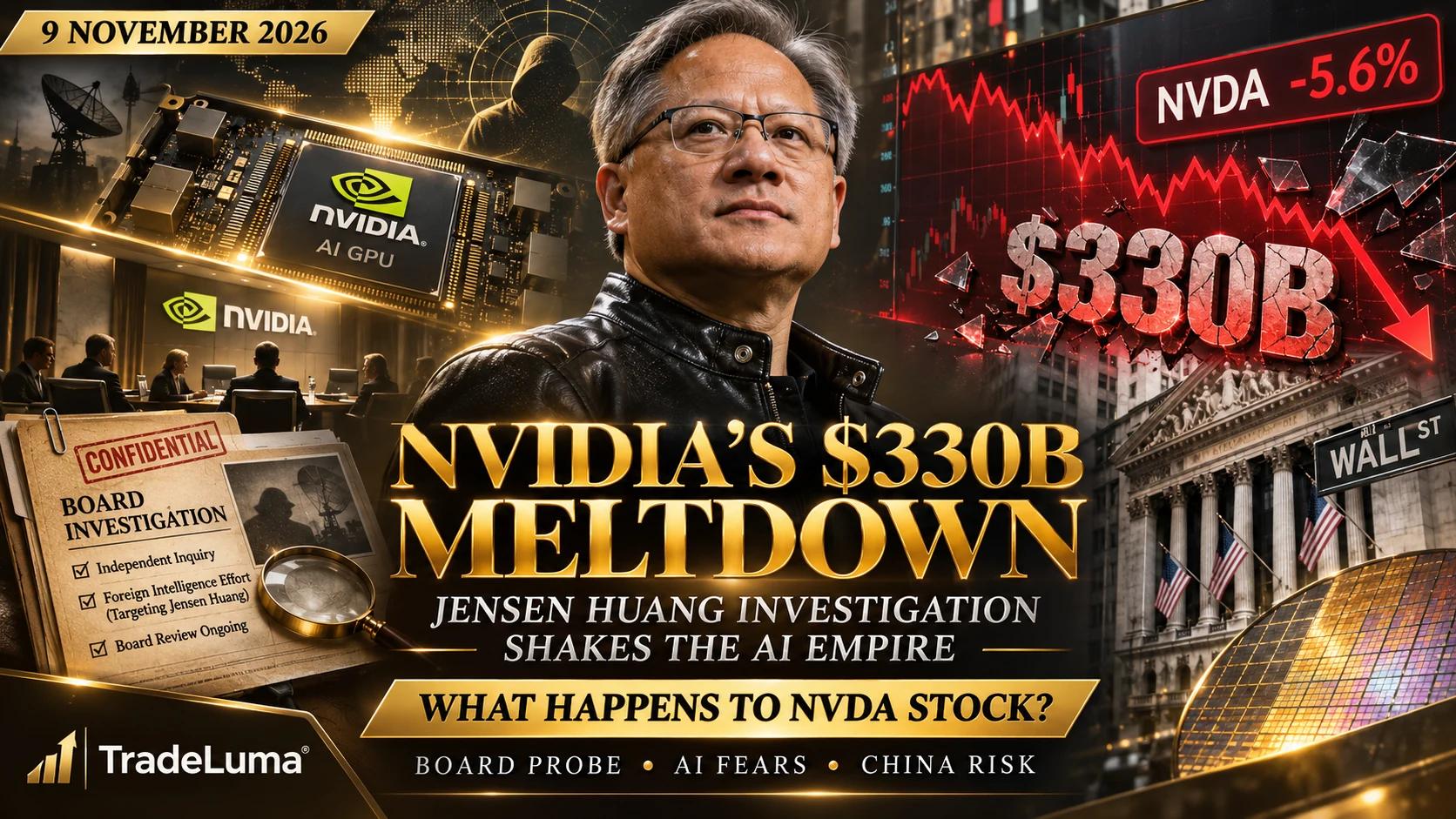
Nvidia became the epicentre of a remarkable Wall Street divergence on Monday, November 9, 2026. After the board announced an independent investigation into reports that chief executive Jensen Huang had been targeted by a foreign intelligence effort, NVDA fell sharply even as the broader Nasdaq rebounded. At one early point, the share-price decline implied roughly $330 billion of market value had evaporated relative to Friday's close. That was an intraday mark-to-market comparison, not a confirmed closing loss or a cash withdrawal from the business. More importantly, the board explicitly said it had no reason to believe national security or company secrets were compromised. The debate for investors is therefore not whether unproven allegations are true; it is how governance uncertainty, US–China export controls and expensive AI-growth expectations combine to influence Nvidia's valuation before its scheduled November 17 earnings.
What Nvidia confirmed on November 8—and what it did not
The official statement was narrow and important. Nvidia said its board would initiate an independent investigation after reports that Huang had been targeted by a foreign intelligence effort. Independent directors, assisted by external counsel, would oversee the review. The company said its board continued to have confidence in Huang and his leadership team, and Huang had agreed to cooperate.
Most critically, Nvidia said it had no reason to believe either national security or its own secrets had been compromised. It did not announce a breach, a criminal finding, a change of CEO or a breakdown in customer shipments. That distinction should remain visible even in a fast-moving headline: an investigation is an effort to assess information, not the result of that assessment.
The reported foreign-intelligence allegations are not established facts
News reports linked the inquiry to a business contact whom US officials reportedly suspected of acting for Chinese intelligence. Some accounts also discussed questions about how restricted AI processors may have reached customers connected to China. Those are attributed reports and reported suspicions, not findings established in Nvidia's board release. Reuters said it could not independently verify important elements of the allegations.
Huang acknowledged a personal lapse in a message to employees and apologised to his family and colleagues. The personal admission does not by itself prove that state secrets, commercial designs or export-controlled technology were transferred. China rejected espionage allegations. For investors, the investable question is whether the independent review identifies a security or governance problem with demonstrable business consequences.
Why did a $330 billion Nvidia sell-off appear on November 9?
Nvidia entered the Monday session with a market value near $4.5 trillion and a Friday closing share price of $186.64. Shortly after the opening bell, media reported the stock around $172.75, almost 7.5% below the prior close. Applying that proportion to a company of Nvidia's size produces an intraday market-cap decline of roughly $330 billion. The exact figure depends on the reference market capitalisation, share count and timestamp.
It would be misleading to describe the $330 billion as a definitive end-of-day loss. Prices continued moving after the early drop, so the closing change was smaller than the worst observed intraday comparison. A fall in market capitalisation means the market was quoting lower prices for shares; it does not mean Nvidia physically paid that amount to investors or lost an equivalent amount of cash from its accounts.
NVDA price action: distinguish the opening plunge from the full-day result
The November 9 reaction unfolded in stages. There were declines in after-hours and offshore instruments after Sunday's board release, followed by a steep opening drop in New York. Market reporting showed Nvidia down more than 5% for much of the session; an early low near $172.75 implied a decline of roughly 7.4% from the Friday close. Those are different timestamps and should not be conflated with a final official closing auction price.
An eye-catching chart can also exaggerate the impression of a continuous collapse. For accurate trading analysis, label whether the numbers describe premarket, opening, intraday low, 4 p.m. close or an after-hours quote. The covers accompanying this article are conceptual illustrations of the headline, not verified tick-by-tick NVDA price charts; their printed -5.6% is an illustrative point-in-session figure.
How did the Nasdaq rally while its AI bellwether fell?
The contrast was striking. On November 9 the Nasdaq Composite closed up roughly 2.7%, the S&P 500 about 2.3%, and the Dow around 2.2%, as falling energy prices and a broader risk rebound helped lift US equities. Nvidia nevertheless declined. Broad indexes hold many companies, and their movements need not mirror the largest stock when other heavyweights and sectors gain strongly enough.
The relative-strength divergence may matter more than any single intraday percentage. If a sector rebounds while one large member underperforms, traders can investigate whether the market is repricing a company-specific risk, responding to competing earnings news, or simply unwinding crowded positions. One session is not enough to distinguish a lasting fundamental shift from short-term volatility.
Why Jensen Huang represents a key-person risk to Nvidia
Huang co-founded Nvidia in 1993 and has become unusually identified with the company's technical roadmap, AI-platform strategy and relationships with customers, governments and suppliers. Nvidia's rise from graphics processors to accelerated computing makes his leadership experience particularly valuable. Investors therefore may attach a higher risk premium to uncertainty about his ability to continue performing that role.
Key-person risk does not mean the company cannot function without one individual. Nvidia employs extensive engineering, software, sales and operational leadership, and it has established products, customer contracts and intellectual property. The question is whether an unexpected leadership disruption would harm execution, negotiation or investor confidence at a time when competition and scrutiny are already intense.
What might an independent board investigation actually examine?
A well-run independent review may assess interactions relevant to security policies, access privileges, reporting obligations, conflicts of interest, handling of sensitive information and compliance with applicable export-control rules. External counsel can help directors separate substantiated evidence from speculative reporting. None of those workstreams, merely because they might be examined, implies wrongdoing by Huang or any other named person.
The timing and eventual public detail are unknown. Companies sometimes release a summary when a review concludes while keeping protected legal or personal information confidential. Investors should watch for official updates on scope, findings and remediation, and avoid treating anonymous commentary or social-media allegations as an equivalent substitute for an announced outcome.
The China question: Nvidia faces export-control risk regardless of the inquiry
Advanced AI accelerators sit at the centre of US export restrictions intended to limit access by certain Chinese organisations. Nvidia must navigate changing licensing rules, demand from Chinese customers, product-specific restrictions and scrutiny of intermediaries. Business models involving resellers and overseas cloud operators create additional questions about end users and compliance documentation.
The latest governance headlines may amplify investor attention to this established policy challenge, but they do not establish that Nvidia violated an export rule. In its previous earnings guidance Nvidia excluded data-centre compute revenue from China, underscoring that the market is already a constrained part of its near-term sales plan. A new tightening, a licence approval or a compliance finding could each produce a very different outcome.
Are AMD and Broadcom gaining while Nvidia stumbles?
Shares of AMD and Broadcom rallied on November 9 as investors looked for semiconductor exposure outside Nvidia. Reports described substantial single-session gains in both names, helped in AMD's case by analyst commentary about future data-centre growth. This was an especially vivid contrast with Nvidia's slide, but higher rival share prices are not proof that Nvidia customers moved orders that day.
Enterprise AI procurement is sticky: chips must work with software frameworks, networking, memory, deployment tooling and customers' internal development teams. Switching suppliers can require considerable engineering. AMD's accelerators and Broadcom's custom silicon are serious competitors, yet any durable market-share gain should ultimately appear in contracts, shipments, revenue, margin or customer disclosures rather than being inferred from one trading session.
Nvidia is still selling real AI infrastructure, not only a story
The governance shock arrived against unusually strong underlying business results. In August, Nvidia reported approximately $96.2 billion of revenue for fiscal Q2 2027, up 106% from a year earlier, including around $89 billion of data-centre revenue. It projected approximately $108 billion of revenue for its next fiscal quarter, plus or minus 2%, with a gross-margin outlook around 74%. These are company-reported numbers and guidance, not a guarantee of future results.
That level of operating scale is why the investment debate is difficult. A very profitable company can still have an overextended valuation if expectations accelerate faster than earnings. Likewise, a dramatic share-price decline does not mean the underlying business suddenly stopped generating revenue. Separate the governance discount, the AI spending cycle and the earnings outlook before assessing NVDA's valuation.
Why export controls and AI demand create different kinds of risk
Export limits directly constrain certain markets, customers or product configurations. Demand risk is broader: hyperscalers may slow capital expenditure if AI monetisation disappoints, electricity costs rise or data-centre development faces permitting delays. A company could experience both shocks at once—or one might partly offset the other if demand remains robust elsewhere.
Investors should not bundle every AI concern under the word 'bubble'. Track orders, unit volumes, networking demand, software adoption, customer concentration, pricing and the cost of creating a full deployed cluster. Good industry demand can coexist with geopolitical limits and intense valuation volatility. The important task is to identify which mechanism actually changes Nvidia's earnings capacity.
Was the whole AI chip industry falling on November 9?
No. The sector picture was more nuanced than a uniform chip crash. Major semiconductor peers advanced while Nvidia lagged, and broader indexes rebounded. Some of that difference reflected analyst upgrades and a rotation away from company-specific concerns, rather than purely negative sentiment about accelerated computing. The dispersion helps explain why looking only at NVDA can give a distorted picture of the day's equity market.
There is also a feedback risk: when a stock has enormous index weight, sharp losses can pressure ETFs and options hedges even when many smaller constituents are rising. Conversely, a rebound in other mega-cap companies can conceal persistent weakness in the single name drawing headlines. Relative performance and breadth can clarify whether risk is becoming concentrated or widespread.
Nvidia Q3 fiscal 2027 earnings on November 17: the next catalyst
Nvidia has scheduled its next earnings conference call for Tuesday, November 17, 2026, at 5 p.m. Eastern Time, covering its third quarter of fiscal 2027, which ended October 25. The company said it expects to make the results public around 1:20 p.m. Pacific Time and publish CFO commentary before the call. The date is confirmed in Nvidia's own investor-relations announcement, not an estimate from an earnings-calendar website.
Questions investors may focus on include data-centre revenue, future accelerator demand, gross margins, supply constraints, profitability of new platform ramps, the role of China, and customer capital-expenditure trends. Earnings can reset the market's fundamental assumptions even if the board review remains unresolved. Equally, strong results do not automatically erase a separately priced governance concern.
Three scenarios for NVDA after the investigation headline
Bullish scenario: the independent process finds no security breach or material misconduct, Huang remains engaged in management, and November 17 results support ambitious growth assumptions. Confidence could recover as investors refocus on shipments and earnings. This scenario requires evidence, not simply a reassurance repeated on social media.
Balanced scenario: the review proceeds without a near-term finding while Nvidia continues to execute; shares remain choppy around earnings and export-policy headlines. Bearish scenario: material adverse findings, leadership disruption, tighter chip restrictions or weaker-than-expected growth magnify the valuation correction. These are conditional possibilities, not price forecasts or recommendations to buy and sell.
How traders can evaluate a violent headline without chasing it
Start with timestamped facts: the original board release, a reliable market-price source, the latest securities filings and earnings dates. Separate the intraday low from the close, and distinguish market-cap changes from money flows. Compare Nvidia with a sector ETF and its peers to identify dispersion. When options are active, implied volatility and bid-ask spreads can move sharply and distort apparently simple directional bets.
Avoid treating a large gap as proof of further downside or an automatic bargain. Set position size, maximum loss and leverage according to a documented risk plan; news can change while markets are closed. A stop order may execute away from the intended price in volatile conditions. For longer-horizon investors, revisit growth, governance, China access and concentration risk rather than trying to forecast a single candle.
Frequently asked questions
Why did Nvidia stock fall on November 9, 2026?+
Investors reacted to Nvidia's announcement of an independent board review of reports that CEO Jensen Huang had been targeted by a foreign intelligence effort, amid wider AI valuation and geopolitical concerns. The inquiry itself does not establish wrongdoing.
Did Nvidia actually lose $330 billion?+
At an early intraday low, the decline in its quoted share price implied about $330 billion less market capitalisation than at the prior close. This was not cash withdrawn from Nvidia, and it was not necessarily the end-of-day value change.
Was Jensen Huang confirmed to have passed secrets to China?+
No. The board said it had no reason to believe Nvidia secrets or national security had been compromised. Reported allegations remain unproven and the independent review is not a criminal finding.
Has Jensen Huang resigned as Nvidia CEO?+
No such resignation was announced in Nvidia's November 8 statement. The board said it had confidence in Huang and his leadership team.
Is the Nvidia board investigating a foreign spy allegation?+
The company is reviewing reports that its CEO was targeted by a foreign intelligence effort. That wording does not confirm that espionage occurred, that any third party was an agent, or that sensitive data was transferred.
Why did AMD and Broadcom rise when Nvidia shares fell?+
Other chip stocks benefited from investor rotation and distinct catalysts, including analyst commentary. Their share-price gains alone do not show they secured contracts or displaced Nvidia.
When is Nvidia's next earnings date?+
Nvidia scheduled fiscal third-quarter 2027 financial results and a conference call for Tuesday, November 17, 2026. Its announced call time is 5 p.m. US Eastern Time.
What did Nvidia forecast for the fiscal third quarter of 2027?+
In its August 2026 Q2 report, Nvidia guided to approximately $108 billion of revenue for its next quarter, plus or minus 2%, and about 74% gross margin, subject to its stated assumptions.
Did the Nasdaq crash on November 9 as well?+
No. The Nasdaq Composite rose roughly 2.7% that day, despite Nvidia declining. Several other technology and semiconductor shares rallied.
Is NVDA a buy after the November 9 sell-off?+
There is no automatic answer. Assess governance risk, the November 17 earnings release, AI spending, valuation, China export controls and personal risk tolerance. A large intraday fall does not guarantee either a rebound or further losses.
Put it into practice
Use the risk maths next to the guide.
Open TradeLuma's free position-size, risk/reward, expectancy, and drawdown tools to test the numbers behind a risk-management decision.
Open free trading calculators →Continue learning
Related guides.
CoreWeave's 50% Stock Crash: Is Nvidia's AI Cloud Partner Sitting on a Debt Time Bomb?
CoreWeave stock plunged roughly 49% in a month as some bonds yielded 15%. Explore CRWV debt, Nvidia ties, $104B backlog and November 10 earnings risks.
GTA 6's $8.2 Billion Gamble: Record Preorders, an Earnings Miss and the TTWO Stock Countdown
GTA 6 preorders near 7.71M in third-party estimates as Take-Two reports a Q2 bookings miss. Explore TTWO stock, $8.2B FY27 guidance and Nov 19 launch.

Anthropic's $69.3 Billion IPO Gamble: Is the AI Bubble Facing Its Biggest Test?
Anthropic's reported $69.3B IPO ambition meets $895.4B in compute commitments. Explore Claude growth, IPO risks, valuation and the AI trade.