
AI Stocks & Global Markets
AI’s Pressure-Cooker Week: Nvidia Earnings, Anthropic’s IPO and the Sell-Off Testing Wall Street
Nvidia reports on Nov 17 as Anthropic targets a Nov 19 IPO amid a Nasdaq sell-off. Explore NVDA earnings, ANT valuation, options risk and AI-stock scenarios.
On this page+
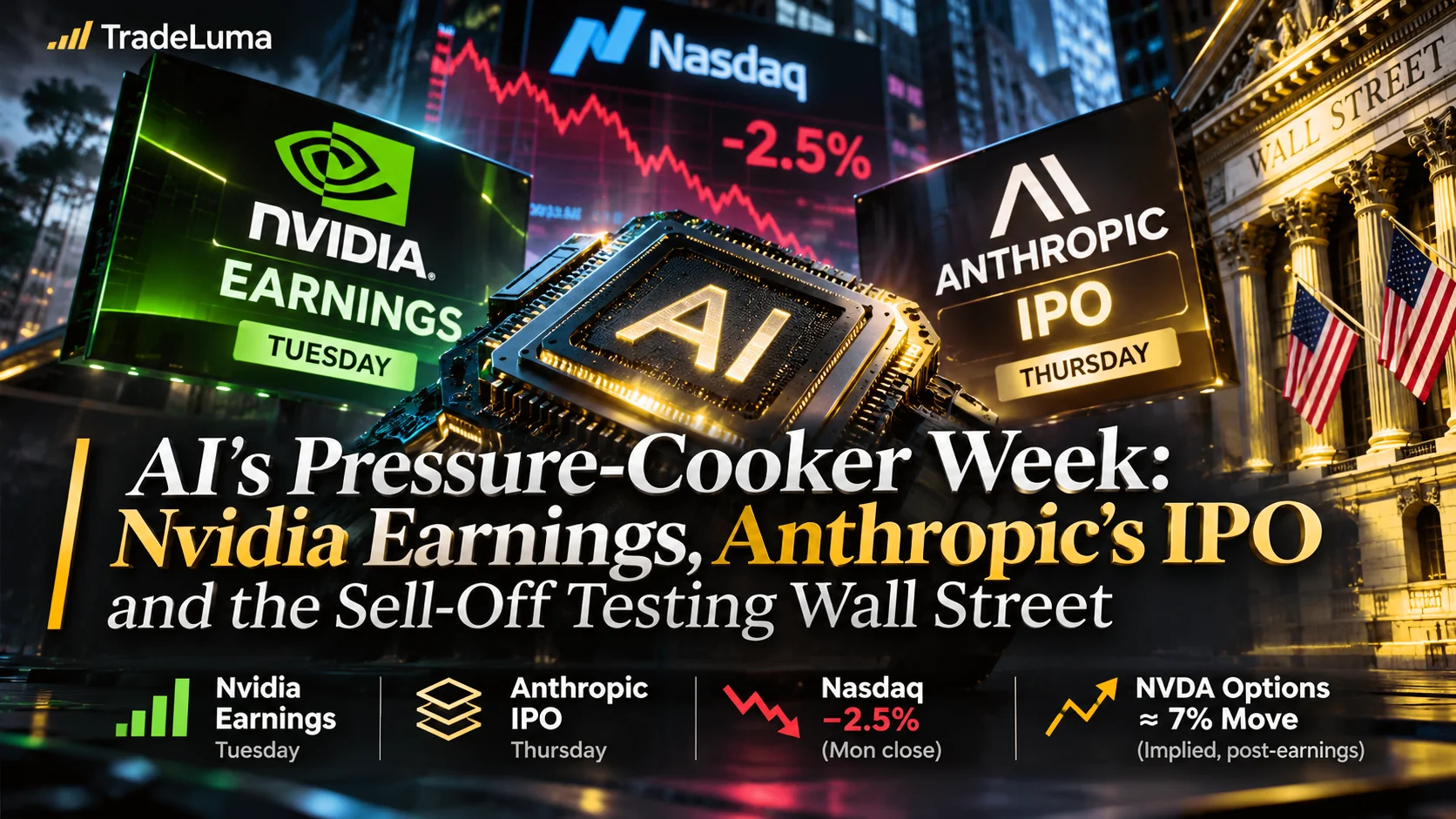
Wall Street is about to test both ends of the AI investment boom. Nvidia's earnings arrive after the US market closes on Tuesday, November 17, 2026, with management's previous quarterly revenue guidance at US$108 billion and investors still assessing the departure of founder Jensen Huang. On Thursday, Claude developer Anthropic is targeting a landmark Nasdaq debut under the proposed ticker ANT, with preliminary IPO terms of US$70–78 per share and a potential fully diluted valuation approaching US$1.4 trillion. The timing is fraught: the Nasdaq Composite fell 2.49% on Monday, November 16, while the semiconductor index lost about 5.3%. This is not a single-company story. It is a test of whether extraordinary spending on chips and computing infrastructure is becoming durable revenue and shareholder value. The key distinction for readers is that Nvidia's result and Anthropic's final IPO price were still pending when this November 17 pre-event analysis was prepared. Here are the events, numbers, feedback loops and conditional scenarios that matter most.
Why this is a pressure-cooker week for the entire AI trade
On Monday, November 16, the Nasdaq Composite closed at 24,509.76, down 2.49%, while the S&P 500 fell 1.92% to 7,416.59. The Philadelphia semiconductor index lost roughly 5.3%. Those are closing-session changes, not a rolling quotation for Tuesday. The sell-off had multiple drivers, including anxiety over semiconductor export controls, expensive AI valuations, higher-rate expectations and Nvidia's leadership transition. The timing is unusually consequential: Nvidia announces earnings after Tuesday's US close, and Anthropic is targeting a Nasdaq debut on Thursday. Both events test the industry's ability to turn immense demand for artificial intelligence into sustainable shareholder returns.
The story is bigger than whether NVDA rises or falls after one quarter. Investors are attempting to value an interlocking system: chip designers sell accelerators to cloud providers, cloud providers finance large data-centre expansions, AI labs purchase computing capacity, and public-market investors fund parts of the entire chain. A disappointment at one point can change the assumptions used at another. A strong Nvidia report and a popular Anthropic float could reinforce confidence, but they could also reveal that investors are demanding much more attractive financial terms than during the earlier AI boom.
The dated market scorecard before the catalysts
Monday's US close provides a clean baseline: Nasdaq Composite 24,509.76 (-2.49%), S&P 500 7,416.59 (-1.92%), Dow Jones Industrial Average 51,608.17 (-1.41%) and Nvidia roughly US$156.14 (-4.1%). The semiconductor index's approximately 5.3% decline shows that weakness extended beyond one company. These prices are observations from November 16 and should not be represented as live values on November 17 or later. The article's cover uses illustrative candlesticks rather than a verified intraday exchange feed.
The baseline matters for cause and effect. A day of heavy semiconductor selling before earnings says investors have already repriced risk; it does not establish the direction of the next move. After-hours trading, option hedging and the opening of regular trading can produce different signals. When measuring the eventual reaction, use a defined window—for example, the November 16 close versus the November 18 close after Nvidia's report—rather than mixing extended-hours indications and official settlement prices.
Nvidia's exact earnings date, time and fiscal period
Nvidia's own investor-relations calendar states that it will release its fiscal third-quarter 2027 results on Tuesday, November 17, 2026, at approximately 1:20 pm Pacific Time, and hold its analyst conference call at 2 pm Pacific Time (5 pm Eastern). The quarter ended October 25. For readers in Melbourne, the results arrive on Wednesday morning, November 18, because of the time-zone difference. The timing is important: an article dated early November 17 must discuss scenarios rather than results that have not yet been published.
The company has said Colette Kress will provide written commentary with the release. Analysts will examine revenue, data-centre growth, gross margin, operating expenses, and forward guidance, but the call will also test management's ability to reassure customers and shareholders. A headline claiming Nvidia 'beat' or 'missed' prior to its scheduled announcement would be premature, and any later update should carry a clearly identified time and date.
The $108 billion revenue bar: guidance is not an earnings result
In its previous quarterly report, Nvidia guided to US$108.0 billion of fiscal-third-quarter revenue, plus or minus 2%, implying a company guidance range of approximately US$105.84 billion to US$110.16 billion. That is management's prior forecast, not a confirmed result. Reuters subsequently cited a market consensus near US$109.08 billion, although estimates from different data providers can vary. A reported revenue total slightly above one benchmark can still disappoint investors who were positioned for a larger beat.
Comparisons should also include quality, not just headline size. A stronger-than-expected top line with softer margins, slowing orders, or cautious next-quarter guidance may not satisfy a premium valuation. Conversely, unexpectedly healthy product mix, clear shipment visibility and resilient margins can improve confidence even if the company's central revenue number is close to expectations. For context, Nvidia reported US$96.22 billion of revenue in the prior quarter and guided to approximately 74% gross margin for the next; the change in revenue and profitability together gives the result its economic meaning.
Life after Jensen Huang: why leadership is now an earnings issue
On November 12, Nvidia announced that co-founder Jensen Huang had resigned as chief executive and president and from the board. Long-serving finance chief Colette Kress became interim CEO while the company began a search for a permanent successor. Harvey C. Jones was appointed board chair. This is confirmed by Nvidia's announcement and related SEC filing. The resignation was a major market event, but the verified corporate transition should be kept separate from unproven explanations circulating in social media.
Investors will listen for how management plans to maintain customer relationships, execute the product roadmap, allocate capital, manage export-control uncertainty and retain engineers. Founder influence is relevant, yet operational responsibilities are distributed across teams and customers still need hardware. A succession risk is not proof of a collapse in demand, just as a strong quarter does not automatically resolve governance uncertainty. This is why the Tuesday briefing may move NVDA independently of a standard earnings surprise.
Options imply a large Nvidia move—but not its direction
Options markets have priced unusually high uncertainty around Nvidia's earnings. A November 16 Saxo analysis put the report-day implied move at approximately 7.7%, versus about 4.0% average realised movement after its previous eight reports. Other option-chain approaches have published somewhat different figures because expiries, underlying prices and valuation methodologies vary. The approved artwork rounds the market estimate to roughly 7%; that is a measure of expected movement, not an analyst price target.
An at-the-money straddle can be used to estimate the market cost of volatility, but a move larger than the implied amount can still produce a loss for an options buyer if premiums or timing were unfavourable. Sellers of options face different, potentially substantial downside if the stock gaps. Neither 'plus 7%' nor 'minus 7%' is a forecast. Traders should check which expiry underlies a quoted statistic, the bid-ask spread, implied-volatility compression after the announcement, and how the position performs across multiple realistic outcomes.
Anthropic's IPO: the precise terms still under discussion
Anthropic's November 10 preliminary prospectus described a proposed offering of 825 million Class A shares at US$70–78 each, with a Nasdaq application under the ticker ANT. The headline share count includes approximately 801.35 million shares to be sold by Anthropic and another 23.65 million from selling shareholders. Multiplying all 825 million shares by the indicative range gives about US$57.75–64.35 billion in total offered stock value; it does not mean all the proceeds go to the company, because selling shareholders receive the proceeds for their own shares.
Reuters described a potential fully diluted equity valuation approaching US$1.4 trillion at the upper end of the range. A separate US$26 billion concurrent private placement with strategic investors is described in the prospectus. The prospectus remains subject to completion, the final price and allocations can change, and the listing could be delayed or withdrawn. The market is watching a planned Thursday, November 19 US debut, not an already-established history of ANT share trading. Australian calendar references can display Friday, November 20 because of the time-zone difference.
Why Anthropic's $1.4 trillion valuation is controversial
A proposed US$1.4 trillion fully diluted market capitalisation is a statement about what investors might pay for expected future cash flows, not the amount of cash Anthropic currently generates. Its AI services may expand quickly, but analysts still have to estimate inference costs, training investment, gross margin, enterprise contract durability, depreciation, financing and dilution. Reuters reported an annualised revenue run rate near US$81 billion at the end of October; a run rate is an extrapolation from a point in time, not the same as full-year recognised revenue or free cash flow.
At lofty valuations, small changes in the assumed long-run operating margin, cost of capital or terminal growth can have large effects on the estimated share value. A busy book of IPO orders would show demand for allocations at a particular price, but not automatically prove that secondary-market buyers will support a much higher price. Equally, a weak debut would say something about risk appetite and the offered terms, not necessarily that Anthropic's products lack customers or utility.
A $26 billion private placement complicates the simple IPO story
The preliminary Anthropic prospectus describes agreements with major technology partners—including firms in AI chips, software and cloud—to purchase a combined US$26 billion of Class N shares in a placement contingent on completion of the public offering and other conditions. This capital is separate from the Class A shares offered to public investors. Its presence signals significant strategic interest, but the stated commitment should not be casually added to public IPO proceeds and described as money already received.
The arrangements also show why the AI ecosystem can be hard to value. A chipmaker may invest in an AI laboratory that buys expensive compute supplied in part by that chipmaker's ecosystem. The underlying arrangements may be legitimate, but analysts need to distinguish external customer revenue, strategic investment flows, non-cash commitments and financed equipment demand. Investors should examine related-party terms, financing sources and contingent obligations rather than treating every contractual headline as incremental economic profit.
The AI supply chain: one trade or several different businesses?
Nvidia and AMD design advanced processors; manufacturing partners such as TSMC fabricate chips; memory suppliers, networking vendors, power and cooling companies build supporting infrastructure; hyperscalers buy hardware and construct data centres; model developers such as Anthropic sell AI services. These businesses face different risk factors, capital intensity and timing. Hardware orders can occur long before downstream customers demonstrate that the applications generate attractive cash returns.
A strong Nvidia quarter is evidence of chip demand and recognised sales in Nvidia's reporting period, not proof of equally strong margins for every cloud provider or AI laboratory. Similarly, an Anthropic IPO priced above its range would show demand for its equity at that valuation, not a direct profit upgrade for every semiconductor stock. TradeLuma readers should avoid treating the 'AI trade' as one perfectly correlated security, especially when company-specific earnings, export rules and financing costs diverge.
The feedback loop between chips, cloud spending and AI revenue
A simple AI growth narrative begins with increasing enterprise adoption: more inference workloads produce more revenue for model vendors, which increases the need for computing infrastructure, which supports chip demand. The vulnerable version reverses the order: infrastructure commitments and equity valuations rise first, while customer revenue and sustainable margins arrive later. Interest-rate expectations then matter because a long-duration investment depends on earnings far into the future.
If model usage accelerates and unit economics improve, investment can be justified even after an expensive build-out. If marginal revenue fails to cover growing computing costs, customers may optimise hardware, delay expansion or renegotiate pricing. A single quarter cannot establish the lifetime return on AI infrastructure, but it can show whether management is seeing demand converted into shipments, billings and cash flow. This distinction is central to evaluating both NVDA earnings and the prospective ANT listing.
What Monday's Nasdaq sell-off actually tells us
The Nasdaq's 2.49% Monday decline was broad enough to matter, but it occurred before Tuesday's Nvidia report and before the planned Anthropic IPO. It therefore cannot be attributed to an earnings miss or post-IPO disappointment that had not happened. Contemporary reporting linked the selling to technology valuation fears, Nvidia leadership uncertainty, stricter restrictions on access to US computing technology and a changing macro outlook. A large index fall can contain many overlapping causes.
The semiconductor sector's approximately 5.3% slide is also not a direct measurement of money fleeing AI companies. Index changes reflect repricing of shares on their last trades, not a fund transferring an equivalent amount of cash out of the sector. A market-capitalisation fall is a valuation change, while ETF outflows, venture financing and IPO proceeds are different kinds of financial measures. Keeping them distinct is vital when this week's headlines feature striking trillion-dollar numbers.
Could Nvidia earnings rescue the Nasdaq?
A bullish relief scenario requires more than a favourable headline. Strong revenue, margins and forward guidance—combined with a credible strategy under interim management—could reduce the risk premium investors have placed on the stock. In that case, suppliers and the broader semiconductor ETF complex might also recover as investors reassess demand and near-term cash flows. However, a market already positioned for an impressive result can sell even after apparently exceptional reported growth.
The bearish scenario is that results or management commentary disappoint elevated expectations. That could pressure high-multiple AI shares and complicate Anthropic's bookbuilding before the offer is priced. An intermediate outcome is equally plausible: Nvidia delivers strong numbers but investors remain cautious about governance or export restrictions, leaving sector leadership divided. These are conditional paths, not calculated probabilities or advice to buy or sell a security.
Could Anthropic's IPO trigger an AI rebound—or accelerate a rotation?
A well-supported Anthropic offering could validate investor appetite for businesses selling enterprise AI applications, while shifting the conversation from hardware spending to recurring software revenue. If institutions accept the valuation and the stock holds the offering price after trading begins, adjacent software and cloud names could attract fresh interest. But a spectacular first-day print can reflect tight supply and trading dynamics rather than a fully independent appraisal of future cash flows.
If demand is weak, the underwriters may adjust pricing, allocations or timing. Some investors may also sell other technology positions to fund participation in a blockbuster offer, creating short-term rotation even without changing their long-term AI view. Conversely, a delayed listing might reduce immediate supply pressure while increasing concern about pricing. Any claim that the IPO has 'succeeded' or 'failed' should wait for confirmed pricing, actual shares traded and a meaningful observation window.
The Federal Reserve and the cost of the AI build-out
This week's technology catalysts coincide with concern about higher US inflation and whether the Federal Reserve will tighten policy in December. The October Federal Open Market Committee minutes are scheduled for Wednesday, November 18. Higher expected yields tend to raise the discount rate applied to future earnings and increase the financing cost of data-centre investments. These effects can be especially relevant for firms with heavy capital expenditure or profits expected many years from now.
That does not mean every Fed headline determines the price of NVDA or ANT. Strong growth, cheaper inference, proprietary technology and better margins can outweigh a change in rates. The useful approach is to distinguish a sector-wide valuation effect from a company-specific demand surprise. If both the Fed outlook and AI earnings expectations move in an unfavourable direction, risk assets may face reinforcing pressure; if either improves, the outcome can look quite different.
Export controls, China and the missing part of the revenue story
US restrictions on the shipment of advanced AI hardware and on remote access to computing capacity can alter where chips are sold and which end users can access them. Nvidia's prior US$108 billion quarterly revenue guidance did not assume China data-centre compute revenue. This does not mean global demand is unaffected by additional rules, but it explains why the revenue bridge cannot be calculated by simply subtracting a guessed value for China from reported sales.
Investors will seek clarification about shipment eligibility, customer concentration, product modifications, supply-chain allocation and demand from permitted markets. Export rules can also affect competitors and cloud operators differently. A further policy announcement ahead of or after the earnings call could dominate trading independently of the company's quarterly numbers. Regulatory risk belongs in the scenario analysis, but unannounced retaliation or licensing decisions should not be presented as settled facts.
Who is most exposed beyond Nvidia and Anthropic?
Broadcom, AMD, TSMC, Micron and AI-networking companies are exposed to portions of the same infrastructure cycle, but not in the same way. Chip designers may benefit from new accelerators or customer diversification; foundries face utilisation and capital-spending questions; memory vendors depend on supply and pricing cycles; cloud providers have to demonstrate the economics of the capacity they purchase. Microsoft, Alphabet and Amazon are both customers and AI-platform competitors, so their capex announcements must be read alongside revenue disclosures.
Sector ETFs such as SMH and SOXX can provide a broad measure of semiconductor investor sentiment, yet their concentration and weighting methods differ. The Nasdaq is even broader and contains major firms with limited direct AI-chip sales. A trader attributing every movement in those instruments to Nvidia risks overlooking interest rates, macroeconomic data, earnings from other index constituents and company-specific portfolio rebalancing.
The three-catalyst calendar: what is known on November 17
Tuesday, November 17: US retail sales and industrial production arrive during the morning US session, while Nvidia's earnings are due at approximately 1:20 pm Pacific Time followed by its 2 pm call. Wednesday, November 18: the Fed's October meeting minutes are scheduled, potentially affecting rate expectations and high-duration technology valuations. Thursday, November 19: Anthropic is targeting the commencement of Nasdaq trading under ANT, subject to final pricing, regulatory conditions and changes to the offering schedule.
The order matters. The Nvidia earnings reaction may influence Anthropic's bookbuilding environment before its first trade. The Fed minutes may alter discount rates between the two corporate events. Market participants should timestamp new guidance and prospectus changes rather than blending them into the initial November 17 article. In Australia, Nvidia results arrive Wednesday morning, and the US Thursday IPO can fall on Friday local time.
Bullish, neutral and bearish AI-market scenarios
In a bullish scenario, Nvidia posts robust results and guidance, outlines convincing execution under interim leadership, and Anthropic prices without a damaging valuation reset. Buyers regain confidence that AI infrastructure spending will generate durable revenue. In a neutral scenario, Nvidia's business remains strong but uncertainty about leadership, policy and capital intensity persists; Anthropic launches near its expected range and the market trades selectively between profitable incumbents and speculative names.
In a bearish scenario, Nvidia disappoints expectations or cannot reassure investors on strategy, while the proposed Anthropic offering attracts weaker-than-anticipated demand or trades poorly after listing. Higher yields or export-control news could compound pressure. None of these paths has a reliable numeric probability from the evidence currently available, and none implies a guaranteed Nasdaq destination. Investors should define what future facts would falsify each scenario rather than committing to a single sensational storyline.
How to evaluate a result without chasing the opening gap
For Nvidia, compare the actual quarterly result with the company guidance and current analyst consensus, then review forward-quarter revenue, gross margin and the substance of the earnings call. Do not evaluate only whether the company 'beat' a stale estimate. For Anthropic, first confirm the final shares sold, public offering price, any private-placement conditions and the opening market capitalisation on a consistent share-count basis. Then study the prospectus risk factors, cash needs and how the business economics compare with the valuation.
Price reactions also deserve disciplined measurement. If a stock gaps at the next open, a market order can execute far from the last widely quoted value. Spreads may widen, volatility premiums may fall abruptly after the event and orders can fill in multiple pieces. A robust trading workflow accounts for a worst-case acceptable loss, avoids accidentally duplicating live orders, reconciles fills against the broker's system and does not assume that a news alert itself proves execution.
The bottom line: the AI boom faces its most visible valuation test
The November 17 story is not that artificial intelligence has suddenly stopped growing. It is that the market is demanding fresh evidence before assigning extremely high values to the companies building, financing and using the technology. Nvidia's earnings will test shipment strength and management confidence after a leadership shock. Anthropic's planned listing will test the public market's willingness to fund a model developer at a valuation approaching US$1.4 trillion on a fully diluted basis.
The two outcomes may reinforce each other, diverge sharply or be overshadowed by rates and geopolitics. The sensible TradeLuma takeaway is to distinguish known results from pending events, revenue from cash flow, market-value changes from capital moving through funds and implied volatility from a directional forecast. This article is a dated, general market analysis published ahead of the catalysts—not a live signal or a promise that any stock will rise or fall.
Frequently asked questions
When does Nvidia report earnings in November 2026?+
Nvidia is scheduled to announce fiscal Q3 2027 results on Tuesday, November 17, at approximately 1:20 pm Pacific Time, with its analyst call at 2 pm. The reporting period ended October 25.
Are Nvidia earnings already out on November 17?+
Not at the publication point for this pre-earnings article. Nvidia has scheduled its announcement after the normal US trading day. Any subsequent results require a clearly dated update.
What is Nvidia’s $108 billion guidance?+
It is the prior management guidance for fiscal third-quarter revenue, plus or minus 2%, not a confirmed result. Some contemporary consensus estimates were around US$109 billion.
Who is Nvidia’s CEO after Jensen Huang resigned?+
Nvidia appointed Colette Kress interim CEO, while she remains chief financial officer, and began a search for a permanent successor following the November 12 leadership announcement.
How large a move are NVDA options pricing after earnings?+
A November 16 Saxo report estimated about a 7.7% report-day move. Other methods and expiries can differ. Implied movement is not a prediction of whether shares rise or fall.
When is Anthropic expected to go public?+
Anthropic is targeting Thursday, November 19, 2026, for its first US Nasdaq trading session, subject to final prospectus, pricing and scheduling. The listing may be Friday, November 20, in Australian local time.
What is Anthropic’s expected ticker?+
The November 10 preliminary prospectus identified ANT as the proposed Nasdaq ticker. It was a proposed listing, not yet a trading public stock at this article’s publication.
What is Anthropic’s IPO price range?+
Its preliminary price range is US$70–78 per share across a planned 825 million-share offering. The final IPO price and total shares issued may change.
Is Anthropic already worth $1.4 trillion?+
The approximately US$1.4 trillion figure refers to a potential fully diluted valuation near the proposed top-of-range price, not a confirmed traded market value.
What happened to the Nasdaq on November 16, 2026?+
The Nasdaq Composite closed at 24,509.76, down approximately 2.49%. Technology and semiconductors led a broad sell-off before Nvidia earnings and Anthropic’s proposed IPO.
Does Nvidia’s earnings result determine whether Anthropic’s IPO succeeds?+
No. The Nvidia report can affect sector sentiment, but Anthropic’s valuation, final pricing, financial outlook, underwriting and market conditions determine its own offering and trading performance.
Is the AI sector definitely in a bubble?+
No single daily sell-off, earnings report or IPO valuation establishes that conclusion. Investors must compare the durability of demand, cash generation, financing costs, margins and future expectations across multiple businesses.
Put it into practice
Use the risk maths next to the guide.
Open TradeLuma's free position-size, risk/reward, expectancy, and drawdown tools to test the numbers behind a risk-management decision.
Open free trading calculators →Continue learning
Related guides.

Trump's AI Chip War Goes Global: $960 Billion Tech Sell-Off as Five Countries Face New US Restrictions
New US AI-chip export controls target overseas data centres in five countries as tech stocks slump. Understand the $960B estimate, Nvidia, AMD and next risks.
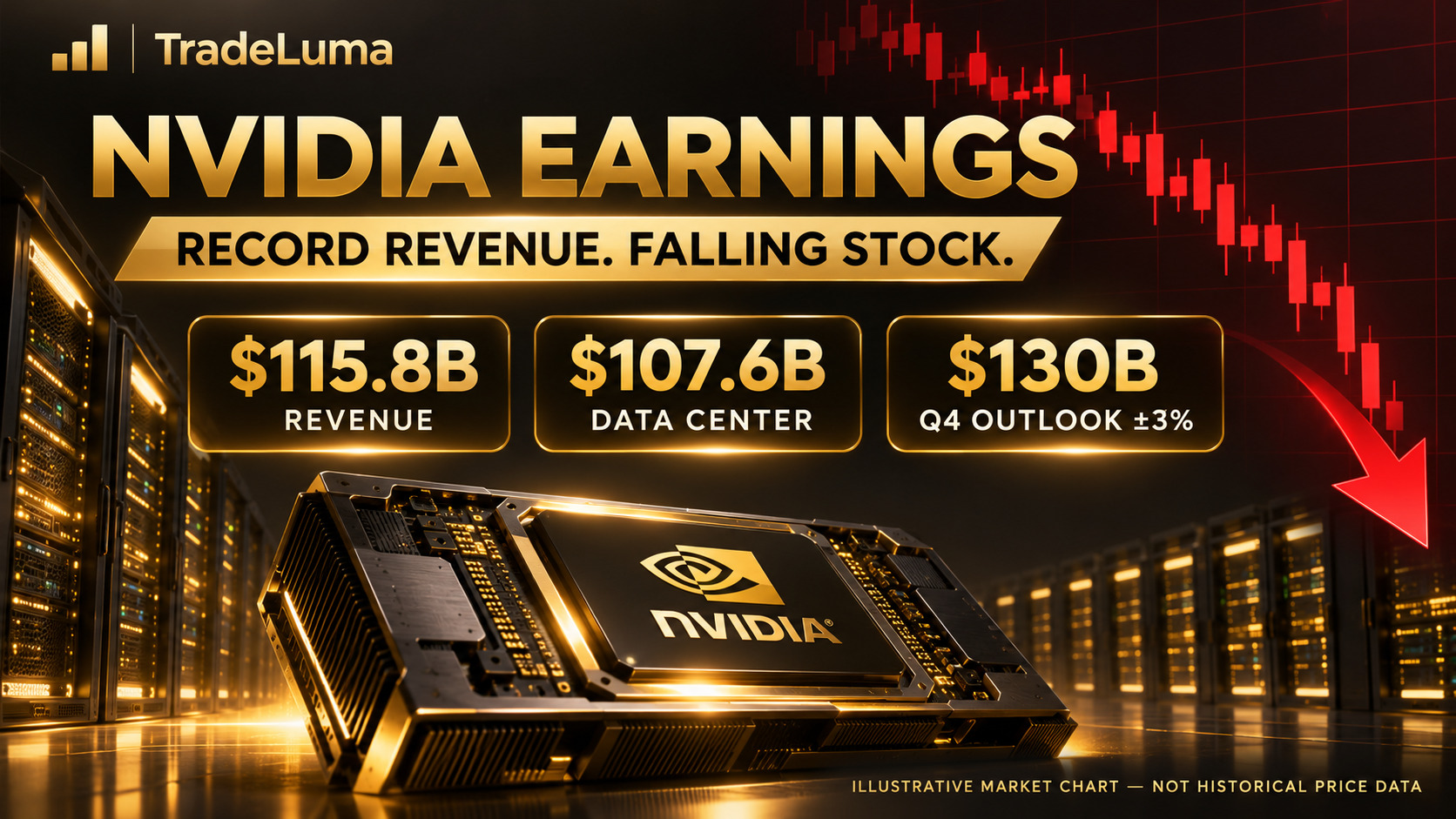
Nvidia's $115.8 Billion Earnings: Why NVDA Fell Despite Record AI Revenue
Nvidia reported $115.8B revenue and $107.6B Data Center sales on Nov 17, 2026. Why NVDA fell after earnings, Q4 guidance, investigation reports and AI risks.
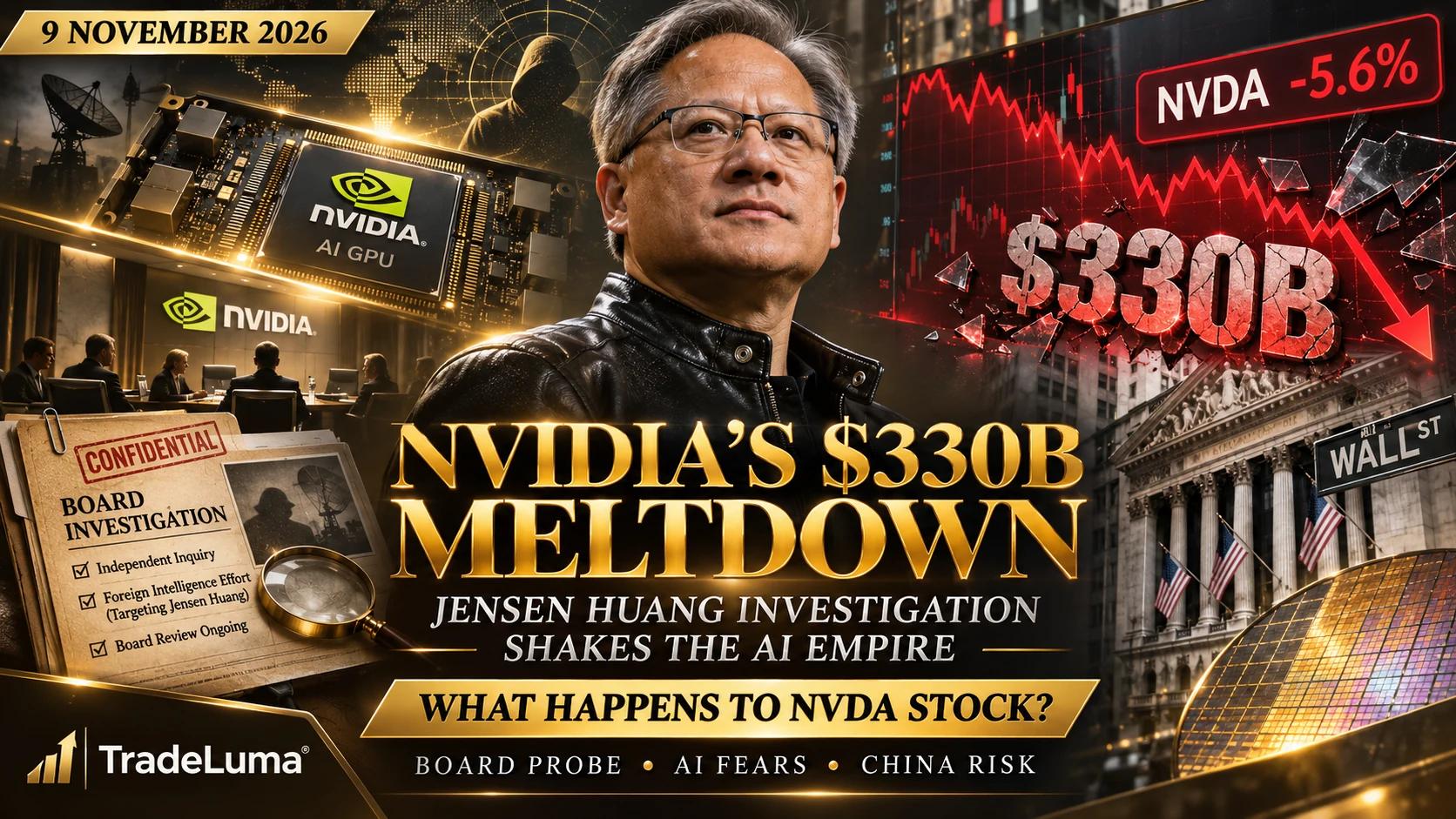
Nvidia's $330 Billion Intraday Meltdown: Jensen Huang Board Probe Shakes the AI Trade
Historical November 9 Nvidia selloff and board review, updated November 24 following Jensen Huang's confirmed reinstatement as CEO.