
AI Stocks & Markets
Nvidia Without Jensen Huang: The $108 Billion Earnings Test That Could Shake Wall Street
Historical November 17 Nvidia earnings preview, updated November 24 after Jensen Huang's reinstatement. $108B was guidance, not actual earnings.
On this page+
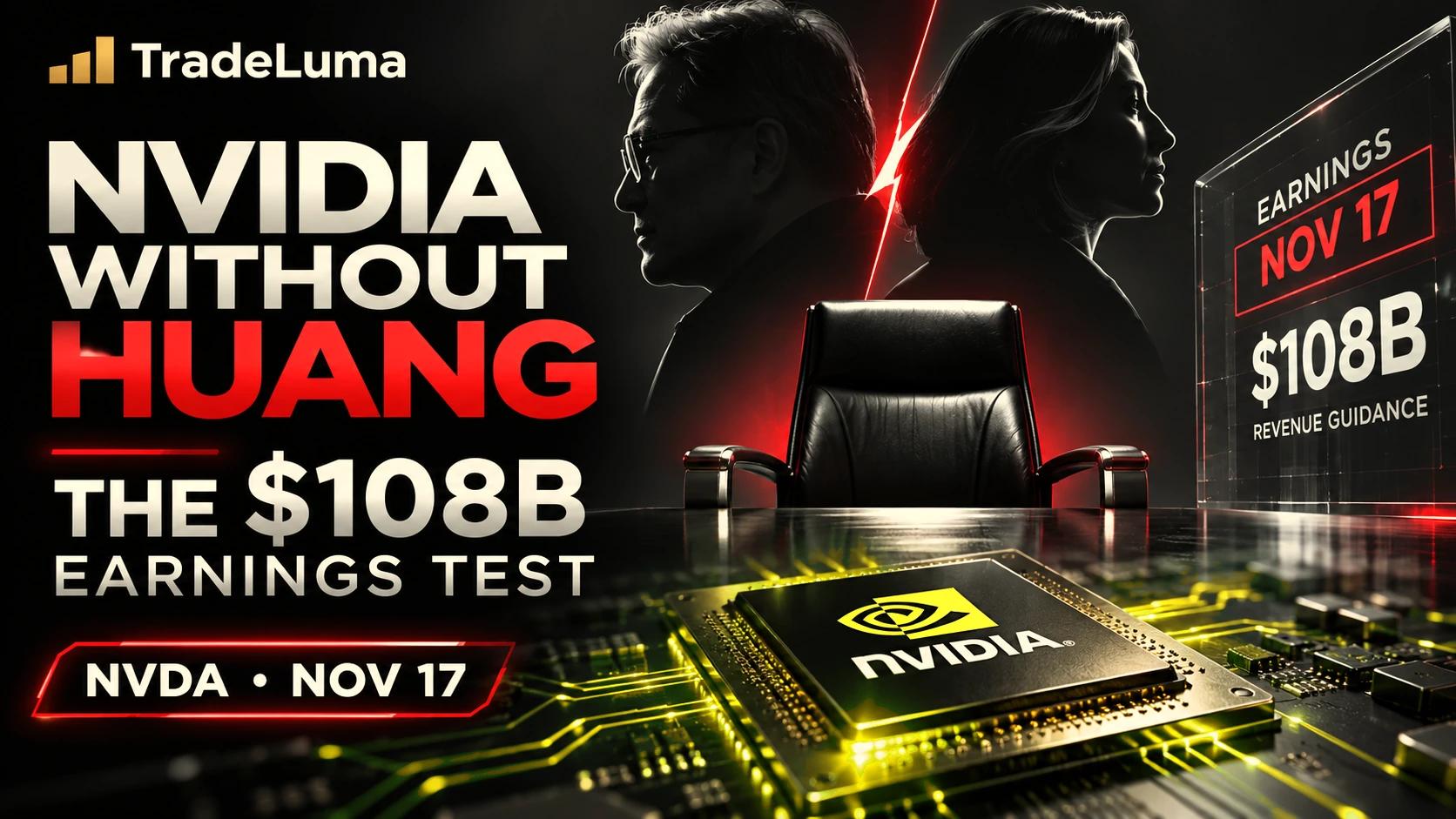
Update — November 24, 2026: Nvidia announced on November 23 that Jensen Huang had been reinstated as president, CEO and a member of its board, following the board's November 22 decision. Nvidia shares closed November 23 at US$165.05, up approximately 31.5%. The original article below records the information available on its publication date; it should not be read as a current leadership or earnings forecast. Nvidia's reinstatement does not itself establish a finding about earlier allegations. Nvidia is heading toward one of the most consequential earnings announcements in the AI boom—and for the first time in more than three decades, Jensen Huang is no longer leading the company. Its board accepted his resignation on November 11, 2026, and announced CFO Colette Kress as interim CEO on November 12. Just five days later, the chipmaker is due to publish fiscal-third-quarter results on Tuesday, November 17. Management’s previous revenue forecast was US$108 billion, plus or minus 2%, but investors surveyed by Visible Alpha expect roughly US$109.4 billion. At the same time, options prices indicate a potentially large NVDA move, and unresolved questions about the permanent CEO, US-China export rules and financing across AI infrastructure have intensified scrutiny. This November 16 TradeLuma preview separates confirmed facts from allegations and forecasts, identifies what the earnings report can genuinely establish and maps the risks for Nvidia, semiconductor stocks and the Nasdaq.
November 24 update: Jensen Huang has returned as CEO
Update — November 24, 2026: Nvidia announced on November 23 that Jensen Huang had been reinstated as president, CEO and a member of its board, following the board's November 22 decision. Nvidia shares closed November 23 at US$165.05, up approximately 31.5%. The original article below records the information available on its publication date; it should not be read as a current leadership or earnings forecast. Nvidia's reinstatement does not itself establish a finding about earlier allegations.
The company's November 23 announcement and SEC Form 8-K are the controlling sources for the leadership decision. See TradeLuma's Nvidia $950 billion comeback article for the market reaction. The earlier material below is retained as dated historical analysis, not a statement that the former interim arrangement or forecasts remain current.
Why November 17 is Nvidia’s first big test without Jensen Huang
Nvidia is heading into Tuesday’s fiscal-third-quarter earnings announcement in a position few investors imagined a month ago: Jensen Huang, the co-founder who ran the chipmaker for more than three decades, is no longer chief executive. An official November 12 company statement confirmed his immediate resignation as president, CEO and director, with longstanding CFO Colette Kress taking the interim role. The earnings date itself was already on the calendar; what changed is that financial expectations now collide with uncertainty about leadership, culture, compliance and strategic direction.
The market needs answers at two different levels. Financially, investors want to see whether the company can deliver its August forecast of about $108 billion in quarterly revenue and sustain very high margins. Strategically, they need to know who is empowered to make decisions about major AI infrastructure commitments, US-China restrictions, customer financing and the permanent CEO search. A single quarterly beat may not fully resolve the second set of questions.
The confirmed timeline: board action, official announcement and earnings
Nvidia’s Form 8-K says its board accepted Huang’s resignation on November 11, 2026, effective immediately. Nvidia publicly announced the leadership transition on November 12. It appointed Colette Kress interim chief executive while she continues as CFO, and named longtime director Harvey C. Jones the board’s first chair. The board said it would consider internal and external candidates for a permanent CEO.
Nvidia has scheduled fiscal-Q3 2027 results for Tuesday, November 17 at approximately 1:20 p.m. Pacific Time, followed by a results call at 2 p.m. Pacific Time. The November 16 article is a preview; it should not include November 17 revenue as if known. This timeline also clarifies that the resignation and the financial results are separate events, even though markets will evaluate them together.
What Nvidia actually guided: $108 billion is a forecast, not a result
At its August 26 fiscal-Q2 release, Nvidia forecast third-quarter fiscal-2027 revenue of $108.0 billion, plus or minus 2%. The same outlook set both GAAP and non-GAAP gross margin around 74.0%, with a tolerance of 50 basis points, and non-GAAP operating expenses near $9.0 billion. Nvidia stated that the guidance assumes no data-centre compute revenue from China.
In the preceding quarter, Nvidia reported $96.221 billion of revenue, up 106% from a year earlier, with approximately $89.0 billion from Data Center. Those numbers demonstrate the size of the underlying business, but they do not answer what will be reported on Tuesday. Readers should compare the eventual Q3 results with the forecast period and use the same accounting basis for margin and earnings comparisons.
Wall Street consensus versus Nvidia guidance
Ahead of the release, a Visible Alpha analyst survey cited by Investopedia placed expected revenue around $109.4 billion and net income around $60.9 billion. That revenue estimate is slightly above management’s prior $108.0 billion midpoint. The difference helps explain why simply reporting the company’s guide may not satisfy traders who have already priced in more.
Consensus numbers are aggregates, not promises, and can change as analysts update their models. It matters whether the quoted figure refers to GAAP net income, non-GAAP EPS, company-provided guidance or an analyst survey. A credible earnings recap should use actual released figures and state the comparison source and timestamp.
The options market signals large uncertainty—not a guaranteed direction
Investopedia reported that options prices indicated an approximately 8% potential move in Nvidia shares by the end of earnings week. That is an implied volatility-based estimate of the magnitude of possible movement, not a guaranteed range or a directional price target. Realised volatility can be substantially greater or smaller, and option premiums can collapse after the announcement even when the share price moves.
For traders, the takeaway is that both a sharp rebound and renewed weakness are plausible scenarios. Spreads, liquidity, stop-order slippage and gaps around earnings can all diverge from normal-session expectations. There is no evidence that an 8% expected move creates a risk-free long or short options trade.
Who is Colette Kress, Nvidia’s interim CEO?
Kress joined Nvidia as chief financial officer in 2013 after senior finance work at Microsoft, Cisco and other technology companies. Nvidia’s November 12 statement emphasised her experience across the company’s growth and said its management team would continue to execute the existing product roadmap. Her appointment provides operational continuity but also places an executive best known for finance in charge of a business whose founder was deeply involved in product design and customer relationships.
Reuters reported, citing people familiar with internal deliberations, that Kress at times challenged the scale and financing risk of Huang’s proposed AI investments. That characterisation is reporting, not an audited account of particular investment decisions. Investors will look for evidence of how she delegates technical authority, handles supplier relationships and decides whether the company’s aggressive spending model needs adjustment.
The permanent CEO search could change the Nvidia investment case
Nvidia says it is considering candidates from both inside and outside the company. Reports have mentioned Arm chief Rene Haas and other technology executives, but no candidate should be described as appointed without a company announcement. Treasury Secretary Scott Bessent publicly argued on November 15 that the board should seek an outside leader and respond to export-compliance concerns; this is political pressure rather than a formal Nvidia board decision.
The market may distinguish between an interim leader who stabilises the business and a permanent leader capable of making long-term bets across GPUs, software, networking, autonomous systems and giant AI data centres. A transparent search process, clear governance and an explanation of decision rights could reduce uncertainty. Delays or contradictory messages could have the opposite effect.
Nvidia’s AI infrastructure demand: customers, cloud providers and supply
The most important financial question remains whether hyperscale and enterprise buyers continue ordering Nvidia accelerated-computing systems fast enough to justify a high-growth valuation. Nvidia’s prior reports described strong uptake of Blackwell Ultra and the Vera Rubin platform, with software, networking and integrated rack systems becoming more important alongside chips.
When earnings arrive, investors should separate announced orders, capacity commitments, shipped hardware, recognised revenue and collected cash. Each is a different stage of demand. Strong AI announcements can make for compelling headlines while receivable collection, constrained memory supply and delivery timing still determine how much near-term revenue converts into cash.
Why gross margin and cash flow may matter more than a headline beat
Nvidia’s August outlook put fiscal-Q3 gross margin at about 74%. Even small movements around that level can materially affect profitability at a revenue run rate exceeding $100 billion per quarter. Higher component prices, changes in product mix, packaging, networking and customer-negotiated system prices can all change gross margin without necessarily changing demand for AI computing.
Cash flow, receivables and inventory provide a second test. Investors have debated whether the AI investment boom depends too heavily on financing or interconnected customer relationships. Those concerns do not prove that reported sales are fictitious, but they do make working-capital trends and disclosures about customer credit risk unusually important.
China export controls and allegations: keep facts separate
US export restrictions on advanced AI processors have created commercial and political tension for Nvidia. The company’s own August Q3 outlook assumed no China data-centre compute revenue. Nvidia’s leadership transition has amplified questions about how the company will manage export controls and comply with applicable licensing rules.
News outlets have reported allegations connected to Huang’s personal relationships and foreign-intelligence concerns. These reports are not the same as proof of espionage, a confirmed breach or a finding that Nvidia broke the law. Nvidia has said it had no reason to believe company secrets or national security were compromised. Readers should watch official regulatory disclosures and completed investigations rather than equating a headline allegation with an established conclusion.
What US Treasury Secretary Scott Bessent said on November 15
On November 15, Reuters reported that Treasury Secretary Scott Bessent urged Nvidia to search outside the company for a permanent chief executive and called for answers from the board and counsel on export-compliance culture. His remarks add political attention days before earnings, even though the board retains responsibility for hiring a CEO under corporate governance arrangements.
His statements could affect perceptions of regulatory risk and customer confidence, but they should not be interpreted as an order forcing a particular candidate or as a finding of export-control wrongdoing. Political commentary, legal process and Nvidia’s official announcements each have different levels of authority.
Is the chipmaker still positioned for the next AI generation?
Nvidia is not only a seller of stand-alone AI chips. Its business includes interconnects, systems, software and accelerated-computing platforms that cloud providers build into long-lived data-centre infrastructure. That ecosystem may continue to operate through a leadership transition, particularly when customers have already designed deployment plans around an existing product architecture.
Nevertheless, maintaining a technology lead requires sustained execution. Competing products from AMD and custom silicon offered by hyperscalers are relevant over longer periods. An upcoming earnings call can illuminate manufacturing capacity, product availability and demand, but it cannot settle every competitive question for fiscal 2028 and beyond.
What NVDA’s recent stock sell-off does—and does not—tell us
Nvidia shares had already been under heavy pressure when Huang resigned. Investopedia reported that NVDA lost roughly 12% in the week ending November 13 and sat more than 30% beneath an October peak. Those are dated market observations, not proof that every dollar of decline resulted from the same incident. Interest-rate expectations, broader semiconductor selling and concerns about returns on AI capital spending also influenced sentiment.
A lower share price can reduce the valuation hurdle for positive earnings surprises, but it can also reflect a genuine re-pricing of risk. A stock can rebound sharply on acceptable results or fall further despite powerful historical growth. Traders should identify the benchmark, comparison period and price timestamp before attributing a move to any single catalyst.
Scenario one: a strong beat and credible leadership plan
In a constructive scenario, quarterly revenue and profit exceed consensus, gross margin holds up, management demonstrates healthy cash conversion and the next-quarter outlook implies robust customer demand. Colette Kress and the new board chair might also provide a credible timeline for identifying a permanent CEO and clear assurance that commercial commitments and engineering decisions remain well managed.
Such evidence could support a rebound in the chipmaker and related AI stocks. This is conditional analysis, not a statement that such results have occurred or a forecast of how far NVDA should rise. Market prices can still fall if optimistic expectations are already reflected in valuations.
Scenario two: strong sales but disappointing guidance or unanswered questions
The most frustrating outcome for investors would be strong Q3 numbers alongside weaker-than-expected forward guidance or incomplete answers about China, customer financing, receivables and succession. A headline revenue beat could be overshadowed if management forecasts a slower product ramp, higher operating costs or thinner gross margins.
Under that scenario, a negative stock reaction would not contradict the fact that Nvidia is growing rapidly. Markets discount future cash flows and governance risk, not just the previous quarter’s revenue. This scenario is especially relevant because analysts already expect a quarter above the company’s original midpoint.
Scenario three: an upside surprise with an unconvincing market response
Sometimes a company delivers impressive results but its stock barely responds. That can happen when options-implied volatility was very high before earnings, when investors focus on management questions that remain unresolved or when the whole sector is moving with interest rates and risk appetite.
For traders, the observation is to avoid assuming that good news must produce a sustained positive price trend. Price reaction, liquidity and post-earnings guidance matter more than whether a single revenue headline sounds spectacular.
How Nvidia earnings may transmit into the Nasdaq and AI sector
NVDA is a large and closely watched component of technology indexes, semiconductor funds and a global AI supply chain. A large move can influence the Nasdaq-100 and related ETFs mechanically through index weighting and psychologically through read-across to cloud spending, semiconductors, memory, networking and data centres.
The market effect need not be uniform. A weaker Nvidia outlook might weigh on its suppliers while boosting interest in rivals, or it might trigger broader caution about AI spending. Conversely, strong demand may help hardware suppliers but raise questions about whether Nvidia’s largest customers can earn a sufficient return on their capital expenditure. These are different transmission channels and should be analysed separately.
Risk management for traders around November 17
Earnings releases are discrete events that can create gaps, sudden liquidity changes and unusually wide spreads. Traders should check when their broker permits orders, whether stop instructions are guaranteed or merely triggered into market orders, and whether derivatives have expiry or implied-volatility exposure. Position sizes based on normal daily volatility can be inappropriate for a company facing both earnings and governance headlines.
A practical framework is to define the maximum acceptable loss before entering, distinguish a directional thesis from an options-volatility thesis, avoid adding exposure solely because a quote has moved sharply and confirm that automated strategies cannot accidentally duplicate orders during a reconnect. TradeLuma’s educational focus on signal validation, duplicate prevention and broker reconciliation is relevant to operational risk, but it does not remove financial market risk.
The calendar: Nov 17 results, then the Fed and macro backdrop
Nvidia’s earnings are due Tuesday, November 17 after the regular US trading session. The same week includes US retail-sales data and Federal Reserve meeting minutes, making it a volatile macroeconomic period for technology valuations. Higher US Treasury yields can pressure richly valued growth stocks even when company-specific execution is strong.
Readers should not confuse the exact date of Nvidia’s scheduled release with the date US markets reopen after the weekend, or mistake a morning stock move for an earnings reaction before the results exist. TradeLuma’s November 16 preview will need a separate, clearly dated update after the company reports.
The bottom line: Nvidia’s results and its next CEO are now one story
Nvidia enters November 17 with enormous quarterly revenue expectations, a company-confirmed leadership transition and unresolved investor questions about export rules, AI finance and the next generation of computing systems. The $108 billion guidance and 74% gross margin forecast are real historical company projections; the actual third-quarter figures remain unknown until the release.
For investors, the most valuable information will be the combination of reported performance, forward-looking guidance, credible succession plans and verifiable cash generation. For traders, the premium on disciplined risk controls is unusually high. A dramatic week can produce opportunity and severe loss; an article should explain the possibilities without pretending to know tomorrow’s headline.
Frequently asked questions
Did Jensen Huang resign as Nvidia CEO in November 2026?+
Yes. Nvidia announced on November 12 that co-founder Jensen Huang had resigned as president, CEO and a director, effective immediately. An SEC Form 8-K records the board action on November 11. Colette Kress became interim CEO.
Who is running Nvidia after Jensen Huang?+
Jensen Huang was reinstated effective November 22, announced November 23. Colette Kress had served as interim CEO before his return.
When is Nvidia’s November 2026 earnings report?+
Nvidia scheduled its fiscal third-quarter 2027 results for Tuesday, November 17, 2026 at about 1:20 p.m. Pacific Time, followed by a 2 p.m. Pacific earnings call.
Does $108 billion refer to Nvidia’s actual Q3 revenue?+
No. $108 billion, plus or minus 2%, was management’s guidance issued in August for the upcoming third quarter. Actual results were not known at publication on November 16.
What did analysts expect before the November 17 results?+
At the November 16 preview, Visible Alpha consensus cited by Investopedia was around $109.4 billion revenue and $60.9 billion net income. These were historical estimates, not actual results.
How much could NVDA stock move after earnings?+
Investopedia reported that options were pricing an approximately 8% move in either direction through the week. Implied movement is not a probability-weighted promise or a recommendation to trade options.
Is Colette Kress Nvidia’s permanent CEO?+
No. Kress served as interim chief following Huang's departure; Nvidia subsequently reinstated Huang as CEO in its November 23 announcement.
Was an espionage or national-security breach proven?+
No. Reporting has discussed allegations and investigations, but Nvidia has said it had no reason to believe company secrets or national security were compromised. Allegations should not be presented as established findings.
Does Nvidia assume any China AI-chip revenue in its $108 billion forecast?+
Nvidia’s August revenue outlook expressly assumed no China data-centre compute revenue. Actual geographic mix and export exposure should be checked against the upcoming earnings release.
What metrics matter besides quarterly revenue?+
Investors should watch guidance for the following quarter, data-centre growth, gross margin, receivables and cash conversion, platform supply, China compliance and the CEO transition timetable.
Could strong earnings send NVDA stock down?+
Yes. The stock reaction depends on how results and forward guidance compare with expectations already reflected in the share price. Strong absolute growth may still disappoint elevated forecasts.
Does Nvidia earnings affect the Nasdaq?+
Nvidia is a major semiconductor and AI-infrastructure company with substantial index weight. A large stock move can affect sector ETFs and broad benchmarks, but other constituents and macroeconomic developments also matter.
Keep learning
Continue through the TradeLuma research library.
Browse practical guides across trading, automation, execution, futures, technical analysis, and risk management.
Browse all guides →Continue learning
Related guides.

AI’s Pressure-Cooker Week: Nvidia Earnings, Anthropic’s IPO and the Sell-Off Testing Wall Street
Nvidia reports on Nov 17 as Anthropic targets a Nov 19 IPO amid a Nasdaq sell-off. Explore NVDA earnings, ANT valuation, options risk and AI-stock scenarios.
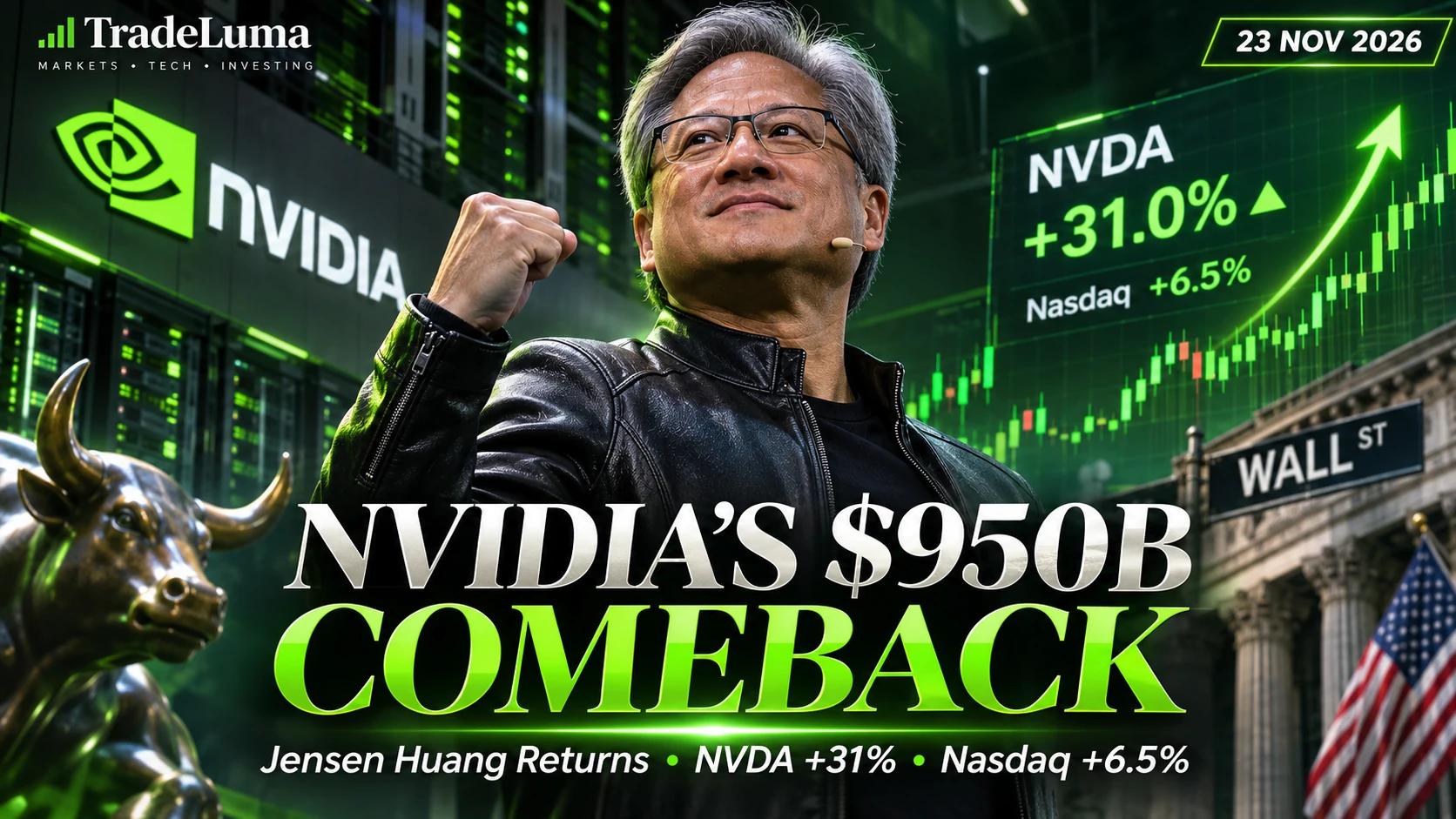
Nvidia's $950 Billion Comeback: Jensen Huang Returns as NVDA Jumps 31.5%
Nvidia shares jumped 31.48% on Nov 23, 2026 after Jensen Huang's reinstatement as CEO, adding roughly $952B in market value. Why the Nasdaq surged 6.5%.

CoreWeave's 50% Stock Crash: Is Nvidia's AI Cloud Partner Sitting on a Debt Time Bomb?
CoreWeave stock plunged roughly 49% in a month as some bonds yielded 15%. Explore CRWV debt, Nvidia ties, $104B backlog and November 10 earnings risks.