
AI Stocks & Markets
Nvidia's $950 Billion Comeback: Jensen Huang Returns as NVDA Jumps 31.5%
Nvidia shares jumped 31.48% on Nov 23, 2026 after Jensen Huang's reinstatement as CEO, adding roughly $952B in market value. Why the Nasdaq surged 6.5%.
On this page+
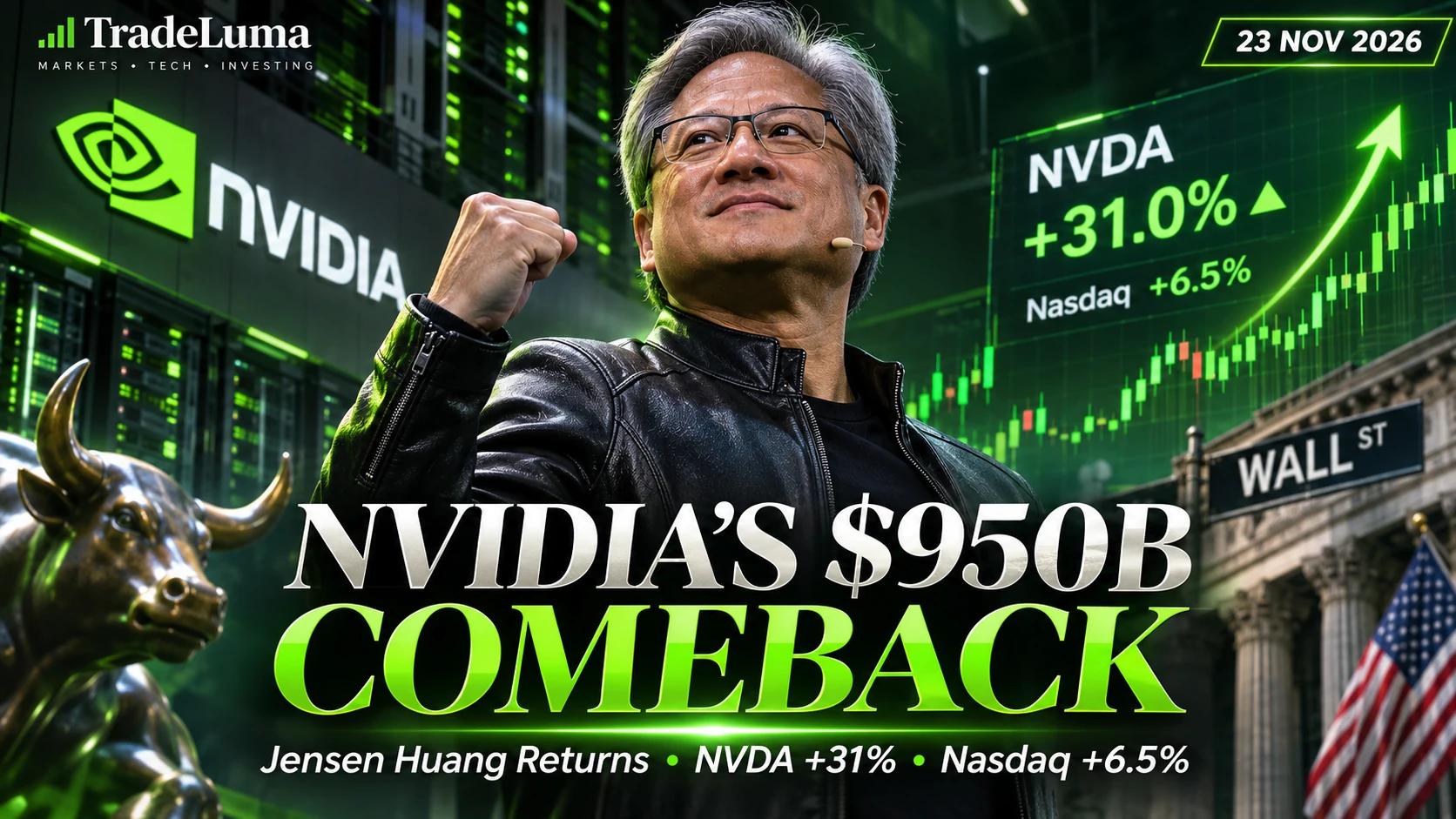
On Monday, November 23, 2026, Nvidia shares closed at US$165.05, up 31.48% in a single session after the company announced that co-founder Jensen Huang had been reinstated as president, chief executive and a board director. MarketWatch reported a record approximately US$952 billion one-day increase in Nvidia's equity market value; the Nasdaq Composite finished about 6.5% higher as AI-linked shares rallied broadly. Nvidia's own press release and an SEC Form 8-K confirm the leadership move, following Huang's earlier departure and a period with Colette Kress as interim CEO. The share price and market-cap figures are historical November 23 closing observations, not live quotes, not cash paid to the company and not a guarantee of future gains. Here is why the board decision mattered so much to investors, what it does and does not change about Nvidia's fundamentals, and what traders can learn from the biggest market moves.
What happened at Nvidia on November 23, 2026?
Nvidia announced on Monday that Jensen Huang had been reinstated as its president and chief executive officer and returned to the board. The company's SEC Form 8-K says the board acted November 22 with immediate effect; the public statement followed on November 23. The announcement came after his earlier departure had unsettled investors and introduced leadership uncertainty at a company central to the global AI infrastructure buildout.
Reuters described an immediate, powerful repricing of Nvidia shares and a wider relief rally in AI-exposed equities. A restored CEO can alter market expectations about strategy and continuity, but this announcement was a personnel decision rather than an earnings release or an acquisition.
The phrase 'Huang returns' should not imply that his earlier departure never happened. The original November 12 company transition announcement and the November 23 reinstatement are separate official corporate events.
How much did NVDA gain — and what does $952 billion mean?
MarketWatch reported that NVDA ended November 23 at US$165.05, a rise of US$39.52 or 31.48% from the preceding close, citing Dow Jones Market Data. It described the resulting approximately US$952 billion increase in market capitalisation as the largest single-day addition in the company's history.
Market capitalisation is the stock price multiplied by shares outstanding. The change represents a mark-to-market repricing of existing shares, not US$952 billion arriving in Nvidia's bank account or new quarterly sales. A shareholder's gain or loss depends on how many shares they owned and when they acquired them.
The cover's rounded US$950 billion and +31% are based on the dated November 23 close. They should not be treated as a live price feed or a promise that the same percentage move will recur.
Why the Nasdaq Composite rose roughly 6.5%
AP reported that the Nasdaq Composite gained around 6.5% on November 23 amid a broad surge in AI-linked shares. Nvidia's size and centrality to the AI supply chain helped transmit the optimism to semiconductors, data-centre vendors and other growth stocks. The S&P 500 and Dow also rose, though their compositions and exposures differ.
The Nasdaq Composite is not the Nasdaq-100 futures contract. The separate November 23 futures price-limit event occurred around the US market opening and must not be confused with the index's final close. Exchange-traded NQ and MNQ contracts have specific price bands and different point multipliers.
A market-wide rise may combine relief buying, short-covering, fund rebalancing and company-specific news. A single headline rarely accounts mechanically for every index point.
The November leadership timeline
Nvidia's November 12 statement said Huang had stepped down and that CFO Colette Kress would serve as interim chief executive. The board subsequently reinstated Huang effective November 22, with the public announcement on November 23. Those dates explain why an investor could have seen sharply different valuations within a short period.
Investors should favour Nvidia's investor-relations releases and SEC filings over viral explanations of personnel decisions. Claims about private conduct, motives or national-security conclusions require reliable sourcing and should not be inferred from a stock chart.
The reversal reduces some uncertainty over who runs Nvidia today; it does not eliminate the need for board oversight, succession planning or clear disclosure of future decisions.
Does Jensen Huang's return fix the AI investment thesis?
Huang has been closely associated with Nvidia's accelerated-computing strategy, AI processor roadmap, networking products and partnerships. Investors may regard leadership continuity as valuable, especially when customers commit large capital budgets over several years.
But GPU demand, supply availability, gross margins, cash receipts, software competitiveness, export restrictions and customer concentration do not change automatically with the identity of the chief executive. Analysts still need to reconcile bookings, recognised revenue and financial guidance with capital expenditure at AI cloud customers.
A sensible analysis separates the leadership-risk discount that the market may have removed from any lasting improvement to future free cash flow. The stock can rebound sharply on reassurance while remaining exposed to a later operational disappointment.
What Nvidia's latest reported earnings can and cannot tell us
The relevant fiscal Q3 2027 numbers were released by Nvidia in November, prior to the CEO reinstatement. That financial statement is the appropriate source for actual revenue and margins, rather than the US$108 billion estimate discussed in older pre-earnings articles. The date of each statistic should accompany its use.
An earnings beat or powerful guidance does not prove every AI infrastructure buyer earns attractive returns from the computing capacity it purchases. Infrastructure spending flows through multiple vendors and can involve delayed deployment, rising electricity costs and financing requirements.
The company's valuation depends on future performance relative to already optimistic expectations. Investors should compare new official guidance with the prior quarter and with market assumptions rather than conclude the business is safer solely because shares rose.
Why CoreWeave, Oracle and other AI cloud stocks rallied too
The November 23 relief trade extended beyond Nvidia. MarketWatch reported that CoreWeave rose around 22%, Nebius about 20% and Oracle approximately 12%. Those companies have different customers, debt structures and business models, even if they all benefit from investor willingness to fund AI computing capacity.
Oracle also made a separate announcement about funding for its OpenAI infrastructure commitment, according to AP. Therefore it would be inaccurate to attribute every percentage point of ORCL's rise to the Nvidia news alone.
A broad rebound reveals sentiment and positioning as well as fundamentals. Investors should test how much durable contract demand, financing capacity and profitability underpin each company.
Why extreme rallies are risky for options and inverse products
In derivatives, an extreme underlying share move can have an amplified or nonlinear effect. Short-dated options may reprice through both directional exposure and changing implied volatility. Leveraged inverse ETPs attempt a multiple of daily share performance, not a simple long-term inverse.
On November 23, two London-listed -3× Nvidia exchange-traded products were temporarily halted after losses exceeding 90%, according to ETF Stream. This dramatic result is a related but separate story about product design and path dependence, not evidence that every investor short Nvidia lost 92%.
Traders should not infer personal exposure from a dramatic headline; a conventional unleveraged short position, an inverse ETP and an option spread have very different mechanics.
Three scenarios after the CEO reinstatement
Scenario one: Leadership stability accompanies strong demand, improving cash generation and credible guidance. In that case, some of the rebound may be supported by fundamentals, though valuation still limits prospective returns.
Scenario two: The leadership announcement lifts sentiment but capital-spending returns or margins disappoint. The stock can become volatile again even though the CEO situation appears resolved.
Scenario three: New regulatory, supply-chain or customer-financing developments alter growth expectations independently of personnel changes. All three outcomes are hypothetical frameworks, not quantified probabilities or trading recommendations.
What investors should watch next
Monitor Nvidia's investor-relations filings, next results, product announcements, gross margins, customer concentration and liquidity across the AI cloud supply chain. Compare sector price movements with company fundamentals rather than assuming that a single large trading day establishes a new long-term trend.
For price statistics, specify the security, exchange, observation time and whether the price is a closing value or an intraday snapshot. Nvidia closed November 23 at US$165.05; that is not a live November 24 quote.
This article is published on November 24 and is educational financial commentary. The cover charts are illustrative and the rounded market-value change is a historical equity-mark-to-market estimate.
Frequently asked questions
Did Jensen Huang return as Nvidia CEO in November 2026?+
Yes. Nvidia announced his reinstatement as president, CEO and board director on November 23, effective immediately; the SEC filing records board action on November 22.
How much did Nvidia shares rise on November 23, 2026?+
MarketWatch, citing Dow Jones Market Data, reported a US$165.05 close, up US$39.52 or 31.48%.
Did Nvidia make $950 billion in one day?+
No. The approximately US$952 billion figure refers to its stock-market capitalisation rising as shares were repriced, not cash earnings or revenue.
What caused the Nvidia rally?+
The immediate catalyst was Nvidia's confirmed reinstatement of Jensen Huang, amid wider relief buying in AI-linked companies. Stock moves can have multiple drivers.
How much did the Nasdaq rise on November 23?+
AP reported the Nasdaq Composite rose approximately 6.5% on November 23, 2026.
Who was Nvidia's interim CEO?+
Nvidia appointed its CFO Colette Kress as interim CEO following Huang's earlier November departure; Huang was subsequently reinstated.
Is Nvidia's $950 billion comeback a real cash inflow?+
No. Market capitalisation is a share-price-based valuation of equity. A one-day rise does not put that sum directly onto the company's balance sheet.
Why did AI cloud stocks rise too?+
Broad AI-sector confidence improved; CoreWeave, Nebius and Oracle rose sharply, while Oracle also had its own infrastructure-financing announcement.
Did Nvidia short sellers universally lose 92%?+
No. Around 92% losses were reported for particular -3× inverse Nvidia ETPs, not all bearish positions or all short sellers.
Should investors expect another 30% rally?+
No such prediction follows from one session. Future returns depend on valuation, company results, new information and market conditions.
Keep learning
Continue through the TradeLuma research library.
Browse practical guides across trading, automation, execution, futures, technical analysis, and risk management.
Browse all guides →Continue learning
Related guides.
Nvidia Without Jensen Huang: The $108 Billion Earnings Test That Could Shake Wall Street
Historical November 17 Nvidia earnings preview, updated November 24 after Jensen Huang's reinstatement. $108B was guidance, not actual earnings.
Nvidia's $115.8 Billion Earnings: Why NVDA Fell Despite Record AI Revenue
Nvidia reported $115.8B revenue and $107.6B Data Center sales on Nov 17, 2026. Why NVDA fell after earnings, Q4 guidance, investigation reports and AI risks.
AI’s Pressure-Cooker Week: Nvidia Earnings, Anthropic’s IPO and the Sell-Off Testing Wall Street
Nvidia reports on Nov 17 as Anthropic targets a Nov 19 IPO amid a Nasdaq sell-off. Explore NVDA earnings, ANT valuation, options risk and AI-stock scenarios.