
ETFs & Leveraged Products
Nvidia Shorts Wiped Out: 3× Inverse ETPs Crash 92% as NVDA Surges
GraniteShares 3SNV plunged 92.1% and Leverage Shares NV3S fell 91.4% during Nov 23, 2026 Nvidia's rally. Why 3× inverse ETPs can collapse and halt.
On this page+
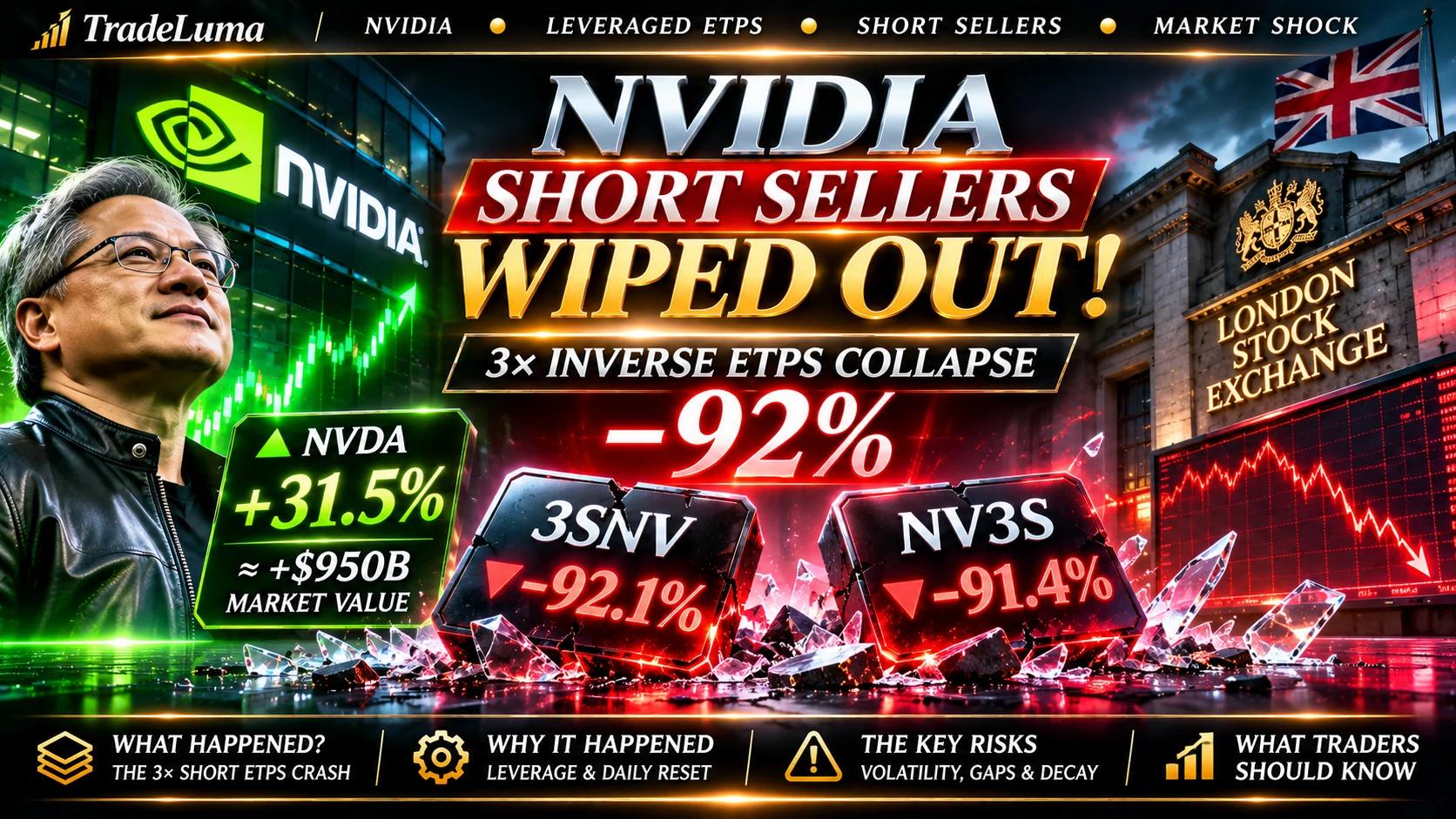
On Monday November 23, 2026, Nvidia's extraordinary rally put two London-listed three-times inverse Nvidia exchange-traded products under extreme pressure. ETF Stream reported that GraniteShares 3X Short Nvidia Daily ETP (3SNV) fell 92.1% and Leverage Shares -3X Short Nvidia (NVDA) ETP (NV3S) fell 91.4% in observations immediately before temporary London Stock Exchange trading halts. Nvidia shares were rising more than 30% following confirmation of Jensen Huang's return as chief executive. The product losses were dated trading snapshots, not statements that all short sellers had identical outcomes or that every holder's account fell 92%. These products target amplified inverse daily exposure, and an extreme move can require risk controls, intraday rebalancing and trading interruption. The incident illustrates why a -3× label is not a simple, safe way to express a multi-day view on a single stock.
What happened to 3SNV and NV3S on November 23?
ETF Stream reported that London trading was temporarily stopped for GraniteShares' 3SNV and Leverage Shares' NV3S shortly before 2:30 p.m. UK time as Nvidia shares rocketed upward following a surprise management announcement. The quoted product moves were -92.1% for 3SNV and -91.4% for NV3S before trading resumed later that afternoon.
A single-stock index product cannot create unlimited liquidity merely because it is listed on an exchange. When the underlying jumps violently, market makers and issuers may need to reconsider fair values, exposure limits, rebalancing and trading arrangements.
Use time-stamped ETP prices and official issuer notices rather than treating the cited figures as the final trading-session return. The approved artwork shows a historical snapshot and deliberately says so in its footer.
Why three-times inverse leverage can lose almost everything
A simple one-day -3× return target means an underlying stock gain of 10% would imply approximately a 30% product loss before costs and tracking effects. A gain of 30% would mechanically imply about a 90% loss. At a gain of 33⅓%, the simplified mathematical inverse return reaches -100%.
Real-world leveraged ETPs implement collateral, swaps, financing, resets and extraordinary-event provisions rather than guaranteeing that a formula can operate normally beyond every possible market gap. Some products may rebalance during an exceptional move to avoid exhausting value.
This is why buyers should not assume they can wait for a recovery when a highly leveraged product approaches its reset threshold. Near-total loss in one session is possible even when the holder never borrows money directly.
What do 3SNV and NV3S actually track?
The GraniteShares 3X Short Nvidia Daily ETP and Leverage Shares -3X Short Nvidia ETP are UK-listed securities designed to express amplified daily downside exposure to Nvidia stock. Their issuer structures, risk disclosures, financing costs, rebalancing rules and possible acceleration conditions can differ.
They should not be conflated with buying a put option, borrowing NVDA shares to short directly, or investing in a broadly diversified inverse index ETF. The daily reset and single-stock concentration create an unusual form of risk that deserves product-specific due diligence.
The ticker, exchange and ISIN matter. A trader typing 'short NVDA' may encounter several instruments with very different outcomes. A screenshot from one product does not determine another issuer's terms.
What was the connection to Jensen Huang's reinstatement?
Nvidia confirmed on November 23 that Jensen Huang was returning as CEO and a board director. US shares surged after the announcement and closed up 31.48%, according to MarketWatch citing Dow Jones Market Data.
The sudden upward repricing was exceptionally damaging for products designed to move three times in the opposite daily direction. Yet the precise loss in each ETP reflects its own reference price, reset mechanics, currency, trading window and pricing.
The event also produced sector-wide moves in semiconductors and AI infrastructure. The more important lesson than one executive's biography is the fragility of highly leveraged, concentrated daily exposures during extraordinary news.
Why were the London products temporarily halted?
ETF Stream said both 3SNV and NV3S were temporarily suspended from trading on the London Stock Exchange and resumed later. In volatile conditions, exchanges and issuers may invoke safeguards when orderly pricing or rebalancing becomes difficult.
A trading halt is not proof the financial issuer defaulted, that the Nvidia underlying itself was halted or that every investor was forcibly liquidated. Those would require separate confirmed notices. Leverage Shares also announced an intraday rebalance in response to the huge price move.
For holders, the operational risk is that an exchange-traded product can become difficult or impossible to exit during a period of extreme price discovery. An ordinary stop-loss order cannot guarantee a desired fill through a suspension.
Daily rebalancing and why two-day returns are not -3× the stock
Suppose Nvidia rises 10% on day one and falls 10% on day two. A hypothetical unleveraged share changes from 100 to 110 to 99, a two-day return of -1%. A perfectly tracking -3× daily inverse product changes from 100 to 70 to 91, a cumulative loss of 9% before costs.
Multiplying Nvidia's total -1% return by negative three would instead suggest +3%, which is not what daily resetting produces. This difference is path dependence; it can be magnified by volatility, compounding and financing costs.
The example is schematic and should not be used as an actual historical backtest for 3SNV or NV3S. Real issuer documents explain precisely how daily exposure is measured and reset.
What happens to a -3× ETP if Nvidia rises 35%?
In the simplified return formula, -3 × 35% equals -105%, beyond the value of the invested capital. Such a notional calculation illustrates why exceptional-event protection, intraday resets and issuer procedures matter so much. A listed ETP cannot promise normal continuous exposure under every imaginable discontinuous move.
The correct real-world outcome depends on the issuer's financing and legal terms; a provider might change exposure or close/rebalance in response to predefined thresholds. The existence of those safeguards does not guarantee recovery of investment.
An ETP holder generally risks losing the purchase price of the product, whereas someone shorting Nvidia shares directly has a different liability profile that can include margin calls and potentially losses beyond the initial funds posted.
Are these products suitable for long-term bearish investing?
A daily leveraged product is designed for a one-day target, not to guarantee -3× the stock's inverse return over weeks or months. Frequent changes in the underlying price can erode value through compounding even if the long-run direction appears favourable.
Some sophisticated traders may use such ETPs to express a narrowly timed hedge or view, but the risks grow with holding duration, volatility, financing expense and lack of liquidity. Their suitability depends on the complete portfolio, and losses can be severe.
Before trading, obtain the product's prospectus or key information document, verify exchange opening times and whether your broker restricts trading during extreme swings. A catchy headline is not a substitute for the product's actual risk disclosure.
Trader checklist after the November 23 collapse
Record the precise security ticker and issuer; confirm the quoted decline's timestamp and currency; check whether the product's current indicative value, reset and trading status are available. Reconcile any partially filled orders with the broker rather than automatically retrying.
Study event-specific issuer notices, especially thresholds for intraday rebalancing, changes in leverage and suspension/termination treatment. Check bid-ask spreads and realistic exits: an indicative value is not a guarantee a market maker will quote at that level.
This November 24 article is educational coverage of observed ETP losses, not a recommendation to buy a short, leveraged security or pursue the opposite trade.
Frequently asked questions
Did Nvidia short ETPs really fall more than 90% in November 2026?+
Yes. ETF Stream reported 3SNV down 92.1% and NV3S down 91.4% immediately before temporary London Stock Exchange halts on November 23.
What is 3SNV?+
3SNV is the GraniteShares 3X Short Nvidia Daily ETP, a London-listed product targeting amplified daily inverse Nvidia exposure.
What is NV3S?+
NV3S is the Leverage Shares -3X Short Nvidia ETP, another issuer's product targeting daily negative three-times Nvidia exposure.
Why did these products fall so much?+
Nvidia shares surged more than 30% after Jensen Huang's reinstatement, a move that is mechanically very damaging to three-times inverse daily positions.
Was London Stock Exchange shut down?+
The reporting concerns temporary trading suspensions for two named Nvidia ETPs, not a shutdown of the entire exchange.
Does an inverse 3x ETP return -3 times Nvidia over a month?+
Not necessarily. The objective is linked to daily returns, and compounding, resets, costs and volatility can make multi-day outcomes very different.
Can the investor owe money if a leveraged ETP goes down 100%?+
The holder of a limited-liability listed ETP generally risks the amount invested; separate margin borrowing or other account arrangements can create additional obligations.
What is an intraday rebalance?+
It is an exposure adjustment during the trading day, which may be invoked under the issuer's product rules after a very large underlying price move.
Why were ETPs halted?+
ETF Stream reported temporary suspensions amid extreme Nvidia volatility; precise exchange and issuer procedures should be checked against official notices.
Are 3x short ETPs equivalent to directly shorting NVDA?+
No. A direct stock short, a long inverse ETP and a put option involve distinct leverage, margin, liability and path-dependence mechanisms.
Put it into practice
Use the risk maths next to the guide.
Open TradeLuma's free position-size, risk/reward, expectancy, and drawdown tools to test the numbers behind a risk-management decision.
Open free trading calculators →Continue learning
Related guides.
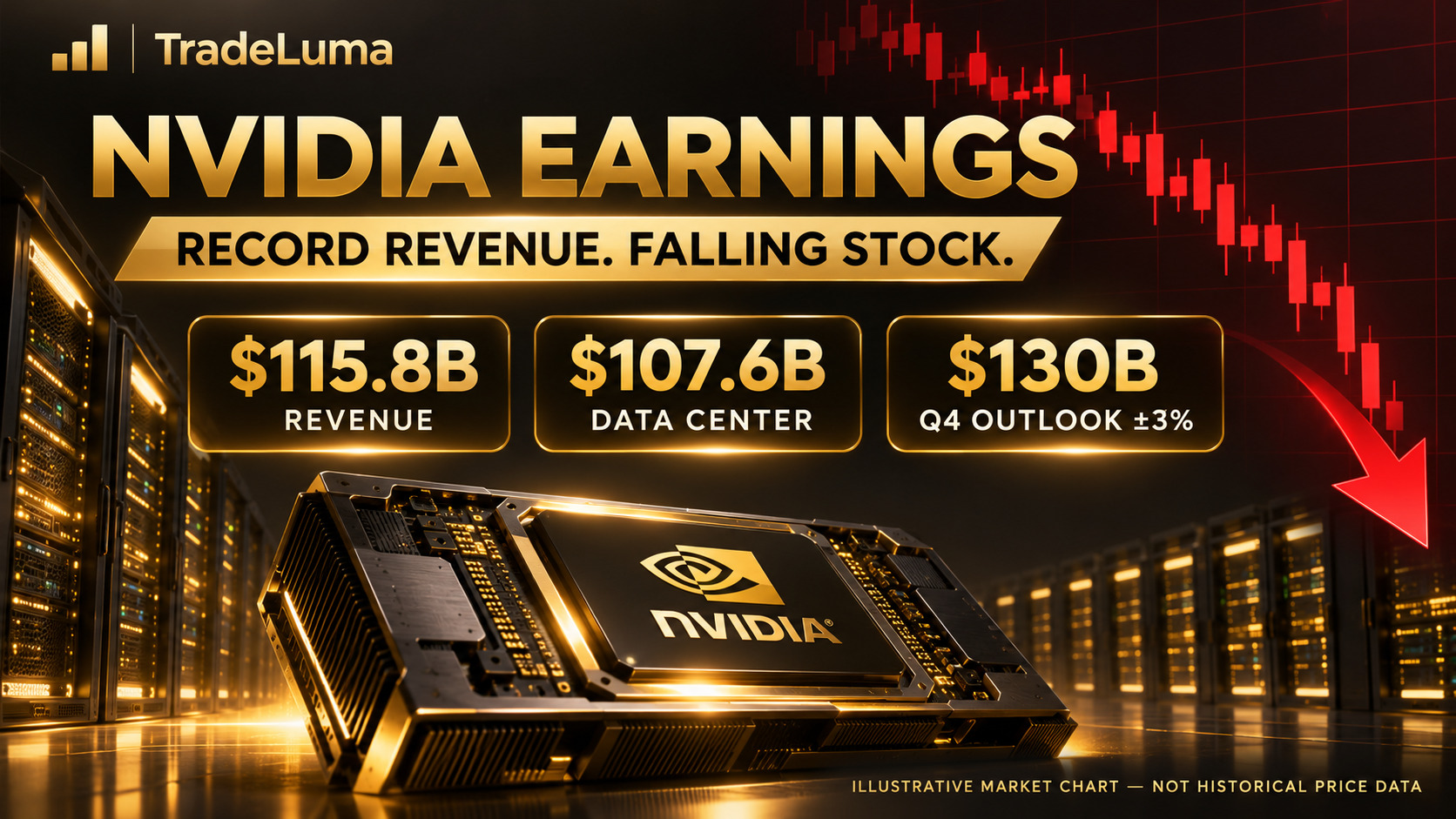
Nvidia's $115.8 Billion Earnings: Why NVDA Fell Despite Record AI Revenue
Nvidia reported $115.8B revenue and $107.6B Data Center sales on Nov 17, 2026. Why NVDA fell after earnings, Q4 guidance, investigation reports and AI risks.

The Great Everything Sell-Off: Why Gold, Bitcoin and Nasdaq Crashed Together — and What Happens Next
Why did stocks, Bitcoin and gold fall together on November 20, 2026? Understand the Nasdaq plunge, VIX surge, margin calls, liquidity risk and what to watch.

AI’s Pressure-Cooker Week: Nvidia Earnings, Anthropic’s IPO and the Sell-Off Testing Wall Street
Nvidia reports on Nov 17 as Anthropic targets a Nov 19 IPO amid a Nasdaq sell-off. Explore NVDA earnings, ANT valuation, options risk and AI-stock scenarios.