
AI Infrastructure & Stocks
AI Cloud Stocks Explode: CoreWeave +22%, Nebius +20%, Oracle +12%
CRWV +22%, NBIS +20% and ORCL +12% on November 23, 2026. Why Nvidia's CEO return and Oracle funding lifted AI cloud stocks — and what risks remain.
On this page+
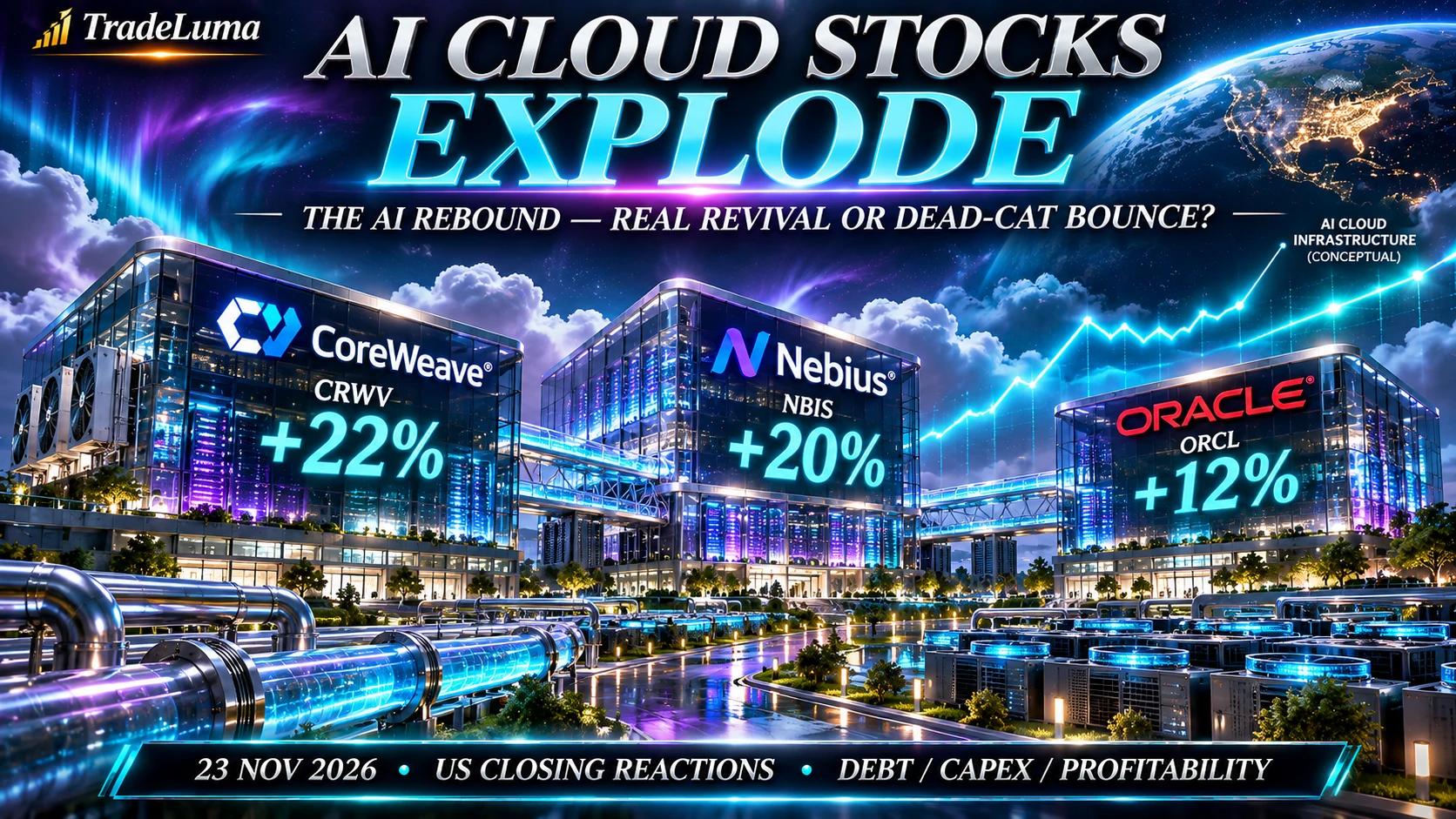
The AI infrastructure trade roared back on Monday, November 23, 2026. CoreWeave (NASDAQ: CRWV) closed up approximately 22%, Nebius (NASDAQ: NBIS) rose around 20% and Oracle (NYSE: ORCL) gained about 12%, according to MarketWatch. The moves followed Nvidia's announcement that Jensen Huang was returning as CEO, which sent NVDA up roughly 31.5% and drove a wider technology rebound. But not every stock moved for the same reason: Oracle also issued a separate statement that it had arranged the financing required to fulfil its data-centre computing commitment to OpenAI, according to AP. Those closing percentages are historical one-day observations, not present market prices. Behind the headlines lies a difficult question: does a stock bounce establish durable AI infrastructure earnings, or simply restore investor confidence in a sector carrying substantial construction and capital-intensity risk?
What happened to CoreWeave, Nebius and Oracle on November 23?
AI-exposed shares rebounded sharply after Nvidia's board reinstated Jensen Huang as chief executive. At the US close on Monday, MarketWatch reported CoreWeave up 22%, Nebius up 20% and Oracle up 12%. Nvidia itself closed approximately 31.5% higher.
This was a high-volatility relief trade after substantial pressure on technology and AI shares. The common denominator was a change in sentiment about the sector's leadership and funding outlook, not a simultaneous new earnings release from all three providers.
The percentages on the TradeLuma hero are dated November 23 closing moves and rounded from contemporaneous coverage. They are not implied annual returns, live quotes or a guarantee of another strong session.
Why Nvidia's CEO return mattered to AI infrastructure stocks
Nvidia provides accelerators and systems central to much of today's large-scale AI computing. A sudden leadership change can shake market expectations about hardware supply, product roadmaps and customer partnerships. Huang's reinstatement helped remove some uncertainty and produced a powerful rally across AI-related names.
Cloud infrastructure buyers and system providers can benefit when investors believe hyperscale projects will continue. However, a rise in Nvidia's share price does not directly add new customers, improve electricity grid access or reduce the cost of capital for every cloud vendor.
A common market catalyst can move the whole sector even when underlying contract economics differ substantially between companies.
CoreWeave (CRWV): a specialist AI compute provider
CoreWeave is a specialised cloud-infrastructure provider focused on GPU-heavy computing workloads. Its investment proposition is tied to the ability to deploy substantial accelerator capacity and rent or provide that capacity to customers seeking training and inference performance.
The opportunities include growing compute demand and long-lived customer relationships. Challenges include acquiring costly hardware, maintaining utilisation, financing expansion and operating facilities reliably at competitive economics.
A 22% daily stock bounce may reflect investors revisiting those expectations, but it does not demonstrate that every new data-centre site is complete or that CoreWeave has achieved an attractive long-term free-cash-flow margin.
Nebius (NBIS): growth potential and deployment risk
Nebius is another participant in the emerging AI-focused cloud category. Its market valuation is sensitive to expectations about the scale and profitability of new AI compute capacity, including access to accelerators, site readiness and customers.
The approximately 20% November 23 gain illustrates how quickly investors can reprice a company perceived as highly exposed to an AI expansion cycle. That sensitivity also works in the opposite direction if capex, revenue ramps or funding conditions disappoint.
Different business lines and contract structures mean that a percentage gain matching CoreWeave's does not establish equal growth, equivalent leverage or identical risk.
Oracle (ORCL): why the funding announcement matters
Oracle provides a broad mix of enterprise software and cloud services. Its infrastructure expansion is relevant to the AI story, but Oracle is not a pure-play neocloud with the same operating mix as CoreWeave or Nebius.
AP reported that Oracle rose about 12.3% after saying it had funding in place to fulfil its computing-power arrangement with OpenAI. This firm-specific disclosure gave investors a second reason to re-evaluate execution and financing concerns, beyond the broader Nvidia-led rally.
Financing availability is not the same as a project's completion or proof of profitability. Investors should still assess interest expense, construction timetables, operating margins and when customer payments are received.
What is a 'neocloud' and how does it differ from a hyperscaler?
Neocloud is a broad industry term often applied to companies that specialise in AI accelerator infrastructure and rent computing power to customers. Hyperscalers such as Amazon, Microsoft and Google offer vast multi-service cloud platforms spanning storage, applications, networking and general-purpose computing.
Specialised providers may bring flexibility or faster access to particular GPU configurations, while hyperscalers can benefit from existing customer distribution and large integrated ecosystems. Firms increasingly cooperate, compete and sell capacity to each other.
These categories are descriptive, not regulated financial classifications. Oracle spans traditional enterprise software and infrastructure; no single label perfectly captures its revenue streams.
Why AI data-centre investment can increase financial risk
AI facilities require expenditure on land, data halls, electricity connections, cooling, racks, accelerators, networking equipment and maintenance. Those costs arrive before all customer revenue is recognised, often requiring debt, equity funding or financing arrangements.
If customers keep growing their workloads and utilisation is high, future operating cash flow could justify the capital outlay. But slower deployment, pricing pressure or technology obsolescence can make projects less profitable than originally expected.
The central distinction is committed capital spending versus cash generated after all construction, operating and financing costs. Revenue alone is not the best measure of financial resilience.
Does a signed AI contract guarantee profit?
A large contract can improve revenue visibility if the customer meets its obligations, but contracts differ by capacity reservation, usage, deployment milestones, cancellation clauses and collateral. The supplier may have substantial obligations to build and maintain the infrastructure.
Paying for the accelerators and electrical infrastructure can precede receipt of customer cash. The company may also rely on refinancing or new investments to complete later phases. Analysts should examine revenue recognition, backlog definitions, customer concentration and debt maturities.
It is therefore misleading to treat every dollar of announced AI compute capacity as immediate operating profit or cash collected.
Three scenarios: real recovery, relief bounce or renewed weakness
Scenario one: Customer demand remains strong, financing is sustainable and sites come online with healthy utilisation. Over time, earnings and cash flow could validate part of the November 23 repricing.
Scenario two: Market sentiment improves faster than operating economics. Shares might retain some gains or become range-bound while investors wait for clearer cash-generation evidence.
Scenario three: Financing costs, project timing or AI end-user demand disappoint. High-capex companies could face another selloff despite previously rising sharply. These are illustrative scenarios, not percentage forecasts.
What to monitor after the November 23 rally
For each company, review official results, operating cash flow, capex, committed debt and financing, construction milestones, expected capacity, utilisation and customer concentration. Separate management's future targets from realised figures.
Compare CoreWeave and Nebius as specialised infrastructure providers, and Oracle as a broader enterprise technology company with specific AI expansion commitments. Watch for new verified contract announcements and interest-rate changes.
A high one-day percentage return is a news event, not evidence that the AI trade is permanently repaired. TradeLuma's hero uses a fictional glowing campus as an editorial visual. Educational analysis only.
Frequently asked questions
How much did CoreWeave stock rise on November 23, 2026?+
MarketWatch reported CRWV closed approximately 22% higher during the Nvidia-led AI relief rally.
How much did Nebius stock rise?+
MarketWatch reported NBIS finished around 20% higher on November 23, 2026.
How much did Oracle stock gain?+
Oracle rose roughly 12%, according to MarketWatch; AP reported a gain of about 12.3% and separate news about its OpenAI financing arrangement.
Why did AI cloud shares rally?+
The broad catalyst was Nvidia's reinstatement of Jensen Huang as CEO; company-specific news and a wider relief rally also contributed.
Did Oracle secure financing for its OpenAI project?+
AP reported Oracle said it had the financing needed to fulfil its computing-power arrangement with OpenAI. That does not prove all facilities are built or profitable.
Is CoreWeave the same kind of business as Oracle?+
No. CoreWeave concentrates on specialised GPU infrastructure, while Oracle combines a much broader enterprise software and cloud portfolio.
What is Nebius?+
Nebius is an AI-focused infrastructure and cloud company whose growth depends in part on deploying and utilising computing capacity.
Why does AI data-centre debt matter?+
Expensive upfront hardware, construction and power contracts can consume cash before facilities generate customer revenue, creating financing and refinancing risks.
Does a 20% stock rise prove the AI bubble is over?+
No. A daily price bounce is not proof of sustained cash flow, profit growth or durable valuations.
Are the figures on TradeLuma's cover live stock prices?+
No. The 22%, 20% and 12% gains are rounded historical November 23, 2026 closing reactions.
Put it into practice
Use the risk maths next to the guide.
Open TradeLuma's free position-size, risk/reward, expectancy, and drawdown tools to test the numbers behind a risk-management decision.
Open free trading calculators →Continue learning
Related guides.

The Fed’s AI Bubble Warning: Wall Street Faces a Double Shock from Rate Hikes and Risky AI Debt
November 18 Fed minutes warned of opaque AI-related debt as officials considered further rate hikes. Learn the risks for Nasdaq stocks, bonds, Bitcoin and gold.
AI’s Pressure-Cooker Week: Nvidia Earnings, Anthropic’s IPO and the Sell-Off Testing Wall Street
Nvidia reports on Nov 17 as Anthropic targets a Nov 19 IPO amid a Nasdaq sell-off. Explore NVDA earnings, ANT valuation, options risk and AI-stock scenarios.
SoftBank's $7 Billion AI Nightmare: Masayoshi Son's $64.6 Billion OpenAI Bet Faces a Reckoning
SoftBank swung to a ¥1.12T ($7.1B) quarterly loss as US data-centre charges hit $3.7B and financing costs jumped. What happens to its $64.6B OpenAI investment and 9984 stock?