
Federal Reserve, AI Markets & Investing
The Fed’s AI Bubble Warning: Wall Street Faces a Double Shock from Rate Hikes and Risky AI Debt
November 18 Fed minutes warned of opaque AI-related debt as officials considered further rate hikes. Learn the risks for Nasdaq stocks, bonds, Bitcoin and gold.
On this page+
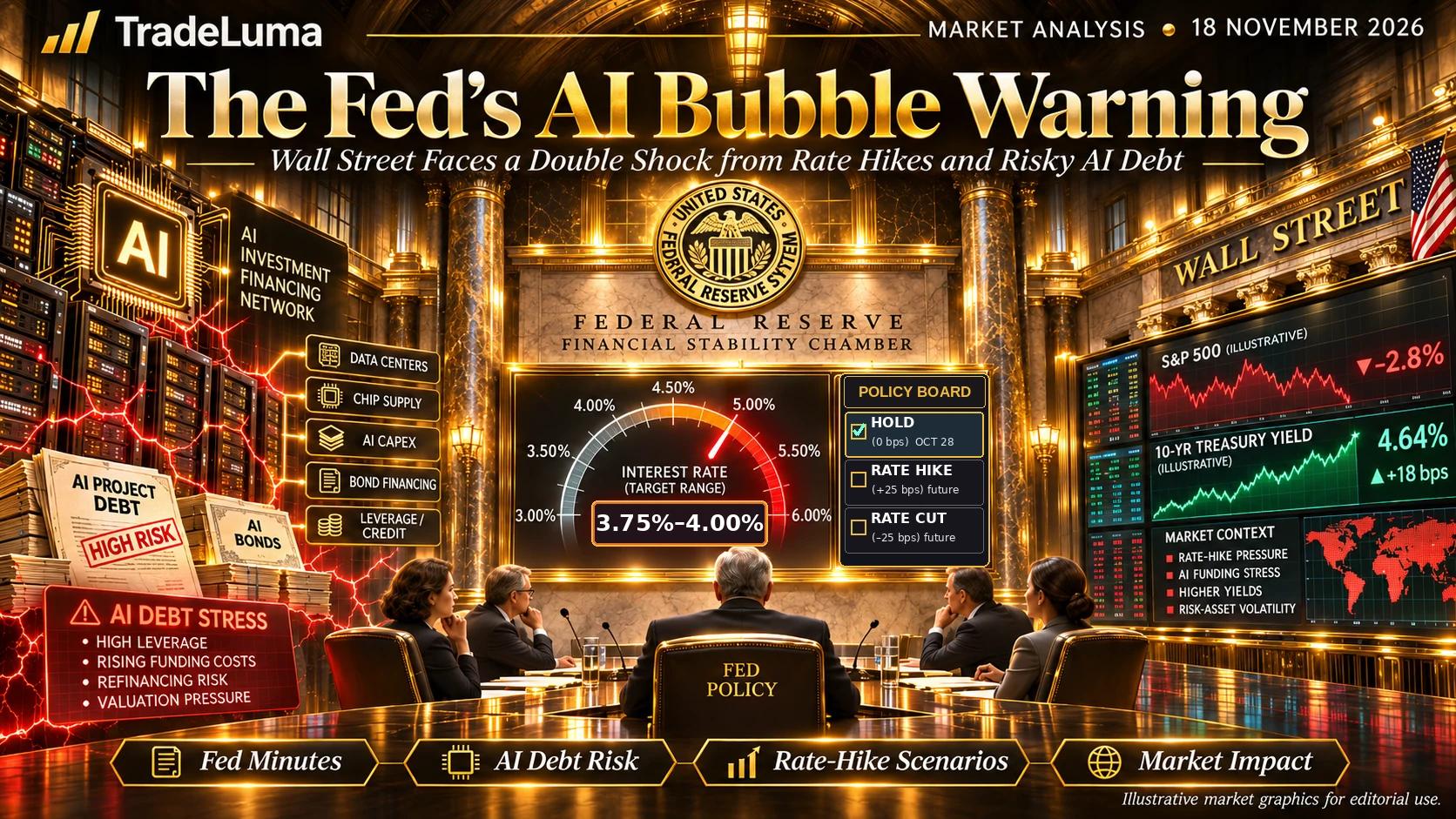
The Federal Reserve delivered two warnings to Wall Street on 18 November 2026—but neither was a new interest-rate decision. Minutes published that afternoon from the Fed’s 27–28 October meeting revealed broad support for additional tightening if inflation remains stubborn, while participants and staff openly discussed risks from the artificial-intelligence investment boom. The concerns included rapidly growing AI-related debt, complex financing structures, off-balance-sheet leasing obligations and a possible repricing of richly valued technology assets if investment returns disappoint. At the October meeting itself, the Fed voted 10–2 to hold its target interest-rate range at 3.75%–4.00%; a subsequent December increase was being discussed, not yet approved. That distinction matters. A tougher interest-rate outlook can pressure the valuations of growth companies, while expensive borrowing can make heavily financed data-centre projects more fragile. Yet the Fed also acknowledged the potential productivity benefits of AI, and its financial-stability discussion was conditional, not a declaration that a bubble has already burst. This guide separates what the minutes actually say from market speculation, explains the financing mechanics, and maps the possible implications for Nasdaq technology shares, bonds, the dollar, gold and Bitcoin.
What happened on November 18—and what did not
At 2:00 p.m. Eastern Time on Wednesday, November 18, the Federal Reserve published minutes of its October 27–28 Federal Open Market Committee meeting. A release of minutes is a record of discussion from a previous meeting, not a live policy vote. The actual decision at that October meeting had already been announced on October 28: the target federal funds range stayed at 3.75%–4.00%. The statement passed 10–2; the two dissenters favoured an immediate 25-basis-point increase.
That chronology is central to interpreting the headline. The Fed's November 18 publication did not raise interest rates, approve a December move, direct investors to sell AI stocks or declare that the economy had entered a recession. It showed that policymakers were weighing the possibility of tighter monetary policy at future meetings at the same time that they were discussing financial vulnerabilities tied to the AI investment cycle.
The rate-hike message: almost all participants expected more tightening
According to the October minutes, almost all participants considered further increases in the federal funds target range likely to be appropriate under their baseline economic outlooks, broadly consistent with the September projections. The rationale was the need to return inflation to the Fed's 2% goal. Officials differed on how quickly to act. Many saw value in gathering more information about how previous tightening was affecting demand, inflation and financial conditions.
A couple of participants noted that a larger-than-usual move could be appropriate at the December meeting if inflation outcomes were disappointing. That discussion is newsworthy because a 50-basis-point increase is twice the conventional 25-basis-point step. But the words 'could be appropriate' are not an announced decision or a committee consensus. The next meeting would still need to assess the information available at that time.
Why the Fed's AI comments are more than an earnings headline
Almost all participants discussed risks associated with a scenario in which the financial returns from AI investment fell short of investor expectations. Many considered what might follow if AI-related equities or other assets underwent a substantial repricing. Most observed that debt linked to AI investment had grown quickly, with a significant portion financed through structures described as complex and opaque. A few also pointed to concentration of exposures among a small number of firms.
The concern is not that the technology has no productive potential. It is that large investments can be valuable in the long run while the prices paid to fund them in the short run become difficult to justify. A data centre may operate successfully for years and still fail to produce the returns implied by the original valuation. The economic risk becomes broader when large owners, suppliers, financiers and customers are linked by the same assumptions about future demand.
What does 'AI bubble' mean—and did the Fed officially call one?
The phrase 'AI bubble warning' is an editorial description of the risk discussion. The minutes did not make a formal declaration that a speculative AI bubble currently exists. Instead, they described a conditional scenario: if expected investment returns disappoint, asset prices can fall, financing can tighten and loss transmission can become more severe. A careful reader should separate that scenario analysis from an official diagnosis.
A bubble generally describes prices that become disconnected from sustainable cash flows or fundamentals, often reinforced by credit, optimistic narratives and momentum. Proving such a condition is difficult in real time, especially for a technology that can change productivity and market size. Rather than pretending to know the ultimate outcome, the more useful analytical questions are whether capital spending is translating into paid demand, whether projects earn their cost of capital, and whether investors can absorb an adverse scenario.
How AI data-centre financing creates a chain of exposures
A modern AI infrastructure project can involve cloud providers, specialised computing operators, chip suppliers, electricity providers, construction contractors, landlords, private lenders, public bondholders and customers purchasing computing capacity. The project may require large cash payments long before revenue becomes reliable. The economics therefore depend on utilisation rates, contract terms, power availability, replacement cycles and the ability to refinance borrowings.
Consider a hypothetical infrastructure company that borrows heavily to finance servers and expects AI customers to rent them at attractive rates. If utilisation falls or a major customer's spending plans change, cash inflows can disappoint even while interest expense remains fixed. Credit covenants, lease obligations and collateral agreements can magnify the pressure. An equity investor in an unrelated technology company may still be affected if broad market risk appetite falls or counterparties retrench.
Off-balance-sheet leases: why headline debt may understate exposure
The minutes specifically cited off-balance-sheet leasing commitments as a possible channel of financial stress. Under modern accounting, many leases are recognised on balance sheets, but the phrase may refer to commitments, structured arrangements or exposures that are not obvious from a single headline measure of funded debt. Investors cannot infer an individual company's true obligations from that term alone.
Imagine a business that avoids buying equipment outright and instead enters multi-year capacity leases. Those agreements can create economically meaningful fixed commitments. If future demand is lower than expected, payments may remain due while the expected revenue falls. A disciplined analysis therefore examines contractual commitments, maturity schedules, purchase obligations, lease liabilities, guarantees, collateral and liquidity rather than focusing only on the borrowings shown in a summary figure.
Circular financing: why cash can travel through a connected ecosystem
Fed staff also referred to circular financing arrangements among AI-related businesses. In a simplified example, an investor funds a compute provider, the compute provider buys chips or cloud services, and suppliers or strategic partners in the same ecosystem support other customers through additional investments or purchasing commitments. Such transactions can be commercially rational, but they can also make the network more dependent on the continued availability of financing.
Sales to a counterparty are not automatically false merely because the parties also invest in one another. The analytical challenge is to separate cash paid by independent end customers from demand indirectly supported by capital moving around an interconnected group. Investors should ask how contracts are priced, whether financing commitments are conditional, how counterparties are related, and what happens if one major source of capital slows.
Why concentration of AI exposure matters
The AI infrastructure supply chain is capital-intensive and can rely on a relatively small group of major cloud buyers, chip vendors, financing firms and large model developers. If one key participant reduces spending, suppliers and service providers can lose anticipated demand, while lenders may revise the collateral value supporting loans. That is one reason a few Fed participants highlighted concentration risk.
Concentration can also bring advantages. Large buyers often have substantial cash flow and technical resources, while standardised infrastructure can benefit from economies of scale. The important issue is the durability and diversity of cash flows, not simply whether a company participates in AI. Scrutinise counterparty concentration, the share of contracts tied to a single customer, and whether equipment retains value if technology improves faster than expected.
AI spending has two opposite inflation channels
In the near term, building large data centres can increase demand for electricity, construction services, specialised chips, cooling systems, network equipment and capital. If supply cannot expand quickly enough, those expenditures can add inflationary pressure. The Fed's minutes discussed AI-related investment as a material contributor to economic demand and a potential source of price pressure.
Over a longer horizon, productive AI deployment could help companies produce more output with the same resources. Higher productivity can ease unit-cost pressures and expand supply, potentially making it easier to contain inflation. The timing matters: investment spending and resource bottlenecks may arrive first, with productivity gains developing later and unevenly. Policymakers must make decisions under uncertainty about both effects.
25 versus 50 basis points: a worked interest-rate example
One basis point is one hundredth of one percentage point. A 25-basis-point increase equals 0.25 percentage points, and a 50-basis-point increase equals 0.50 percentage points. Using the actual October federal funds range of 3.75%–4.00% as a hypothetical starting point, a 25-basis-point increase would produce 4.00%–4.25%, while a 50-basis-point increase would produce 4.25%–4.50%. These outcomes are illustrations only; the December decision had not occurred on November 18.
The financing effect depends on how quickly lenders pass through the rate change, the maturity of outstanding debt, and whether borrowers pay fixed or floating interest. On a hypothetical US$1 billion floating-rate borrowing, a full 0.25-percentage-point annualised increase represents roughly US$2.5 million in additional interest a year, while 0.50 percentage points represent about US$5 million. Actual cash interest may differ because of hedges, spreads, amortisation and changing principal balances.
Why higher discount rates can hurt high-growth technology valuations
The value of a financial asset reflects the future cash flows an investor expects to receive and the discount rate used to convert those flows into present value. If investors require a higher return, the present value of a distant cash payment generally falls. Growth stocks with substantial earnings expected years into the future can be especially sensitive because much of their implied worth relies on long-dated cash flows.
Take a simplified cash flow of US$1 million expected in five years. Discounted at 8% per year, its present value is about US$681,000; at 10%, it is about US$621,000. The approximate 9% decline occurs without changing the forecast cash flow. This example is not a valuation of Nvidia or any other named company. It illustrates why a hawkish change in the rate outlook can weigh on equity multiples even when operational demand remains healthy.
How a tightening cycle can stress debt-funded AI infrastructure
A company financing servers with long-term fixed-rate debt is insulated from an immediate change in the benchmark rate on that borrowing. A firm relying on floating-rate loans or regular refinancing is less insulated. As debt matures, lenders may demand more compensation for risk, lower the amount they are willing to advance or insist on stronger guarantees. Borrowing costs can therefore rise because benchmark yields increase, credit spreads widen, or both.
A simultaneous shock is possible: expectations for AI returns weaken just as the cost of financing climbs. Lower demand reduces expected operating cash flow; higher rates increase interest costs; lower collateral valuations make borrowing harder. The Fed's financial-stability discussion addressed such amplification mechanisms rather than declaring that every data-centre project is distressed.
Nvidia, AMD and the AI chip supply chain: what to assess
Chip companies may benefit from exceptional near-term orders while still facing risk from a slowdown in their customers' capital expenditure. For Nvidia, AMD and other suppliers, relevant indicators include product shipments, recognised revenue, gross margins, order concentration, customer financing conditions and forward guidance. A supplier with robust current earnings can still see a share-price decline if investors previously priced in even faster future growth.
Conversely, a shift toward more selective capital expenditure does not necessarily imply an industry-wide collapse. Some customers may replace costly older systems with more efficient equipment, and some services may generate strong recurring cash flow. Investors should distinguish individual company fundamentals from headline narratives about the entire AI sector. The Fed minutes do not provide earnings forecasts for these companies or tell investors which shares to buy or sell.
Cloud operators, infrastructure specialists and private credit
The riskiest financial exposures may not align neatly with the most famous ticker symbols. A diversified hyperscaler can fund a substantial portion of its buildout from operating cash flow. A smaller infrastructure developer that depends on customer prepayments, specialist loans or private-credit refinancing may have a very different risk profile. Both might use similar AI hardware, but their capacity to withstand weaker demand can diverge sharply.
For public and private financing, compare recurring cash flow, contractual commitments, debt covenants, counterparty quality, equipment resale assumptions and cash interest coverage. A headline financing amount does not show how quickly it must be repaid, whether it has recourse to a parent company, or whether it is adequately supported by the projects' assets. Those details matter when analysing opaque structures.
The Nasdaq and S&P 500: a valuation shock versus an earnings shock
Markets can experience two different types of pressure. A valuation shock occurs when investors demand higher returns, causing price-to-earnings or price-to-sales multiples to decline even before forecasts change. An earnings shock occurs when revenue, margins or future cash flow expectations are revised downward. If both occur together, share-price reactions can be larger than either shock in isolation.
The Nasdaq has considerable exposure to long-duration technology companies, while the S&P 500 spans a wider range of sectors but still contains large AI-related constituents. Rising yields can weigh on expensive growth shares; defensive or cash-generative businesses may hold up relatively better in some scenarios, although broad risk-off episodes can affect nearly everything. Any chart appearing in this article's covers is illustrative, not a measured November 18 index return.
Treasury bonds and the dollar: why the response is not always obvious
A more hawkish policy outlook may push short-dated Treasury yields higher as traders price in additional tightening. Longer maturities can behave differently because they incorporate inflation expectations, long-term growth and the term premium. If investors fear a severe slowdown, demand for safe government bonds might push longer yields lower even while near-term Fed expectations remain firm.
The US dollar can strengthen when expected US interest rates rise relative to other economies, though growth expectations and global risk appetite matter too. Investors should not assume that one set of FOMC minutes must mechanically produce a uniform move in the 2-year yield, 10-year yield, dollar and stock market. Time-stamped prices and changing expectations are needed to assess a specific session.
Gold and Bitcoin: competing forces, not simple one-way trades
Gold often faces a headwind when inflation-adjusted yields rise, since holding bullion does not provide an interest coupon. At the same time, demand for a perceived safe haven can increase during financial instability or geopolitical stress. That creates two potentially conflicting forces: higher real yields can weigh on gold, while fear of broader disruption can support it.
Bitcoin is also difficult to reduce to a single 'Fed rates up, Bitcoin down' formula. Tighter financial conditions and reduced appetite for speculative risk can hurt cryptocurrency prices, but Bitcoin has its own flows, positioning, liquidity and narrative drivers. A debt-driven AI sell-off might spill into crypto through deleveraging, or the relationship could weaken in a different market environment. Neither the Fed minutes nor the illustrative cover prove the direction of these assets.
What a market-implied probability does—and does not—say
Tools based on short-term interest-rate futures, such as CME FedWatch, can estimate how market participants price the likelihood of different policy outcomes. These are snapshots derived from traded contracts and simplifying assumptions, not official Fed forecasts or guaranteed probabilities. They move when new inflation reports, employment figures or speeches change expectations.
Readers should always record the time of a probability snapshot and distinguish a 25-basis-point hike from a 50-basis-point hike, unchanged rates and the starting target range. A figure reported around the November 18 release should not be presented as today's live probability. Because rapidly changing forecasts can render a precise percentage stale, the core takeaway here is the shift in policy risks rather than an unsupported permanent odds figure.
Three scenarios for AI stocks and financial conditions
In a constructive scenario, future inflation eases, policymakers tighten only gradually, and AI spending increasingly produces measurable sales and productivity gains. Equity valuations might remain elevated where earnings justify them, while infrastructure financing stabilises. This outcome would be consistent with the potential benefits of AI that the Fed also recognised; it is not guaranteed by today's investment pace.
In a selective-rotation scenario, funding grows more expensive and investors discriminate between companies with strong cash flows and projects reliant on aggressive refinancing. AI investment continues, but capital shifts toward transparent balance sheets and higher-return projects. In an adverse scenario, stubborn inflation prompts faster tightening just as AI profitability disappoints, producing valuation declines, widening credit spreads and weaker capital spending. The adverse case illustrates the Fed's discussed risks; it should not be confused with a forecast that a crash will occur.
Five indicators worth monitoring after the November minutes
First, watch future inflation releases and how underlying price trends compare with the Fed's 2% objective. Second, monitor Fed communications and rate-futures pricing for changes in the expected timing and size of hikes. Third, track Treasury yields and the spread that risky corporate borrowers must pay above government debt. Fourth, compare AI infrastructure spending forecasts with actual revenue growth, margins and the quality of cash flow.
Fifth, look for evidence that key data-centre and cloud commitments are being funded sustainably: contract renewals, utilisation, refinancing conditions, customer concentration and any changes in off-balance-sheet commitments. A major part of risk management is distinguishing a macroeconomic warning from specific evidence about a company's financial health.
How to read FOMC minutes without confusing them with official decisions
The minutes record debate, alternatives and staff assessments from a previous meeting. Phrases such as 'a few', 'some', 'many', 'most' and 'almost all' are deliberately graded and should not be treated as interchangeable. 'The staff noted' differs from 'the Committee decided', and an individual participant's conditional scenario is not a formal policy promise.
Read the statement to identify what was actually voted on, the minutes to understand the range of views, and later comments to see how individual officials respond to new data. Monetary policy is contingent on information not yet known at the time of a past meeting. This is why November 18 headlines about possible December hikes cannot substitute for the December decision itself.
The bottom line: the danger is a double squeeze, not a declared collapse
The November 18 release revealed that Federal Reserve officials were concerned both about inflation requiring additional rate hikes and about vulnerabilities connected with debt-financed AI investment. The two risks can interact: higher borrowing costs can pressure projects that depend on optimistic revenue and refinancing assumptions, while disappointing AI returns can weaken risk appetite and valuations. The minutes document concern about such a scenario; they do not establish that an AI bubble has already burst.
For investors, the most useful response is analytical discipline. Separate the October hold at 3.75%–4.00% from future rate scenarios; examine the economics of individual AI projects; read credit obligations as carefully as share-price charts; and avoid interpreting illustrative cover data as actual November market returns. This article is general financial education and market analysis, not personalised investment advice.
Frequently asked questions
What did the Fed announce on November 18, 2026?+
The Fed released minutes of its October 27–28 FOMC meeting. It did not make a new interest-rate decision on November 18.
What was the Federal Reserve interest-rate range in November 2026?+
After its October 28 decision, the target federal funds range was 3.75%–4.00%. The October vote was 10–2 to hold it there.
Did the Fed officially say that AI is a bubble?+
No. The October minutes discussed risks if returns on AI investment disappoint and if AI-related asset prices are repriced. The term 'AI bubble warning' is an editorial characterisation of those conditional risks.
What did the FOMC minutes say about AI-related debt?+
Most participants observed that AI-related debt had grown rapidly, often through complex and opaque financing. Staff discussed off-balance-sheet leasing and circular financing structures as possible channels for amplifying losses.
Did the Fed approve a 50-basis-point hike for December 2026?+
No. A couple of participants discussed a larger-than-usual possible increase if inflation remained unfavourable, but a December action had not been decided as of November 18.
How much is a 25-basis-point interest-rate increase?+
It is an increase of 0.25 percentage points. From 3.75%–4.00%, a hypothetical 25-basis-point rise would take the target range to 4.00%–4.25%.
How much is a 50-basis-point increase?+
It is an increase of 0.50 percentage points. From 3.75%–4.00%, a hypothetical 50-basis-point move would take the range to 4.25%–4.50%.
What is circular financing in the AI industry?+
It describes interconnected arrangements in which investors, suppliers and customers may fund or purchase from one another. Such arrangements are not automatically improper, but they can obscure dependence on the same capital flows.
Why do higher Fed rates hurt growth stocks?+
Higher required returns reduce the present value of future cash flows, particularly distant expected profits. Earnings forecasts, investor positioning and other factors still matter.
Could AI data-centre debt cause a financial crisis?+
The minutes outlined potential vulnerabilities, not a forecast of crisis. Risks depend on debt structures, counterparty exposure, refinancing requirements and the wider financial system's buffers.
What does off-balance-sheet AI financing mean?+
It can involve leasing commitments, guarantees or structured obligations whose full economics are not obvious from headline funded debt. Investors should examine disclosures and contractual commitments.
Will a Fed rate hike make Bitcoin crash?+
Not necessarily. Tighter liquidity can pressure speculative assets, but Bitcoin's direction also depends on leverage, capital flows, market positioning and other factors.
How might Fed rate hikes affect gold?+
Higher real interest rates can pressure non-interest-bearing gold, while risk aversion and safe-haven demand can support it. The net effect is uncertain.
What should investors watch after the November 18 FOMC minutes?+
Inflation releases, Fed communications, Treasury yields, credit spreads, AI companies' cash flow and the financing quality of data-centre projects are useful indicators.
Put it into practice
Use the risk maths next to the guide.
Open TradeLuma's free position-size, risk/reward, expectancy, and drawdown tools to test the numbers behind a risk-management decision.
Open free trading calculators →Continue learning
Related guides.
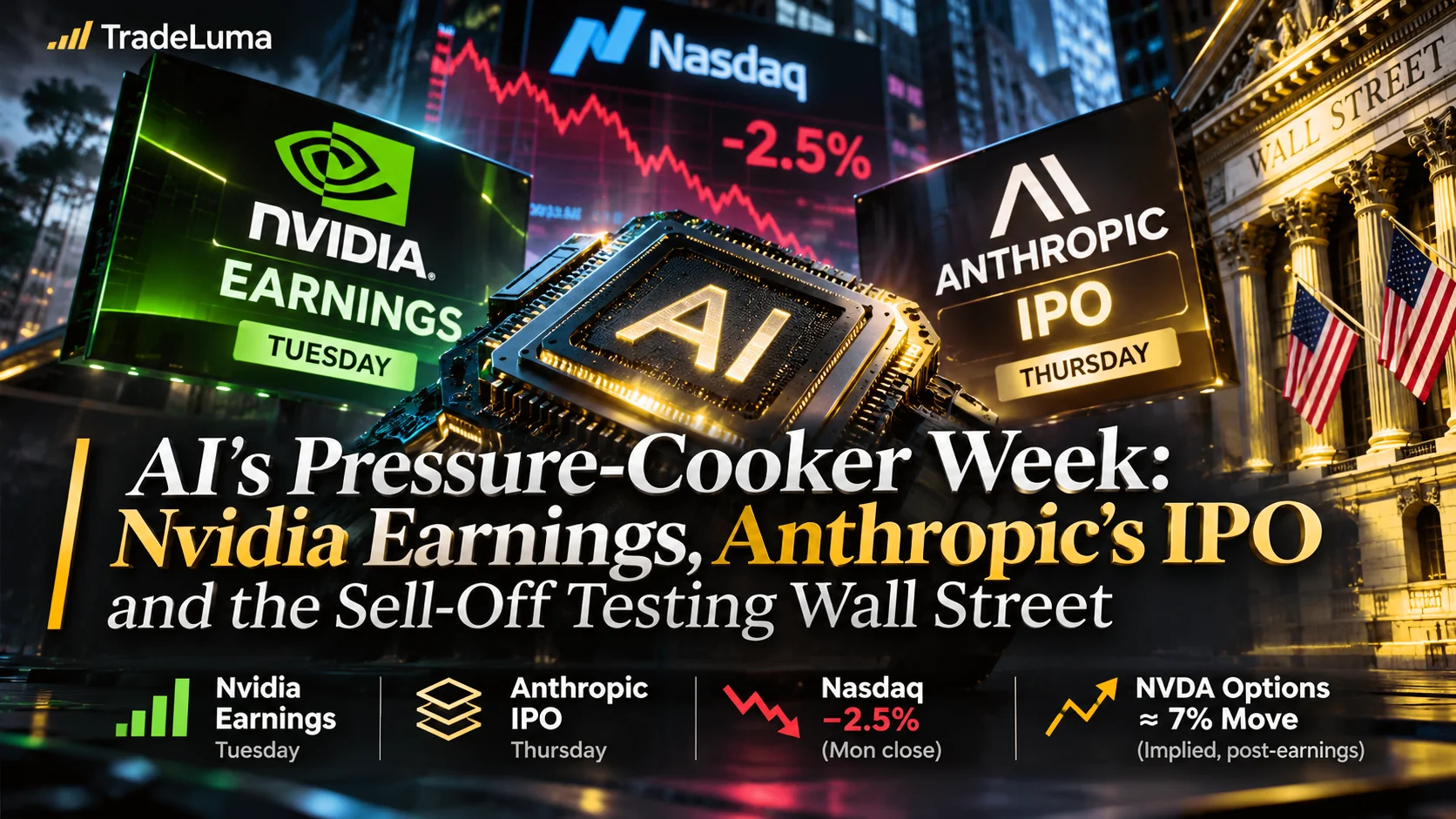
AI’s Pressure-Cooker Week: Nvidia Earnings, Anthropic’s IPO and the Sell-Off Testing Wall Street
Nvidia reports on Nov 17 as Anthropic targets a Nov 19 IPO amid a Nasdaq sell-off. Explore NVDA earnings, ANT valuation, options risk and AI-stock scenarios.
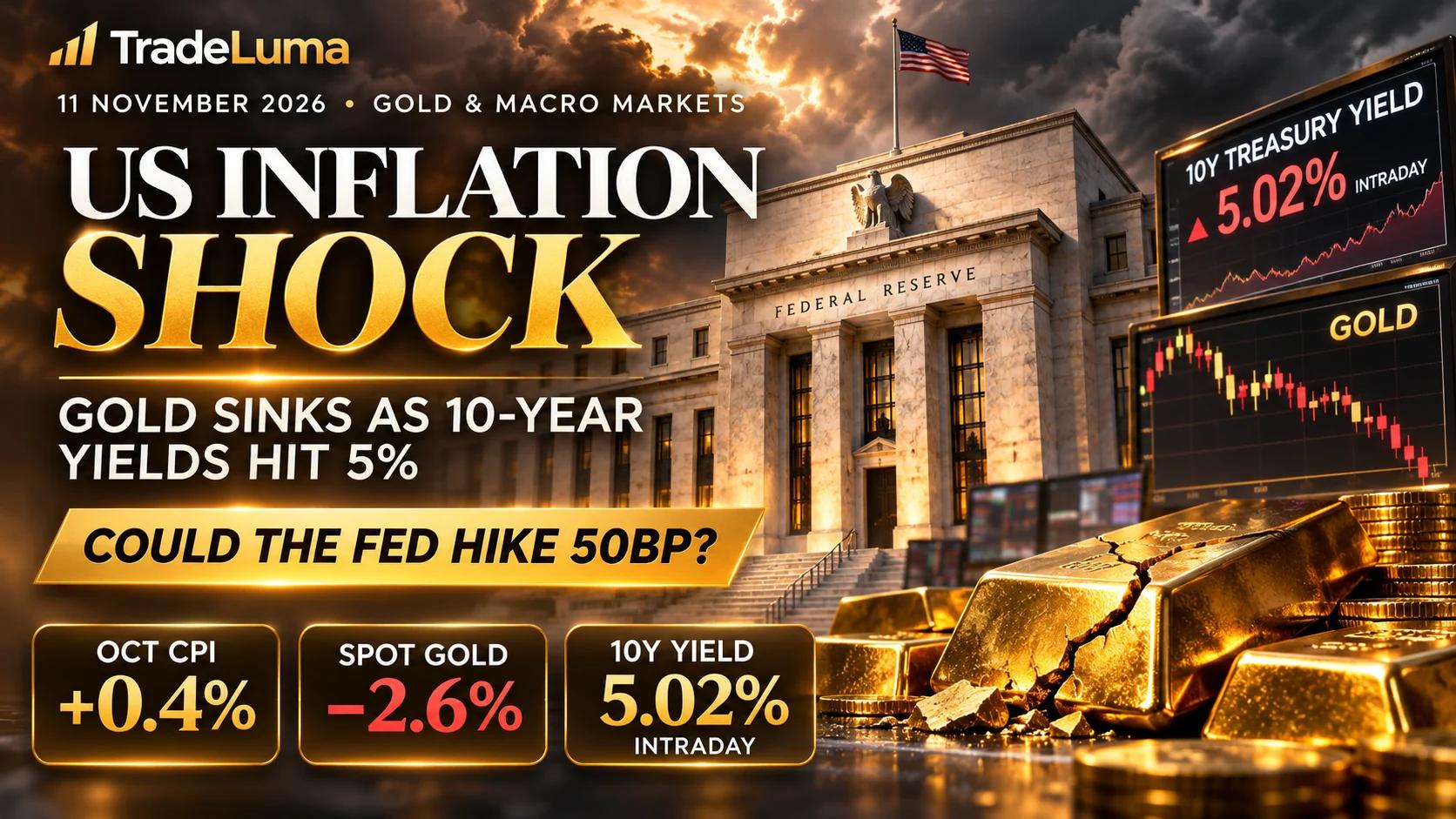
US Inflation Shock: Gold Sinks as Treasury Yields Hit 5% — Will the Fed Hike 50 Basis Points?
October US CPI beat forecasts, gold slid 2.6%, the 10-year yield briefly topped 5%, and the Nasdaq fell. Could a 50bp Fed hike follow?

The Great Everything Sell-Off: Why Gold, Bitcoin and Nasdaq Crashed Together — and What Happens Next
Why did stocks, Bitcoin and gold fall together on November 20, 2026? Understand the Nasdaq plunge, VIX surge, margin calls, liquidity risk and what to watch.