
AI Stocks & Institutional Investing
Wall Street’s AI Civil War: Renaissance Dumps 99.7% of Nvidia While Cathie Wood Buys 85% More
Renaissance cut its reported Nvidia holding 99.7% while Cathie Wood’s ARK raised NVDA 85.4%. Q3 2026 13F filings reveal an AI chip investing divide.
On this page+
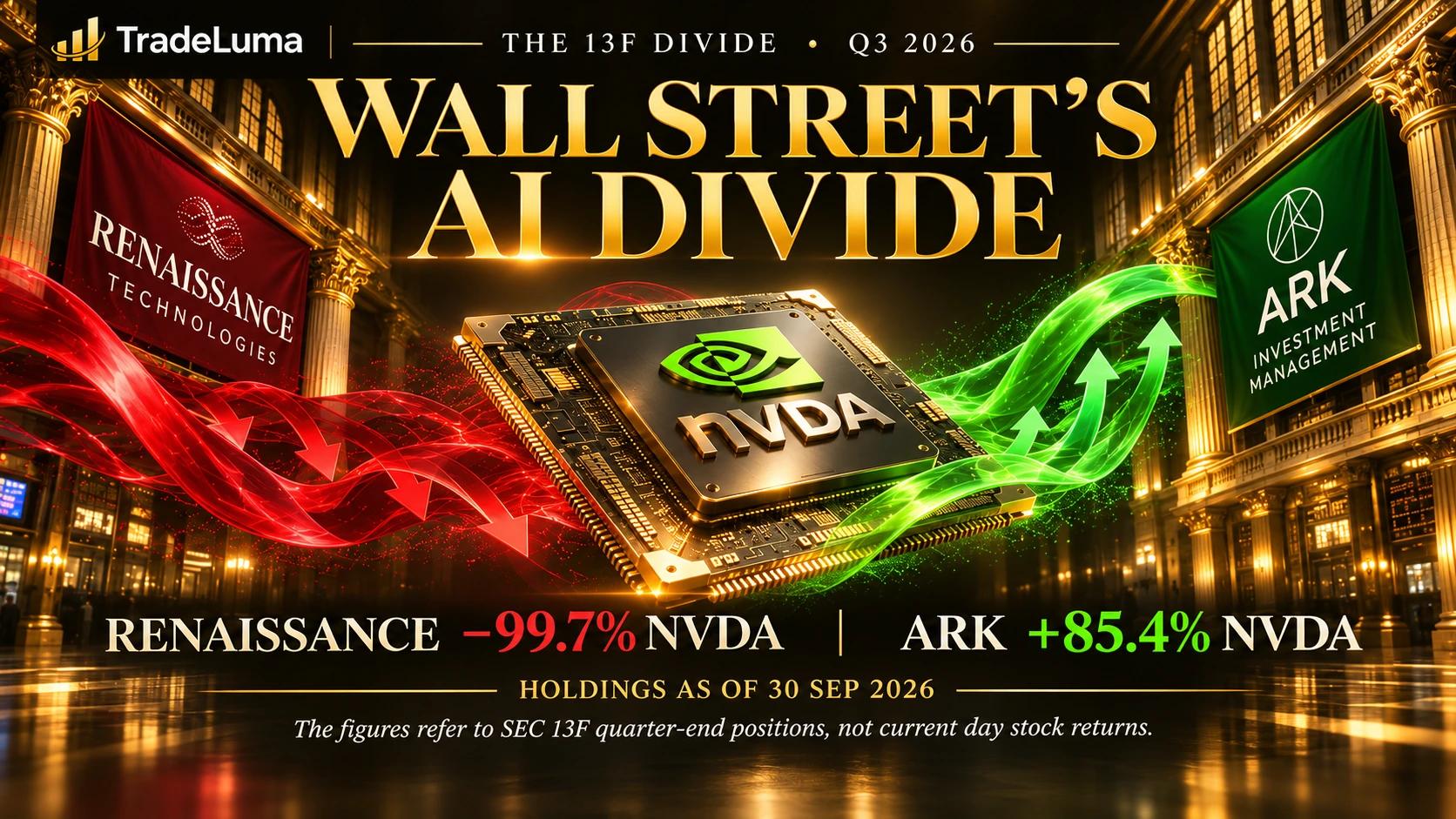
Two of Wall Street’s best-known investment managers reported dramatically different Nvidia positions in their third-quarter 2026 regulatory filings. Renaissance Technologies reduced its reported NVDA share count from 7,091,256 at June 30 to just 23,170 at September 30—a 99.7% decline. Cathie Wood’s ARK Investment Management went the other way: from 1,381,247 to 2,561,223 shares, an 85.4% increase. The apparent clash comes as investors question the price, durability and leadership of the artificial-intelligence trade. Yet the filings reveal a more complicated story than a simple battle between Nvidia believers and bears: Renaissance increased its reported holdings of Micron and AMD, while Soros Fund Management sharply expanded an Intel position. These are delayed snapshots of reportable long holdings, disclosed in November, not verified real-time trades or complete views of each firm’s risk. Here is what the numbers actually say, how to interpret the divergence, and what it might mean for NVDA, MU, AMD and INTC.
Renaissance’s Nvidia reduction: what the 99.7% really measures
A decline of 99.7% sounds almost total, and for Renaissance’s disclosed long Nvidia share count it was. But it is not proof that the fund has turned bearish on the entire AI economy. A Form 13F is a report of covered securities, not a memo explaining a manager’s outlook. It omits ordinary short positions; it also lacks the detailed financing, hedging and intraperiod transactions needed to reconstruct the complete trade.
The chronology matters too. Renaissance had increased its reported Nvidia shares from about 2.53 million at March 31 to 7.09 million at June 30, before reporting the dramatic September reduction. That history shows the position can change substantially between quarters. The new filing establishes the end-state, not whether a given price move triggered the change or whether the manager has already rebuilt exposure since September.
Why Renaissance’s Micron and AMD increases change the story
The most revealing counterweight to the Nvidia reduction is Renaissance’s other semiconductor holdings. Its reported Micron Technology position climbed from 211,580 shares to 1,520,639 shares, an increase of 618.7%. The September line was valued at roughly US$1.62 billion. That made Micron one of the largest reported common-stock positions in Renaissance’s filing.
The same filing showed 1,995,101 AMD shares, up from 829,697 in the prior quarter—an increase of about 140.5%—with a reported quarter-end value around US$1.21 billion. Renaissance also had a significant Intel position, although its reported Intel share count was modestly lower than in Q2. Taken together, these holdings undercut the idea that the manager simply abandoned the semiconductor industry. The observed shift could reflect valuation, risk balancing, factor exposures, company-specific fundamentals or short-term signals, but the filing does not identify which.
Soros and Intel: a third, surprising semiconductor wager
Soros Fund Management added another wrinkle. The family office reported 2,830,000 Intel shares at September 30, up from 100,000 at June 30. The Q3 position was valued at approximately US$340.25 million. That is a 2,730% increase in the reported quantity, calculated from a small starting base, and represents a large dollar exposure in the disclosed 13F long portfolio.
Intel’s business model, product exposure and manufacturing challenges are different from Nvidia’s. An Intel position is not a straightforward substitute for Nvidia AI accelerators. It can express expectations about CPUs, data-centre demand, manufacturing, restructuring or valuation. The filing does not choose between those explanations. Interestingly, Renaissance itself reported about 6.94 million Intel shares, down around 5.2% from the prior quarter. Even two managers holding the same semiconductor can be changing their quantities in opposite directions.
The 13F blind spot: what the filings cannot tell you
US Form 13F applies to qualifying institutional investment managers with at least US$100 million in certain Section 13(f) securities under the SEC framework. The disclosure is a quarter-end information table, and managers generally file within 45 days. The SEC deadline for the quarter ended September 30, 2026 was November 16. That creates an unavoidable time gap between the reported holdings and the moment readers discover them.
Form 13F does not report ordinary short sales. It does not provide a complete record of foreign securities traded outside the covered universe, cash, most private investments or every derivatives hedge. Some listed options are reportable, but their reported share equivalents do not reveal full strategy economics, expiry or all offsetting legs. Confidential-treatment requests and reporting-manager differences can create other complications. A 13F is useful evidence about covered long holdings at a stated date; it is not a live portfolio feed.
A quantitative manager and a thematic manager can disagree without either being irrational
A quantitative process may optimise thousands of exposures simultaneously. If other names offer better modelled return-to-risk characteristics, a position may be cut even if the underlying company remains strong. A thematic approach may focus on a multi-year adoption curve and accept more short-term volatility in exchange for exposure to a secular narrative. A 13F does not disclose the precise strategy of a fund, but these general differences explain why two sophisticated investors can report divergent holdings.
The investment horizons also matter. ARK’s public-facing themes and Renaissance’s historical quantitative reputation do not establish the exact mandate or time horizon of the specific reported portfolio. Different capital bases, leverage, risk controls, liquidity needs and benchmark constraints produce different portfolio decisions. Treating one disclosed move as a verdict on the wisdom of another is an oversimplification.
Micron versus Nvidia: why the AI supply chain is not one trade
Nvidia’s positioning centres on accelerated computing platforms and software ecosystems. Micron is exposed to memory products, including technologies relevant to high-bandwidth data movement. AMD competes in several compute segments, and Intel has a different combination of CPU, platform and manufacturing exposure. Demand growth across AI infrastructure can affect these businesses differently, particularly through pricing, capacity constraints, customer concentration and capital expenditure.
This is why relative opportunity may matter more than an all-or-nothing AI thesis. A portfolio can reduce one stock while adding another because expected returns, valuations or risks have shifted. It can also seek to diversify exposure away from a single dominant company. The Q3 Renaissance filing makes such a semiconductor rotation worth investigating, but it does not prove that it was the manager’s explicit investment thesis.
Does the Renaissance move predict trouble for NVDA?
Not necessarily. A large reduction is a genuine historical fact about the reported position, but the causal chain from one manager’s quarter-end holdings to Nvidia’s future performance is not established. The size and speed of a position change may reflect a model signal, a risk limit, trading liquidity or an unrelated portfolio decision. Reconstructing an actual trading rationale would require information the filing does not supply.
Likewise, ARK’s increase does not establish that Nvidia is undervalued or that another investor should buy. Both firms can change their positions after September 30. Nvidia’s actual results, margins, product execution, management credibility, export restrictions, customer spending and valuation expectations will matter independently of any third-party holding disclosed weeks later.
How the filings interact with Nvidia’s November earnings catalyst
The filing season overlaps with a major company-specific event. Nvidia’s next earnings announcement is scheduled for November 17 in the United States. The 13F numbers date back to September 30, before that result, and are not evidence that either manager had knowledge of the forthcoming outcome. Investors watching the reaction should keep these separate timelines in view.
The most informative post-results questions concern business execution: whether demand translates into recognised revenue, whether gross margin remains resilient, how credible management’s forward guidance appears and whether a shift in expected growth changes the stock’s valuation. Options-driven volatility around earnings may amplify near-term trading. None of these uncertainties can be resolved from a Q3 13F alone.
Three scenarios for the next phase of the AI semiconductor trade
In a broad-confidence scenario, strong demand and credible earnings guidance support the entire infrastructure complex. Nvidia, Micron, AMD and selected related names could benefit, but different starting valuations still matter. A second scenario is selective rotation: AI infrastructure spending remains large, while investors prefer one part of the supply chain over another because margins, capacity or pricing differ. That is a possible interpretation of the filings, not a confirmed forecast.
The third scenario is risk reduction across the sector. If spending expectations weaken, financing costs rise, export-policy constraints bite or earnings disappoint, multiple semiconductor stocks could come under pressure simultaneously. A portfolio concentrated in alternative AI suppliers would not automatically be protected. The practical point is to test company fundamentals and position risk under several outcomes rather than extrapolating from a single institution’s historic allocation.
What investors should watch in NVDA, MU, AMD and INTC
For Nvidia, watch reported results against expectations, forward guidance, margins, customer demand and changes in governance or export rules. For Micron, watch memory demand, supply conditions, pricing and the economics of high-bandwidth memory. For AMD, monitor product adoption, competitive positioning and margins. For Intel, pay particular attention to financing, manufacturing execution and the sustainability of its data-centre business. Each stock has different operational and financial risks.
A second layer is market context. Compare share-price changes with sector-index moves and earnings revisions rather than attributing every tick to 13F disclosures. Look at whether the relevant filings are amended and whether later company commentary materially changes the premise. Share-count moves from September should be one input among many, never a substitute for fresh information.
How to read a sensational 13F headline without being misled
Start with five questions. Which manager filed? Which quarter-end does the filing describe? Are the percentages calculated using shares, values or portfolio weights? Is the line an ordinary shareholding or an option? And what other positions changed at the same time? In this case, the most important fact beyond the two NVDA percentages is Renaissance’s substantial reported Micron and AMD exposure.
Then ask what is missing. The filing cannot reveal the full portfolio’s hedges or the timing of transactions inside the quarter. It cannot tell you whether the manager has since reversed course. The percentage alone is useful for catching attention, but the context is what makes it actionable as research rather than market gossip.
The bottom line: a split in reported positioning, not a verdict on AI
The Q3 2026 filings do show a remarkable divergence. Renaissance’s reported Nvidia holding fell to 23,170 shares; ARK’s rose to 2,561,223. At the same time, Renaissance increased Micron and AMD exposure, and Soros expanded a substantial Intel stake. That is a much richer account than 'smart money is abandoning AI' or 'smart money is all-in on Nvidia.'
Investors should treat the filings as dated evidence about institutional positioning and a prompt to investigate the semiconductor supply chain. They should not treat them as live trade recommendations, complete risk exposures or proof of what happens next. This article is general financial information, not personal investment advice.
Frequently asked questions
Did Renaissance Technologies sell 99.7% of its Nvidia stock?+
Its reported long NVDA share count fell by about 99.7% between June 30 and September 30, 2026—from 7,091,256 to 23,170 shares. The 13F does not disclose exact trade dates or the manager’s complete hedges.
How many Nvidia shares did Cathie Wood’s ARK report for Q3 2026?+
ARK Investment Management reported 2,561,223 NVDA shares at September 30, up 1,179,976 shares or 85.4% from the prior-quarter filing.
What was ARK’s Nvidia position worth at September 30, 2026?+
Its reported NVDA line was valued at approximately US$584.93 million at the September 30, 2026 reporting date. That is not its present-day value.
Did Renaissance abandon all AI semiconductor stocks?+
No. Its filing showed Micron shares up 618.7% and AMD shares up 140.5% at quarter-end, among other semiconductor positions.
How much Intel did Soros Fund Management hold?+
Soros Fund Management reported 2,830,000 Intel shares valued at about US$340.25 million as of September 30, compared with 100,000 shares as of June 30.
What is a Form 13F?+
It is a US SEC quarterly report of certain securities holdings by qualifying institutional investment managers. It is filed after the quarter ends and is not a live or complete portfolio statement.
Do 13F reports disclose hedge fund short positions?+
Ordinary short positions are not included on Form 13F. Reportable option positions can appear, but they still do not reveal every hedge or overall directional exposure.
Do 13F position changes prove a manager bought or sold on the filing date?+
No. A Q3 filing describes covered holdings as of September 30, 2026. Publication in November does not mean the transactions occurred then.
Does the 99.7% figure describe an Nvidia price crash?+
No. It describes a change in Renaissance’s reported share count, not Nvidia’s share-price change or the investor’s return.
Should investors copy the 13F trades?+
Copying delayed, partial disclosures is risky. They omit trade timing, many hedges, cash and the portfolio constraints of the reporting manager. Evaluate current fundamentals and personal risk instead.
Keep learning
Continue through the TradeLuma research library.
Browse practical guides across trading, automation, execution, futures, technical analysis, and risk management.
Browse all guides →Continue learning
Related guides.

AI’s Pressure-Cooker Week: Nvidia Earnings, Anthropic’s IPO and the Sell-Off Testing Wall Street
Nvidia reports on Nov 17 as Anthropic targets a Nov 19 IPO amid a Nasdaq sell-off. Explore NVDA earnings, ANT valuation, options risk and AI-stock scenarios.

Black Friday’s $1 Trillion Test: Can American Consumers Save Wall Street After the AI Crash?
Black Friday 2026 arrives after a Wall Street sell-off. Explore NRF's $1.013T holiday sales forecast, Adobe's $12.9B online projection, inflation and retail stocks.
Nvidia Without Jensen Huang: The $108 Billion Earnings Test That Could Shake Wall Street
Historical November 17 Nvidia earnings preview, updated November 24 after Jensen Huang's reinstatement. $108B was guidance, not actual earnings.