
Strategy Research
One Trading Strategy Is Not Enough? Building a Multi-Strategy Portfolio
Learn how complementary trading strategies, correlation, risk budgets, market regimes and portfolio monitoring can affect aggregate exposure.
On this page+

Learn how complementary trading strategies, correlation, risk budgets, market regimes and portfolio monitoring can affect aggregate exposure. This TradeLuma educational guide is general information, not personal financial advice. TradeLuma has a commercial interest in its own strategy products and platform. Futures involve leverage and losses can exceed initial margin. Illustrations are conceptual, not performance evidence.
Why consider more than one strategy?
Different rules may respond differently to market conditions. Combining them can reduce dependence on a single setup, but only when their exposures and losses are sufficiently complementary. One well-understood strategy can be preferable to several poorly understood ones.
Diversify behaviour as well as instruments
Trend, breakout and mean-reversion rules have different intended behaviours. Gold and silver can share metal exposure; Nasdaq and S&P 500 can share equity risk. Market labels alone do not establish independence.
Measure correlation on comparable data
Align strategy returns by time and include costs and periods with no trades. Inspect rolling correlations and joint drawdowns. Historical correlation is unstable and can rise during market stress.
Set a portfolio risk budget
Evaluate contract multipliers, margin and aggregate notional and directional exposure. As an illustrative stress case, three simultaneous $500 losses total $1,500 before additional slippage. Individual strategy limits do not automatically constrain the combined portfolio.
Handle simultaneous signals and conflicts
A long and short signal on the same instrument may offset or conflict depending on account and broker rules. Define how exposure is calculated and reconcile actual positions before acting on new instructions.
Review evidence and operational load
Adding strategies increases monitoring and maintenance needs. Use out-of-sample testing and forward observations, measure joint drawdown, and review whether each strategy adds distinct behaviour net of costs.
Explore the TradeLuma catalogue
TradeLuma's published Gold, Nasdaq, Silver and Platinum collections provide examples to research, not a recommended allocation. Oil and S&P 500 in the cover are illustrative market categories, not claims of available products. Diversification may reduce some risks but does not guarantee smoother returns or lower drawdown.
Frequently asked questions
How many strategies should I use?+
There is no universal optimal number.
Does diversification eliminate losses?+
No. Correlated losses and leverage can magnify drawdowns.
Are gold and silver independent?+
No; they can share drivers and correlation can change.
Can long and short strategies conflict?+
Yes. Account netting and order rules need careful review.
How do I compare strategies?+
Use aligned net returns, joint drawdowns and exposure under stress.
Are the pictured markets recommendations?+
No. They are educational examples.
Put it into practice
Use the risk maths next to the guide.
Open TradeLuma's free position-size, risk/reward, expectancy, and drawdown tools to test the numbers behind a risk-management decision.
Open free trading calculators →Continue learning
Related guides.

How to Build a Futures Strategy Portfolio With a $10,000 Account
A hypothetical US$10,000 futures account framework for risk budgets, micro contract sizing, correlated exposure, margin buffers and strategy testing.
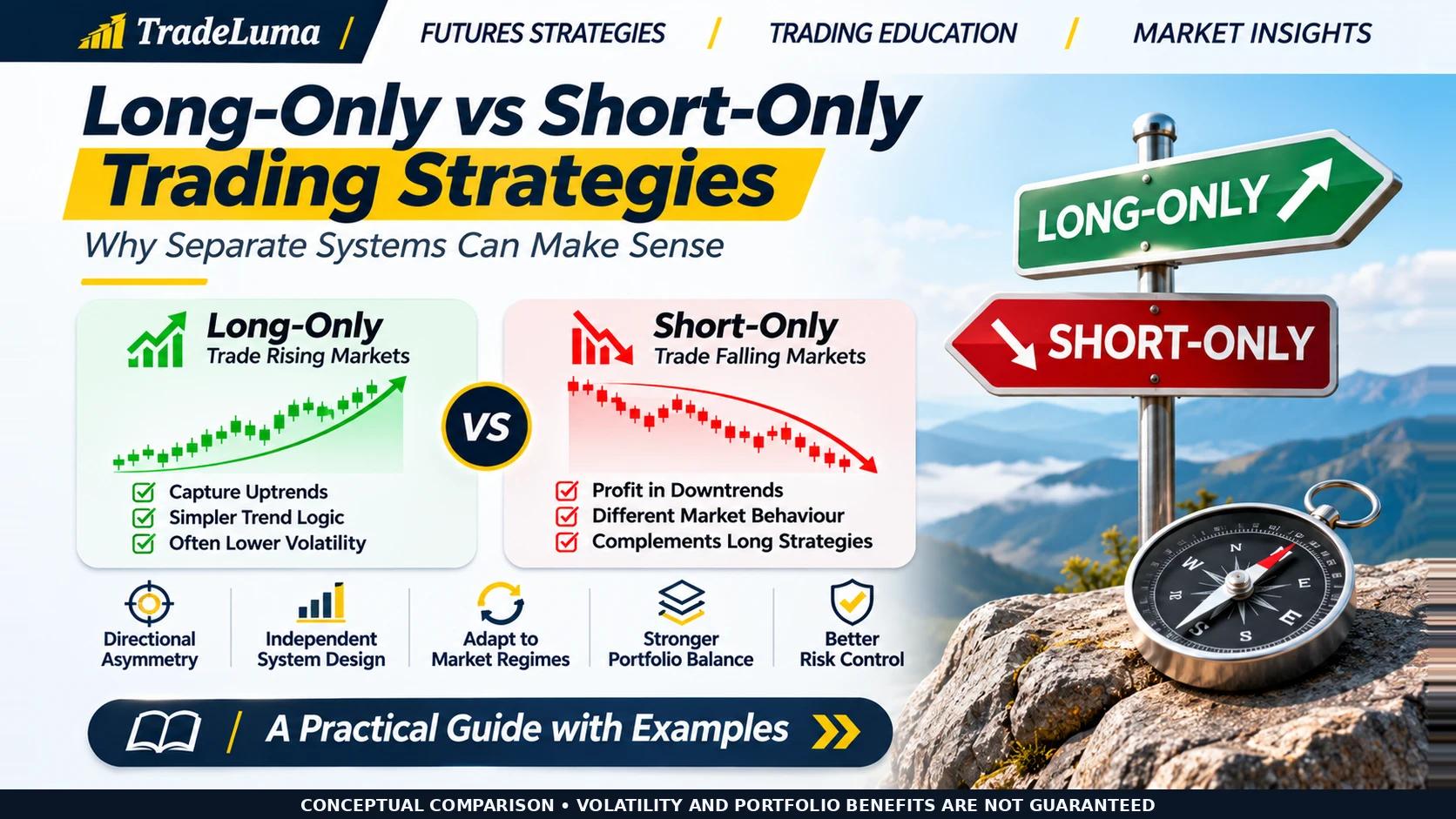
Long-Only vs Short-Only Trading Strategies: Why Separate Systems Can Make Sense
Compare directional trading systems, asymmetric market behaviour, combined exposure and separate long/short strategy research for futures traders.

Gold vs Silver vs Platinum Futures: Which Is More Volatile?
Compare percentage volatility, ATR, dollar exposure and market drivers without assuming fixed metals volatility rankings.