
Options Trading & Market Education
0DTE Options Explained: Why Same-Day SPX, SPY and XSP Options Are Booming—and the Risks
Learn 0DTE options with examples, gamma and theta, SPX vs SPY vs XSP, the new SPXO contracts, and practical risk controls for same-day trading.
On this page+
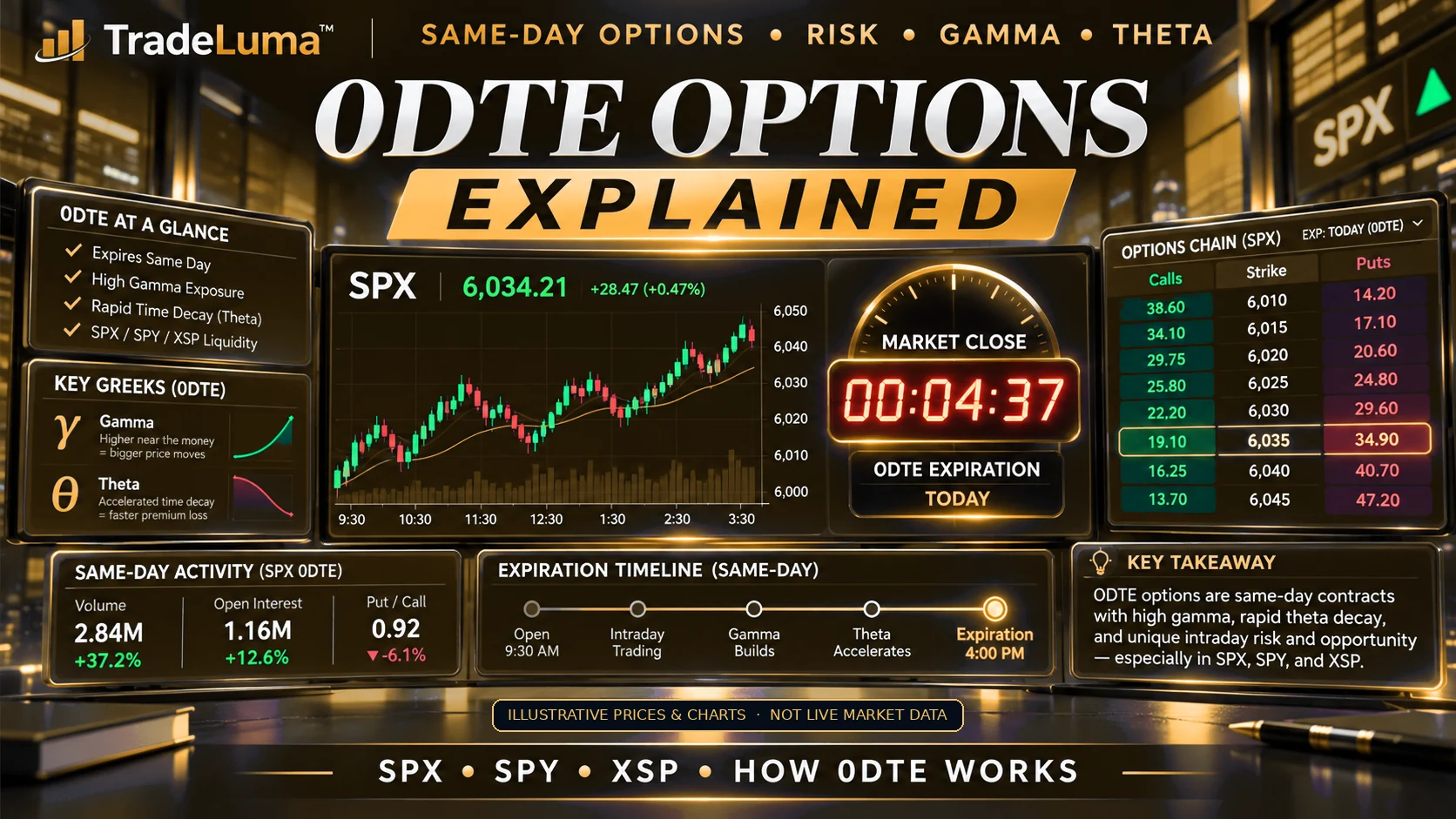
Zero-days-to-expiration options, known as 0DTE, are no longer a niche corner of the US derivatives market. According to Cboe's third-quarter 2026 industry review, options expiring on the trading day averaged a record 24.2 million contracts per day across the US market, roughly 36% of total options activity. In October, SPX zero-day options alone set a record average of 3.58 million contracts a day. These instruments attract traders because a small premium can gain or lose value rapidly as the underlying index moves. That same sensitivity makes them unforgiving: time value can disappear, bid-ask spreads can consume an apparent opportunity, and settlement rules vary sharply between index options and ETF options. A newly launched product, SPXO, adds another important distinction because it settles in the morning rather than at the usual end-of-day index close. This guide explains what 0DTE means, how the Greeks work, exactly what a contract can cost, why SPX, SPY and XSP are different, and the risk controls worth understanding before placing any order.
What does 0DTE actually mean?
0DTE stands for zero days to expiration. The contract's expiration date is the current date, and in a familiar PM-settled 0DTE contract its remaining market life is measured in hours or minutes. An option normally provides a right, but not an obligation for its buyer, to transact or receive a cash settlement based on a specified strike and underlying reference. Calls benefit from sufficiently higher settlement prices; puts benefit from sufficiently lower prices. The seller has the corresponding obligation under the contract's rules.
A contract can become 0DTE even if it was listed a month earlier or bought the previous week. This is not a separate magic species of option; it is an existing contract near its final settlement. The label also needs product context: an AM-settled option can expire at the opening calculation rather than the afternoon close. Always read the precise series description, settlement methodology and last trading time instead of assuming that every line marked 'today' works identically.
Why 0DTE options are attracting so much attention in 2026
Cboe's published Q3 2026 figures show market-wide 0DTE volume averaging 24.2 million contracts a day, approximately 36% of overall US options volume. The figure covers multiple categories, not merely S&P 500 index options. Within it, 0DTE index options accounted for about 3.4 million contracts per day, and ETF plus single-stock same-day options contributed nearly 20.8 million contracts. Those are separate product pools with different exercise and delivery mechanics.
For October 2026 specifically, Cboe reported an SPX 0DTE average daily volume of 3.58 million contracts, while all SPX options averaged about 5.5 million contracts per day. That is a product-specific October record, not the same denominator as the Q3 US-wide 24.2 million figure. The expansion reflects greater availability of frequent expirations and multiple uses—short-term hedging, directional positioning, spread trading and volatility exposure. Trading volume demonstrates activity, not profitability for an average participant.
How an options chain works on expiration day
An options chain lists strikes, puts, calls, bids, asks, quantities and expiry dates. The strike is the reference level used for exercise or cash settlement. A call's intrinsic value at settlement is the positive excess of the settlement value over strike, if any; a put's intrinsic value is the positive excess of strike over settlement value, if any. A contract that finishes out of the money typically has no intrinsic payout.
Quotes on an options screen are generally expressed in premium points or dollars per share and must be multiplied by the contract multiplier to find cash exposure. For standard SPX, XSP and most US listed equity options, the multiplier is US$100. A displayed 6.00-point premium means US$600 per contract, before commissions and fees. Check strike, side, expiry, settlement type and quantity each time: the wrong contract can turn a cautious educational exercise into unexpectedly large exposure.
Calls and puts: direction is only one part of the equation
A call buyer wants the settlement reference to finish sufficiently above the strike, while a put buyer wants it sufficiently below. For a hypothetical SPX put with a 6,000 strike bought for 5.00 points, the cash cost is US$500. Its break-even at expiration is 5,995. If the settlement value ends at 5,992, the intrinsic value is 8 points, or US$800, and the net payoff after premium is US$300 before charges.
Merely forecasting an up day or down day is not enough. A trader must forecast a move large enough and fast enough to overcome the premium and trading costs. At-the-money options may retain substantial time value in the morning that approaches zero rapidly later in the session. Far-out-of-the-money options can appear cheap but still expire worthless even after the underlying moves in the predicted direction. A low premium per contract should not be confused with a high probability of profit.
Gamma explained: why option sensitivity changes so rapidly
Delta is a model estimate of how an option's price responds to a small change in the underlying, all else equal. Gamma measures how quickly that delta itself changes when the underlying moves. For an at-the-money option with only minutes remaining, a shift from just below to just above strike can change its chance of finishing with intrinsic value dramatically. As a result, the option may move from low delta to high delta in a relatively small market move.
Gamma generally becomes most concentrated around at-the-money strikes as expiration approaches. A position that seemed to have modest directional sensitivity a few minutes earlier can acquire much larger exposure after a sharp price move. This is not a free source of profits: the same sensitivity can work against the position on a reversal, and market spreads or liquidity can worsen when prices change quickly. A gamma estimate is local and conditional, not a guarantee of a particular premium change.
Theta explained: the clock is part of every 0DTE trade
Theta is a model estimate of the option price's sensitivity to time passing, holding other inputs constant. For buyers, losing extrinsic value is usually a headwind; for sellers, it can be a source of premium decay, paired with significant market risk. The decay is not a guaranteed constant amount per hour. It depends on moneyness, implied volatility, interest rates, model assumptions and the amount of time left.
Consider an out-of-the-money call held into the last minutes of its life while the index barely moves. If the contract never gains intrinsic value, the remaining premium can collapse toward zero. Conversely, if the index quickly crosses the strike, gamma can overwhelm the immediate passage-of-time effect. Both forces are intertwined. A trader should not sell premium simply because theta is 'high' without also considering how a fast move, sharp gap or settlement surprise could overwhelm that credit.
Delta, gamma, theta and vega: the four Greeks beginners should know
Delta approximates directional sensitivity; gamma approximates how that directional sensitivity changes; theta approximates time decay; and vega approximates sensitivity to changes in implied volatility. On the final trading day, gamma and theta can dominate the practical experience of an at-the-money option. Vega tends to be more pronounced in longer-dated contracts, although changes in volatility expectations still affect short-dated premiums.
These numbers are outputs of pricing models and are valid only for a stated market snapshot and assumptions. They can change sharply with price, time and implied volatility. Greeks are not orders, stops or profit forecasts. They are diagnostics that help explain why a position reacts differently from a simple one-for-one bet on the underlying. Positions involving multiple legs have combined exposures that depend on the strikes and quantities selected.
SPX vs SPY vs XSP: not interchangeable contracts
SPX options are based on the S&P 500 index, use a US$100 multiplier and are cash-settled with European-style exercise. Many frequently expiring SPX series, commonly displayed as SPXW, settle in the afternoon of their expiry day. XSP is linked to a mini index at approximately one-tenth of the SPX level, also uses a US$100 multiplier, and also provides European-style cash settlement. This makes one XSP contract approximately one-tenth of the notional exposure of one SPX contract at the same relative market level.
SPY is an exchange-traded fund, not the index itself. Standard SPY options have a US$100 multiplier representing 100 ETF shares, American-style exercise and physical delivery. A long in-the-money SPY call can therefore produce ownership of shares at exercise, while a short position can result in share-delivery obligations. Broker exercise thresholds, cutoffs and account permissions matter. SPX and XSP cash settlement avoids delivery of ETF shares, but it does not remove option trading losses, leverage or settlement risk.
Why the option multiplier matters more than the sticker price
A 4.00-point SPX option premium is US$400 per contract at a US$100 multiplier. If the trader buys three contracts, the premium outlay is US$1,200 before fees. XSP also uses a US$100 multiplier, but its index is near one-tenth of SPX. Its strike and premium points will therefore reflect a much smaller absolute index reference. Contract counts cannot be compared without considering both strike levels and cash exposure.
SPY premiums quote per ETF share, so a US$2.50 SPY option is generally US$250 for one standard 100-share contract. However, an in-the-money SPY option can involve the funds or margin needed for a 100-share position, depending on exercise, assignment and broker handling. Check the full order preview and scenario payoff rather than assuming a small displayed premium means a small possible obligation for every strategy.
What is SPXO? The November 2026 AM-settlement development
On November 9, 2026, Cboe introduced a new SPXO symbol for AM-settled S&P 500 index weekly options. The initial listed expirations are Wednesday, November 18 and Wednesday, December 16, 2026, aligned with standard monthly VIX settlement dates. Like other European-style SPX index options, SPXO is cash-settled, with a US$100 contract multiplier. The settlement value is based on the special S&P 500 opening calculation rather than the ordinary afternoon closing index value.
The key detail as of November 17 is the last trading day: an expiring SPXO series currently stops trading at 5:00 p.m. Eastern on the business day before its morning expiration. It does not resume in the overnight Global Trading Hours session for that series. Therefore SPXO expiring on November 18 is not an ordinary intraday 0DTE contract that a trader can keep trading through the next afternoon. Cboe has discussed future changes to the AM settlement trading timetable, but those prospective rules should not be mistaken for the launch schedule.
AM settlement versus PM settlement: an overnight gap example
Imagine an AM-settled index option that last trades Tuesday afternoon but settles from the next morning's opening calculation. After the final opportunity to trade that expiring contract, futures, global markets or company news may shift expectations overnight. The final settlement can be different from the last observable index close. This is gap and settlement-method risk, not a software error.
A PM-settled SPXW option typically references the expiry-day closing calculation and generally stops trading on that day. SPXO's AM framework changes the timeline: the last trading opportunity comes before the expiration morning. Investors therefore should not group every short-dated S&P 500 option into the same 'close at 4 p.m. on expiry day' rule. Read the contract specification, opening-settlement methodology and any exchange holiday adjustments.
A defined-risk credit spread example, with its own dangers
Consider a hypothetical 0DTE put credit spread using European-style cash-settled SPXW options. A trader sells a higher-strike put and buys a lower-strike put, five index points apart, for a net credit of 1.20 points. With the US$100 multiplier, the most the spread can earn at expiration is US$120 before fees. Its theoretical maximum expiration loss is (5.00 minus 1.20) multiplied by 100, or US$380. These figures assume the legs are correctly structured and settle normally.
Defined theoretical risk does not make a strategy easy. The spread can move quickly toward its maximum loss, fills may be poor, and traders can mis-enter leg quantities or construct an unexpectedly uncovered position. Brokers also apply approval levels, margin or collateral rules, and may liquidate short-dated positions. A naked short call has different, potentially unbounded risk; an uncovered short put can suffer very large losses. Beginners should learn payoff diagrams, assignment mechanics and account rules before treating a small credit as regular income.
Does 0DTE options activity move the S&P 500?
Options market makers often hedge changes in their net delta exposure, and those hedges can involve futures or underlying securities. Under certain conditions, hedging flows may reinforce or dampen intraday market moves. Gamma exposure matters to that discussion because it determines how rapidly hedging needs change as prices shift. But the direction depends on the net positioning, concentration, who is long or short gamma, liquidity and market conditions.
Large 0DTE volume by itself does not prove that options traders caused a particular rally or sell-off. Volume includes opening and closing trades, hedging, spreads and transactions that offset one another. Without a detailed view of positions and flows, claims that '0DTE caused the crash' are speculative. A responsible analysis separates a plausible market mechanism from evidence supporting a specific day.
Five common beginner mistakes in same-day options
The first error is equating cheap premium with low risk: an inexpensive option can have a high chance of expiring worthless. The second is forgetting the contract multiplier, causing the cash outlay or obligation to be misread. The third is relying only on price direction instead of estimating the move required to beat the premium and trading costs. The fourth is ignoring settlement differences between SPY, SPXW and AM-settled SPXO. The fifth is increasing position size after losses because the next expiration is only minutes away.
Another frequent mistake is misunderstanding the clock shown on a brokerage platform. It may describe the market session, last trading time or calendar expiry, which are not always the same. A visually dramatic chart or options chain can also be illustrative rather than a live quote; the accompanying TradeLuma editorial artwork uses conceptual market graphics. Order decisions require the actual current contract details from the relevant exchange and broker.
Risk controls to establish before a first 0DTE test
A cautious learning process starts with paper trading. Record the instrument, expiry, settlement style, strike, premium, multiplier, maximum theoretical loss and the reason for the entry before initiating any trade. Compare a planned exit with the realistic bid and ask, and verify the account's exercise and auto-liquidation policies. Predetermine the maximum amount one position and one day can lose without affecting essential funds.
Use an explicit plan for data releases, trading halts, late-session liquidity changes and what happens when an order cannot be exited. Understand that stop instructions do not guarantee a price. For any spread, check that every intended leg and quantity is present. An attractive projected percentage return on premium received is not a substitute for measuring the full amount at risk. This content is education, not a recommendation to trade leveraged options.
How to backtest a 0DTE strategy without fooling yourself
A serious options backtest needs timestamped historical contracts and quotes, not only an S&P 500 candlestick chart. The strategy must identify which expiration series was available at that time, which strikes and quotes were tradable, and whether fills at the displayed price were realistically possible. It should account for spreads, commissions, market data latency, exchange hours, early closes, exercise rules and transaction size relative to available liquidity.
Separate in-sample design from out-of-sample validation, and review distinct market regimes, including major economic releases and sharp intraday reversals. Measure drawdown, expectancy, hit rate, average win and loss, time of day, percentage of trades affected by spreads, and the frequency of unrecoverable losses. A strategy that looks good after selecting only the most attractive trades in hindsight is not an evidence-based trading system. Paper results also do not guarantee live fills.
Where 0DTE fits in the broader options learning path
A trader learning options should first understand long calls and puts, exercise and settlement, then the multiplier and expiration payoff before exploring spreads. Once those are intuitive, delta and gamma explain price sensitivity, while theta adds the passing-time dimension. Bid-ask spreads, liquidity and volatility complete the practical picture. The same concepts apply to longer-dated options, but the changes are usually less compressed into a few minutes.
For US-listed products, consult Cboe contract specifications and Options Industry Council education, then confirm your own broker's precise rules. In Australia, access to US options may involve currency conversion, local account approvals, overseas trading hours and tax considerations that depend on personal circumstances. The educational takeaway is simple: same-day expiration magnifies the importance of product knowledge, disciplined sizing and execution quality; it is not a shortcut to dependable income.
The bottom line: 0DTE is popular because it compresses opportunity and risk
Record US options volume and new index products make 0DTE a legitimate market-structure topic in November 2026, not merely a social-media fad. But neither heavy trading volume nor a tiny premium proves that the average trade is profitable. The fundamental mechanism is the same as other listed options: a payoff conditioned on strike, settlement, premium, time and the underlying market. The special challenge is that these inputs can change their economic impact quickly as expiration approaches.
Always distinguish SPXW and XSP PM-settled options from SPY physically settled ETF options and from the new SPXO AM-settled structure. Understand the maximum loss and the range of settlement outcomes before opening a position. For readers who are not ready to calculate the full payoff and monitor the position, practicing with simulated quotes and smaller, longer-dated educational examples is a more sensible starting point. This article provides general financial education, not personalised investment advice.
Frequently asked questions
What does 0DTE mean in options trading?+
0DTE means zero days to expiration: the option's stated expiration date is the current day. The contract may have been listed or purchased earlier; always check settlement and last trading times.
Can you lose 100% trading 0DTE options?+
Yes. A buyer can lose the full premium if a same-day option expires without sufficient intrinsic value. Uncovered sellers can face losses beyond the initial premium and, for uncovered calls, potentially unlimited losses.
How is 0DTE different from a regular weekly option?+
A weekly option can have multiple days remaining. It becomes 0DTE when its expiration date arrives. The strike, multiplier and product rules remain those of its option series.
Is SPX 0DTE cash-settled?+
Common PM-settled SPXW same-day options are European-style, cash-settled index options. Always check the exact series: standard third-Friday SPX and the new SPXO can be AM-settled instead.
Are SPY 0DTE options cash-settled?+
No. Standard SPY ETF options are American-style and physically settled into 100 shares per contract upon exercise or assignment, subject to account and broker handling.
What is the difference between SPX and XSP options?+
XSP is based on a mini index equal to approximately one-tenth of the SPX level. Both generally use a US$100 multiplier and cash settlement, so one XSP option represents roughly one-tenth the notional index exposure of one comparable SPX contract.
What is gamma risk in 0DTE options?+
Gamma measures how delta changes with the underlying price. Near-the-money options close to expiry can have very high gamma, leading to rapid changes in directional exposure.
Does theta always mean an option loses the same amount every hour?+
No. Theta is an estimate under specified assumptions. Time decay is nonlinear near expiration and is influenced by moneyness, volatility and changing market conditions.
How much did the US 0DTE options market trade in Q3 2026?+
According to Cboe, market-wide 0DTE options volume averaged 24.2 million contracts per day in Q3 2026, about 36% of overall listed US options volume.
What is SPXO and when did it launch?+
SPXO is Cboe's new AM-settled S&P 500 index options symbol, launched November 9, 2026. Its first listed expiry is November 18, with a second on December 16.
Can SPXO be traded during its expiration morning in November 2026?+
Under Cboe's November 2026 launch schedule, expiring SPXO stops trading at 5 p.m. ET on the preceding business day and does not resume overnight before its morning settlement. Future proposed trading-hour changes are not yet active.
Do 0DTE options make the stock market more volatile?+
Dealer hedging can influence intraday moves under some conditions, but large 0DTE volume alone does not establish that the contracts cause a specific rally or crash. Net positioning and market liquidity matter.
What is the theoretical maximum loss on a five-point-wide SPX credit spread sold for 1.20 points?+
Assuming a correctly structured US$100-multiplier European-style spread and normal settlement, theoretical maximum loss is (5.00 - 1.20) × $100 = $380 per spread before fees. Execution and operational risks still apply.
Is 0DTE options trading suitable for beginners?+
It is complex and high risk because of rapid Greeks, settlement rules, spreads and potentially total premium loss. A beginner should first learn basic option payoffs, practice with simulated orders and understand account-specific rules.
Put it into practice
Use the risk maths next to the guide.
Open TradeLuma's free position-size, risk/reward, expectancy, and drawdown tools to test the numbers behind a risk-management decision.
Open free trading calculators →Continue learning
Related guides.
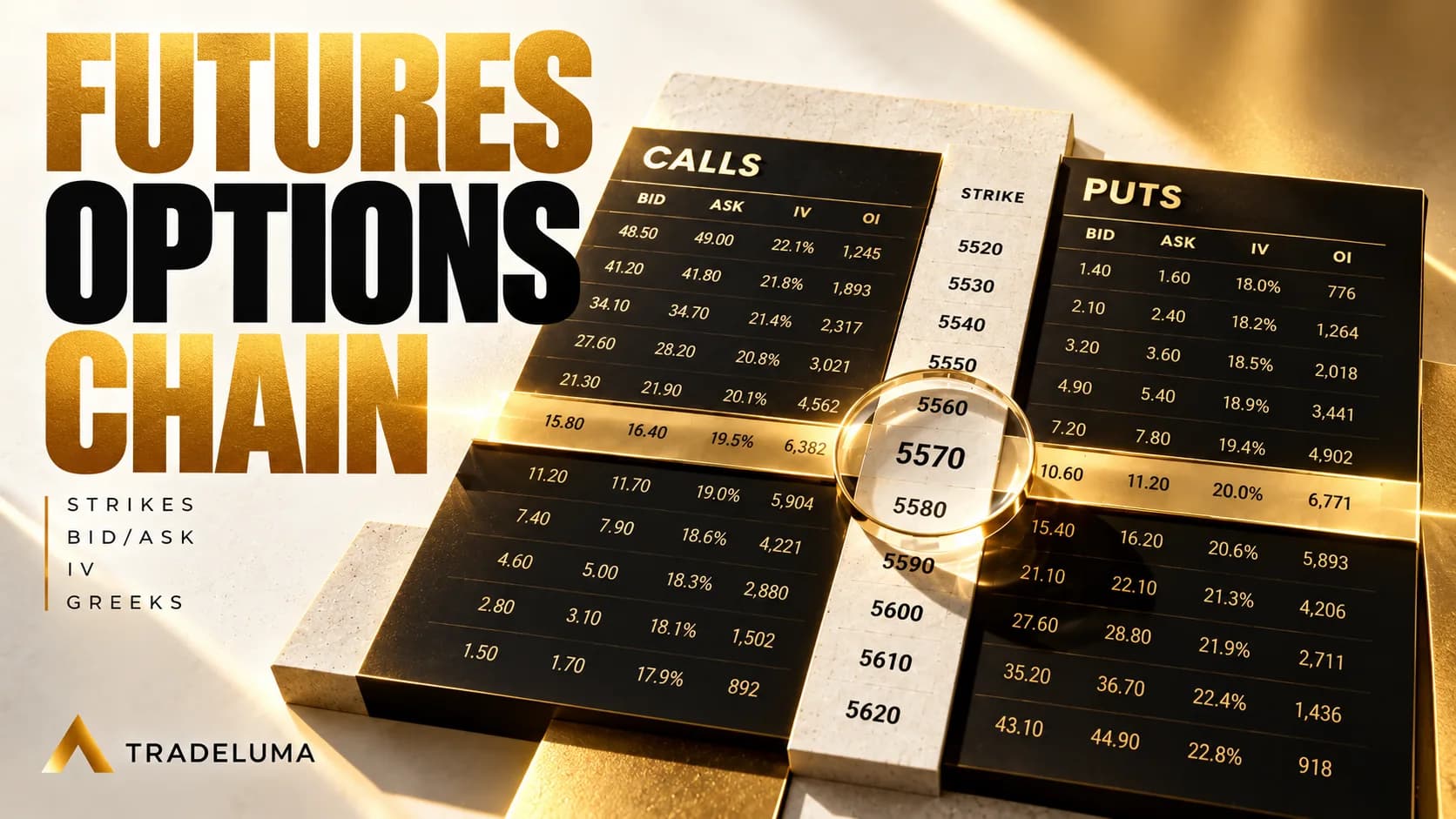
How to Read a Futures Options Chain: Strikes, Bid/Ask, IV & Greeks
Learn how to read an options chain on futures: calls and puts, strike prices, bid/ask, liquidity, implied volatility, Greeks and MES/MNQ premium examples.

Options on Futures Explained: Calls, Puts, Premium & Risk
Learn how options on futures work, from calls, puts and premium calculations to exercise, cash settlement, margin, expiry and trading risks.

Prediction Markets Explained: How Kalshi and Polymarket Are Changing Wall Street—and the Hidden Risks
Learn how prediction markets work, Kalshi vs Polymarket, YES/NO probabilities, actual payoff math, spreads, resolution risks and the latest 2026 regulation.