
Prediction Markets & Financial Education
Prediction Markets Explained: How Kalshi and Polymarket Are Changing Wall Street—and the Hidden Risks
Learn how prediction markets work, Kalshi vs Polymarket, YES/NO probabilities, actual payoff math, spreads, resolution risks and the latest 2026 regulation.
On this page+
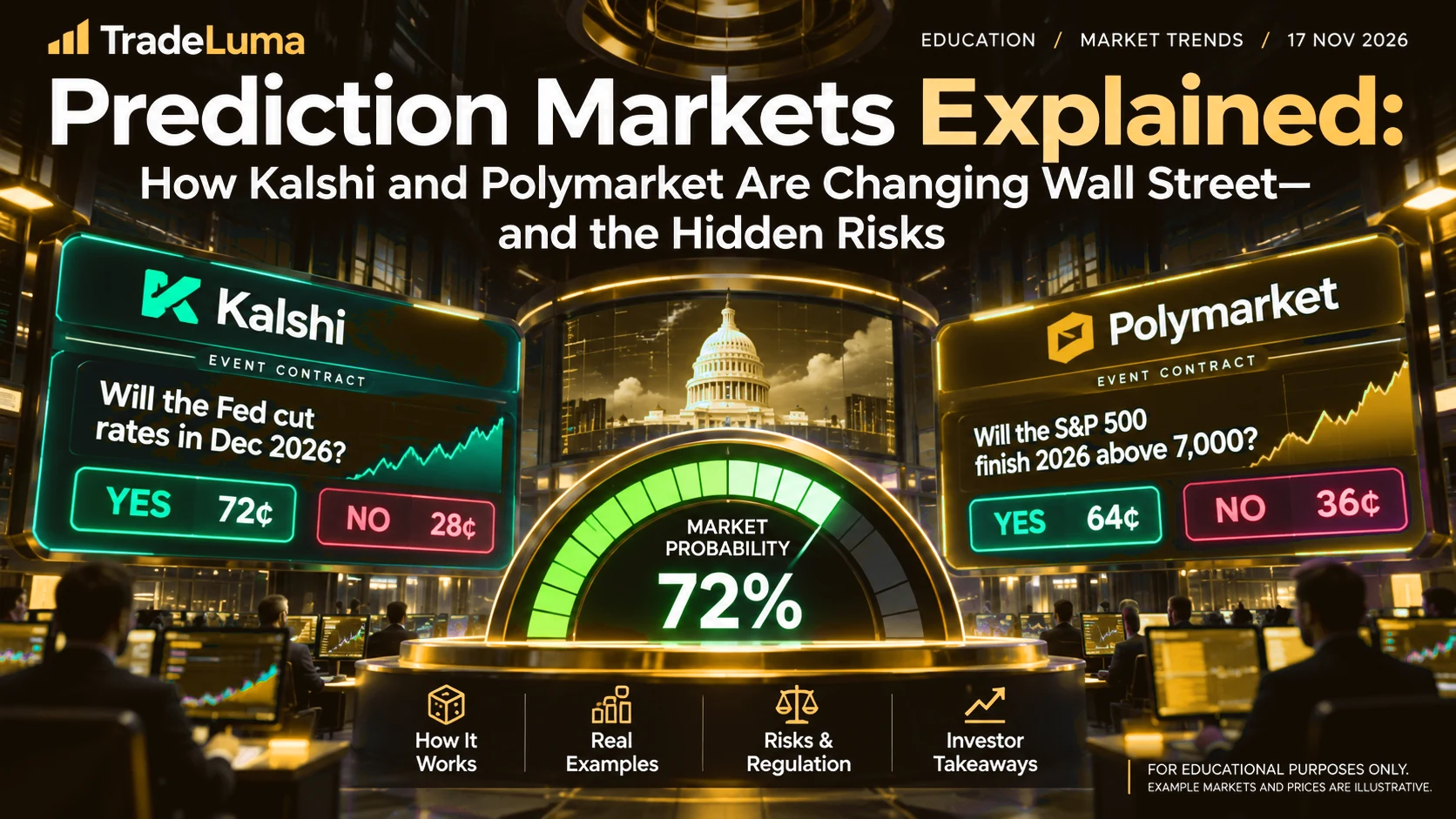
Prediction markets are moving from internet novelty to serious financial infrastructure—and the numbers explain why. A Pew Research Center analysis found combined monthly global trading volume on Kalshi and Polymarket rose from roughly US$25.7 billion in May 2026 to US$53.0 billion in July. Much of the surge was related to sports, not just elections or interest-rate forecasts. Now Kalshi has reportedly acquired a broker-dealer and plans to expand towards ordinary stock and ETF trading, while the US Commodity Futures Trading Commission and individual states continue to contest the boundaries of event-contract regulation. Beneath the headlines is a deceptively simple product: a YES or NO contract that may pay US$1 if a precisely defined outcome occurs and nothing if it does not. But a price that looks like a 72% probability is not a promise, a large traded volume is not money earned, and even a correct intuition can lose money after costs or settlement surprises. This guide explains the mechanics with worked calculations, compares Kalshi with the different Polymarket venues, and shows how investors can read prediction-market data without mistaking it for a guarantee.
What exactly is a prediction market?
A prediction market is a venue where participants trade contracts whose payout depends on a specified future event. Questions may concern inflation, central-bank rates, elections, sports results, company announcements or other measurable outcomes. Many markets are binary: YES pays out if the event happens under the written rules; NO pays out if the event does not happen. The quoted price changes as buyers and sellers exchange risk and information.
US regulators generally describe many event contracts as derivatives, often swaps, whose value depends on the outcome of an event. The words 'forecast', 'bet' and 'trade' may appear in casual conversation, but the actual legal classification depends on the product, venue and jurisdiction. For a reader, the first task is not to choose the right side. It is to identify the underlying event, settlement source, expiry and exact amount the contract pays.
Why prediction markets became a major 2026 financial story
Trading volume has grown extraordinarily quickly. Pew Research Center, using data from The Block, measured combined global monthly volume across Kalshi and Polymarket at US$25.66 billion in May 2026, US$47.75 billion in June and US$52.99 billion in July. The July figure was more than twice the May total. These statistics use a defined data set and include Polymarket US; they should not be confused with separate industry estimates with different venue coverage.
The less obvious finding is what drove the jump. Pew reported that sports contracts dominated the new turnover around the mid-2026 football World Cup, with large volumes on both platforms. That makes the growth story more complex than the familiar narrative that prediction markets are primarily about elections. Their expansion creates new questions about market integrity, consumer protection, the status of sports contracts and competition for the trading interfaces used by retail customers.
Kalshi versus Polymarket: the most important distinctions
Kalshi is a US CFTC-regulated exchange offering event contracts and an order-book trading experience. It has expanded its product range and, according to mid-November reports, acquired New York broker-dealer FB Securities in July 2026 as part of a planned move into stocks and ETFs. A planned brokerage launch is not the same thing as an already operating stock-trading service.
Polymarket needs to be described more carefully than a single label suggests. Its international platform has a blockchain-oriented architecture with outcome shares, token-based settlement mechanisms and restrictions on who may trade. Polymarket US is a separate CFTC-regulated offering for American users. A legal or technical statement that is accurate for the international platform may not describe Polymarket US. Fees, custody, market selection, permitted jurisdictions and resolution mechanisms can vary by product. Always confirm which actual venue the account and contract use.
YES and NO contracts: the simplest payoff model
Imagine a hypothetical question: 'Will a specified central bank announce a rate cut at its December meeting?' A YES share costs 72 cents and pays US$1 if the precise contractual condition is satisfied. If it is not, the YES share pays zero. A NO share can pay US$1 in the opposite outcome. In an ideal frictionless model, complementary YES and NO values add to US$1, but displayed executable quotes may not sum to exactly one dollar because of bid-ask spreads, fees and market structure.
The contract's written criteria are essential. Does a 25-basis-point cut count? Does a temporary emergency decision count? Does the contract reference a statement, a published target range or a specific official data source? Two markets with seemingly identical question titles may resolve differently. The artwork accompanying this guide shows YES 72 cents and NO 28 cents purely as a teaching example. Those are not reported live quotes for any real November event.
Worked example: buying YES at 72 cents
Suppose a trader buys 100 YES shares at US$0.72 each. The cash paid is 100 times 0.72, or US$72, before any platform or funding charges. If the event resolves YES, each share pays US$1 and the total payout is US$100. The gross profit is therefore US$28. If the event resolves NO, the payout is zero and the gross loss is the whole US$72. The winning gross return relative to the amount paid is about 38.9%, while the losing return is minus 100%.
This asymmetry is easy to overlook. A price near 72 cents indicates a high-priced favourite that can still lose every dollar of premium if the less likely event occurs. The trader also does not have to wait until settlement if the market allows resale: selling 100 shares at 78 cents would generate US$78, or a US$6 gross gain over the original US$72 cost. But a desired exit quote is not a guaranteed executable price; available bids, order size, slippage and fees determine the realised result.
Worked example: the NO side at 28 cents
Now suppose a different trader buys 100 NO contracts for US$0.28 each. The initial cost is US$28. If the event does not occur and the NO side is the winner, the settlement payment is US$100, making gross profit US$72. If the event does occur, the position expires with zero payout and the trader loses the US$28 paid.
A low-priced outcome can generate a very large percentage gain if it wins, but it wins less frequently if the quoted probabilities are sensible. Buying long shots repeatedly is not automatically an attractive strategy. Trading performance depends on whether the true probability is higher than the probability embedded in the price plus costs. Always evaluate the actual probability estimate, the uncertainty of that estimate and the possibility that the contract's resolution wording differs from casual expectations.
What does a 72-cent prediction-market price really mean?
Under a simplified US$1 binary payoff, a 72-cent YES contract has a break-even event probability of 72% before trading costs: if the event truly happens 72% of the time, the expected payout is US$0.72 and the expected net result is zero. If a trader independently estimates an 80% chance, the simplified expected value is 0.80 times US$1 minus US$0.72, or eight cents per share before fees. If the true chance is only 60%, that same contract has negative expected value.
A market-implied probability is an aggregation of bids, offers and who is willing to trade, not a direct statement of objective truth. It may be influenced by incentives, liquidity, stale prices, hedging demand and participants with unequal information. Research on market calibration often finds informative forecasts in aggregate, while performance varies by category and improves nearer resolution. Good historical calibration does not guarantee correctness for any one contract, especially one with ambiguous wording or little trading depth.
Why a profitable forecast can still be a losing trade
Being right about the event and making money are different achievements. A 72-cent YES buyer can be correct about the outcome and still receive poor compensation for the risk if a fair estimate was only 70%. The event may happen, but the strategy could lose money in the long run across repeated trades at overly expensive prices. Fees and the difference between the current buy and sell quotes make the hurdle higher.
Suppose a hypothetical platform or execution path charges two cents per share in all-in costs on a 72-cent purchase. The true cash cost becomes 74 cents per share and the break-even event probability rises to 74% if the contract pays US$1 at settlement. This example is deliberately simplified and does not represent a quoted fee from any named platform. The correct calculation always starts with the actual transaction preview, including exchange fees, taker or maker charges, withdrawal charges and any currency-conversion cost.
Bid-ask spread: the invisible obstacle in the probability display
Imagine an event contract displaying a 70-cent best bid and a 74-cent best ask. A trader who wants to buy immediately may have to pay 74 cents. If the trader sells immediately into the best bid, the exit price is only 70 cents. The four-cent round-trip spread represents a cash drag before any move in the event probability. Screens that display a single last-traded price can hide this distinction.
Large visible volume does not guarantee tight spreads in every contract. A major election question may attract deep liquidity while a niche question about a weather station or corporate announcement has only a few meaningful bids. The order size needed to move the market is often more revealing than the headline percentage. Thin order books can jump or freeze near resolution, making orders hard to exit at the displayed price.
Trading fees, deposits and net realised profit
Platforms have different fee schedules that can change over time, and some products carry special maker or taker rules. Kalshi's published fee schedules use formulas that depend on contract price, quantity and product; the current schedule should be checked rather than applying a flat universal commission. Blockchain-based venues can also involve network or conversion costs, while other markets may have different taker fees or subsidised liquidity. A fee-free headline does not necessarily mean the whole trading and withdrawal process is costless.
For any position, write down the net cash paid to enter, the executable exit proceeds or payout, each trade fee, the cash conversion rate and any settlement delay. Gross profit of US$28 on 100 YES shares does not equal net profit if it required paid transactions or conversion costs. For traders outside the United States, legal availability, funding methods, FX conversion and personal tax treatment are additional reasons not to copy a US-based illustration uncritically.
Why US$53 billion of trading volume does not mean US$53 billion in cash deposits
Volume measures trades over a period, generally as defined by the data provider. A contract can change hands repeatedly. If the same economic exposure is bought and sold several times, turnover rises without requiring a fresh dollar of committed capital for every historical trade. Different aggregators may also count notional value, trade prices or various venues differently. These measurement choices are why two industry dashboards can publish different but individually explainable totals.
Volume is not net investor profit, total open interest, unique users, revenue or money in customer accounts. A trading venue can report extremely high volume and still contain markets where the number of outstanding contracts is relatively small. Readers should inspect the source, included platforms, time window and definition before extrapolating from a spectacular notional figure to profitability or mainstream adoption.
How event contracts are priced and traded before the result
In an order-book market, traders submit buy and sell intentions at chosen prices. Orders match when another participant accepts the price, and the available market changes continuously. The market price can move after a central-bank speech, an inflation release, a sports injury or unexpected political news, even though the underlying event has not yet resolved. Contracts are often traded multiple times before final settlement.
That means a trader can earn or lose money from a change in perceived probability rather than waiting for YES or NO to pay at the end. However, marking a position to a mid-market price is not the same as being able to exit at that price. A position that appears to have appreciated can remain difficult to liquidate if the quoted size is too small, the market is paused or an announcement makes participants withdraw orders.
How settlement and market resolution actually work
Every event contract needs an authoritative way to decide what happened. A contract might point to an official government release, a declared election result, a central-bank decision, a specific sports governing body or a measurement window. A well-defined rule says what source has priority, how corrections are handled, what happens if the event is postponed and whether an ambiguous or cancelled event produces a special outcome.
On Polymarket International, many markets are resolved using the UMA Optimistic Oracle process, where an outcome can be proposed and challenged before finalisation. Other products and venues may use different oracle feeds or operational processes. US-regulated exchange products rely on their published exchange and clearing rules. Traders should never assume that the most popular news headline is automatically the legal settlement result. The written rules and any applicable dispute mechanism control.
Kalshi's planned move into stocks and ETFs: what is and is not confirmed
Mid-November 2026 reporting says Kalshi acquired New York-based FB Securities in July and plans to add trading in conventional stocks and exchange-traded funds. That would broaden the platform beyond binary event contracts into investment products that brokerage customers already understand. The planned timetable has been described as a launch in the coming months or later in the year, but a planned launch is not evidence that ordinary securities transactions are already available to every user.
Event contracts, perpetual futures and ordinary shares are legally and economically different products. A prediction contract paying US$1 after an event is not a stock with a residual ownership claim on corporate profits. A leveraged perpetual derivative is not the same as buying and holding an ETF. As platforms blend these interfaces, product identification, suitability, disclosures and account permissions become more important, not less. Readers should check what the actual order represents before confusing a familiar ticker with a familiar investment.
The November 2026 regulatory battle is far from settled
Regulation is one of the biggest uncertainties. Kalshi is a CFTC-regulated designated contract market, and Polymarket US operates separately from Polymarket's international venue. At the same time, US states have argued that some sports-related event contracts amount to unlicensed gambling within their territory. In November, the CFTC took the opposite position in legal action against Arkansas, arguing that federal commodities law preempts certain state enforcement efforts against registered exchanges. Those positions are part of ongoing litigation, not one universally settled rule.
Separately, Reuters reported in November that the CFTC had warned Kalshi about potential charges linked to product-notification compliance; Kalshi characterised the matter as procedural and said it was being addressed. A warning is not a finding of liability, and an exchange's regulatory designation does not establish that every proposed product is lawful in every setting. Legal availability varies by jurisdiction, product and sometimes the user's location. Do not assume that using technical workarounds to access a restricted platform is permitted.
Are prediction markets the same thing as sports betting?
To a casual observer, a sports-result event contract may resemble a wager because the economic outcome is binary and depends on the result of a match. Operators and supporters of federally regulated event contracts argue that exchange trading, hedging and the Commodity Exchange Act make the products distinct from conventional state-licensed sportsbook bets. State regulators and other critics argue that some sports-based contracts function like gambling and should remain within state gaming rules.
The legal debate is contested, and terminology alone does not resolve it. Regardless of classification, customers face many of the same behavioural risks as in other short-duration outcome products: chasing losses, increasing exposure after near misses, misjudging probabilities and treating rapid trades as entertainment rather than financial commitments. The more active the product, the more important it is to set practical limits.
Prediction markets versus options and futures
A traditional call option gives its buyer specified rights connected to an underlying asset or settlement reference, with a payoff that often varies with how far the market moves beyond a strike. A futures contract generally has a more continuous payoff tied to a reference price and can involve margin, variation settlement and significant leverage. A binary event contract is different: many have a fixed terminal payout determined by a YES/NO event test.
These distinctions affect the shape of risk. A fully paid long binary share commonly has a maximum loss limited to the cost paid, excluding related costs, while leveraged products or short-side arrangements can create different obligations. All markets share execution risks, liquidity concerns and the need to understand contract specifications. A familiar trading screen should never substitute for the exact payoff calculation.
Can investors use prediction-market prices to interpret Fed decisions?
One of the most interesting educational applications is monitoring market-implied expectations for discrete economic outcomes. A series of contracts might express expectations about the next Federal Reserve target range, an inflation threshold or recession definitions. Researchers have examined Kalshi prices alongside survey forecasts and other market-implied measures because event prices can update quickly when news arrives and can reveal a distribution across possible outcomes.
But contracts do not all reference the same policy question, and liquidity may differ substantially across outcomes. The arithmetic of mutually exclusive outcomes matters: prices across a full set should be interpreted with spread and fee effects, not casually added as if they were perfectly clean probabilities. An investor should also compare the pricing with official economic data, futures-market estimates, macroeconomic forecasts and the full contract wording before using it to explain a market move.
Are prediction markets accurate? Calibration versus a single headline
Accuracy should be assessed across groups of similar resolved events, not by celebrating a few famous calls. A reasonably calibrated market quoting 70% for many comparable events should see roughly seven in ten materialise over time. That does not mean the next 70% event is certain; three in ten such events may still fail. Research published in 2026 suggests many active prediction markets can be informative, particularly nearer resolution, while forecasting quality varies by topic, attention, liquidity and market type.
Calibration is not the whole story. A system that always predicts the historical base rate could be calibrated but unhelpful for distinguishing specific events. Proper evaluation examines a scoring rule, sample selection, timing and whether the forecast outperforms a relevant baseline. Market narratives should also distinguish a quote captured several days before resolution from one made seconds before an outcome becomes almost certain.
Manipulation, inside information and concentrated participation
A market with thin liquidity may be moved significantly by a participant placing relatively small orders. Prices can also reflect hedging incentives, publicity or someone attempting to influence what observers think is likely. High attention does not guarantee clean information. Participants may have unequal access to information, and rules about confidential, nonpublic or illegally obtained information can differ by venue and law.
An investor looking for useful signals should examine how fast prices move around public announcements, whether trading depth is sufficient, whether a move persists and whether other independent information supports it. A dramatic jump from 20% to 80% is an observation about the order book, not proof that the event will happen. Regulatory oversight, surveillance and dispute procedures matter because a probability signal is only as trustworthy as the market producing it.
Security, custody and access restrictions
Before using any prediction-market venue, users should distinguish exchange custody, brokerage accounts and non-custodial crypto wallets. Depending on platform and jurisdiction, assets may be held and funded in different forms. Blockchain settlement introduces wallet-address, key-management and transaction risks; conventional account models introduce credentials, account recovery and counterparty considerations. A familiar logo on a website is not a substitute for confirming the official domain and the precise legal entity.
Product availability is particularly important for readers outside the United States. Australia and other countries apply their own laws and access requirements, and the international nature of a website does not mean every contract is authorised for every person. Check restrictions, identity verification, funding rules and applicable tax treatment. Never treat a technical ability to access a website as proof that a transaction is lawful or appropriate.
A practical risk checklist before placing an event-contract order
First, identify the exact YES/NO proposition and confirm which venue and jurisdiction govern it. Second, read every resolution clause, including the relevant deadline and official source. Third, calculate the dollar cost and maximum loss of the position at the intended size. Fourth, inspect the executable bid and ask and actual available quantity, not just the large probability number. Fifth, include every known commission, conversion charge and potential funding cost in the break-even calculation.
Next, write down your independent probability estimate and why it differs from the market's. If you cannot articulate that difference, you may be paying a fair price for an event you simply hope will occur. Finally, predetermine how much money you are prepared to lose, whether you will hold to settlement and what you will do if the market becomes illiquid or the result is disputed. Never risk money needed for essential expenses, and avoid using credit or leverage merely because a contract looks affordable.
Seven common beginner mistakes
The first mistake is reading 72% as certainty. The second is confusing potential payout with profit. The third is comparing YES and NO prices without checking their actual executable sides. The fourth is ignoring maker or taker fees and the cost of an early exit. The fifth is assuming an ambiguous real-world outcome will resolve the way a news headline suggests. The sixth is extrapolating a US$53 billion volume figure into platform deposits or typical user returns. The seventh is assuming that a regulator's approval of a venue settles every product or state-law question.
Another recurring error is confusing an open position's mid-price with guaranteed exit proceeds. Traders should focus on exact contract rules, real bids and offers, position size and the possibility that a large implied probability still leaves a material loss scenario. A better educational use of prediction markets is to compare dated forecasts, examine how they update with evidence and learn probability reasoning before considering financial exposure.
The bottom line: probability is information, not a promise
Prediction markets are becoming a substantial part of the conversation about financial information because they aggregate real trading decisions around clearly specified events. Their fast growth, Kalshi's potential expansion into stock brokerage and continued US litigation make 2026 an especially important moment to understand the product. Used carefully, their prices can complement traditional forecasts and reveal changing expectations across economic, political and other events.
The product's apparent simplicity should not hide its risks. A 72-cent YES share can still become worthless, a 28-cent NO share is not automatically underpriced, and high trading volume says little about a particular customer's likelihood of making money. Learn the settlement rule, compare the quote with your own defensible probability estimate, calculate costs and verify legal eligibility. This article is general financial education, not personalised investment, legal or tax advice.
Frequently asked questions
What is a prediction market?+
A prediction market is a venue where participants trade contracts tied to future events, often YES/NO outcomes paying US$1 if the specified result occurs and zero if it does not, subject to the contract rules.
How do YES and NO shares work on Kalshi and Polymarket?+
A binary YES position generally benefits if the specified event occurs; the complementary NO position benefits if it does not. The exact payout, settlement source, expiry, fees and permitted trading depend on the product and venue.
Does a 72-cent YES price mean there is a 72% chance?+
It is often interpreted as an approximately 72% market-implied probability before costs and market imperfections. It is not an objective fact or a guaranteed forecast.
How much do 100 YES contracts at 72 cents cost?+
They cost US$72 before fees. With a standard US$1 binary settlement, they pay US$100 if YES resolves as the winner and zero if NO wins; gross profit or loss is therefore +US$28 or −US$72.
What is the break-even probability for buying YES at 72 cents?+
In the simplified US$1 binary payoff model, the break-even chance is 72% before costs. Fees and trading friction push the required probability higher.
Is Kalshi the same as Polymarket?+
No. Kalshi is a US CFTC-regulated exchange. Polymarket operates distinct venues, including an international blockchain-oriented platform and a separate US-regulated offering. Product, custody, settlement and access rules differ.
Are prediction markets legal in the United States?+
Some event contracts trade on CFTC-regulated exchanges, but legal challenges involving state gaming laws and sports-related contracts remain active as of November 2026. Eligibility depends on the venue, contract and location.
Can Australians trade on Kalshi or Polymarket?+
Access and legality depend on the specific service, user's location, regulatory requirements and current terms. Readers in Australia should check local laws and the platform's restrictions before attempting to trade.
How big were Kalshi and Polymarket trading volumes in July 2026?+
Pew Research Center reported roughly US$53.0 billion in combined monthly global volume in July 2026, up from around US$25.7 billion in May using its defined dataset.
Does US$53 billion in trading volume mean users deposited that amount?+
No. Volume measures turnover. Positions can change hands repeatedly, and volume is not equivalent to cash deposited, open interest, platform revenue or trader profit.
How are Polymarket prediction markets settled?+
Many markets on Polymarket International use an oracle-based process including the UMA Optimistic Oracle, where outcomes may be proposed and disputed. Other products and the US venue can use different resolution procedures.
Are prediction-market probabilities reliable?+
They can be informative, particularly in active markets nearer resolution, but forecasting performance varies across topics, liquidity and time horizons. A quoted probability does not guarantee the outcome of a single event.
Is Kalshi launching stock and ETF trading?+
As reported in mid-November 2026, Kalshi plans to add conventional stock and ETF trading following the acquisition of FB Securities. The planned rollout should not be confused with an already completed launch.
Can you lose all your money on a prediction-market trade?+
A fully paid long YES or NO position can lose its entire purchase cost if the opposing outcome wins. Other arrangements can carry different risks, so read the contract and account rules.
Why do prediction markets have bid-ask spreads?+
Buyers and sellers offer different executable prices; the difference is a trading cost. Illiquid markets may have wide spreads even when a platform displays a single market probability.
What is the difference between an event contract and an option?+
Many event contracts pay a fixed amount based on whether a specified event happens. Options often have a payoff linked to how far an underlying price moves beyond a strike. Contract, margin and settlement rules differ.
Put it into practice
Use the risk maths next to the guide.
Open TradeLuma's free position-size, risk/reward, expectancy, and drawdown tools to test the numbers behind a risk-management decision.
Open free trading calculators →Continue learning
Related guides.
0DTE Options Explained: Why Same-Day SPX, SPY and XSP Options Are Booming—and the Risks
Learn 0DTE options with examples, gamma and theta, SPX vs SPY vs XSP, the new SPXO contracts, and practical risk controls for same-day trading.
AI’s Pressure-Cooker Week: Nvidia Earnings, Anthropic’s IPO and the Sell-Off Testing Wall Street
Nvidia reports on Nov 17 as Anthropic targets a Nov 19 IPO amid a Nasdaq sell-off. Explore NVDA earnings, ANT valuation, options risk and AI-stock scenarios.
The Fed’s AI Bubble Warning: Wall Street Faces a Double Shock from Rate Hikes and Risky AI Debt
November 18 Fed minutes warned of opaque AI-related debt as officials considered further rate hikes. Learn the risks for Nasdaq stocks, bonds, Bitcoin and gold.