
Stocks & Technology
Tesla–SpaceX Merger Talks: Elon Musk’s $3.45 Trillion Gamble and What Happens to TSLA Stock
Tesla and SpaceX are exploring a $3.45T combination. What merger talks, stock-swap terms, Musk’s control and regulators could mean for TSLA and SPCX.
On this page+
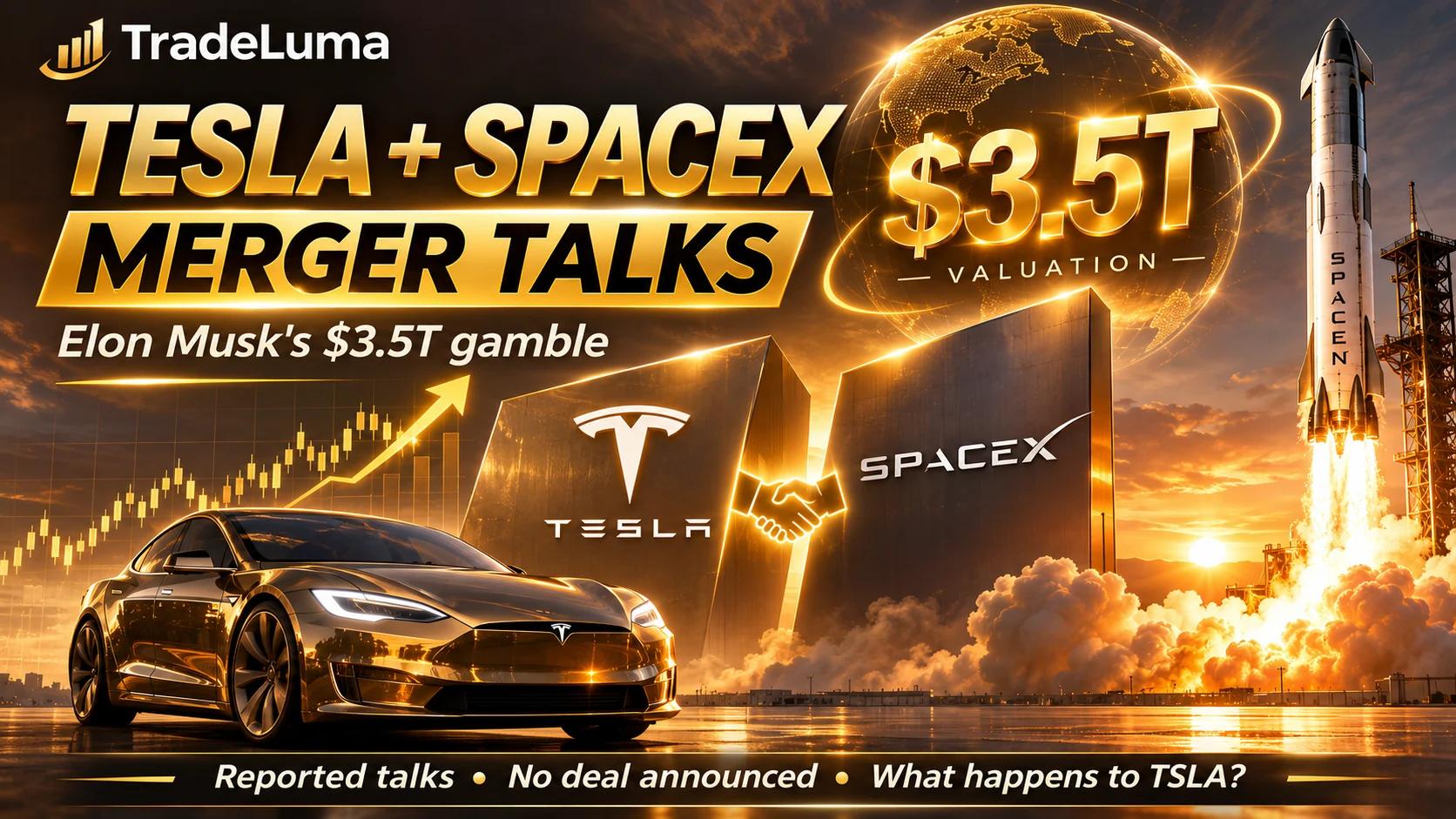
Tesla and SpaceX are discussing a combination that could reshape two of the most closely watched companies in global markets. On November 12, 2026, Reuters relayed a Bloomberg report that the talks were progressing and that an announcement could come as early as December, although early 2027 remained possible. Using market values reported around the announcement, Tesla was worth about US$1.55 trillion and publicly traded SpaceX about US$1.90 trillion: a combined US$3.45 trillion, not an agreed purchase price. Tesla and SpaceX have separately disclosed special committees to evaluate a potential combination, but neither has announced an exchange ratio, merger premium, definitive agreement or final shareholder vote. As of this November 15 edition, the compelling question is not simply whether Elon Musk can put electric vehicles, robots, Starlink, launch services and AI under one roof. It is who controls the resulting company, how Tesla and SpaceX shareholders are treated, whether regulators permit the structure and how much of the promised synergy can turn into cash flow.
What happened on November 12, 2026?
The immediate catalyst was a Bloomberg report, carried by Reuters, that Tesla and SpaceX advisers and boards were advancing their merger discussions. The companies were said to be considering an announcement in December, while acknowledging the timetable could slip into early 2027. Both companies declined to immediately provide substantive public comment on that reporting. An advanced discussion is neither a completed transaction nor a promise that one will be signed.
This did not emerge from nowhere. On October 20, Elon Musk said on SpaceX’s third-quarter earnings call that combining the companies was a “good idea”. Regulatory filings subsequently described independent committees formed to study a potential combination. Those filings are higher-confidence evidence that a review exists; the specific December timing remains media reporting rather than a binding commitment.
As of November 15, the essential undisclosed items are the legal acquirer, how stockholders would receive consideration, a proposed exchange ratio, voting terms, valuation assumptions, tax structure, required approvals and a detailed timetable. Any article naming those as final terms would be moving beyond the known evidence.
Is Tesla officially merging with SpaceX? What the SEC filings actually say
Tesla’s filing for the quarter ended September 30 says its board established a special committee of disinterested directors to evaluate options for deepening the relationship with SpaceX, including a possible business combination. It also says there is no assurance a transaction will occur and that a deal would need a favourable committee recommendation and, if appropriate, shareholder approval.
SpaceX’s own September-quarter 10-Q confirms a special committee to assess a Tesla combination and says any transaction would need approval of that committee, SpaceX’s board and its controlling shareholder. The SpaceX filing expressly permits its committee to decline a deal if it is not in shareholders’ best interests. These are process disclosures, not a signed agreement.
A signed definitive merger agreement would generally spell out what each share receives, closing conditions, termination fees, voting arrangements and expected closing dates. Investors should watch for official company releases and material SEC filings rather than treating a media headline as a completed combination.
The US$3.45 trillion number: why it is not a US$3.45 trillion purchase price
Reuters reported a market value near US$1.90 trillion for SpaceX and roughly US$1.55 trillion for Tesla at the prior close. Their sum is approximately US$3.45 trillion. It is an easy number to headline, but the addition of two standalone equity capitalisations is not a negotiated enterprise valuation, the cash required to buy Tesla, or the amount Tesla shareholders would necessarily receive.
A transaction could use shares rather than cash, involve adjustments for cross-holdings and could change market values as the share prices move. If one company already owns part of the other, simply adding two market capitalisations may double-count some economic exposure. Investors must also distinguish equity value from enterprise value, which takes account of debt and cash. No final deal document provides these calculations yet.
A larger combined stock market value is possible if investors reward credible synergies; it could also be lower if investors discount integration costs, dilution, debt or regulatory uncertainty. The headline is a snapshot, not an independently appraised transaction price.
Why the deal would be unusual: SpaceX is already listed as SPCX
SpaceX completed a public listing in June 2026 and its Class A shares trade under the ticker SPCX. Unlike old discussion of a private SpaceX buying into Tesla, this possible combination would involve two publicly traded equity prices, two shareholder groups and two disclosed corporate governance systems. Tesla continues to trade as TSLA.
This matters because a merger premium cannot be assumed merely from the excitement of giving Tesla holders exposure to Starlink and launch services. Those investors can already buy SPCX directly. A proposed deal would need to make financial sense compared with remaining separate while cooperating under contracts or joint ventures.
Even if SpaceX were the legal surviving parent, investors should not assume TSLA holders automatically receive a fixed number of SPCX shares. The consideration type and exchange formula have not been disclosed.
Why Elon Musk’s voting control is central to the negotiations
Musk serves in leadership positions at both companies and has a large economic interest in both, creating related-party and conflict-of-interest questions. SpaceX’s public listing documents describe a dual-class share system in which Class B carries substantially more votes. They also described Musk holding more than four-fifths of voting power immediately after the offering under the disclosed assumptions. That is a very different governance position from his percentage ownership of Tesla equity.
SpaceX has said any merger would require approval from its controlling shareholder in addition to its committee and board. Tesla disclosed a committee of disinterested directors to assess a deal. An independent committee and transparent fairness analysis are important safeguards, but they do not in themselves guarantee the exchange terms will be attractive to Tesla minority shareholders.
Investors should look for the committee’s recommendation, independent valuation work, any majority-of-the-minority vote requirement, board recusal arrangements and clear explanations of Musk-related interests. These questions could shape the outcome as much as the technology narrative.
The strongest strategic case: AI compute, robots and autonomous vehicles
Proponents imagine a combined business linking Tesla’s autonomous driving, Optimus robots and battery and energy hardware with SpaceX launch capacity, Starlink connectivity and infrastructure engineering. The idea is that software, specialised AI chips, data networks and physical manufacturing could be coordinated faster under one ownership structure.
That case is plausible as an industrial thesis, not an established financial benefit. Tesla’s automotive, robotics and energy units differ from SpaceX’s satellite, launch and government services businesses in regulation, cost structure and capital intensity. Merger integration can slow decision-making rather than accelerate it if the companies compete for engineering, compute and cash.
A credible investor presentation would need measurable milestones: development costs, incremental revenue, capital expenditure, deployment timing and margins. None of the reported talks establishes a quantified synergy target or guarantees that merging is necessary for the projects to succeed.
Terafab is real cooperation—but does it require a merger?
Tesla and SpaceX already work on a chipmaking initiative known as Terafab. Reuters reported Musk’s October remarks that a first test chip was expected around May or June 2027, with volume production targeted for the third quarter of 2028. These are management targets, not delivered production milestones.
The partnership is evidence that the businesses can collaborate before any business combination. Shared sourcing or chip development could theoretically reduce duplication or speed deployment. It also raises a key counterargument: if the companies can achieve much of the benefit through a joint venture and long-term contracts, why would all shareholders need to exchange ownership stakes?
Analysts should compare the incremental benefits of a full merger with the much lower governance and integration burden of continued partnerships. Investors should also avoid valuing an unproven chip venture as if its planned capacity were already operating profitably.
Starlink, orbital compute and the data-centre investment question
SpaceX’s Starlink business gives the combined-company vision a global satellite connectivity platform, while Starship potentially changes the economics of launching equipment into orbit. Supporters have floated ideas including more extensive space-based compute infrastructure and closer integration of connectivity with autonomous systems.
Yet orbital data centres are not equivalent to a commissioned terrestrial data-centre fleet. Launch mass, power supply, thermal control, radiation resilience, networking costs, spectrum and repair logistics create uncertain unit economics. Investors should ask what has been built, which contracts exist and how revenue would be recognised, rather than capitalising a futuristic concept at its most optimistic potential.
Likewise, technical links between Starlink and Tesla vehicles do not by themselves demonstrate that a merger is required. The economic benefits must exceed the cost of integration, dilution, regulatory concessions and the opportunity cost of capital.
The biggest regulatory obstacle: US defence work versus Tesla’s China footprint
SpaceX supplies launch, satellite and related services to US government agencies, including sensitive defence programmes. Tesla manufactures and sells vehicles internationally and has significant operational exposure to China. Reuters identified these links as a central reason a combined group could face substantial national-security and cross-border regulatory scrutiny.
Potential oversight could involve foreign investment, access to sensitive technical information, export controls, procurement conditions and the separation of restricted programmes. Whether particular approvals are required depends on the final legal structure and facts; neither a blanket prohibition nor an assured clearance is justified by the current record.
Regulators may require information barriers, governance protections, structural commitments or other conditions. A deal that appears financially compelling on a spreadsheet may be delayed, changed or abandoned if those conditions are unacceptable to the companies or shareholders.
Could a US–China dispute stop the transaction?
Tesla’s China operations are material to its production footprint and commercial strategy. Meanwhile SpaceX handles technologies and contracts where US national-security interests are prominent. Bringing those interests into one parent could invite questions from governments and defence customers about access to data, intellectual property, supply chains and board oversight.
This should not be simplified into a claim that China has already blocked the deal. As of November 15, there was no definitive agreement detailing the cross-border structure or the specific regulatory filings to be made. Without those documents, commentary on exact approval deadlines is necessarily conditional.
Investors can follow official statements about any proposed ring-fencing of Tesla’s Chinese operations and any requirements attached to SpaceX’s government work. A credible risk model should include both transaction failure and reduced synergy after regulatory concessions.
Three scenarios for TSLA and SPCX: bullish, cautious and no deal
Bullish case: special committees agree terms that both shareholder groups regard as fair, regulatory concerns are addressed, and management presents credible, measurable operational synergies. That could reduce the market’s uncertainty about the combined structure. Even then, valuation and the ratio of share issuance remain decisive; a successful combination is not a guarantee that either ticker rises.
Cautious case: negotiations continue, but the companies disclose difficult governance, China or defence-contract issues, and investors demand a higher discount for complexity. The timeline could move beyond the December discussion. Price volatility might increase while each company continues to operate independently.
No-deal case: committees decline to recommend a transaction or regulatory or shareholder conditions make it unattractive. The companies may preserve or expand commercial partnerships instead. Any speculative merger premium embedded in the share prices could unwind, but their standalone earnings, products and capital plans would still matter.
Why Bitcoin is a small part of the US$3.45 trillion story
Both companies hold Bitcoin on their balance sheets. Tesla’s September 2026 filing lists 11,509 BTC, while SpaceX disclosed 18,712 BTC for the same date: approximately 30,221 BTC combined, before any later disposals or acquisitions. The combination does not itself oblige either company to buy or sell additional cryptocurrency.
Even at an illustrative Bitcoin price around US$70,000, those coins would represent about US$2.1 billion of gross market value—tiny compared with US$3.45 trillion in combined reported equity value. Their inclusion may attract cryptocurrency-focused searches, but it is not a credible primary rationale for the proposed deal.
Investors should distinguish the companies’ historical holdings from current valuations and avoid suggesting Bitcoin’s price will mechanically follow a merger announcement.
What would a $3.45 trillion merger mean for index funds and ETFs?
A completed stock exchange could alter outstanding share counts, free float, industry classifications and weights in indices tracked by large funds. The details would depend on the surviving entity, ticker structure, eligibility rules and closing date. Index providers typically announce changes after reviewing an actual corporate action rather than a rumour.
Shares of TSLA and SPCX are already publicly traded, so this is not the creation of a new listed asset from nothing. Investors should not infer that every Nasdaq or S&P 500 tracker must immediately buy the combined company. Such claims require specific index methodologies and corporate-action notices.
The potential for passive-investing flows is a legitimate area to monitor once deal terms exist, but quoted flow amounts now would be speculative.
A practical checklist: what to monitor before December and early 2027
Watch for a formal 8-K or equivalent SEC disclosure by Tesla or SpaceX, official language about the exchange ratio, whether consideration is all stock, what each shareholder group would own, and the independent committees’ recommendations. Examine any shareholder-vote standards, appraisal or dissent rights and the treatment of Musk’s various holdings and incentive arrangements.
Next, follow regulatory language about US government contracts and China, legal documentation of any required separation arrangements, capital-expenditure commitments for Terafab and SpaceX infrastructure, and whether analysts present an auditable schedule of expected synergies.
Finally, track both tickers’ prices using the same observation time. If a definitive transaction is announced, calculate the implied consideration from the disclosed ratio rather than from rounded media market-cap figures. Consider position sizing and gap risk if holding a stock through an anticipated announcement.
Frequently asked questions
Is Tesla merging with SpaceX in 2026?+
Tesla and SpaceX have established committees to explore a potential combination, and talks reportedly progressed in November. No signed merger agreement or confirmed closing date had been announced as of the article’s November 15, 2026 date.
Could a Tesla–SpaceX deal be announced in December 2026?+
Reuters relayed Bloomberg reporting that December was possible, with early 2027 also considered. Neither date is a guaranteed announcement or closing date.
Is the Tesla–SpaceX deal worth US$3.45 trillion?+
Approximately US$3.45 trillion is the sum of reported standalone equity values near the November 12 announcement, not an agreed takeover price or the eventual enterprise value.
Is SpaceX publicly traded and what is its ticker?+
Yes. SpaceX completed its IPO in June 2026 and its Class A shares trade on Nasdaq under SPCX. Tesla trades under TSLA.
What will TSLA shareholders receive in a merger?+
No exchange ratio, premium, share consideration or ownership allocation has been announced. Those terms would need to be documented in a definitive deal.
Does Musk control both companies?+
Musk has leadership and economic interests in both. SpaceX’s dual-class structure gives him exceptionally strong voting control; Tesla’s governance and approval requirements are different.
Will Tesla shareholders vote on the merger on December 3?+
Tesla’s annual shareholder meeting is scheduled for December 3, 2026, but that does not automatically mean a merger vote is scheduled. Only official materials establishing such a vote would confirm it.
Why would Tesla and SpaceX merge?+
The strategic argument is potential coordination of AI, robotics, autonomy, energy storage, Starlink, launch systems and chip manufacturing. No merger-specific quantified savings or earnings benefits have been announced.
What is the Terafab connection?+
The companies already cooperate on a chipmaking initiative called Terafab. Management targeted an initial test chip in May or June 2027 and volume production in the third quarter of 2028; these are goals, not completed milestones.
What could block a Tesla–SpaceX merger?+
Governance conflicts, a disagreement over shareholder exchange terms, SpaceX’s sensitive US government contracts, Tesla’s China ties, regulatory conditions and shareholder approval could complicate or prevent a deal.
Does a merger mean either company will sell its Bitcoin?+
No. Tesla and SpaceX reported a combined approximately 30,221 BTC at September 30, 2026. A merger by itself does not mandate any Bitcoin sale or purchase.
Should investors buy TSLA because merger talks are progressing?+
Merger talks can create volatility, but they are not a guaranteed positive catalyst. Investors need official terms, comparable values, risk controls and an understanding of downside if no transaction happens.
Put it into practice
Use the risk maths next to the guide.
Open TradeLuma's free position-size, risk/reward, expectancy, and drawdown tools to test the numbers behind a risk-management decision.
Open free trading calculators →Continue learning
Related guides.
CrowdStrike to Acquire Zscaler for $43.9B: Deal Terms, CRWD and ZS Risks
CrowdStrike and Zscaler signed a $43.9B all-stock merger agreement on Nov 22, announced Nov 23. Each ZS share receives 1.135 CRWD shares, pending approvals.
MSCI to Remove Strategy (MSTR): Could an $8.8 Billion Sell-Off Hit Bitcoin’s Biggest Treasury?
MSCI will remove Strategy from indexes after Nov. 30. Explore the $2.8B versus conditional $8.8B MSTR outflow estimates, Bitcoin impact and investor risks.
Anthropic's $1.4 Trillion IPO Shock: The $69.3B False Start, $64.4B Reset and AI Bubble Test
Anthropic's IPO terms changed from a withdrawn $69.3B proposal to 825M shares at $70–$78, potentially raising $64.35B. Decode the $1.4T valuation, $26B placement and ANT risks.