
Stocks & Technology
Tesla Kills the Cybertruck? Elon Musk’s Cybercab Gamble—and What Happens to TSLA Stock
Is Tesla ending the Cybertruck in 2027? Musk plans to dismantle its Texas line for Cybercab. Explore sales, robotaxi risks, TSLA shares and what investors should watch.
On this page+
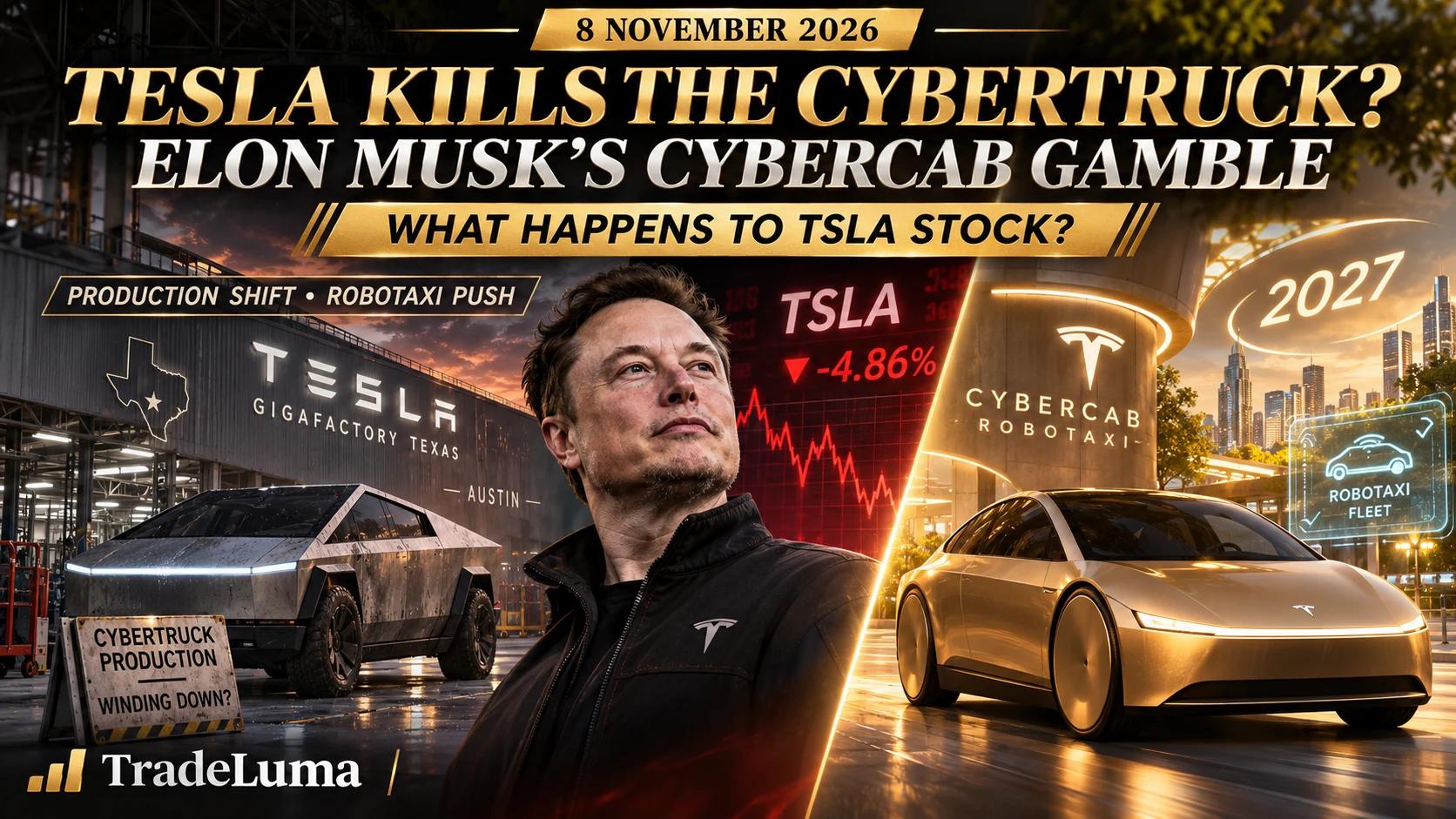
Is Elon Musk really killing the Cybertruck to make room for robotaxis? On November 6, 2026, Tesla’s chief executive said production of the polarising stainless-steel pickup would wind down at Gigafactory Texas around the middle of 2027 so the factory could expand output of its purpose-built Cybercab. On November 7, Musk said an extra Cybertruck production shift would be added to try to fill outstanding orders before the line is dismantled around June or July. The decision is striking because estimated US sales fell to 20,237 in 2025 from 38,965 in 2024, well short of an earlier 250,000-a-year ambition. But there is an important caveat: winding down the Texas line does not prove the model is cancelled globally. Tesla shares rose 4.23% on Friday, November 6, as investors assessed the decision alongside a wider market rebound. Here is what is confirmed, what remains unknown, and the financial risks behind the Cybercab investment thesis.
What Elon Musk announced on November 6 and November 7
On Friday, November 6, Musk said Tesla would wind down production of Cybertruck at its Texas gigafactory around mid-2027 to make room for higher Cybercab output. On Saturday, November 7, he added that Tesla intended to run an extra Cybertruck shift to try to complete outstanding orders before dismantling the existing line around June or July 2027. A temporary increase in output and a future shutdown can coexist: the company has a fixed window in which to fulfil remaining demand.
These are statements about manufacturing plans, not a completed shutdown. The dates and exact factory reconfiguration could change. Tesla has not supplied a detailed capital-spending estimate or a complete production transfer schedule. Investors should distinguish Musk’s stated intention from a finished transition and watch for subsequent disclosures of timeline, cost and expected output.
Is the Cybertruck discontinued, or only the Texas production line?
The verified announcement concerns the existing production line at Gigafactory Texas. As of November 8, Tesla has not publicly established whether it will transfer the pickup to another plant, discontinue it outright, or continue delivering any completed inventory after the changeover. The Austin operation is the only location publicly known to have the specialised tooling used to assemble Cybertruck, so relocating it would not necessarily be simple.
“Tesla ends the Cybertruck” is an attention-grabbing headline; “Tesla plans to wind down the Texas Cybertruck line” is the more accurate statement. Existing vehicles do not disappear when a production line closes. Owners’ warranty, parts and service conditions are separate questions and should be answered by Tesla rather than inferred from the factory announcement.
Why Cybertruck sales fell so far below Elon Musk’s target
Kelley Blue Book estimates place US Cybertruck sales at 38,965 in 2024 and 20,237 in 2025, a decline of roughly 48%. Preliminary estimates for January through September 2026 pointed to approximately 11,586 sales, down about 28% from the comparable 2025 period. These are estimated retail sales in the US, not Tesla’s official global production figures. Tesla does not publish an individual Cybertruck deliveries line in its quarterly delivery summary.
The 2025 number was only around 8% of Musk’s earlier ambition of 250,000 units annually. That dramatic gap explains why analysts question whether the pickup justified a high-volume bespoke line. It does not mean no one wants a Cybertruck: an enthusiast market and outstanding customer orders can exist without meeting the economics of a much larger factory programme.
What went wrong: price, production, design and quality
The stainless-steel, angular pickup was deliberately unconventional, making it highly visible but also polarising. Mainstream pickup customers often want predictable towing performance, charging access, repair networks, familiar controls, acceptable insurance premiums and manageable total ownership costs. Tesla’s revisions to specifications and prices complicated the value proposition for buyers who initially expected a less expensive or longer-range truck.
Repeated recalls and quality complaints added friction, although the number of recall campaigns alone does not establish that every vehicle is unsafe. The unusual body and weight also posed challenges outside North America, including compliance with European pedestrian-protection and vehicle rules. A product can be a technological showcase yet fail to attract enough cost-sensitive buyers to support its proposed scale.
Why Musk is adding a shift before shutting down the line
Musk said Cybertruck’s outstanding order backlog exceeded what the company could build before the planned line dismantling, and that an additional shift would help it try to complete those orders. Adding labour and production hours to a line with a known retirement date can be a rational way to fulfil existing commitments, use components already ordered and preserve customer relationships.
But investors should not confuse an unquantified “backlog” with a verified return to mass-market demand. The comment did not say how many firm orders remain, how many might cancel, or what margin Tesla expects on those vehicles. Nor does the extra shift reverse the stated plan to reallocate Texas manufacturing capacity toward Cybercab.
What is Cybercab, and why is Tesla betting the factory on it?
Cybercab is Tesla’s purpose-built two-seat robotaxi, designed around the ambition of unattended ride-hailing rather than simply selling vehicles to private drivers. Tesla’s strategy is to combine vehicle manufacturing with software, dispatch and fleet operations that could generate revenue over a vehicle’s useful life. The theory is that a high-utilisation driverless car might earn substantially more per day than a privately owned vehicle that sits parked most of the time.
The thesis depends on real-world operating economics: paying passenger demand, completed rides, fleet availability, cleaning, charging, accidents, maintenance, remote support and insurance. A robotaxi that is inexpensive to manufacture can still lose money if utilisation is low, if it needs costly oversight or if it cannot operate in enough places. A factory expansion is an input, not proof of profitable demand.
Tesla’s Q3 2026 capacity numbers do not equal actual production
Tesla’s October 2026 shareholder update listed installed annual manufacturing capacity above 125,000 for Cybertruck and above 125,000 for Cybercab at Texas, while cautioning that installed capacity does not equal the current production rate. Equipment uptime, supply chains, factory upgrades, and regulatory conditions can keep output below headline capacity. Investors should not say Tesla is already making 125,000 Cybercabs a year on the basis of that table.
Tesla delivered 486,532 vehicles in total during Q3 2026. Of those, 8,295 were grouped under “other models”—a category that is not exclusively Cybertruck. Treating all 8,295 as Cybertruck sales would be misleading. The crucial future metrics are actual Cybercab builds, fleet deployments, paid rides, operating costs and how much factory retooling disrupts output.
A steering-wheel-free car faces a very different regulatory test
Tesla’s planned Cybercab configuration has no conventional steering wheel or driving pedals. US vehicle rules historically assume certain driver controls, creating certification questions when those components are absent. In September 2026, the National Highway Traffic Safety Administration opened an Audit Query into Tesla’s self-certification that Cybercab satisfies applicable federal motor vehicle safety standards.
The investigation does not prove a violation, and Tesla’s declaration of compliance does not remove regulator scrutiny. NHTSA has been examining the technical basis for certification and which standards apply to the vehicle as it is actually operated. Future rule changes may alter the framework, but proposals are not adopted requirements. Production readiness, certification and authorisation for specific commercial services are separate milestones.
Is Cybercab actually operating in Austin already?
Tesla has begun limited Cybercab activity in Austin, and its shareholder reporting has described autonomous service development and the expansion of ride operations. That is a meaningful advance over a static prototype. However, a restricted operating domain or a small pilot is not evidence that the model can offer driverless paid rides at national scale. Conditions vary across cities and states.
When comparing companies, ask whether the reported ride is paid, supervised, unattended, geographically restricted or performed under a testing authorisation. A headline fleet size can conceal vehicles that are not carrying passengers. Commercial success requires safe, repeatable service and unit economics that survive ordinary operating conditions—not simply a dramatic launch video.
Could Tesla sell Cybercab vehicles to the public this year?
Tesla engineering executives said in October that the company aimed to begin selling Cybercab to the public before the end of 2026, despite the ongoing certification scrutiny. “Aims to” is not the same as a confirmed order-opening date or a promise of delivery to every state. Regulations and service requirements could constrain where and how vehicles are sold or operated.
The distinction between privately sold Cybercabs, a Tesla-owned robotaxi fleet and third-party operators also matters financially. The company might earn a one-time vehicle margin, recurring fleet revenue, software fees or some combination. Investors should check which model management uses whenever it discusses Cybercab revenue, fleet count and payback periods.
What happens to the Cybertruck owners already on the road?
The Texas line’s scheduled wind-down raises practical questions about parts availability, resale values, repairs, insurance and customer support. No single outcome follows automatically. A scarce future supply might help prices for certain variants; weak market demand or repair concerns could have the opposite effect. Tesla has not announced that owners’ current warranties will cease merely because of the production change.
Customers with orders should confirm delivery windows, deposits, contract cancellation rights and warranties with Tesla itself. Existing owners should monitor service bulletins and recall remedies, which are independent from whether the truck is still produced in Austin. Speculation about future collector value is not a reliable investment thesis.
How did Tesla stock react, and is the market cheering the decision?
TSLA closed on Friday, November 6 near $358.22, gaining $14.53, or about 4.23%, during the regular session. That followed a sharp drop in the prior session and occurred amid a broader market rebound. Investors viewed the factory decision differently: some welcomed a sharper focus on robotaxis, while others saw an acknowledgment that Tesla’s most distinctive pickup had not reached its forecast market.
It would be a mistake to attribute the entire daily move to Cybertruck. Positioning, index moves, options activity, macroeconomic news and shifting risk sentiment can all affect TSLA. The new Saturday comments about an additional shift came when US equities were not trading normally. This article’s cover contains a stylised falling TSLA line with an illustrative percentage, not a verified November 6 price chart.
Why Cybercab could be more valuable than a pickup—and why it might not
If Tesla can manufacture Cybercab cheaply, operate vehicles safely for long hours and earn attractive revenue per paid mile, its robotaxi business could carry recurring profit potential that a small specialist pickup line could not match. Economies of scale and higher factory utilisation could support the bullish argument for reallocating scarce engineering and production resources.
Against that, retooling carries costs, an early fleet can be capital intensive, and unsupervised driving must meet safety and regulatory hurdles. Charging, cleaning, insurance, tyres, depreciation, customer acquisition and remote assistance all reduce the apparent margin. Even strong demand would not guarantee positive cash flow at the start of a fleet ramp. No detailed financial bridge has yet shown that shifting this specific line will raise Tesla profits.
The robotaxi competition question: Tesla versus Waymo
Tesla’s robotaxi pitch is often discussed alongside Waymo, which has already developed commercial driverless services in multiple US cities. A fair comparison requires consistent metrics. Promotional vehicle demonstrations, total kilometres, city names, geofenced paid rides and profitable passenger miles measure different things. Fleet size alone is not an economic outcome.
True comparability would include the cost to build each vehicle, required remote assistance, average paid kilometres per day, insurance, service uptime, incident rates and fleet margins. A company could deliver a technically impressive autonomous vehicle and still struggle to compete on safety, availability or price. Likewise, a competitor’s early geographic lead does not guarantee permanent market leadership.
Three TSLA scenarios after the Cybertruck announcement
The bullish scenario: Tesla closes an underutilised production line, manages the transition costs, scales Cybercab volumes, secures appropriate regulatory approvals and generates meaningful paid-ride economics. In that case, investors may reward management for reallocating capital to a higher-return opportunity rather than defending a weak vehicle programme.
The bearish scenario: line conversion costs grow, certification or operating delays persist and robotaxi utilisation falls below expectations. The lost Cybertruck revenue may be modest, but the strategy could still disappoint a valuation built around AI and autonomy. The middle scenario: Tesla reduces losses on the pickup while its existing vehicle and energy operations remain the main profit drivers, and Cybercab scales gradually. These are scenarios, not probabilities or price targets.
What TSLA investors should watch next
First, look for a definitive statement on whether Cybertruck production will transfer or end completely. Second, monitor completed pickup deliveries, order cancellations and the extra shift’s real output. Third, look for financial guidance on Cybercab retooling, capex and the planned build rate. Fourth, follow NHTSA developments and permission for commercial driverless operation. Fifth, measure paid rides, uptime, revenue per mile and real fleet costs.
For traders, the wider Nasdaq trend, interest rates and liquidity remain relevant to a volatile growth stock. Compare reported prices to the correct session and resist interpreting chart artwork as market data. Any leveraged position can suffer a gap or slippage, particularly around policy announcements, earnings and prominent executive statements.
The bottom line: a Texas manufacturing exit, not a proven global cancellation
Tesla has outlined a genuine production shift: wind down the current Cybertruck line at Gigafactory Texas around mid-2027, add an extra shift to fulfil outstanding orders, and use the capacity for more Cybercabs. Sales estimates help explain the change: the Cybertruck fell far short of Musk’s original annual ambition.
What is not yet proven is whether Cybertruck disappears worldwide, whether the transition creates attractive returns, or whether Cybercab will operate commercially at scale with durable margins. The thoughtful TSLA question is not whether the announcement sounds dramatic; it is whether Tesla can convert robotaxi promises into certified, safe, productive assets and ultimately sustainable cash flow.
Frequently asked questions
Is Tesla discontinuing the Cybertruck in 2027?+
Tesla plans to wind down the current Cybertruck production line at Gigafactory Texas around mid-2027. It has not confirmed that production will end globally rather than move elsewhere.
When will Tesla dismantle the Cybertruck line in Texas?+
Musk cited approximately June or July 2027 for the factory changeover. This is a stated plan, not a completed shutdown.
Why add a Cybertruck production shift if Tesla is ending the line?+
Musk said Tesla wants to try to complete outstanding orders before dismantling the line. He did not release an independently verified backlog count.
How many Cybertrucks were sold in 2025?+
Kelley Blue Book estimated 20,237 US Cybertruck sales in 2025 versus 38,965 in 2024, a fall of approximately 48%.
How many Cybertrucks did Tesla deliver in Q3 2026?+
Tesla reported 8,295 deliveries across its “other models” category, which includes vehicles besides Cybertruck. It is not an exact Cybertruck delivery count.
Has Tesla started making Cybercabs?+
Yes. Tesla listed Cybercab in production in its Q3 2026 report, but installed manufacturing capacity does not indicate how many units are built or in paid service.
Is Cybercab fully approved by US regulators?+
NHTSA opened a September 2026 inquiry into Cybercab self-certification. It is an investigation, not a final finding, and approvals for a specific paid driverless service are separate issues.
Did TSLA rise after the Cybertruck announcement?+
TSLA closed Friday, November 6, 2026 around $358.22, up about 4.23%. Several market factors contributed, so the gain should not be assigned solely to the announcement.
Will Cybertruck owners lose warranties or spare parts?+
Tesla has not announced a blanket end to warranties or support as a result of the Texas line wind-down. Owners should verify the latest terms and service availability directly with Tesla.
Will more Cybercabs make Tesla stock rise?+
Not necessarily. Actual returns depend on certification, safety, utilisation, operating costs, demand, future investment and TSLA’s valuation.
Put it into practice
Use the risk maths next to the guide.
Open TradeLuma's free position-size, risk/reward, expectancy, and drawdown tools to test the numbers behind a risk-management decision.
Open free trading calculators →Continue learning
Related guides.

GTA 6's $8.2 Billion Gamble: Record Preorders, an Earnings Miss and the TTWO Stock Countdown
GTA 6 preorders near 7.71M in third-party estimates as Take-Two reports a Q2 bookings miss. Explore TTWO stock, $8.2B FY27 guidance and Nov 19 launch.

Nvidia's $330 Billion Intraday Meltdown: Jensen Huang Board Probe Shakes the AI Trade
Nvidia's Nov. 9, 2026 sell-off, Jensen Huang board investigation, $330B intraday swing, China AI-chip risks and the November 17 earnings catalyst explained.

US Midterms 2026: Stock Market Winners, Losers & What Happens Next
Which stocks won and lost after the 2026 US midterms? Explore healthcare, housing, clean energy, defence, AI, Nasdaq, gold and Treasury yields.