
AI, IPOs & Markets
Anthropic's $1.4 Trillion IPO Shock: The $69.3B False Start, $64.4B Reset and AI Bubble Test
Anthropic's IPO terms changed from a withdrawn $69.3B proposal to 825M shares at $70–$78, potentially raising $64.35B. Decode the $1.4T valuation, $26B placement and ANT risks.
On this page+
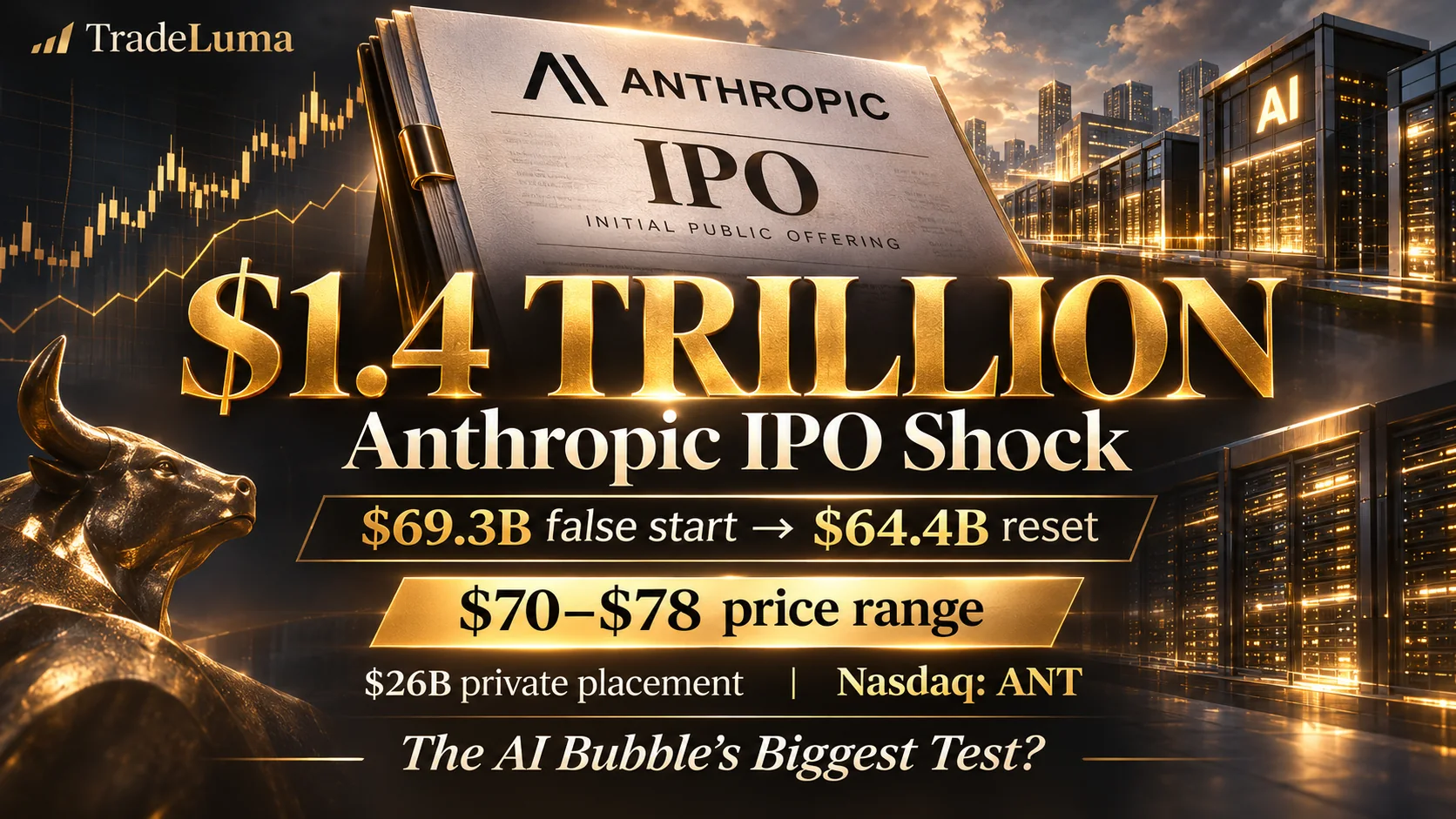
Anthropic is asking Wall Street to value the Claude developer at up to about US$1.4 trillion just as investors question how much AI infrastructure growth can actually earn. The company’s November 10, 2026 amended US prospectus specifies 825 million Class A shares at an indicative US$70–US$78 each: roughly US$57.75 billion to US$64.35 billion in gross public-offering proceeds, including stock sold by existing holders. A separate proposed US$26 billion private placement could lift the combined gross financing to about US$90.35 billion at the top of the range, before underwriting options and fees. Those figures replace a widely reported but retracted US$69.3 billion draft circulated to banks. This is an extraordinary financing plan, but neither a final IPO price nor evidence that ANT shares are already trading. Here is how to read the numbers, why fully diluted and basic valuation differ, what shareholders would actually own, and which risks could turn a historic IPO into a painful test of the AI trade.
The biggest correction: the $69.3 billion IPO story was withdrawn
On November 9–10, preliminary deal details showing about 867 million shares at US$70–US$80 circulated to banks, which implied a maximum offering near US$69.3 billion. Reuters reported that Anthropic quickly retracted those details, describing the pricing information as inaccurate. The precise reason for the error or change was not publicly established. That does not justify claims that the company deliberately misled investors or that the securities offering was cancelled.
The authoritative public update arrived in an amended Form S-1 filed November 10. The new proposed base offering is 825 million Class A shares at US$70–US$78. This is a reset of disclosed proposed terms, not an executed repricing in the stock market. The difference between US$69.3 billion and US$64.35 billion is approximately US$4.95 billion in maximum proposed base gross proceeds.
Where does the $1.4 trillion valuation come from?
An offering’s dollar proceeds and the market valuation of the whole company are separate calculations. Reuters describes valuation near US$1.02 trillion using the outstanding-share count at the top of the range, while fully diluted calculations that incorporate relevant options, restricted stock and other potentially issuable shares put Anthropic as high as roughly US$1.4 trillion.
Neither calculation is intrinsically fraudulent or automatically superior; each answers a different question. Outstanding-share market capitalisation approximates price multiplied by shares already outstanding, while diluted value anticipates potential additional equity claims and the issuance mechanics underlying them. Investors must match the denominator to whatever growth multiple they quote.
The greenshoe could change the headline again
The underwriting syndicate may have an option to purchase up to 123.75 million additional shares, equivalent to 15% of the base offering. At US$78, that option represents up to about US$9.65 billion of additional gross shares if fully exercised. It is therefore possible to see press estimates approaching US$100 billion when the maximum offering, private placement and option are combined.
But options are not guaranteed proceeds. A disciplined analysis should present the base public offering, conditional placement and optional incremental shares as separate buckets, not as one already raised sum.
Why November 19 matters—and why ANT has no public track record yet
The company has applied to list on Nasdaq under the proposed symbol ANT, with reporting pointing to November 19 as a possible first trading date. The prospectus remains preliminary, and the timing is subject to pricing, effectiveness and market conditions. As of November 11, no final public offer price or post-listing returns exist.
Searchers asking for “Anthropic stock price today” may see indications, unofficial grey-market interest or projections. These are not equivalent to Nasdaq last-sale data for a seasoned listed stock. Investors should verify an effective prospectus and exchange announcement before treating any quotation as an executable market price.
The roadshow meets the AI valuation reset
The IPO roadshow is effectively a negotiation between management’s long-run AI growth narrative and institutional investors who are newly sensitive to financing costs, higher Treasury yields and the gap between AI adoption and cash profits. Earlier public discussion of valuations approaching US$2 trillion makes a US$1.4 trillion diluted target look less aggressive by comparison, but a lower estimate is not necessarily cheap.
The market will weigh contract quality, durable customer usage, competitive barriers and future margins. In a volatile tape, an apparently strong IPO can still trade below its opening valuation if buyers have already priced in exceptional results.
Anthropic’s $81 billion annualized run rate is not $81 billion booked in 2026
The amended disclosures and contemporaneous reporting place Anthropic’s October-end annualized revenue run rate near US$81 billion, up about US$10 billion from September. Run rate generally annualizes a recent revenue pace; it is not a full-year audited revenue total, guaranteed forward sales or cash collection. The company had disclosed roughly US$16.96 billion in Q3 2026 revenue in its prior filing.
Investors should assess how much comes from durable enterprise contracts versus usage-sensitive API demand, whether gross margin improves as capacity expands, and how pricing might evolve when competitors offer cheaper models. Rapid sequential growth can be genuine without eliminating execution risk.
The compute obligation rises to roughly $900.9 billion
The newest amended filing presents aggregate committed computing and infrastructure spending of approximately US$900.9 billion, compared with US$895.4 billion in the prior November 2 amendment. The commitments are spread across procurement and leases extending into the 2040s, with important termination conditions and contractual distinctions.
This is not a claim that Anthropic has US$900.9 billion of immediately due bank debt. It is also not a trivial expense: if model economics, customer demand or available financing disappoint, contract commitments can pressure liquidity and flexibility. Investors should study the schedule of near-term cash requirements and the portions that are cancellable or contingent, rather than simply comparing a trillion-dollar headline with one quarter of revenue.
Could the IPO proceeds fund the infrastructure race?
A large public equity raise and strategic placement would increase funding flexibility, but they do not guarantee profitable infrastructure deployment. Capital raised today must finance data-centre access, long-lived computing obligations, research, staff, customer acquisition, AI safety and public-company compliance over time.
The key question is whether future revenue and gross profit can cover cumulative spending without repeated dilutive equity raises. If model inference becomes materially more efficient, that can improve margins; if capacity costs or competitive pricing move against Anthropic, even vast IPO proceeds could be consumed more quickly than expected.
Why Google and Nvidia can be investors and counterparties simultaneously
Technology groups participating in the private placement could benefit both as shareholders and as suppliers or platform partners in Anthropic’s expansion. Such relationships may provide strategic assurance, capacity access and ecosystem integration, but related economic incentives require careful examination. Investments by chip or cloud vendors are not identical to independent end-customer demand.
Investors should separate equity capital contributed, the terms of compute procurement, service revenues, credits and any contractual minimums. Counting the same ecosystem dollar repeatedly as financing, expenditure and final consumer demand can create a misleading picture of the total AI market.
How does this compare with SpaceX, OpenAI and other mega-IPOs?
The proposed sale would rank among the largest equity offerings in history if completed at this scale. But comparisons with SpaceX or earlier IPOs depend on whether one is comparing base offer proceeds, private placements, over-allotment options or company value. Similar-looking headline figures may conceal different transaction structures.
Anthropic also serves a different mix of AI research, cloud-delivered inference and enterprise software customers than space-launch, consumer internet or traditional semiconductor companies. A borrowed multiple can be a starting reference, never a full valuation model.
Five valuation questions more important than the trillion-dollar headline
First, what is the normalized gross margin after infrastructure spending and usage costs? Second, how predictable is enterprise net revenue retention when usage expands but model pricing declines? Third, how much of the compute pipeline is binding versus conditional, and how does the maturity schedule compare with cash generation? Fourth, how much equity dilution could arise from options, RSUs and later financing? Fifth, what voting rights and governance checks will a retail buyer actually receive?
An exceptionally fast-growing business can justify a premium, but investors need to connect future gross profit and free cash flow to the fully diluted share count. At a US$1.4 trillion valuation, even small changes in terminal margins or discount rates can imply enormous differences in equity value.
Bull case: Anthropic becomes the enterprise AI infrastructure standard
In the optimistic scenario, Claude develops durable enterprise adoption, demand for model intelligence expands rapidly, infrastructure investment per unit of output falls, and Anthropic converts the current revenue pace into significant long-run margins. Strong public-market demand could support a premium IPO and future access to cheaper capital.
This outcome requires more than an impressive roadshow: customer retention, safety performance, model quality, capital discipline and verified operating results must continue improving. A strong opening-day share price would not by itself prove these longer-term assumptions.
Bear case: AI returns lag the size of the buildout
In the pessimistic scenario, competition compresses model pricing, infrastructure commitments remain expensive, deployment or reliability problems disrupt customers, and the company has to raise additional capital at less favourable terms. Governance concerns and broad technology-market weakness could compound the pressure.
The key risk is not that the proposed IPO is “too big” in isolation. It is that investors could be paying a very high multiple of revenues and expected future earnings before the economics of frontier-model deployment are fully proven.
Base case: a successful listing with a volatile, uneven path
A middle scenario combines strong demand with uneven quarter-to-quarter profitability and substantial ongoing compute spending. The deal may price, trade and build institutional coverage, but the market could rotate rapidly between enthusiasm about revenue growth and concern over cash burn and valuations.
Because there is no settled public trading history for ANT yet, investors should avoid precision price targets built from imaginary volatility estimates. Scenario thinking is more honest than pretending there is a confirmed post-IPO support level or options market.
What does this mean for Nasdaq, Nvidia, Google and AI stocks?
A successful mega-listing could validate institutional appetite for frontier-model business models and provide a valuation marker for privately held AI companies. Demand for Anthropic shares might also compete with existing technology exposures as portfolio managers make space for a large new issuer.
There is no automatic direction for Nvidia, Alphabet, AMD or other ecosystem stocks. Strategic investments can signal relationships and access to growth while also raising questions about circular financing and whether supplier-linked investments are generating sustainable end-user returns.
Bottom line: this is more than an IPO—it is a market test of AI economics
The real breaking news is not simply an enormous US$1.4 trillion valuation: it is that Anthropic has replaced withdrawn draft terms with an SEC-filed US$70–US$78 price range, an 825-million-share base deal, a separate US$26 billion planned strategic placement and an ambitious Nasdaq timetable. The finances behind that proposal have also evolved, with annualized revenue accelerating alongside nearly US$901 billion of contracted compute spending.
Whether the IPO succeeds commercially depends on price discovery and, over many years, on whether cash generated from AI products can reward investors after financing the infrastructure behind them. Keep draft and final numbers distinct, stay alert to dilution and governance, and resist treating even the biggest IPO headline as a guaranteed trade.
Frequently asked questions
Has Anthropic confirmed a $1.4 trillion IPO valuation?+
Its November 10 preliminary range implies a fully diluted valuation near US$1.4 trillion at the upper end, according to calculations reported by Reuters and financial news outlets. The final IPO valuation is not set until pricing and closing.
Is Anthropic still planning to raise $69.3 billion?+
No. Those draft figures were circulated to banks and retracted as inaccurate. The public November 10 amended prospectus proposes up to US$64.35 billion in base gross public offering proceeds at US$78 per share.
How many Anthropic shares are offered in the IPO?+
The amended SEC filing proposes 825,000,000 Class A shares: 801,351,354 from Anthropic and 23,648,646 from selling shareholders.
What is the Anthropic IPO price range?+
The preliminary November 10 price range is US$70–US$78 per share, subject to change before final pricing.
How much of the $64.35 billion goes to Anthropic?+
At US$78, approximately US$62.51 billion gross comes from company-sold shares; roughly US$1.84 billion relates to selling-shareholder stock. Underwriting fees reduce company net proceeds.
Is the $26 billion private placement part of the public share offering?+
No. It is a separately planned, conditional issuance of Class N stock to strategic investors and is not part of the 825 million public Class A shares.
When will Anthropic stock start trading?+
Trading under the proposed Nasdaq symbol ANT is expected around November 19, 2026, but the timing depends on final pricing, regulatory effectiveness and market conditions.
Is ANT already a publicly traded share?+
Not as of the November 11 editorial cut-off. The proposed symbol and prospectus do not establish a live public stock price or post-listing chart.
Why do outlets show $1.02 trillion and $1.4 trillion valuations?+
They use different share denominators: roughly US$1.02 trillion based on outstanding shares at the top end, versus up to US$1.4 trillion on a more fully diluted basis that reflects additional equity claims.
Does Anthropic owe $900.9 billion immediately?+
No. The amended filing describes long-dated aggregate purchase and lease commitments, not an immediate bank loan balance. Timing, contingent terms and cash-generation capacity remain critical.
What does the $81 billion Anthropic revenue figure mean?+
It is an annualized revenue run-rate snapshot as of October 31, not revenue booked across a completed fiscal year or a guaranteed forward outcome.
Could Anthropic shares fall after a successful IPO?+
Yes. Valuation, opening-day supply and demand, lockup expirations, margins, infrastructure spending and broader market conditions could all cause material volatility despite strong business growth.
Put it into practice
Use the risk maths next to the guide.
Open TradeLuma's free position-size, risk/reward, expectancy, and drawdown tools to test the numbers behind a risk-management decision.
Open free trading calculators →Continue learning
Related guides.

Anthropic's $69.3 Billion IPO Proposal Was Withdrawn: What Changed?
Updated 11 Nov: Anthropic retracted the $69.3B draft and filed a new $70–$78 IPO range, up to $64.35B. Historical Nov 10 analysis of AI compute economics.
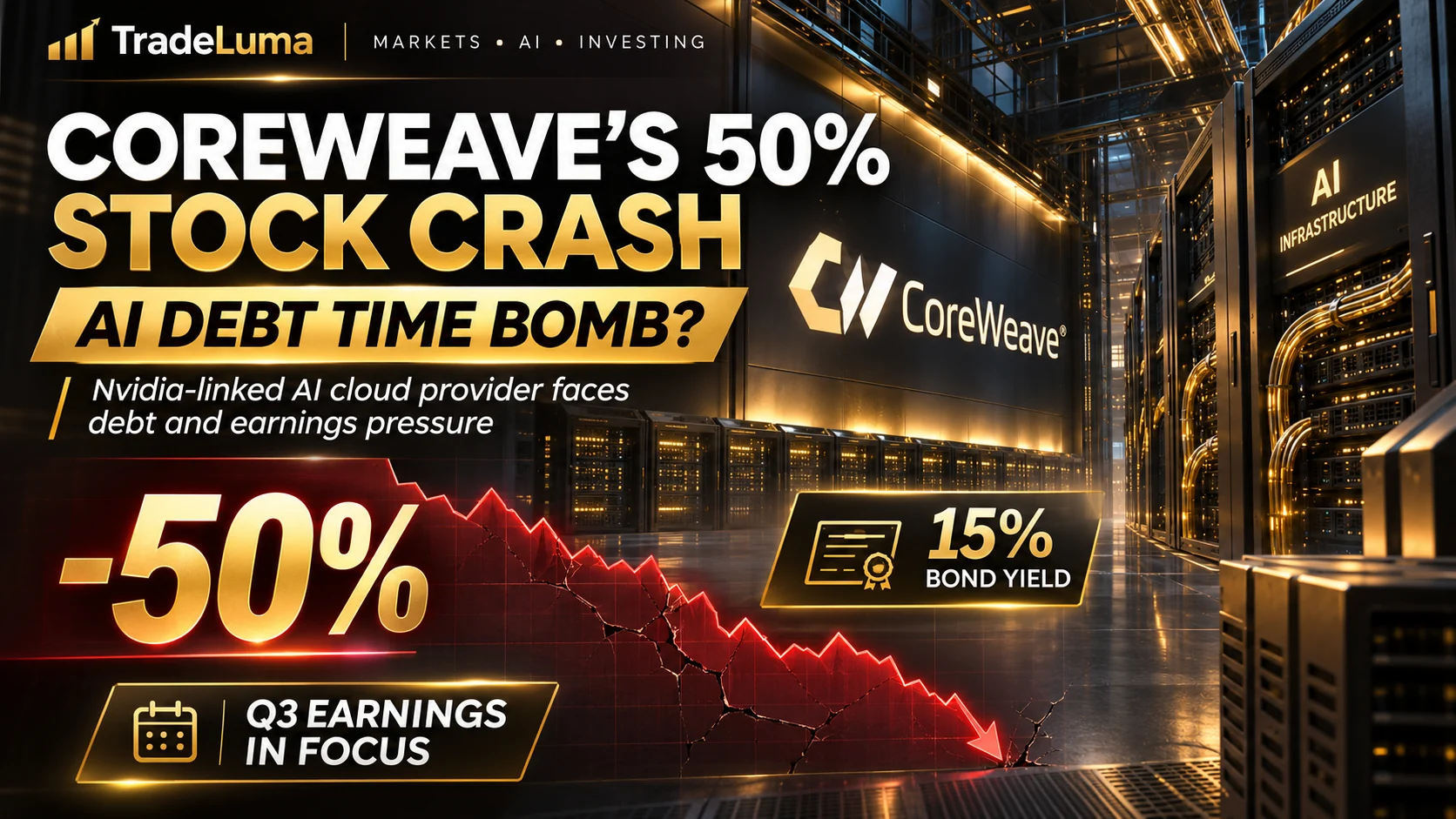
CoreWeave's 50% Stock Crash: Is Nvidia's AI Cloud Partner Sitting on a Debt Time Bomb?
CoreWeave stock plunged roughly 49% in a month as some bonds yielded 15%. Explore CRWV debt, Nvidia ties, $104B backlog and November 10 earnings risks.

US Inflation Shock: Gold Sinks as Treasury Yields Hit 5% — Will the Fed Hike 50 Basis Points?
October US CPI beat forecasts, gold slid 2.6%, the 10-year yield briefly topped 5%, and the Nasdaq fell. Could a 50bp Fed hike follow?