
Global Markets
Taiwan Stock Market Crash: 17.5% Weekly Drop and $15 Billion Rescue Fund
TAIEX fell 17.5% in the week to November 20, 2026. Taiwan tightened short-selling rules and activated its NT$500 billion stabilisation fund. What happens to TSMC?
On this page+
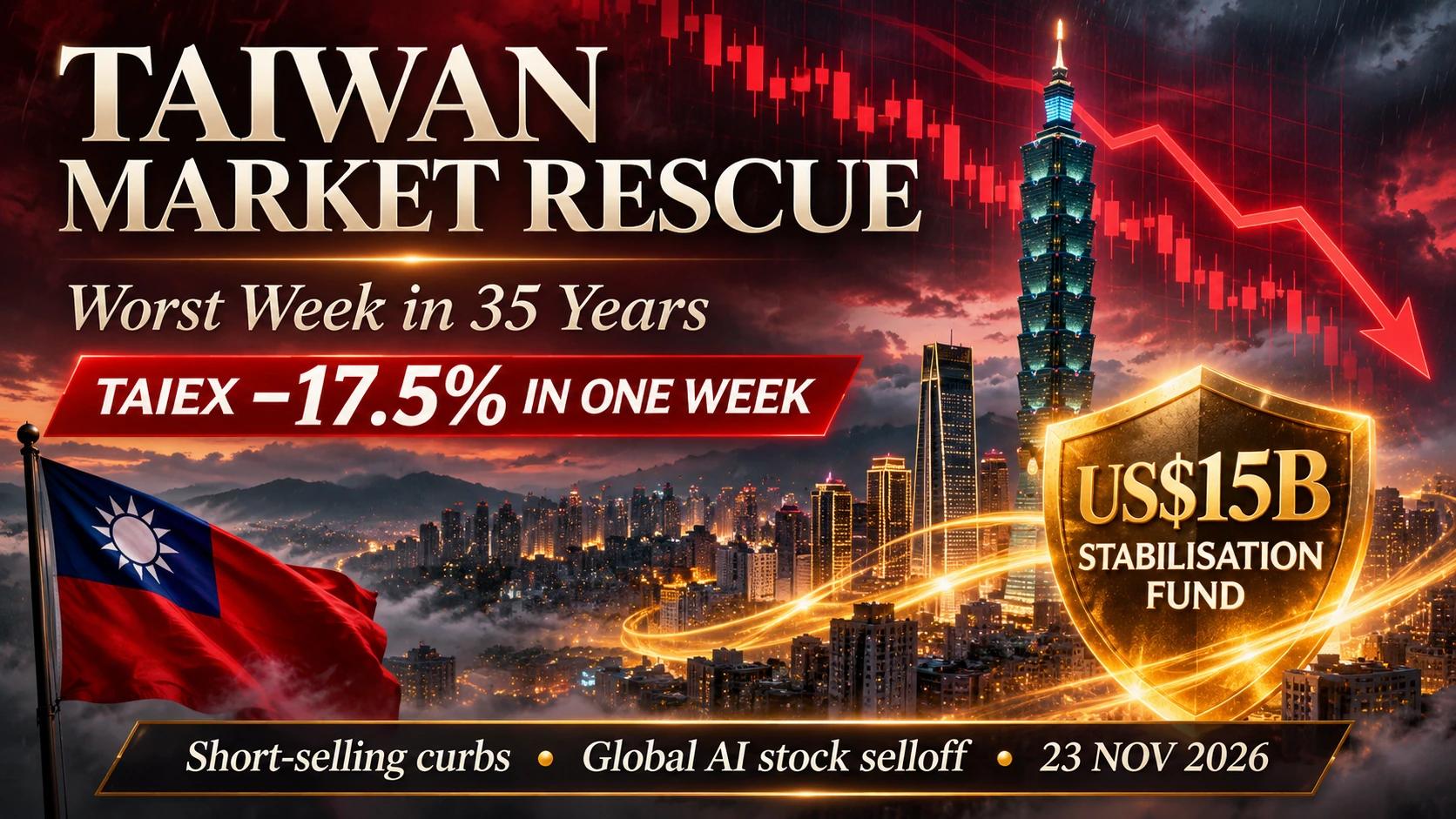
Taiwan's benchmark TAIEX index fell approximately 17.5% in the five trading days ending Friday 20 November 2026, its worst weekly performance in 35 years according to contemporary reporting. The island's Financial Supervisory Commission responded with additional short-selling restrictions, while Taiwan's NT$500 billion National Financial Stabilization Fund—roughly US$15 billion at the cited exchange rate—was authorised to support local shares. The number on TradeLuma's cover is the size of the fund, not a claim that officials spent all that money. The selloff attracted global attention because Taiwan hosts critical semiconductor suppliers, including Taiwan Semiconductor Manufacturing Company (TSMC), with enormous importance to AI hardware. Here is what actually happened, what the rules change, and which risks traders should track.
How far did Taiwan's stock market fall?
Taiwan's TAIEX index lost approximately 17.5% in the week ending November 20, 2026, an unusually large weekly fall that market reports described as its worst in 35 years. On the Friday, the index was reported to have fallen another 2,393.6 points to close near 36,033.29, with the weekly point decline around 7,641.83.
Those numbers describe a specific historic week, not the current price of TAIEX on a later date. Traders looking at an intraday chart should distinguish the index's open, its sharpest fall within a session and the official closing level.
High-volatility weeks can contain sharp rallies and reversals. One late-session recovery does not prove that selling pressure has ended, nor does a steep one-week decline by itself determine a fair long-term valuation.
What triggered the 2026 Taiwan AI stock selloff?
Taiwan is deeply exposed to the semiconductor and electronics supply chain. When investors question the sustainability of AI infrastructure spending, local chip manufacturers, equipment companies and related exporters can experience simultaneous repricing. Broader international equity weakness may amplify the shock.
Contemporary commentary pointed to a combination of AI valuation concerns, foreign investor selling, deleveraging, margin calls and market-wide risk reduction. These influences can reinforce each other: a fall in prices may trigger risk limits or collateral calls, creating sales that generate further declines.
However, it would be inaccurate to say that an AI bubble has definitively burst or that one overseas IPO, chip supplier or geopolitical event alone caused the 17.5% decline. A proper attribution would require transaction, flow and position data at specified timestamps.
What is Taiwan's US$15 billion stabilisation fund?
Taiwan's National Financial Stabilization Fund is a state-backed mechanism designed to support confidence during major domestic or international disturbances. The Ministry of Finance documented its decision to activate market-support operations on November 6, citing significant falls, foreign selling and risks to confidence.
The fund's NT$500 billion resources were widely translated as about US$15 billion. This is the approximate authorised fund size, not a statement that NT$500 billion was invested in a particular week, and not an announced profit-and-loss figure.
Public authorities can decide when and how to participate under the governing rules. Investors should look for official statements about activity or reported purchases rather than infer that the full amount was deployed simply because it appeared in headlines.
How did short-selling rules change?
The Financial Supervisory Commission announced further restraints on November 19 effective November 20 for stocks that met specified previous-day decline conditions. On November 21 it broadened measures, with reporting describing a ban on selling short below the prior trading day's closing price across listed stocks.
Other reported steps included lifting minimum short-sale margin from 130% to 150% and limiting applications for new put warrants. Rules must be interpreted by their legal scope and effective dates; they are not the same as a complete ban on all selling or all securities lending.
Short-sale restrictions aim to reduce certain kinds of bearish pressure, but they can also change liquidity and price discovery. A holder of existing shares can still seek to sell them, so market direction ultimately remains connected to fundamentals and overall demand.
Does restricting short selling prevent a market crash?
Not necessarily. Restrictions can suppress certain bearish positions or raise their cost, but an index may continue falling as long investors reduce exposure, foreign funds withdraw, or leveraged participants must meet collateral obligations.
Market liquidity can become patchy when uncertainty is high. Wider spreads and thin order books can create intraday jumps even with short-selling limits in place. That makes limit orders and documented slippage assumptions especially relevant to active trading.
The result depends on policy credibility, underlying earnings prospects, global rates, currency moves and domestic investor confidence. History provides examples both of temporary relief and of continued declines; there is no guaranteed policy floor.
Why is TSMC so important to this story?
Taiwan Semiconductor Manufacturing Company (TSMC) is a crucial contract manufacturer for many high-end logic chips used across smartphones, networking equipment and AI computing systems. Its significance extends beyond Taiwan because global technology firms depend on sophisticated semiconductor fabrication and packaging capacity.
TSMC trades in Taiwan and through US-listed depositary shares under ticker TSM. The two securities do not have identical trading calendars or currency exposures. A US-listed TSM price move cannot be directly equated with the percent change of the TAIEX index without accounting for the company, market hours and foreign-exchange effects.
A share-price drop does not imply a fab stopped producing chips. Investors must separate valuation concerns from evidence about actual wafer demand, production yield, customer orders and operating revenue.
Why foreign selling and margin calls can matter more than headlines
Institutional investors may reduce emerging-market exposure when volatility rises, while retail or professional accounts using leverage may face margin calls after large declines. Selling to meet margin obligations is not the same as a discretionary bearish short sale and can continue despite restrictions.
A feedback loop may develop when falling prices reduce collateral value, causing more selling. Foreign flows can add a currency dimension, particularly where an investor's return is measured in US dollars rather than New Taiwan dollars.
To evaluate whether the selling is exhausting, compare exchange turnover, foreign net flows, margin balance changes, short-interest statistics and market breadth over multiple days. A single fund-support headline is insufficient.
Could the Taiwan crash spread to Nvidia, Broadcom and Nasdaq?
Taiwanese semiconductor firms sit inside global supply chains for accelerators, networking and memory. A broad Taiwan valuation shock can coincide with weakness in US semiconductor equities, including Nvidia and Broadcom, as investors rethink the durability of AI demand or de-risk high-beta holdings.
That does not mean a fall in TAIEX mechanically causes a particular US company's sales to decline. TradeLuma's separate Broadcom report examines a November 20 supply-chain analyst's claim involving Google-designed TPUs, which should be assessed on its own evidence rather than treated as a proven explanation for Taiwan's entire market.
Cross-market correlations are conditional and can shift with earnings, exchange rates, policy and global sentiment. Traders can study sector ETFs, the Philadelphia Semiconductor Index and company disclosures to see whether the moves are broad or company-specific.
Three market scenarios after the intervention
In a stabilisation scenario, official buying, reduced leverage and clearer earnings signals could restore confidence and narrow spreads. Investors would want evidence in transaction data and price breadth rather than just a single rebound.
In a prolonged selloff, continued foreign withdrawals or weaker global technology earnings could offset stabilisation purchases, leaving the index under pressure despite market restrictions.
In a volatile consolidation, policy measures may slow selling without producing a sustained recovery. None of these scenarios is a forecast or an investment recommendation; conditions can change quickly.
What traders should monitor next
The most important sources are the Taiwan Stock Exchange's TAIEX closes and daily statistics, Financial Supervisory Commission rules and Ministry of Finance statements about the fund. Note the exact dates of each announced measure before interpreting trading effects.
For international investors, track TSMC's operating releases, Taiwan dollar movements, semiconductor indexes and changes in US AI-spending expectations. Differentiate fund authorisation, confirmed intervention and realised outcomes.
The approved cover's 17.5% weekly index fall and US$15 billion fund reference are based on cited late-November observations. The red market chart is conceptual artwork, not an exact plotted historical time series. This article is informational financial commentary, not personalised advice.
Frequently asked questions
How much did Taiwan's TAIEX fall in November 2026?+
The benchmark fell about 17.5% in the week ending November 20, 2026, according to contemporaneous reporting, its worst week in roughly 35 years.
Did Taiwan spend US$15 billion buying stocks?+
The figure is a rounded estimate of the NT$500 billion National Financial Stabilization Fund's resources, not verified total expenditure. The fund had authorised support operations.
When did Taiwan activate the stabilisation fund?+
The Ministry of Finance said the management committee approved market-stabilisation operations on November 6, 2026.
Was short selling banned in Taiwan?+
The FSC introduced and broadened restrictions on short sales below previous-day closing prices, among other measures. It was not a blanket prohibition on selling shares already owned.
What were the new short-selling margin rules?+
Contemporaneous reports described a rise in the minimum short-selling margin from 130% to 150%, among other restrictions.
What was TAIEX's closing level on November 20?+
A contemporary market report gave approximately 36,033.29 points at the November 20 close, following a further large Friday decline.
Is TSMC responsible for Taiwan's stock market crash?+
No single issuer can be established as the sole cause. Broad AI valuation worries, foreign sales and deleveraging were cited as contributing factors.
Can the government fund guarantee that TAIEX rebounds?+
No. Intervention may support liquidity or confidence, but earnings, investor flows and economic conditions still determine outcomes.
Does Taiwan's selloff automatically mean US chip stocks will fall?+
No. Global semiconductor stocks may share risk factors, but prices also depend on company-specific results, currency and investor positioning.
Is the TradeLuma cover showing a live Taiwan index price?+
No. It shows the reported weekly drop and fund capacity in a conceptual cinematic illustration.
Keep learning
Continue through the TradeLuma research library.
Browse practical guides across trading, automation, execution, futures, technical analysis, and risk management.
Browse all guides →Continue learning
Related guides.
The Great Everything Sell-Off: Why Gold, Bitcoin and Nasdaq Crashed Together — and What Happens Next
Why did stocks, Bitcoin and gold fall together on November 20, 2026? Understand the Nasdaq plunge, VIX surge, margin calls, liquidity risk and what to watch.

Trump's AI Chip War Goes Global: $960 Billion Tech Sell-Off as Five Countries Face New US Restrictions
New US AI-chip export controls target overseas data centres in five countries as tech stocks slump. Understand the $960B estimate, Nvidia, AMD and next risks.

AI’s Pressure-Cooker Week: Nvidia Earnings, Anthropic’s IPO and the Sell-Off Testing Wall Street
Nvidia reports on Nov 17 as Anthropic targets a Nov 19 IPO amid a Nasdaq sell-off. Explore NVDA earnings, ANT valuation, options risk and AI-stock scenarios.