
AI Stocks & Markets
Google AI Chip Shock: Why Broadcom Stock Plunged 12% on TPU Order Concerns
Broadcom AVGO fell roughly 12% on November 20, 2026 after a supply-chain analyst flagged a possible 20% cut to Google's planned TPU 8i shipments. What is confirmed?
On this page+
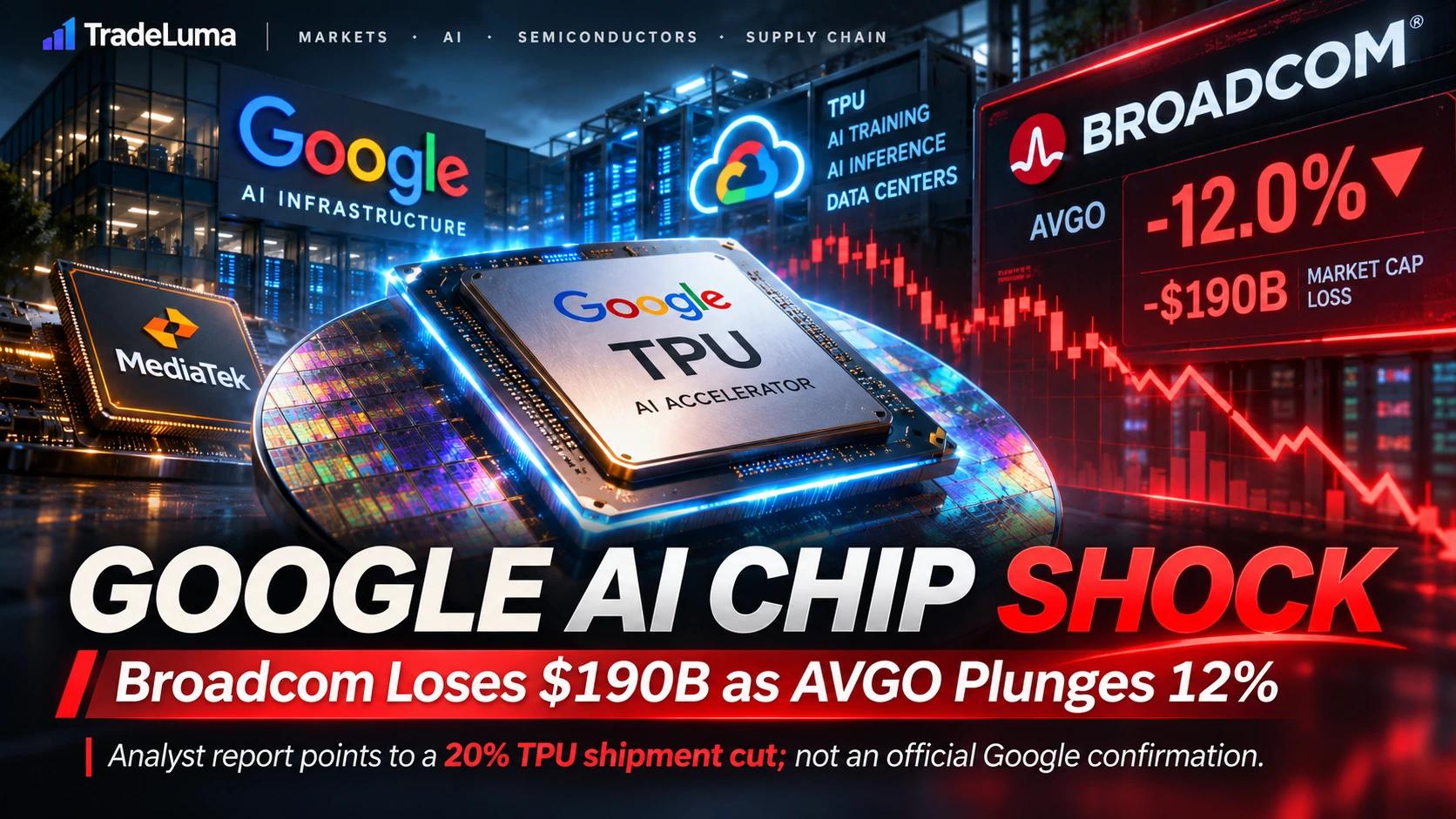
Broadcom (NASDAQ: AVGO) plunged roughly 12% during US trading on Friday, 20 November 2026, as investors reacted to a supply-chain analyst's report that Google had reduced planned 2027 shipments of the Broadcom-designed TPU 8i chip family by about one million units, or around 20%. The estimate came from TF International Securities analyst Ming-Chi Kuo and was not an official Google announcement. Contemporary reporting put the intraday market-capitalisation reduction at approximately US$190–191 billion; both the percentage move and dollar value describe a Friday snapshot, not a live Monday quote or audited final loss. The story exposes a high-stakes question for AI investors: how dependent is Broadcom's custom-silicon growth story on the decisions of a few enormous customers, and where does MediaTek fit?
Did Google officially cancel 20% of Broadcom's AI chip orders?
No official Google confirmation of a cancelled 20% of firm Broadcom purchase orders was established in the reporting used for this article. The claim concerned planned 2027 shipment volumes for a particular TPU series, based on an external analyst's survey. Planned shipments can be revised multiple times before products are manufactured and sold.
The distinction matters because a purchase order, a design-win commitment, a unit forecast, a shipment schedule and recognised revenue are five different things. A supply-chain check may flag a real inflection but still get the size, timing or economics wrong.
Investors should therefore describe a reported reduction in 2027 plans—not a confirmed corporate announcement that Google has cut all of Broadcom's AI spending.
What are the TPU 8i and TPU 8t chips?
Tensor Processing Units are Google's family of custom accelerators designed for machine-learning workloads. Compared with buying a generic processor for every task, custom silicon can be optimised for particular training and inference requirements and for the surrounding data-centre system.
Contemporary supply-chain reporting distinguished a Broadcom-designed TPU 8i series from a MediaTek-associated TPU 8t line. If Google shifts mix, the relevant technical questions are performance per watt, memory bandwidth, packaging, networking, availability, integration and total deployment costs.
A chip name is not a full financial forecast. Even if one design loses planned units to another, total custom-silicon spending might rise, fall or shift in time. Public buyers do not always disclose exactly how accelerator procurement splits between design partners.
Why could a 20% shipment change create such a large stock move?
Shares are priced based on investors' expectations of future cash flow, not simply the last published quarterly revenue. If a company trades at a valuation that assumes years of rapid AI growth, a report implying lower participation in a major customer's next chip generation can cause investors to revise multiples and future margin assumptions quickly.
Google is a strategically important custom-silicon customer. A reported change in business awarded to a rival therefore raises questions not only about near-term units but also longer-term engineering relationships and competitive positioning.
However, a double-digit stock decline does not mathematically establish a double-digit reduction in future earnings. The price can also reflect portfolio risk reduction, semiconductor sector weakness and uncertainty about the reliability of the survey.
Is MediaTek taking business away from Broadcom?
Kuo's account suggested Google could raise TPU 8t shipments designed with MediaTek while lowering 8i volume associated with Broadcom. This supports a hypothesis of a partial allocation shift between design partners, not proof that Broadcom has lost all TPU exposure or that MediaTek will capture every displaced unit.
Partners can participate differently in chip design, intellectual property, interconnect, packaging, software or manufacturing services. Gross shipment counts alone do not reveal their margins or the share of a chip's total value each supplier captures.
To evaluate a durable share shift, investors need evidence in future product ramps, supplier commentary, actual purchase commitments and reported financial performance. Analyst predictions should remain attributed until corroborated.
What happens to Broadcom's AI revenue forecast?
Broadcom had discussed an ambitious fiscal 2027 AI growth outlook before the November 20 report. One market account cited a US$115 billion AI revenue forecast associated with management's earlier commentary. That number is a forecast, not confirmed realised sales.
The correct sensitivity question is: how much revenue and profit contribution was already included from the affected TPU models, in what quarters, at what margin and with what alternative customer demand? Public information in the news report does not provide enough inputs to calculate a reliable revised earnings estimate.
A simple hypothetical example shows why: a 20% drop in planned units for one chip family, if the family represented only a portion of total AI revenue and customers bought more networking or other ASIC products, might translate into a much smaller company-wide sales effect. Conversely, a high-margin flagship mix shift could have outsized profit implications. Both are scenarios, not stated results.
How does Google's choice relate to Nvidia and the wider AI chip race?
Nvidia's general-purpose GPU ecosystem, Google's in-house TPUs and merchant suppliers of custom ASIC design services fulfil overlapping but not identical roles. Some cloud workloads favour flexibility and broad software support; others can justify custom chip investment at very large scale.
The relevant contest is therefore not simply 'Nvidia versus Broadcom'. There is also competition among design partners serving hyperscale customers, among manufacturing and advanced-packaging capacity providers, and among systems that combine compute, memory and networking.
For the Nasdaq and semiconductor indexes, a report of reduced planned units can be interpreted as weaker demand, a sourcing shift or improved efficiency. The conclusions differ, and a single supplier report does not establish that total global AI capital spending has collapsed.
What were investors already concerned about?
High-growth AI hardware companies are sensitive to the possibility that capital spending, customer concentration or product cycles may disappoint earlier expectations. Separate analyst price-target changes can affect sentiment, but targets are opinions rather than price guarantees. Contemporary reporting said Goldman Sachs reduced its Broadcom target from US$540 to US$460 while maintaining a Buy rating.
Margins may also depend on whether a chip is designed in-house or sold as part of a broader package including networking, custom engineering and support. If the mix moves to products with different value capture, unit numbers alone can mislead.
Broad market risk appetite matters. To attribute a particular trading session to Google alone, analysts would need to compare AVGO with sector peers, volume, options positioning and the timing of other material announcements.
What to watch after November 23
Look first for official comments from Alphabet and Broadcom, especially revised unit plans, recognised AI revenue, custom ASIC backlog commentary and customer concentration risk in filings. Later earnings calls can clarify whether the 2027 forecast has changed.
Watch independent signals of supplier mix: MediaTek's relevant business updates, packaging capacity and TPU product announcements. Avoid multiplying one purported shipment reduction by an assumed average selling price to report an invented lost-revenue figure.
Finally, date every stock number. The approved editorial cover's 12% slide and approximately US$190 billion of market value lost describe reported Friday observations, not live AVGO returns or the final cash impact of a chip contract. This is educational market analysis, not a recommendation to trade.
Frequently asked questions
Why did Broadcom stock fall in November 2026?+
AVGO fell sharply on Friday November 20 after supply-chain analyst Ming-Chi Kuo reported that Google may have cut its planned 2027 TPU 8i chip shipments by about 20%.
Did Google confirm a 20% cut in Broadcom chip orders?+
No. The figure in the November 20 story was an external supply-chain estimate about planned shipments, not a confirmed company disclosure of cancelled purchase orders.
How much did AVGO fall on November 20?+
Contemporary Friday afternoon reporting described an approximately 12% decline. That is a dated trading observation, not a live November 23 price.
Did Broadcom really lose $190 billion?+
Reports estimated that roughly US$190–191 billion of Broadcom market capitalisation was erased at a particular Friday trading snapshot. This is a change in implied equity value, not cash taken from the company.
What is a Google TPU 8i chip?+
It is a generation of Google's custom tensor processing units used for AI workloads. Industry reporting associated the 8i design with Broadcom.
Is MediaTek replacing Broadcom?+
The analyst reported possible higher 2027 shipments for MediaTek's TPU 8t programme, but no official complete replacement of Broadcom was confirmed.
Would a 20% shipment cut mean 20% less AVGO revenue?+
No. The purported change concerns one chip series and planned units. Revenue depends on product mix, price, timing and other businesses.
Is Nvidia affected by Google's Broadcom decision?+
Changes in Google's custom-chip sourcing do not directly establish a reduction in Nvidia orders. Custom TPUs and general-purpose GPUs compete in some workloads but are separate procurement decisions.
What should investors watch next?+
Company disclosures, Google TPU product plans, Broadcom's future AI revenue guidance and MediaTek commentary are more reliable than extrapolating a single supply-chain survey.
Is the price chart on the TradeLuma cover live?+
No. The chart is conceptual artwork, and the 12% figure reflects a dated reported Friday move.
Keep learning
Continue through the TradeLuma research library.
Browse practical guides across trading, automation, execution, futures, technical analysis, and risk management.
Browse all guides →Continue learning
Related guides.

Nvidia's $330 Billion Intraday Meltdown: Jensen Huang Board Probe Shakes the AI Trade
Historical November 9 Nvidia selloff and board review, updated November 24 following Jensen Huang's confirmed reinstatement as CEO.
Nvidia Without Jensen Huang: The $108 Billion Earnings Test That Could Shake Wall Street
Historical November 17 Nvidia earnings preview, updated November 24 after Jensen Huang's reinstatement. $108B was guidance, not actual earnings.
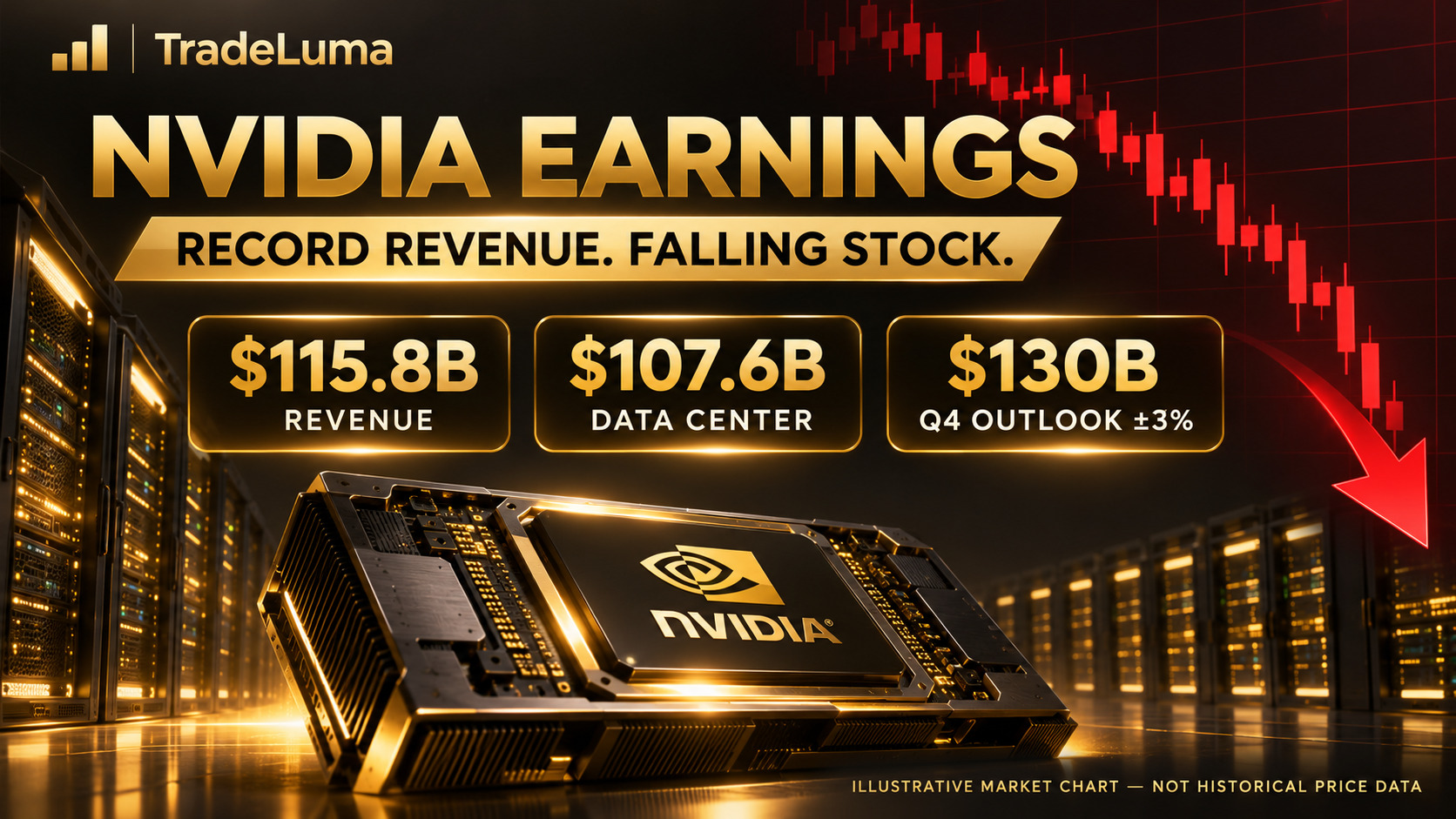
Nvidia's $115.8 Billion Earnings: Why NVDA Fell Despite Record AI Revenue
Nvidia reported $115.8B revenue and $107.6B Data Center sales on Nov 17, 2026. Why NVDA fell after earnings, Q4 guidance, investigation reports and AI risks.