
Futures
Hawkish vs Dovish Fed Explained: Interest Rates, Gold, Nasdaq & Market Reactions
Hawkish vs dovish explained with real Fed examples, rate-cut surprises, Treasury yields and potential impacts on gold, Nasdaq and futures trading.
On this page+
Hawkish and dovish are two of the most searched terms whenever the Federal Reserve speaks. But they describe a policy stance relative to expectations, not simply whether rates rose or fell. This TradeLuma guide explains the difference, why markets react to Fed guidance even during a rate hold, and how Treasury yields, the US dollar, gold and Nasdaq futures can respond. The October 28, 2026 FOMC decision provides a verified case study: the Fed held rates at 3.75%–4.00%, while two policymakers preferred a hike.
Hawkish vs dovish: the short answer
Hawkish describes a central-bank stance that gives relatively greater weight to controlling inflation, often favouring higher interest rates for longer or less easing than markets anticipated. Dovish describes a comparatively more accommodative stance, often associated with lower rates, more willingness to ease or greater concern about economic weakness. These are descriptions of policy posture, not official labels or automatic trading signals.
The critical word is relative. A quarter-point rate cut can still sound hawkish if investors expected a larger cut or if policymakers suggest fewer future cuts. Equally, unchanged rates can be interpreted as dovish if officials signal that easing is becoming more likely. Traders should compare what was announced with what had already been priced into futures, bonds and currencies.
Hawkish vs dovish Fed: comparison at a glance
A hawkish message tends to emphasise inflation risks, restrictive policy, the possibility of higher rates or delayed easing. A dovish message tends to place more emphasis on employment downside, slowing demand, disinflation, cuts or reduced restriction. Neither necessarily implies an immediate rate change.
Illustrative—not guaranteed—first-order reactions: a hawkish surprise can push short-term Treasury yields and the US dollar higher while weighing on duration-sensitive equities and non-yielding gold; a dovish surprise can produce the opposite. Real-world outcomes can differ because growth news, risk appetite, positioning, geopolitical events and prior expectations are also moving.
What does hawkish mean in economics?
In monetary policy, a hawk is more inclined to restrain inflation even when tighter financial conditions risk slowing economic growth. Hawkish communications can include a warning that inflation remains persistent, an explicit willingness to hike again, a higher projected path for rates or language indicating that cuts are premature.
Hawkish does not mean the Fed must raise rates at that meeting. A hold is hawkish when policymakers maintain restrictive settings or signal that borrowing costs could stay high for longer than previously assumed. Distinguish hawkish *tone* from an actual rate *action*.
What does dovish mean in economics?
A dove is comparatively more willing to support employment and activity through easier financial conditions when inflation permits. Dovish language may highlight improving inflation trends, increased downside risks to hiring or a readiness to reduce interest rates.
Dovish does not guarantee an immediate cut, either. A central bank may hold rates but lower its forecast rate path, describe policy as sufficiently restrictive or make clear that a future cut is under active consideration. What matters for markets is whether those signals are more dovish than investors expected.
Hawkish hold vs dovish hold: why the same decision can sound different
Suppose the Fed leaves its target range unchanged. In Scenario A, officials stress stubborn inflation, say there is no urgency to cut and indicate that further tightening remains possible. This is a relatively hawkish hold. In Scenario B, officials acknowledge weaker hiring, welcome disinflation and signal that policy easing could begin soon. That is a relatively dovish hold.
The numerical decision is identical. The path of expected rates differs. Because asset prices discount future conditions rather than only today's overnight interest rate, the statement, the voting split and the press conference may matter more than the headline.
Real example: the October 28, 2026 FOMC decision
On October 28, 2026, the Federal Open Market Committee voted 10–2 to maintain the federal funds target range at 3.75%–4.00%. The two dissenters—Lisa D. Cook and Beth M. Hammack—preferred raising the range by 25 basis points. That is a verified example of a rate hold accompanied by disagreement in a more restrictive direction.
The Fed statement described strong economic activity, resilient domestic spending, robust capital investment and inflation that remained elevated. Those facts may inform a hawkish interpretation, but the label depends on the full communication and how it compared with expectations. This example is not evidence that every asset reacted in any particular direction: market performance must be measured separately.
The statement and implementation note were released by the Federal Reserve on October 28, 2026. No new Summary of Economic Projections was scheduled for this meeting; the next projections meeting was set for December.
Why do markets move when the Fed does nothing?
Interest-rate markets price a distribution of future outcomes. Investors may believe that the next cut is likely in December, that another hike is possible, or that rates will stay unchanged for a long period. The Fed can alter those probabilities by changing its wording, economic assessment or voting split without moving the current target range.
For trading, compare the policy statement with the prior statement, then evaluate the Chair's answers, any dissents, short-term Treasury yields, interest-rate futures and the dollar. The market reaction is driven by surprise and repricing, not by a mechanical rule that a hold must be neutral.
Why a Fed rate cut can be hawkish
Imagine the market prices a 50-basis-point cut, but the Fed reduces rates by only 25 basis points and warns that further easing is unlikely. Compared with expectations, that outcome is hawkish even though the policy rate declines. Similarly, a 25-basis-point cut accompanied by higher projected future rates may tighten expected financial conditions.
The opposite can happen: a smaller-than-feared hike or a hold that clearly opens the door to cuts can be a dovish surprise. Never infer the market direction solely from cut, hold or hike.
What is a hawkish surprise vs dovish surprise?
A hawkish surprise occurs when the announced decision or communication implies a tighter future policy path than was priced in immediately beforehand. A dovish surprise implies an easier expected path. Both are relative to consensus and market-implied expectations at that moment.
One way to operationalise this is to record the pre-announcement implied path from interest-rate futures, then measure changes in short-dated yields or futures immediately afterward. Even that is incomplete: the Fed may reveal new information about the economic outlook, and liquidity conditions can distort the first seconds of trading.
How hawkish and dovish Fed signals affect US Treasury yields
Short-maturity Treasury yields, especially the 2-year yield, are often sensitive to anticipated Federal Reserve policy. A surprise pointing to tighter policy may lift the 2-year yield; a more accommodative path may lower it. The 10-year yield also reflects expected rates but is strongly affected by term premium, inflation, growth and duration demand.
A Fed message can make the yield curve steepen or flatten depending on which maturities react most. Watch the 2-year and 10-year changes separately instead of treating the curve as a single indicator. Our Treasury yields guide covers 2s10s spreads and duration in more detail.
How hawkish and dovish policy can affect the US dollar
Higher expected US interest rates can make dollar-denominated assets more attractive relative to other currencies, so a hawkish surprise may support the dollar. A dovish surprise can weaken it when expected rate differentials narrow.
But exchange rates depend on both sides of the currency pair. If another central bank becomes even more hawkish, the dollar may fall despite a relatively firm Fed. Safe-haven flows, trade conditions and investor positioning can overwhelm a straightforward rate-differential story.
How does a hawkish Fed affect gold?
Gold does not pay a coupon or dividend. When real yields rise, the opportunity cost of holding gold can increase; a stronger dollar can also pressure dollar-priced gold. For those reasons, an unexpected hawkish shift is often a headwind for gold futures such as GC and MGC.
Yet gold can rise alongside higher nominal rates when inflation risks, geopolitical uncertainty, reserve demand or safe-haven buying are dominant. The direction and magnitude of real yields can be more informative than the policy rate by itself. Use scenarios, not a claim that hawkish always means gold down.
How does a dovish Fed affect gold?
A dovish repricing can reduce real yields and weaken the dollar, conditions that often improve gold's relative appeal. This is one reason gold traders monitor Fed statements, inflation data and Treasury Inflation-Protected Securities yields.
However, if easing signals a sharp deterioration in growth, forced selling and shifts in liquidity can produce unexpected short-term moves. A heavily anticipated cut may also already be reflected in the gold price. The same headline can trigger an initial rally, reversal or little response.
How a hawkish Fed can affect Nasdaq and NQ/MNQ futures
Growth-oriented equities often derive a large share of their value from expected future earnings. Higher discount rates can reduce the present value of those cash flows, creating an important channel through which hawkish rate surprises may pressure Nasdaq-100 futures (NQ and MNQ).
That is only one channel. If rates rise because the economy is stronger than expected, higher profit forecasts might offset some valuation pressure. Nasdaq performance also depends on large technology companies, earnings news and index concentration. Avoid claiming that a hawkish Fed guarantees red candles.
How a dovish Fed can affect Nasdaq and stock indices
All else equal, lower expected borrowing costs and discount rates can support equity valuations, so dovish surprises can benefit NQ, MNQ, ES and MES. Easier financing conditions can be particularly relevant for long-duration growth companies.
But the reason for easing matters. Cuts driven by financial stress or rapidly weakening demand may coincide with falling earnings expectations and lower share prices. Distinguish a benign disinflation-led cut from a recession-fear cut before assigning a bullish interpretation.
What do FedWatch probabilities tell traders?
CME FedWatch provides model-implied probabilities for target-rate outcomes using 30-Day Federal Funds futures prices and underlying assumptions. It describes market pricing, not a Federal Reserve forecast and not a guaranteed outcome.
A useful process is to note implied probabilities before the event and compare them with the actual decision and guidance. A 25-basis-point cut that was considered nearly certain has very different surprise content from a cut that markets thought unlikely. For the calculation and caveats, see TradeLuma's CME FedWatch guide.
How to read FOMC statement language and votes
Start with the actual decision and the wording of the release. Compare passages about growth, employment, inflation and the policy outlook with the previous statement; changes in emphasis often matter more than repeated standard wording. Then check the vote and whether dissenters preferred a tighter or easier setting.
A dissent does not independently determine the expected path, but it reveals which alternatives some voters preferred. The Chair's press conference can clarify or complicate the interpretation. Rate projections—the dot plot—are published only at designated quarterly meetings, not at every FOMC meeting.
Hawkish vs dovish: rate cuts, hikes and holds in one framework
Use a two-step grid. First identify the action: hike, hold or cut, expressed in basis points. Second identify the surprise: more restrictive or less restrictive than the expected path. A hike can be dovish relative to expectations, a hold can be hawkish, and a cut can be either depending on guidance.
Next observe confirmation in the 2-year Treasury yield, the US dollar and relevant futures, but do not force an interpretation when these signals disagree. In markets, a clear description of uncertainty is more useful than a confident but unsupported directional prediction.
A sample macro-event playbook for gold and Nasdaq futures
Before the announcement, record the consensus decision, market-implied rate path, policy calendar, scheduled statement and press-conference times, contract month, important price levels and permitted risk. Identify whether the strategy is allowed to trade the event or must pause new entries.
At release, separate decision, wording and guidance. Watch for spreads widening, stale price quotes, incomplete fills and the difference between the first algorithmic reaction and the later interpretation. If trading after the event, require a defined setup and invalidation rather than chasing a headline.
Afterward, document the actual rate decision, vote, yield moves, dollar move, gold and NQ/MNQ response, liquidity conditions and whether execution conformed to the trading rules. A good event journal distinguishes the thesis from the fill.
Automation and FOMC: manage execution risk first
Futures can become volatile around central-bank headlines. Stop-market orders can slip substantially, stop-limit orders can fail to fill and spread or depth changes can invalidate ordinary backtest assumptions. A platform receiving trading alerts also needs to consider duplicate signals, entry expiry, broker connectivity and reconciliation.
For automated trading, define news windows, maximum daily loss, account exposure, pending-order lifetime, and rules for pausing or resuming new entries. Confirm broker-reported order and position state after a disconnection or rejection. Paper testing helps validate control logic but cannot reproduce every live liquidity condition.
Common mistakes when interpreting a hawkish or dovish Fed
The most common error is equating the action with the tone: assuming a cut is dovish or a hold is neutral. Others include treating an isolated dissent as a market forecast, assuming a new dot plot appears at every meeting, and using the first one-minute reaction as evidence of a durable trend.
Another error is forgetting the market's prior expectations. To avoid hindsight bias, save the pre-event probability snapshot and a time-stamped decision plan. Do not construct a winning explanation after seeing the chart and pretend it was known before release.
Key takeaways for traders
Hawkish and dovish describe how restrictive monetary policy sounds relative to the previous stance and market expectations. The most important distinctions are action versus guidance, nominal versus real yields, the expected rate path versus today's target range and economic-growth effects versus discount-rate effects.
Gold and Nasdaq can react differently to the same Federal Reserve message. Treat each FOMC decision as a structured macro event, not a shortcut to a directional futures position. TradeLuma's research library also covers the FOMC meeting, FedWatch probabilities, CPI versus PCE inflation, NFP and Treasury yields.
Frequently asked questions
What does hawkish mean?+
Hawkish means relatively more focused on controlling inflation through tighter monetary policy, potentially higher rates or less easing than expected.
What does dovish mean?+
Dovish means relatively more willing to support growth or employment through easier monetary policy, such as lower rates when conditions permit.
Is a rate hike always hawkish?+
No. A smaller-than-expected hike or dovish forward guidance can be perceived as less restrictive than market expectations.
Can a rate cut be hawkish?+
Yes. A small cut when a larger cut was expected, or guidance against additional easing, can constitute a hawkish surprise.
What is a hawkish hold?+
An unchanged policy rate combined with more restrictive inflation commentary or a tighter expected future policy path.
What is a dovish hold?+
An unchanged policy rate accompanied by communication pointing to a greater likelihood of easing than markets previously expected.
What happened at the October 28, 2026 FOMC meeting?+
The Fed maintained the 3.75%–4.00% target range in a 10–2 vote. Lisa D. Cook and Beth M. Hammack preferred a 25-basis-point hike.
Does a hawkish Fed always make gold fall?+
No. Higher real yields or a stronger dollar can pressure gold, but inflation, safe-haven demand, positioning and other factors can reverse that relationship.
Does a dovish Fed always make Nasdaq go up?+
No. Easing driven by recession risks or weakening earnings can coincide with equity declines despite falling expected rates.
Why does the 2-year Treasury yield matter after the Fed?+
It is particularly sensitive to expectations for the path of short-term policy rates and can help reveal the market's repricing after an announcement.
What is the difference between hawkish and dovish Fed guidance?+
Hawkish guidance points toward tighter future policy than anticipated; dovish guidance points toward easier future policy. Both depend on the market's starting expectations.
What is a basis point?+
One basis point is 0.01 percentage point; 25 basis points equal 0.25 percentage point.
Does every FOMC meeting include a dot plot?+
No. The Summary of Economic Projections is associated with scheduled quarterly projection meetings, ordinarily March, June, September and December.
What does FedWatch measure?+
CME FedWatch estimates probabilities of policy target ranges from 30-Day Federal Funds futures pricing under model assumptions. It is not a Fed prediction.
Should automated strategies trade during FOMC?+
Only if the strategy has been tested and its risk controls permit it. Event-time spreads, slippage, rejected orders and fast reversals can make execution substantially harder.
Futures workflows
Explore the strategy side of TradeLuma.
Browse TradeLuma's futures strategy catalogue and the chart, rollover, and reference methodology used for each published strategy.
Explore futures strategies →Continue learning
Related guides.
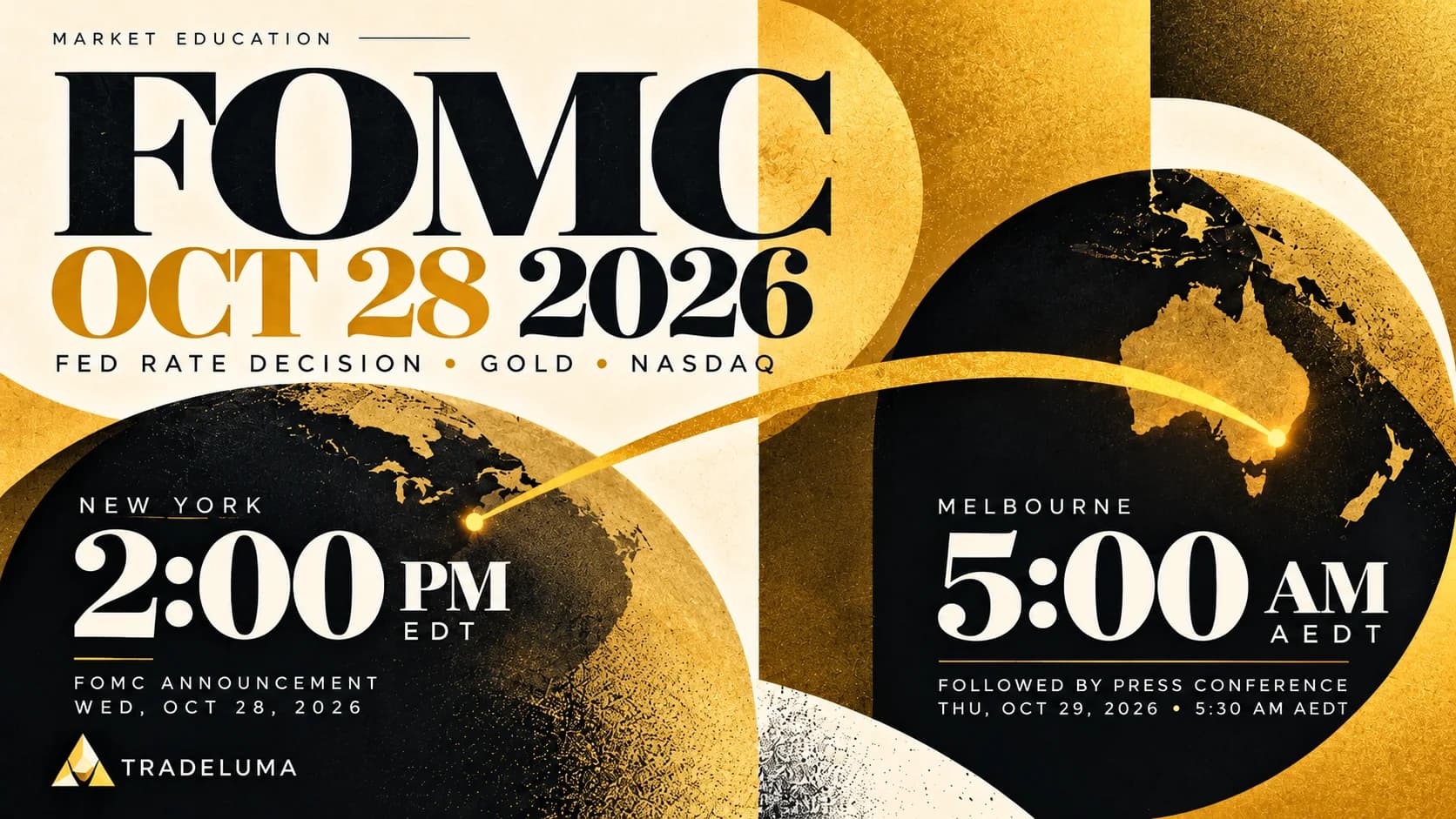
FOMC Meeting October 2026: Fed Rate Decision Time, Expectations & Gold/Nasdaq Impact
October 2026 FOMC decision time in New York and Australia, Fed rate expectations, statement and press conference explained, plus gold and Nasdaq trading risks.
CME FedWatch Tool Explained: How Rate Cut Probabilities Work
Learn how CME FedWatch calculates Fed rate-cut probabilities from Fed Funds futures, read upcoming FOMC outcomes, and interpret changing odds for gold, stocks and bonds.
CPI vs PCE Inflation Explained: Why Gold, Nasdaq & Futures React
Learn how US CPI and PCE inflation differ, what headline and core readings reveal, and why surprises can move gold, Nasdaq and Treasury futures.